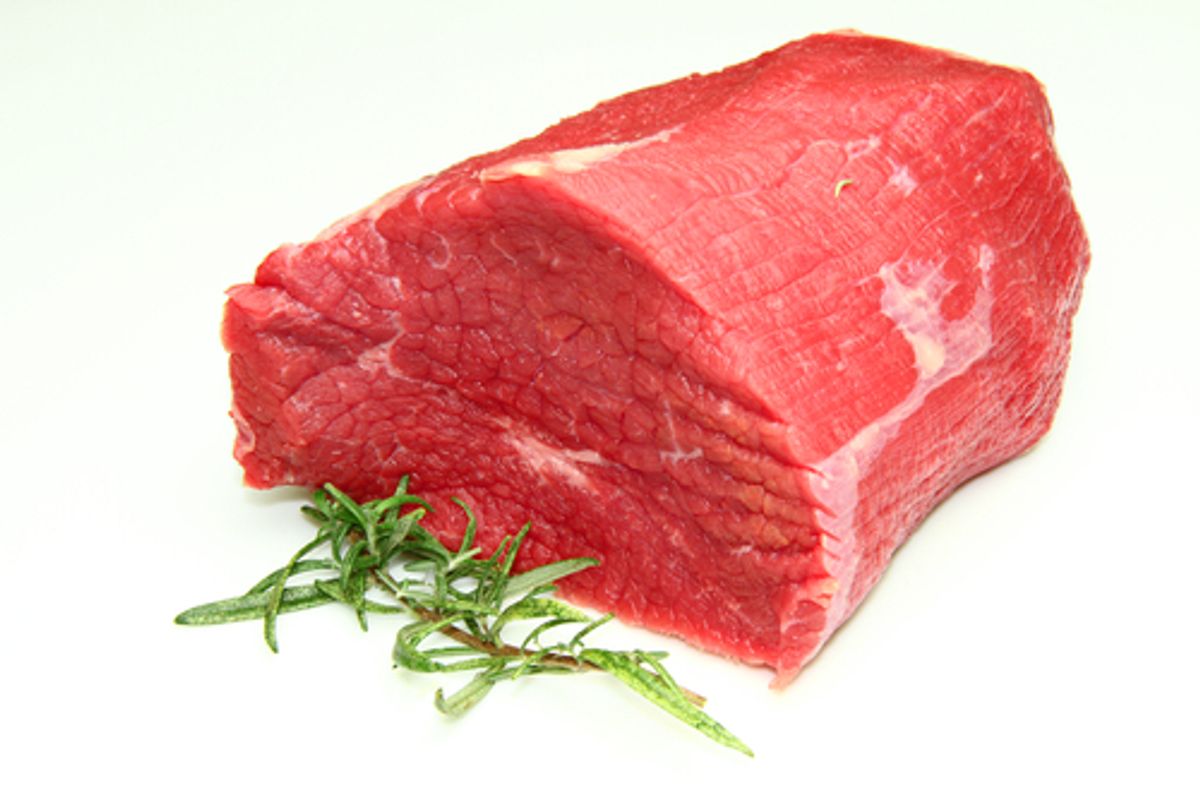
 If acclaimed authors Upton Sinclair (The Jungle), Jeremy Rifkin (Beyond Beef) and John Robbins (Diet for a New America) haven’t given you enough reasons over the last century to be wary of the meat industry, then a year-long investigation by the Kansas City Star may do the trick.
Mike McGraw kicks off the KC Star’sinvestigative series by introducing Margaret Lamkin, who has been forced to wear a colostomy bag for the rest of her life, after a medium-rare steak she ordered three years ago at Applebee’s was contaminated with a pathogen. The resulting illness destroyed her colon.
Of course we already know about E. coli and other food-borne pathogens; people have gotten sick from everything from spinach to peanut butter. But the news here is that what sickened Lamkin wasn’t just the meat, but a process the industry uses to tenderize it. McGraw explains:
The Kansas City Star investigated what the industry calls “bladed” or “needled” beef, and found the process exposes Americans to a higher risk of E. coli poisoning than cuts of meat that have not been tenderized.
... Although blading and injecting marinades into meat add value for the beef industry, that also can drive pathogens — including the E. coli O157:H7 that destroyed Lamkin’s colon — deeper into the meat.
By using this process (which according to the story, 90 percent of processors will use, depending on the cut), people are at a greater risk of exposure to life-threatening illness. And consumers have no way of knowing whether their meat has undergone this process.
Ending up with a fecal-contaminated burger is bad, but it’s just the beginning of what the investigation uncovered. Here are the other key findings, as McGraw writes:
• Large beef plants, based on volume alone, contribute disproportionately to the incidence of meat-borne pathogens.
• Big Beef and other processors are co-mingling ground beef from many different cattle, some from outside the United States, adding to the difficulty health officials have tracking contaminated products to their source. The industry also has resisted labeling some products, including mechanically tenderized meat, to warn consumers and restaurants to cook it thoroughly.
• Big Beef is injecting millions of dollars of growth hormones and antibiotics into cattle, partly to fatten them quickly for market. Many experts believe that years of overuse and misuse of such drugs contributes to antibiotic-resistant pathogens in humans, meaning illnesses once treated with a regimen of antibiotics are much harder to control.
• Big Beef is using its political pull, public relations campaigns and the supportive science it sponsors to influence federal dietary guidelines and recast steaks and burgers as "health foods" people should eat every day. It even persuaded the American Heart Association to certify beef as “heart healthy.”
Read the full investigation, and think about how this scenario fits into the larger picture of what we deem acceptable as a food system. Just last month Consumer Reports shared frightening findings about pork.
And there is a ray of good news. Ocean Robbins wrote today:
People are taking an increasing interest in the way that the animals raised for food are treated. In fact, a poll conducted by Lake Research partners found that 94 percent of Americans agree that animals raised for food on farms deserve to be free from cruelty. Nine U.S. states have now joined the entire European Union in banning gestational crates for pigs, and Australia's two largest supermarket chains now sell only cage-free eggs in their house brands.
The demand is growing for food that is organic, sustainable, fair trade, GMO-free, humane, and healthy. In cities around the world, we're seeing more and more farmer's markets (a nearly three-fold increase in the last decade), and more young people getting back into farming. Grocery stores (even big national chains) are displaying local, natural and organic foods with pride. The movements for healthy food are growing fast, and starting to become a political force.
Investigations like the one done by the Kansas City Star are crucial for public education, as is support for the growing food movement that needs help in turning purchasing power at the market into political power that can affect decisions about food safety and industry practices.
“Big agribusiness would probably like us all to sit alone in the dark, munching on highly processed, genetically engineered, chemical-laden, pesticide-contaminated pseudo-foods,” Robbins writes. “But the tide of history is turning, and regardless of how much they spend attempting to maintain their hold on our food systems, more and more people are saying NO to foods that lead to illness, and YES to foods that help us heal.”
Shares