
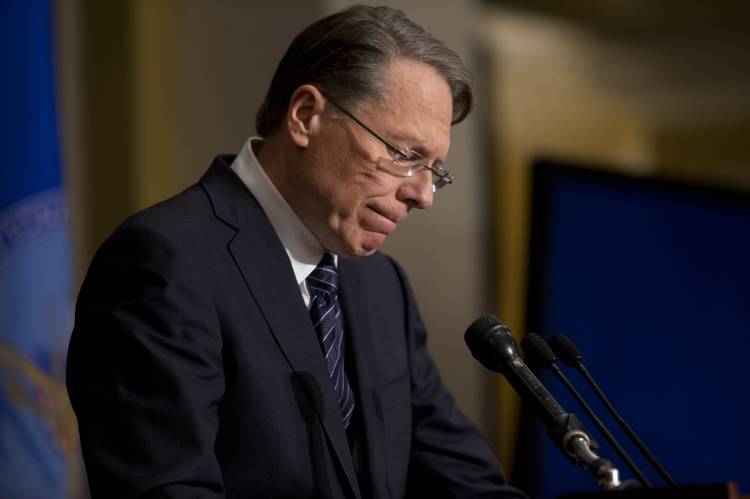

 The National Rifle Association has been in a tough spot since the shootings in Newtown, Connecticut. As an advocacy group for gun manufacturers and a particular set of gun enthusiasts, it has no interest in new gun-control regulations. But as a powerful political force, it has to say something — otherwise, it’s vulnerable to continued criticism.
This morning, NRA president Wayne LaPierre held a press conference — occasionally interrupted by protesters — in which he explained where the organization stood in light of last week’s violence. But rather than stand behind the modest gun-regulation efforts brewing in Congress or even offer a simple message of condolence, LaPierre decided to go on the offensive, blaming everything from video games, movies, and music — “Natural Born Killers,” a 20-year-old film, received a shout out — to Obama’s budget for the proliferation of mass shooters.
In fact, the media came in for wide criticism: “A child growing up in America today witnesses 16,000 murders, and 200,000 acts of violence by the time he or she reaches the ripe old age of 18,” said LaPierre, “And, throughout it all, too many in the national media, their corporate owners, and their stockholders act as silent enablers, if not complicit co-conspirators.” The obvious implication to all of this was that someone ought to limit what media outlets can show, lest it leads to further violence — this despite the fact that there is no known connection between violent media and actual acts of violence.
But those statements, evasive and disingenuous as they were, paled in comparison to LaPierre’s proposal for dealing with school violence. Taking a page from Republican politicians like Virginia Governor Bob McDonnell, LaPierre has proposed a plan for mass arming of the nation’s schools. Here’s his rationale, expressed early in the press conference:
We care about our money, so we protect our banks with armed guards. American airports, office buildings, power plants, court houses, even sports stadiums are all protected by armed security.
We care about our president, so we protect him with armed Secret Service agents. Members of Congress work in offices surrounded by Capitol Police officers. Yet, when it comes to our most beloved, innocent, and vulnerable members of the American family, our children, we as a society leave them every day utterly defenseless, and the monsters and the predators of the world know it, and exploit it.
“The only thing that stops a bad guy with a gun is a good guy with a gun,” declared LaPierre, and as such, he argued, “Before Congress reconvenes … we need to have every single school in America immediately deploy a protection program proven to work and by that I mean armed security.”
In other words, the small-government NRA — which shouts whenever politicians discuss the most modest new rules and regulations on firearms — wants a new program of armed guards in every public school — all 100,000 of them. As LaPierre put it:
[W]hat if when Adam Lanza started shooting his way into Sandy Hook Elementary School last Friday, he’d been confronted by qualified armed security? Will you at least admit it’s possible that 26 little kids, that 26 innocent lives might have been spared that day?
Watching the press conference, it’s hard to understand why the NRA is so influential. LaPierre’s statement —his diagnosis of gun violence, his prognosis for solving the problem — bears little relation to the world as it exists. LaPierre rambled throughout, and at various points, he veered into outright fantasy, describing a United States beset by predators, as if violent crime hasn’t taken a sharp decline over the last 20 years.
Indeed, if there’s anything to take away from this press conference, it’s that politicians should not be afraid of the NRA. It’s mystique is gone. With only 4 million members — and a reactionary, embarrassing president — it is a force that can and should be reckoned with. The curtain is open, and Wayne LaPierre has revealed himself — and his organization — as nothing more than ordinary.
