SALON

The case for an investment budget

How can we repair our failing infrastructure if we don't possess a clear idea of how our money's being spent?

Topics: RobertReich.org, State of the Union, Barack Obama, Investment Budget, Gross Domestic Partner, ,

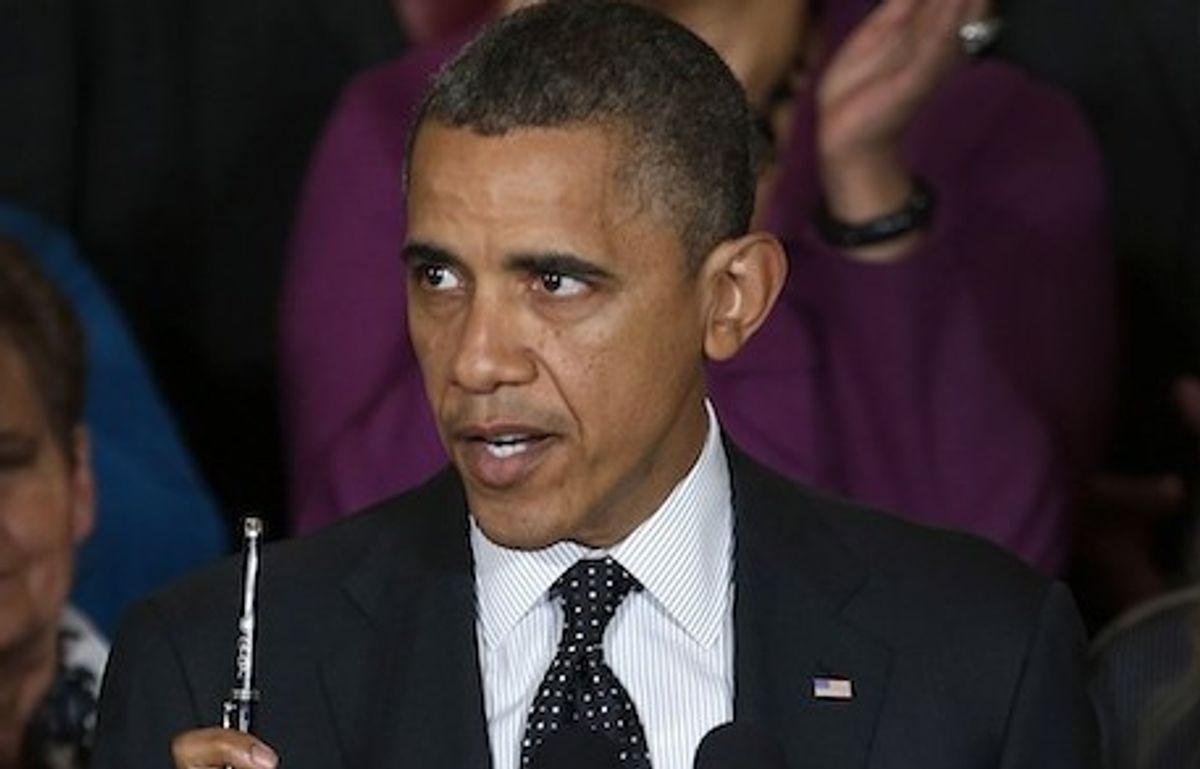
The case for an investment budget (Credit: AP/Carolyn Kaster)
This originally appeared on Robert Reich's blog.

Part of the President’s State of the Union message and of his second term agenda apparently will focus on public investments in education, infrastructure, and basic R&D.

That’s good news. But how do we fund these investments when discretionary spending is being cut to the bone in order to reduce the budget deficit?

Answer: By treating public investments differently from current spending.

No rational family would borrow to pay for a vacation but not borrow to send a kid to college. No rational business would borrow to finance current salaries but not to pay for critical new machinery.

Yet that’s, in effect, what the federal government does now. The federal budget doesn’t distinguish between borrowing for current expenditures that keep things going, and future investments that build future productivity. All borrowing is treated the same.

A rational federal budget would treat them differently. It would allow additional borrowing for public investments whenever the expected return on those investments is higher than the cost of the borrowing. And it wouldn’t borrow a dime if the return on the investment is less than the borrowing costs.

Granted, such public returns can be hard to measure. But well-developed tools exist for doing so.

Consider infrastructure. Too many roads are potholed, bridges unsafe, public transport systems outdated, pipelines bursting, and schools literally falling apart. Studies show a public return on infrastructure investment to average $1.92 for every public dollar invested.

Obviously these investments must be done well and carefully. No bridges to nowhere. But our infrastructure is crumbling. Our future standard of living depends on it being repaired and upgraded.

To take another example, studies show the return on early childhood education to be between 10 and 16 percent, with 80 percent of the benefits going to the general public. At-risk children with access to intensive pre-education are more likely to graduate from high school and attend college, and have full and productive lives.

But only a handful of our children have access to it. If we treated such investments as they should be treated, we’d make substantial investments in early childhood education.

Public investments in basic research and development are also dropping, both in absolute terms and as a percent of GDP — even though the returns have been substantial.

The idea that gave birth to Internet search engines came from the National Science Foundation. The lithium-ion battery that powers iPhones and electric cars was developed by federally-sponsored materials science research.

Some say we don’t need to worry about public investments because private investments will fill any shortfall.

That’s simply wrong.

Capital markets are now global. Money sloshes across borders in search of the highest return anywhere.

That means, increasingly, private investments follow public investment.

The only way to ensure private investors will continue to invest America, and support the high living standards we want, is for Americans to be highly productive. This requires public investments in education, infrastructure, and basic R&D to keep us productive and make us even more productive in the future.

The federal budget doesn’t reveal any of this, and the current debate over budget deficits further obscures it.

We need a public investment budget — separate from the current expenditure budget — that clarifies what we’re investing in, and allows us to keep borrowing for such investments whenever the return justifies it.

Robert Reich, one of the nation’s leading experts on work and the economy, is Chancellor’s Professor of Public Policy at the Goldman School of Public Policy at the University of California at Berkeley. He has served in three national administrations, most recently as secretary of labor under President Bill Clinton. Time Magazine has named him one of the ten most effective cabinet secretaries of the last century. He has written 13 books, including his latest best-seller, “Aftershock: The Next Economy and America’s Future;” “The Work of Nations,” which has been translated into 22 languages; and his newest, an e-book, “Beyond Outrage.” His syndicated columns, television appearances, and public radio commentaries reach millions of people each week. He is also a founding editor of the American Prospect magazine, and Chairman of the citizen’s group Common Cause. His widely-read blog can be found at www.robertreich.org.

Next Article

Related Stories

Featured Slide Shows

The week in 10 pics

close X
  • Share on Twitter
  • Share on Facebook
  • Thumbnails
  • Fullscreen
  • 1 of 11
  • Lisa Montgomery embraces her nephew Thursday after a tornado tore apart her home in Cleburne, Texas. The twister killed six people and destroyed entire swaths of the North Texas town.
    Credit: AP/LM Otero

  • Jack McMahon, the defense attorney for abortion doctor Kermit Gosnell, speaks outside the Criminal Justice Center in Philadelphia Tuesday. His client was convicted of killing three babies in his clinic, and will serve multiple life sentences.
    Credit: AP/Matt Rourke

  • A photo taken Monday captures Vice President Joe Biden's response to a Milwaukee second-grader's innovative proposal to end America's epidemic of gun violence. This guy!
    Credit: AP/Jenny Aicher

  • Sen. Rand Paul, R-Ky., flanked by a grouper-eyed Michele Bachmann, addresses the IRS' admission that it targeted Tea Party groups in advance of the 2012 election. In an op-ed for CNN Thursday, the Kentucky senator slammed the president for his faux outrage.
    Credit: AP/Molly Riley

  • Ousted IRS chief Steven Miller is sworn in on Capitol Hill Friday. Miller testified before the House Ways and Means Committee on the extra scrutiny the agency gave conservative groups applying for tax-exempt status.
    Credit: AP/J. Scott Applewhite

  • Attorney General Eric Holder pauses as he testifies on Capitol Hill before the House Judiciary Committee Wednesday. Holder is under fire, among other things, for the Justice Department's gathering of phone records at the Associated Press.
    Credit: AP/Carolyn Kaster

  • O.J. Simpson sits during an evidentiary hearing at Clark County District Court in Las Vegas, Nev., Thursday. Simpson, who is currently serving a nine-to-33-year sentence in state prison for armed robbery and kidnapping, is using a writ of habeas corpus to seek a new trial.
    Credit: AP/Las Vegas Review-Journal/Jeff Scheid

  • Major Tom to ground control: On Sunday astronaut Chris Hadfield recorded the first music video from space, a cover of David Bowie's "Space Oddity."
    Credit: AP/NASA/Chris Hadfield

  • When it rains it pours. President Barack Obama speaks during a news conference Thursday with Turkish Prime Minister Recep Tayyip Erdogan, inexplicably inspiring an #umbrellagate Twitter meme.
    Credit: AP/Jacquelyn Martin

  • A smoke plume rises high above a road block at the intersection of County A and Ross Road east of Solon Springs, Wis., Tuesday. No injuries were reported, but the the wildfire caused evacuations across northwestern Wisconsin.
    Credit: AP/The Duluth News-Tribune/Clint Austin

  • Recent Slide Shows

  • Share on Twitter
  • Share on Facebook
  • Thumbnails
  • Fullscreen
  • 1 of 11

Comments

3 Comments

Comment Preview

Your name will appear as username

You may use these HTML tags and attributes: <a href=""> <b> <em> <strong> <i> <blockquote>