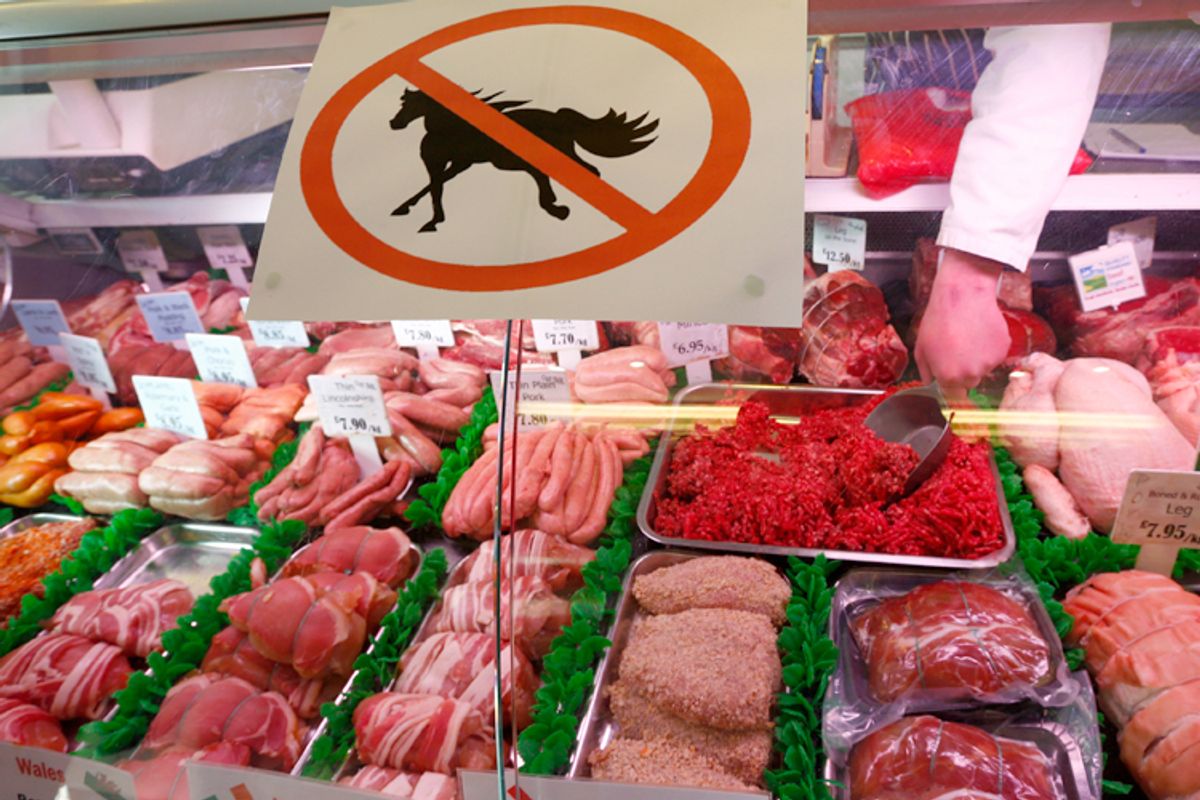
Lawmakers push for ban on horse slaughter

A bipartisan coalition is trying to prevent the US from slaughtering and exporting horses for human consumption

Topics: horse meat, horse meat scandal, , ,

Lawmakers push for ban on horse slaughter

For the first time in six years, the U.S. is set to begin slaughtering and exporting horses for human consumption. But the horse meat scandal sweeping much of Europe has raised the haunches, so to speak, of a bipartisan coalition of lawmakers who have proposed a permanent ban on the practice.

Sen. Mary Landrieu, D-La., Sen. Lindsey Graham, R-S.C., Rep. Patrick Meehan, R-Pa., and Rep. Jan Schakowski, D-Ill., have co-sponsored the Safeguard American Food Exports (SAFE) Act to ban domestic horse slaughter and the practice of shipping horses to other countries to be killed for human consumption. The House version was referred to the Committee on Energy and Commerce and the Committee on Agriculture on Tuesday, and the Senate Committee on Health, Education, Labor and Pensions is currently considering the Senate measure.

“This is a bill whose time has come,” said Rep. Meehan at a press conference on Wednesday. “Until a ban is in place, every horse is just one bad sale away from being sent to slaughter.”

Sen. Landrieu echoed his sentiment in an earlier statement on a similar measure:

“There’s no humane way to slaughter a horse,” Landrieu said. “Most horses going to slaughter are not old and they’re not sick.”

Expressing a lifelong love of horse riding like her daughter, Mary Shannon Snellings, who was present, Landrieu said she was “horrified” to learn in the past that horse slaughterhouses existed in the U.S.

But now, horses are exported under allegedly poor conditions to Mexico and Canada for slaughter and efforts are under way to open slaughterhouses domestically. About 100,000 horses are estimated to be exported for slaughter a year.

The practice may have been dormant for six years, but has a long history in this country. The “horseflesh industry” has been “around since the advent of the train and car,” according to Deanna Stillman.

As she wrote for Salon on Saturday:

By the end of the 19th century, the horse had outlived its usefulness — except for being money on the hoof. At the time, there were about two million mustangs running the range, as well as countless other horses across the country — carriage horses, plow horses, war horses and more. As I document in my book “Mustang: The Saga of the Wild Horse in the American West,” hundreds of thousands of wild horses were driven up the cattle trails right to the plants in Chicago, and they were then shipped to Europe in tin cans or to California as chicken feed for the thriving poultry industry. The railroad even had a special rate for such shipments.

One rendering plant in particular processed most of the horses, figuring prominently in the plundering of the West. This was the country’s first major equine slaughter operation, started in 1923 by the notoriously dapper Englishman P.M. Chappel and his brother, Earl. The Chappel Brothers Corporation, or CBC, rendered so much meat that it was known among cowboys as “the Corned Beef and Cabbage.” In its first year, as Walker D. Wyman reports in his seminal book “The Wild Horse of the West,” “about half the 1,446 horses processed under federal jurisdiction were canned, and it is certain most of them were wild.” The result was 149,906 pounds of meat from the Chappel plant alone; the total yield from the nearly 200 plants that were operating across the country that year was 22,932,265 pounds.

Katie McDonough is an assistant editor for Salon, focusing on lifestyle. Follow her on Twitter @kmcdonovgh or email her at kmcdonough@salon.com.

Next Article

Related Stories

Featured Slide Shows

The week in 10 pics

close X
  • Share on Twitter
  • Share on Facebook
  • Thumbnails
  • Fullscreen
  • 1 of 11
  • Lisa Montgomery embraces her nephew Thursday after a tornado tore apart her home in Cleburne, Texas. The twister killed six people and destroyed entire swaths of the North Texas town.
    Credit: AP/LM Otero

  • Jack McMahon, the defense attorney for abortion doctor Kermit Gosnell, speaks outside the Criminal Justice Center in Philadelphia Tuesday. His client was convicted of killing three babies in his clinic, and will serve multiple life sentences.
    Credit: AP/Matt Rourke

  • A photo taken Monday captures Vice President Joe Biden's response to a Milwaukee second-grader's innovative proposal to end America's epidemic of gun violence. This guy!
    Credit: AP/Jenny Aicher

  • Sen. Rand Paul, R-Ky., flanked by a grouper-eyed Michele Bachmann, addresses the IRS' admission that it targeted Tea Party groups in advance of the 2012 election. In an op-ed for CNN Thursday, the Kentucky senator slammed the president for his faux outrage.
    Credit: AP/Molly Riley

  • Ousted IRS chief Steven Miller is sworn in on Capitol Hill Friday. Miller testified before the House Ways and Means Committee on the extra scrutiny the agency gave conservative groups applying for tax-exempt status.
    Credit: AP/J. Scott Applewhite

  • Attorney General Eric Holder pauses as he testifies on Capitol Hill before the House Judiciary Committee Wednesday. Holder is under fire, among other things, for the Justice Department's gathering of phone records at the Associated Press.
    Credit: AP/Carolyn Kaster

  • O.J. Simpson sits during an evidentiary hearing at Clark County District Court in Las Vegas, Nev., Thursday. Simpson, who is currently serving a nine-to-33-year sentence in state prison for armed robbery and kidnapping, is using a writ of habeas corpus to seek a new trial.
    Credit: AP/Las Vegas Review-Journal/Jeff Scheid

  • Major Tom to ground control: On Sunday astronaut Chris Hadfield recorded the first music video from space, a cover of David Bowie's "Space Oddity."
    Credit: AP/NASA/Chris Hadfield

  • When it rains it pours. President Barack Obama speaks during a news conference Thursday with Turkish Prime Minister Recep Tayyip Erdogan, inexplicably inspiring an #umbrellagate Twitter meme.
    Credit: AP/Jacquelyn Martin

  • A smoke plume rises high above a road block at the intersection of County A and Ross Road east of Solon Springs, Wis., Tuesday. No injuries were reported, but the the wildfire caused evacuations across northwestern Wisconsin.
    Credit: AP/The Duluth News-Tribune/Clint Austin

  • Recent Slide Shows

  • Share on Twitter
  • Share on Facebook
  • Thumbnails
  • Fullscreen
  • 1 of 11

Comments

10 Comments

Comment Preview

Your name will appear as username

You may use these HTML tags and attributes: <a href=""> <b> <em> <strong> <i> <blockquote>