
Stop likening NSA to a private company!

Yes, your credit card and phone companies have access to some personal data. But they have your permission VIDEO

Topics: Video, CNN, White House, Barack Obama, NSA, David Sirota, Civil Liberties, ,

Stop likening NSA to a private company!

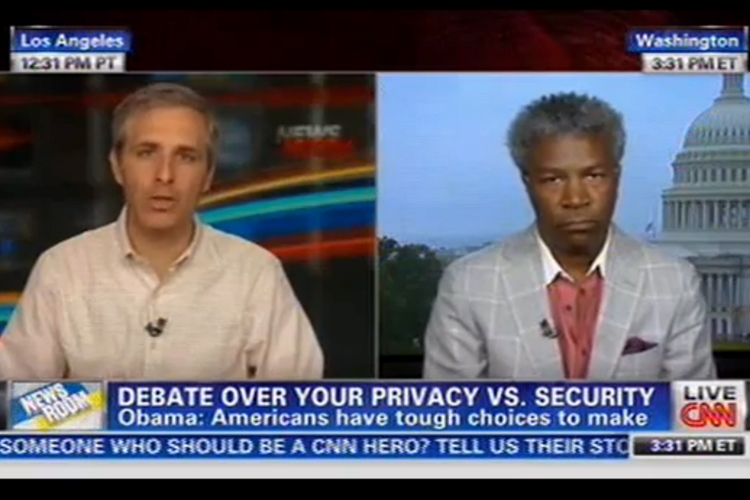
I appeared on CNN today to debate the Obama administration’s NSA spying operation with the president’s pollster, Cornell Belcher. His statements perfectly illustrated the White House’s bait-and-switch rhetorical strategy — one that tries to pretend the mass surveillance system is constrained in its scope and therefore no big deal.

To review the latest news: Earlier today, the president called the unprecedented program “modest” and insisted that “nobody is listening to your phone calls.” Belcher — who advises the White House on how to frame issues — went even further, casting the program as nothing more invasive than, say, your bank logging your personal financial transactions or a pollster evaluating data. Watch it here:

Before evaluating the legal arguments being made by Obama, Belcher and other administration officials, let me just say for the record that the most grotesque part of this CNN exchange was when Belcher tried to justify the surveillance program on the grounds that it is popular. In a country whose constitution was designed, in part, to prevent majority public opinion from trampling the basic rights of minorities, this is a hideous line of reasoning, to say the least. Similarly hideous is Belcher claiming that mass surveillance is making us safer, but not being able to provide any evidence that such a claim is true.

All of that aside, what’s significant here are the larger legal arguments, because they will likely be used in court cases to cement this and other surveillance programs for the long haul. And the fact is, the White House’s legal arguments are deceptive — and at times, outright lies.


First and foremost, let’s remember that a former FBI counterterrorism agent recently told CNN that the administration is, indeed, listening into phone calls. If that’s true, the president is outright lying (which should no longer be considered surprising, in light of his administration’s blatant — and potentially perjurious — lies before Congress on this issue).

But let’s say that despite this, you nonetheless believe President Obama when he says his administration isn’t listening in on phone calls. The fact remains that, as the New Yorker and Reuters both show, the collection of “metadata” about calls is often just as intrusive as listening into the actual calls themselves. Reuters sums it up this way:

Any suggestion that Americans have nothing to worry about from this dragnet collection of communications metadata is wrong. Even without intercepting the content of communications, the government can use metadata to learn our most intimate secrets – anything from whether we have a drinking problem to whether we’re gay or straight… So we shouldn’t be comforted when government officials reassure us that they’re not listening to our communications – they’re merely harvesting and mining our metadata. In a digital world, metadata can be used to construct nuanced portraits of our social relationships and interactions.

That gets to how Belcher followed up his boss during our debate on CNN today. He argued not only that a program sweeping in data from millions of Americans is modest, but also that it is no different than companies analyzing consumer data. Like so many carefully sculpted political talking points, it sounds logical, except when you remember the key facts being omitted — in this case, the fact that the government is using its law enforcement power to obtain the data without the public’s permission. Yes, that’s right: unlike a company with which you personally do business — and with which you sign an agreement about your personal information — the Obama administration is using the government’s unilateral power to simply grab your information across multiple platforms.

That’s hardly, as the dismissive phrase goes, a “distinction without a difference.” As I noted on CNN, when it comes to civil liberties, the Bill of Rights is all about constraining the power of the government to encroach on our freedoms. It does this because the founders recognized that the government isn’t just another institution in society — it isn’t, say, just a private bank or a polling firm. It is granted special powers (subpoena, warrants, etc.) that those other institutions don’t have — but it was granted those powers in exchange for that authority being properly constrained. When such constraints are removed, our liberties are inevitably restricted (this, by the way, is why Senator Obama sponsored legislation to outlaw what President Obama is now doing).

Belcher and other Obama officials likely know all this, but also know that the best way to at once defang the NSA scandal and normalize the government’s assault on civil liberties is to pretend it’s the same as any other company using data in the creepy ways we’ve all gotten accustomed to. It’s the old “nothing to see here, move along” trick. The only question is: Will America fall for it?

David Sirota

David Sirota is a nationally syndicated newspaper columnist, magazine journalist and the best-selling author of the books "Hostile Takeover," "The Uprising" and "Back to Our Future." E-mail him at ds@davidsirota.com, follow him on Twitter @davidsirota or visit his website at www.davidsirota.com.

Featured Slide Shows

7 motorist-friendly camping sites

close X
  • Share on Twitter
  • Share on Facebook
  • Thumbnails
  • Fullscreen
  • 1 of 9

Sponsored Post

  • White River National Forest via Lower Crystal Lake, Colorado
    For those OK with the mainstream, White River Forest welcomes more than 10 million visitors a year, making it the most-visited recreation forest in the nation. But don’t hate it for being beautiful; it’s got substance, too. The forest boasts 8 wilderness areas, 2,500 miles of trail, 1,900 miles of winding service system roads, and 12 ski resorts (should your snow shredders fit the trunk space). If ice isn’t your thing: take the tire-friendly Flat Tops Trail Scenic Byway — 82 miles connecting the towns of Meeker and Yampa, half of which is unpaved for you road rebels.
    fs.usda.gov/whiteriveryou


    Image credit: Getty

  • Chattahoochee-Oconee National Forest via Noontootla Creek, Georgia
    Boasting 10 wildernesses, 430 miles of trail and 1,367 miles of trout-filled stream, this Georgia forest is hailed as a camper’s paradise. Try driving the Ridge and Valley Scenic Byway, which saw Civil War battles fought. If the tall peaks make your engine tremble, opt for the relatively flat Oconee National Forest, which offers smaller hills and an easy trail to the ghost town of Scull Shoals. Scaredy-cats can opt for John’s Mountain Overlook, which leads to twin waterfalls for the sensitive sightseer in you.
    fs.usda.gov/conf


    Image credit: flickr/chattoconeenf

  • Nordhouse Dunes Wilderness Area via Green Road, Michigan
    The only national forest in Lower Michigan, the Huron-Mainstee spans nearly 1 million acres of public land. Outside the requisite lush habitat for fish and wildlife on display, the Nordhouse Dunes Wilderness Area is among the biggest hooks for visitors: offering beach camping with shores pounded by big, cerulean surf. Splash in some rum and you just might think you were in the Caribbean.
    fs.usda.gov/hmnf


    Image credit: umich.edu

  • Canaan Mountain via Backcountry Canaan Loop Road, West Virginia
    A favorite hailed by outdoorsman and author Johnny Molloy as some of the best high-country car camping sites anywhere in the country, you don’t have to go far to get away. Travel 20 miles west of Dolly Sods (among the busiest in the East) to find the Canaan Backcountry (for more quiet and peace). Those willing to leave the car for a bit and foot it would be remiss to neglect day-hiking the White Rim Rocks, Table Rock Overlook, or the rim at Blackwater River Gorge.
    fs.usda.gov/mnf


    Image credit: Getty

  • Mt. Rogers NRA via Hurricane Creek Road, North Carolina
    Most know it as the highest country they’ll see from North Carolina to New Hampshire. What they may not know? Car campers can get the same grand experience for less hassle. Drop the 50-pound backpacks and take the highway to the high country by stopping anywhere on the twisting (hence the name) Hurricane Road for access to a 15-mile loop that boasts the best of the grassy balds. It’s the road less travelled, and the high one, at that.
    fs.usda.gov/gwj


    Image credit: wikipedia.org

  • Long Key State Park via the Overseas Highway, Florida
    Hiking can get old; sometimes you’d rather paddle. For a weekend getaway of the coastal variety and quieter version of the Florida Keys that’s no less luxe, stick your head in the sand (and ocean, if snorkeling’s your thing) at any of Long Key’s 60 sites. Canoes and kayaks are aplenty, as are the hot showers and electric power source amenities. Think of it as the getaway from the typical getaway.
    floridastateparks.org/longkey/default.cfm


    Image credit: floridastateparks.org

  • Grand Canyon National Park via Crazy Jug Point, Arizona
    You didn’t think we’d neglect one of the world’s most famous national parks, did you? Nor would we dare lead you astray with one of the busiest parts of the park. With the Colorado River still within view of this cliff-edge site, Crazy Jug is a carside camper’s refuge from the troops of tourists. Find easy access to the Bill Hall Trail less than a mile from camp, and descend to get a peek at the volcanic Mt. Trumbull. (Fear not: It’s about as active as your typical lazy Sunday in front of the tube, if not more peaceful.)
    fs.usda.gov/kaibab


    Image credit: flickr/Irish Typepad

  • As the go-to (weekend) getaway car for fiscally conscious field trips with friends, the 2013 MINI Convertible is your campground racer of choice, allowing you and up to three of your co-pilots to take in all the beauty of nature high and low. And with a fuel efficiency that won’t leave you in the latter, you won’t have to worry about being left stranded (or awkwardly asking to go halfsies on gas expenses).


    Image credit: miniusa.com

  • Recent Slide Shows

  • Share on Twitter
  • Share on Facebook
  • Thumbnails
  • Fullscreen
  • 1 of 9

Comments

40 Comments

Comment Preview

Your name will appear as username ( settings | log out )

You may use these HTML tags and attributes: <a href=""> <b> <em> <strong> <i> <blockquote>