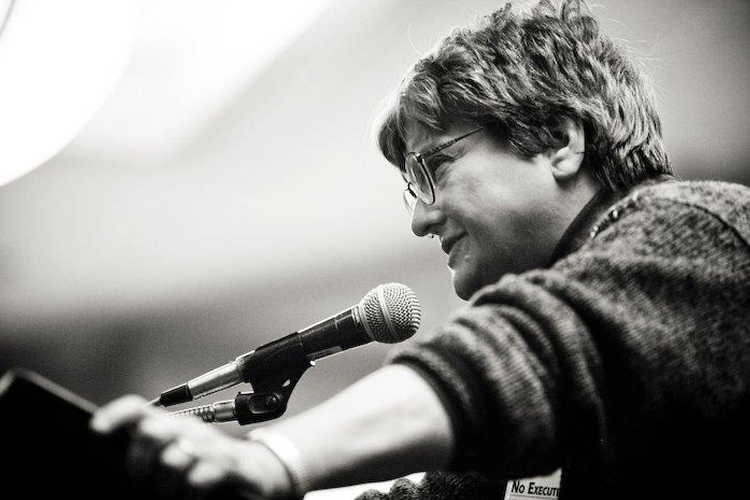

Sister Helen Prejean: “How can watching a person die heal anybody?”

Twenty years after "Dead Man Walking," her mission to end capital punishment is fiercer than ever

Topics: Sister Helen Prejean, Dead Man Walking, capital punishment,

Sister Helen Prejean: Sister Helen Prejean (Credit: Facebook)

It’s been exactly two decades since Sister Helen Prejean published her riveting and deeply personal account of her experience in the Louisiana penitentiary system, and her relationship with death row inmate Patrick Sonnier in the time leading up to his execution. Since then it’s become the basis of an Oscar-winning Susan Sarandon movie, an ongoing school theater project, an opera and a bona fide movement that changed the national conversation about capital punishment.

This month, Vintage has issued a 20th anniversary edition of Prejean’s seminal work, with a new introduction by Archbishop Desmond Tutu and afterwords by Susan Sarandon, Tim Robbins and Prejean herself. “I cannot write this without fierce anger and distress at the blindness and unfairness of the current Court,” she writes in it, “which continues to sanction the death penalty in case after case as if there were not abundant evidence that their ‘machinery of death’ does not work.”

Salon spoke to the 74-year-old nun about the current state of capital punishment, her feelings on the new pope, and why sisterhood is powerful.

What made you decide to write “Dead Man Walking”?

I knew when I came out of that execution. It was the middle of the night. I’d never watched a protocol like that — a human being had been strapped down and killed in front of my eyes. I had in front of me the horror of his crime and then the horror of watching the state kill him. I threw up. My first instinct was to run, and then I went and realized I’d been called to tell the story and get it out to the people.

A lot has changed since you wrote the book. On the one hand, we have abolished the death penalty in several states. On the other, we have far more prisoners on death row. We have legislation like Florida’s Timely Justice Act, to expedite executions. Do you think the American relationship with capital punishment has been getting better or worse in the last 20 years?

There’s the theory of the death penalty and the practice. What does it say that the average wait on death row is over 15 years? What does it say that prosecutors are going for a sentence that’s just keeping people on death row, for so long? It’s all about winning more than it is about justice.


Over 70 percent of the executions in the last year have been done in just four states, and I bet you can guess which states they are. It’s boiling down now to a disparity between the Deep South and the rest of the country.

Do you believe anything is changing for the better?

In 1996, 78 percent of Americans and 80 percent of Catholics supported the death penalty. By 2011 it was 62 percent of Americans and 59 percent of Catholics. Tim [Robbins, who wrote and produced the stage adaptation of "Dead Man Walking" for school theater groups] talks about how young people are the bearers of the message. You notice the issues that are important to them, and how in schools they’re being taught social justice. They are really learning it now.

Speaking of change, how do you feel about the new regime in Rome?

When Pope Francis got up and made one of his first speeches, he said the Church has been too self-referential. He said we have to do what Jesus did; we have to go to the margins of society. And he mentioned two things: hospitals and prisons. He said, you know, one of the most serious sins is spiritual worldliness. Jesus said that you’re not to lord over people; you’re to be the servant of each other. I interpret that as addressing the way the Church has been using its position to silence people and control them and threaten them with excommunication. Those are power moves.

There’s a lot of skepticism toward Catholics in this country. Yet people like you, and movements like the Nuns on the Bus, have been able to find support and acceptance. Why do you think that is?

You’ve got to put sisters within the context of the Church. We are the people of the Church; we stay with the people. I get out on the road and who’s out there inviting me to work with them? It’s the people. I couldn’t get the bishops to do squat when I started. But no matter what the hierarchy is doing, the church is us.

I tell you, one of the key questions in my life was how the catechism talks about the dignity of “innocent” life. That’s why we’ve worked to take out all the loopholes in Catholic teaching. Innocent life has dignity. But when I’m walking with a man to execution and he says to me, “Sister, pray that God holds up my legs,” where is the dignity there? Everyone has a dignity that must not be taken away from him.

So where do we go from here?

One of the major shifts has been that victims’ families have been much more outspoken. In New Jersey, 62 families of victims spoke out, because they are the ones being manipulated and used. What does justice mean? Families wait 10, 15, 20 years for this so-called closure and healing? How can watching a person die heal anybody?

Every conversation is an invitation to go deeper. That’s why stories are important. That’s why theater and movies should wake people up. That’s the role of spirituality. We are all brothers and sisters. And passion is the heart of what spirituality is supposed to be about.

Mary Elizabeth Williams

Mary Elizabeth Williams is a staff writer for Salon and the author of "Gimme Shelter: My Three Years Searching for the American Dream." Follow her on Twitter: @embeedub.

Featured Slide Shows

7 motorist-friendly camping sites

close X
  • Share on Twitter
  • Share on Facebook
  • Thumbnails
  • Fullscreen
  • 1 of 9

Sponsored Post

  • White River National Forest via Lower Crystal Lake, Colorado
    For those OK with the mainstream, White River Forest welcomes more than 10 million visitors a year, making it the most-visited recreation forest in the nation. But don’t hate it for being beautiful; it’s got substance, too. The forest boasts 8 wilderness areas, 2,500 miles of trail, 1,900 miles of winding service system roads, and 12 ski resorts (should your snow shredders fit the trunk space). If ice isn’t your thing: take the tire-friendly Flat Tops Trail Scenic Byway — 82 miles connecting the towns of Meeker and Yampa, half of which is unpaved for you road rebels.
    fs.usda.gov/whiteriveryou


    Image credit: Getty

  • Chattahoochee-Oconee National Forest via Noontootla Creek, Georgia
    Boasting 10 wildernesses, 430 miles of trail and 1,367 miles of trout-filled stream, this Georgia forest is hailed as a camper’s paradise. Try driving the Ridge and Valley Scenic Byway, which saw Civil War battles fought. If the tall peaks make your engine tremble, opt for the relatively flat Oconee National Forest, which offers smaller hills and an easy trail to the ghost town of Scull Shoals. Scaredy-cats can opt for John’s Mountain Overlook, which leads to twin waterfalls for the sensitive sightseer in you.
    fs.usda.gov/conf


    Image credit: flickr/chattoconeenf

  • Nordhouse Dunes Wilderness Area via Green Road, Michigan
    The only national forest in Lower Michigan, the Huron-Mainstee spans nearly 1 million acres of public land. Outside the requisite lush habitat for fish and wildlife on display, the Nordhouse Dunes Wilderness Area is among the biggest hooks for visitors: offering beach camping with shores pounded by big, cerulean surf. Splash in some rum and you just might think you were in the Caribbean.
    fs.usda.gov/hmnf


    Image credit: umich.edu

  • Canaan Mountain via Backcountry Canaan Loop Road, West Virginia
    A favorite hailed by outdoorsman and author Johnny Molloy as some of the best high-country car camping sites anywhere in the country, you don’t have to go far to get away. Travel 20 miles west of Dolly Sods (among the busiest in the East) to find the Canaan Backcountry (for more quiet and peace). Those willing to leave the car for a bit and foot it would be remiss to neglect day-hiking the White Rim Rocks, Table Rock Overlook, or the rim at Blackwater River Gorge.
    fs.usda.gov/mnf


    Image credit: Getty

  • Mt. Rogers NRA via Hurricane Creek Road, North Carolina
    Most know it as the highest country they’ll see from North Carolina to New Hampshire. What they may not know? Car campers can get the same grand experience for less hassle. Drop the 50-pound backpacks and take the highway to the high country by stopping anywhere on the twisting (hence the name) Hurricane Road for access to a 15-mile loop that boasts the best of the grassy balds. It’s the road less travelled, and the high one, at that.
    fs.usda.gov/gwj


    Image credit: wikipedia.org

  • Long Key State Park via the Overseas Highway, Florida
    Hiking can get old; sometimes you’d rather paddle. For a weekend getaway of the coastal variety and quieter version of the Florida Keys that’s no less luxe, stick your head in the sand (and ocean, if snorkeling’s your thing) at any of Long Key’s 60 sites. Canoes and kayaks are aplenty, as are the hot showers and electric power source amenities. Think of it as the getaway from the typical getaway.
    floridastateparks.org/longkey/default.cfm


    Image credit: floridastateparks.org

  • Grand Canyon National Park via Crazy Jug Point, Arizona
    You didn’t think we’d neglect one of the world’s most famous national parks, did you? Nor would we dare lead you astray with one of the busiest parts of the park. With the Colorado River still within view of this cliff-edge site, Crazy Jug is a carside camper’s refuge from the troops of tourists. Find easy access to the Bill Hall Trail less than a mile from camp, and descend to get a peek at the volcanic Mt. Trumbull. (Fear not: It’s about as active as your typical lazy Sunday in front of the tube, if not more peaceful.)
    fs.usda.gov/kaibab


    Image credit: flickr/Irish Typepad

  • As the go-to (weekend) getaway car for fiscally conscious field trips with friends, the 2013 MINI Convertible is your campground racer of choice, allowing you and up to three of your co-pilots to take in all the beauty of nature high and low. And with a fuel efficiency that won’t leave you in the latter, you won’t have to worry about being left stranded (or awkwardly asking to go halfsies on gas expenses).


    Image credit: miniusa.com

  • Recent Slide Shows

  • Share on Twitter
  • Share on Facebook
  • Thumbnails
  • Fullscreen
  • 1 of 9

Comments

14 Comments

Comment Preview

Your name will appear as username ( settings | log out )

You may use these HTML tags and attributes: <a href=""> <b> <em> <strong> <i> <blockquote>