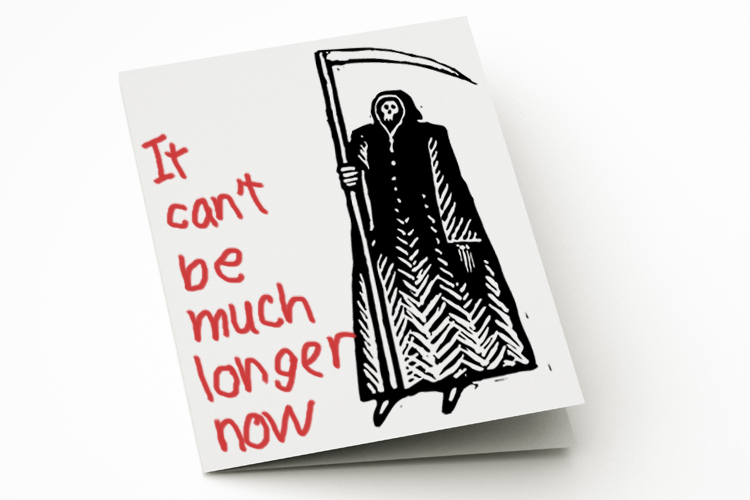

Greeting cards for the terminally ill are a great idea

Hallmark introduces a new line to deal with tough topics -- and that's a good thing

Topics: Cancer, Greeting Cards, Hallmark, Death, Consumerism,

Greeting cards for the terminally ill are a great idea (Credit: mtkang/Ron and Joe via Shutterstock/Salon)

Even in an increasingly paperless world, there are times when an e-card just won’t do. There’s something about the sound of an envelope opening, the feel of paper in your hand. It’s estimated that Americans purchase 6.5 billion cards a year. Cards to say “Happy birthday.” “I’m thinking of you.” And “Thanks for being a pal while you’re dying.”

As the Economist first reported over the weekend, greeting card behemoth Hallmark is preparing to roll out some bold new messages in 2014 – including cards that take on tough topics like terminal illness. “Our paths came together in this life,” reads one. “You’re in some of the best memories I have and you always will be.”

It’s been a long time since greeting cards stuck strictly to generic platitudes about hanging in there, baby. Fifteen years ago Hallmark rolled out its first suicide condolence cards, to offer sympathy for “when someone we love flees from life.” Six years ago, the card company introduced its “Journeys” line of messages for issues like “depression, eating disorders, and cancer.” Finally, consumers at a loss for words over a friend’s miscarriage or infertility could pick up a greeting to say, “I know how much a child would mean to you. I’m still hoping and believing for you.” At the time, AdWeek’s Tim Nudd described the gambit as “unbearably corny” and “hackneyed,” a not entirely unfair assessment of a verse like “Cancer is a villain who doesn’t play fair … but it can’t dim your spirit, and it can’t silence prayer.” Hallmark still offers “cancer support” cards, by the way, with messages that promise “Cancer is not who you are – it’s what’s happening to you.” And two years ago, Hallmark added a new line of job loss sympathy cards, featuring images of wise brown owls and sad pigs trotting toward the unemployment office. “Loss of a job, like any loss, is a grieving process,” explained the company’s creative director Derek McCracken.


The company says its latest direction has been spurred by research it has conducted with grief counselors. There are cards for “tough times” and “extended illness,” cards that acknowledge a parent’s Alzheimer’s and the lingering grief “after the last casserole is finished and the phone stops ringing.” And now, in what seems like the next logical progression, cards that acknowledge when the recipient isn’t going to get better.

Maybe a $3 sentiment written by some stranger in Kansas City sounds like a pretty shallow way to communicate love and support during an immense, life-changing experience. But I can tell you this: in the past few years, my friends and I have gone through all the things you never thought there’d be a card for: suicides, eating disorders, job losses, depressions, parental caregiving, disease, PTSD, death, death, death. There have been plenty of times when the very best among that group, the brightest and most articulate, were struck entirely at a loss for words. I have kept every card, every letter I received from both of my bouts of cancer. I treasure them, even the corniest of them. They remind me of every gesture of solidarity and compassion. And I’d take a card over silence any day of the week. In the darkest moments of life, few among us know exactly the right thing to say or do. Those who do are heroes. The rest of us need help sometimes.

That’s why a card isn’t always just a hokey little set of platitudes picked up at the drugstore. It can be an acknowledgment of something that’s often very hard to acknowledge. We live in a world that denies disease and mortality; we’re encouraged to put on a brave face and not make everybody else uncomfortable. A face that isn’t corny – it’s considerably braver and more innovative than so much of forced cheerleaderism around difficult topics. It’s sure as hell gutsier than ignoring the suffering of others because it’s too awkward and strange. And it doesn’t have to be the sum of the conversation – it can be just the beginning of it.

Mary Elizabeth Williams

Mary Elizabeth Williams is a staff writer for Salon and the author of "Gimme Shelter: My Three Years Searching for the American Dream." Follow her on Twitter: @embeedub.

Featured Slide Shows

7 motorist-friendly camping sites

close X
  • Share on Twitter
  • Share on Facebook
  • Thumbnails
  • Fullscreen
  • 1 of 9

Sponsored Post

  • White River National Forest via Lower Crystal Lake, Colorado
    For those OK with the mainstream, White River Forest welcomes more than 10 million visitors a year, making it the most-visited recreation forest in the nation. But don’t hate it for being beautiful; it’s got substance, too. The forest boasts 8 wilderness areas, 2,500 miles of trail, 1,900 miles of winding service system roads, and 12 ski resorts (should your snow shredders fit the trunk space). If ice isn’t your thing: take the tire-friendly Flat Tops Trail Scenic Byway — 82 miles connecting the towns of Meeker and Yampa, half of which is unpaved for you road rebels.
    fs.usda.gov/whiteriveryou


    Image credit: Getty

  • Chattahoochee-Oconee National Forest via Noontootla Creek, Georgia
    Boasting 10 wildernesses, 430 miles of trail and 1,367 miles of trout-filled stream, this Georgia forest is hailed as a camper’s paradise. Try driving the Ridge and Valley Scenic Byway, which saw Civil War battles fought. If the tall peaks make your engine tremble, opt for the relatively flat Oconee National Forest, which offers smaller hills and an easy trail to the ghost town of Scull Shoals. Scaredy-cats can opt for John’s Mountain Overlook, which leads to twin waterfalls for the sensitive sightseer in you.
    fs.usda.gov/conf


    Image credit: flickr/chattoconeenf

  • Nordhouse Dunes Wilderness Area via Green Road, Michigan
    The only national forest in Lower Michigan, the Huron-Mainstee spans nearly 1 million acres of public land. Outside the requisite lush habitat for fish and wildlife on display, the Nordhouse Dunes Wilderness Area is among the biggest hooks for visitors: offering beach camping with shores pounded by big, cerulean surf. Splash in some rum and you just might think you were in the Caribbean.
    fs.usda.gov/hmnf


    Image credit: umich.edu

  • Canaan Mountain via Backcountry Canaan Loop Road, West Virginia
    A favorite hailed by outdoorsman and author Johnny Molloy as some of the best high-country car camping sites anywhere in the country, you don’t have to go far to get away. Travel 20 miles west of Dolly Sods (among the busiest in the East) to find the Canaan Backcountry (for more quiet and peace). Those willing to leave the car for a bit and foot it would be remiss to neglect day-hiking the White Rim Rocks, Table Rock Overlook, or the rim at Blackwater River Gorge.
    fs.usda.gov/mnf


    Image credit: Getty

  • Mt. Rogers NRA via Hurricane Creek Road, North Carolina
    Most know it as the highest country they’ll see from North Carolina to New Hampshire. What they may not know? Car campers can get the same grand experience for less hassle. Drop the 50-pound backpacks and take the highway to the high country by stopping anywhere on the twisting (hence the name) Hurricane Road for access to a 15-mile loop that boasts the best of the grassy balds. It’s the road less travelled, and the high one, at that.
    fs.usda.gov/gwj


    Image credit: wikipedia.org

  • Long Key State Park via the Overseas Highway, Florida
    Hiking can get old; sometimes you’d rather paddle. For a weekend getaway of the coastal variety and quieter version of the Florida Keys that’s no less luxe, stick your head in the sand (and ocean, if snorkeling’s your thing) at any of Long Key’s 60 sites. Canoes and kayaks are aplenty, as are the hot showers and electric power source amenities. Think of it as the getaway from the typical getaway.
    floridastateparks.org/longkey/default.cfm


    Image credit: floridastateparks.org

  • Grand Canyon National Park via Crazy Jug Point, Arizona
    You didn’t think we’d neglect one of the world’s most famous national parks, did you? Nor would we dare lead you astray with one of the busiest parts of the park. With the Colorado River still within view of this cliff-edge site, Crazy Jug is a carside camper’s refuge from the troops of tourists. Find easy access to the Bill Hall Trail less than a mile from camp, and descend to get a peek at the volcanic Mt. Trumbull. (Fear not: It’s about as active as your typical lazy Sunday in front of the tube, if not more peaceful.)
    fs.usda.gov/kaibab


    Image credit: flickr/Irish Typepad

  • As the go-to (weekend) getaway car for fiscally conscious field trips with friends, the 2013 MINI Convertible is your campground racer of choice, allowing you and up to three of your co-pilots to take in all the beauty of nature high and low. And with a fuel efficiency that won’t leave you in the latter, you won’t have to worry about being left stranded (or awkwardly asking to go halfsies on gas expenses).


    Image credit: miniusa.com

  • Recent Slide Shows

  • Share on Twitter
  • Share on Facebook
  • Thumbnails
  • Fullscreen
  • 1 of 9

Comments

Loading Comments...