
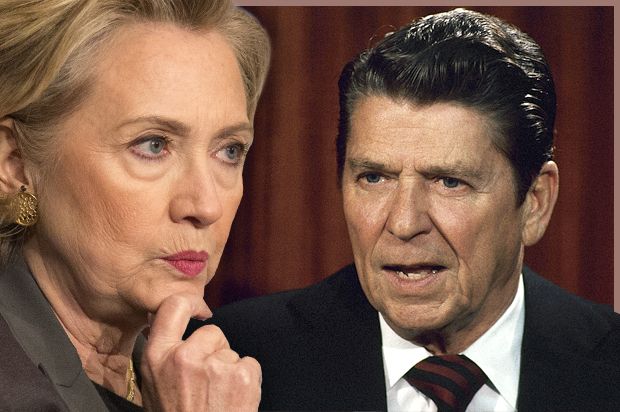

No doubt it’s the height of folly to forecast the results of a presidential election that’s still more than two years away. But most observers of any political orientation, regarding the landscape right now, would conclude that it’s more likely than not that America’s first black president will be directly followed by our first female president. Are you celebrating yet?
Of course we don’t know for sure whether Hillary Clinton is running in 2016, but at this point she’s just toying with us, like a cat with a badly injured mouse. She stands in a virtually unprecedented position of dominance, relative to her own party and the electorate as a whole. While the Democratic left harbors impotent fantasies of defeating her (Bernie Sanders LOL!) and the Republican right prepares for a predictable series of apoplectic seizures about how she’s a lesbian murderess who personally shot up the Benghazi consulate, the public seems generally OK with Clinton’s impending coronation. As numerous commentators have observed, her principal opponent is probably not Jeb Bush or Rand Paul but herself, or at least the possibility that we’ll all feel sick of her before she gets elected. It’s a strange situation, and not a healthy one.
Let’s take a second to recognize that I’m a white dude delivering a dismissive take on events of undoubted historical and symbolic significance that were, or will be, immensely meaningful for many people. But after the disheartening first three-quarters of the Obama era, it’s difficult to avoid the conclusion that symbolic meaning is the last layer of meaning left in our quadrennial electoral circus. Maybe it’s not Hillary Clinton’s fault that her likely ascension feels like the event that will mark the final Dracula-suckage of lifeblood from American electoral politics, just as it’s not entirely Barack Obama’s fault that his “transformational presidency” blundered into a stagnant swamp infested with whining Republican mosquitoes and never got out again. They are just two people, after all! Two imperfect people with the best intentions, supposedly trying to do their best in a screwed-up situation.
Except that I don’t really buy that argument. Obama and Clinton and everybody else in the partisan duopoly are simultaneously the casualties, beneficiaries and perpetrators of a broken system, in which Democrats and Republicans draw their voters from opposing social castes (not classes) but actually represent the interests of rival cliques within a tiny moneyed elite. The onetime Seven Sisters student radical “had to” evolve into a mouthpiece for Wall Street and the entrenched foreign-policy establishment, just as the onetime Chicago community activist “had to” leave the financial sector in the hands of exactly the same criminals who wrecked it and renege on a whole range of hopey-changey campaign promises. I’m well aware of the spin their defenders will put on that stuff – politics is a dirty business and we all need to grow up and anyway SCOTUS! – and we’re not going to settle that debate today, or at any other time.
As you will no doubt recall, people got immensely excited on both sides of the heated Obama-Clinton primary battle in 2008, hurling all kinds of invective about racism and sexism at each other, predicting catastrophic defeat for the other candidate and promising to rip the fragile Democratic coalition apart. (Remember the PUMA demographic, angry Clinton supporters who threatened to bolt for the McCain-Palin ticket out of spite? Ah, memory!) Whatever that was really about – and my former Salon colleague Rebecca Traister has explored it in depth – it had very little to do with those two candidates, except in their roles as symbols or signifiers.
All that fevered discussion about who rigged the Nevada caucus and who made the most obnoxious comments on TV feels like a lifetime ago, the product of an innocent age when politics seemed charged with possibility and hope. But the thing is, it wasn’t all that long ago and we weren’t innocent. We should have known better and basically did. It’s just that presidential elections exert a seductive allure that keeps suckering us back into the tent, like a bunch of Ohio farm boys at a 19th-century carnival, hoping against hope that this time the magic will turn out to be real. It’s a lot easier to write snarky, dispassionate analysis now than it will be in a year or so, when progressives are trying to gin up excitement for a nonexistent Elizabeth Warren campaign or we all have to have a hysterical meltdown about Ted Cruz’s “surprising” poll numbers from a fondue dinner held in an Iowa cornfield.
There’s no precise historical parallel, at least in the contemporary party-politics era, for the commanding position Hillary Clinton appears to hold roughly 16 months out from the first caucuses and primaries. It’s not that there haven’t been heavy favorites or heirs apparent in previous elections – that’s a feature of the system. But it seems not just possible but probable that Clinton will face no serious or significant opposition within her own party, which as far as I can tell is a brand new situation for a non-incumbent candidate. Warren is nowhere near foolish enough to torch her political future on a futile campaign of resistance. While Joe Biden will almost certainly run if Clinton doesn’t, he’s not enough of a masochist to take her on directly and endure yet another public humiliation. If Sanders runs (and he’d have to change his political registration, for one thing) he’ll make the Dennis Kucinich campaigns of 2004 and 2008 look like devastating political whirlwinds.
If there’s a historical precedent to Hillary-zilla it is to be found in the Republican Party, where big-money donors and a Washington-based establishment have long done their best to control the presidential nomination process and quell populist uprisings. Specifically, it’s Ronald Reagan in 1980. Most Republicans assumed going into that campaign that Reagan – who had been waiting around as the conservative savior since nearly wresting the nomination from Gerald Ford in 1976 – would sweep to victory in the primaries and then drive cardigan-clad malaise-monger Jimmy Carter from the White House and restore America to its true greatness. They were ultimately correct about all that (except for the “true greatness”), but Reagan actually faced brief but spirited opposition from George H.W. Bush, who played the role of responsible centrist in that campaign and memorably denounced Reagan’s “voodoo economics.” Bush emulated the Carter-McGovern strategy of slogging through all the meaningless straw polls and small-town dinners in the fall of 1979 while Reagan stayed home in California, and after winning the Iowa caucus Bush momentarily looked like the front-runner. Reagan ultimately swamped him in the South, of course, but Bush won six primaries and more than 3 million votes, essentially forcing himself onto the ticket as the vice-presidential nominee. Who’s going to put up that level of resistance to Hillary Clinton?
I guess the 1988 Republican campaign also looks similar, but only at first glance and only in the rear-view mirror: After two terms as Reagan’s vice president, Bush coasted to the nomination just as everybody expected. (And then to victory over Michael Dukakis, one of the more bathetic also-rans of recent political history.) But those who remember that era in Republican politics can testify that the intra-party divisions were highly acrimonious. Sen. Bob Dole won the Iowa caucus and several Midwestern primaries, and deserves a special footnote in American history for decrying the lies and dirty tricks of Lee Atwater, Bush’s infamous campaign strategist. Televangelist Pat Robertson terrified the world that year by packing a few caucuses with his followers (he got 82 percent of the vote in Hawaii!), thereby compelling all future Republican candidates to pay ritual obeisance to the Christian right.
There is certainly a cadre of disgruntled liberal Democrats who aren’t thrilled about the incoming tsunami of the Clinton campaign, and in the age of social media they’ll get to vent their spleen repeatedly in the months ahead by promising to draft Warren or vote Green or get so stoned that Rand Paul appears palatable. But it’s not at all clear that they represent a significant voting bloc, or that any plausible candidate wants to be their standard-bearer. This tells us a number of things about the contemporary Democratic Party and about politics in general, none of them terribly encouraging.
Among the obvious notes here is the fact that electoral politics has increasingly become an oligarchic or dynastic enterprise, open only to the immensely wealthy and/or the immensely well connected. If we get a Clinton facing a Bush in the 2016 general election – which is not just plausible but reasonably likely – that would mean that 50 percent of the major-party presidential nominees over the last 28 years and eight electoral cycles have had one or the other of those surnames. If politics is a blood sport for the new aristocracy — an American cognate to fox hunting, with you and me as the fox – that does more than symbolize our widening social inequality. It embodies it, and enacts it. You can’t separate the fact that only rich people can run for president from the fact that both parties are fueled by rich people’s money, or from the fact that beneath all their partisan bickering Democrats and Republicans have vigorously collaborated for more than 20 years on a set of deregulatory, low-tax and cheap-credit economic policies that have made rich people a whole lot richer. It’s not like those are unrelated coincidences.
I’m not saying there are no differences between the two parties, or that given the binary choice with a gun to my head, I might not prefer Hillary Clinton as president to whomever the Republicans nominate. (This is a topic for another time, but Democrats clearly have the most to fear from Rand Paul, who represents a potentially significant reboot of the Republican brand.) Generally speaking, the Democratic Party stands for what might be termed the metropolitan caste in American life, a diverse group of people who live in or near major cities and tend to support a range of rights-based issues around race, gender, sexuality and related factors. You can’t say the party represents that caste with much force or courage, and it does so more by following than by leading. Democrats took years to commit fully to a pro-choice position, were late to the party on marriage equality, and are still way behind their metropolitan base on marijuana. Nonetheless that’s a big contrast to the Republicans, who at least for marketing purposes view the metropolitan caste as a bunch of socialistic tree-huggers who will take away your guns and your F-150 and compel you to drive a Prius to your gay marriage.
But what Hillary Clinton and Obama and most other prominent Democrats of the 21st century definitely don’t represent is any form of progressive or class-based economic philosophy. Elizabeth Warren’s election to the Senate caused such a stir because she appears to be a mild exception to this rule. As former Bill Clinton aide Bill Curry wrote recently in Salon, the deregulation of the telecommunications and financial services industries under his onetime boss in the ’90s was a more far-reaching and corporate-friendly policy shift than anything in Ronald Reagan’s wildest trickle-down dreams. That marked the moment, Curry says, when “issues of economic and political power [grew] invisible to Democrats.” When Ralph Nader ran for president in 2000 on precisely those issues, he was viewed as a traitor who cost Al Gore the White House. But if the Democrats had nominated a pro-lifer and Gloria Steinem had run as an independent, it might well have split the party in half.
All of which brings me back to the final point of similarity between Hillary Clinton and Reagan, the man who dominated one election cycle from end to end and the woman who hopes to repeat that feat. They could hardly be more different as political personalities and (one imagines) as human beings, and their electoral appeal is directed at totally divergent audiences. But both function in the political marketplace first and foremost as powerful symbols: Reagan was a symbol of American manhood and the mythical American past, while Clinton stands (I guess) for the upward progress of American women and a more egalitarian future. (It’s not entirely accidental that both have provoked exaggerated hatred among their opponents.)
I write about the movies, and would be the last person on Earth to tell you that symbols don’t matter. But they often do not mean what they seem to mean, and neither Clinton nor Reagan actually represents what they seem to represent. Reagan did little or nothing for the working-class white Americans who elected him, and if Clinton reaches the White House she will not be there to serve metropolitan women. Beneath the scrim of symbolic meanings, which are meant to reassure and distract and most importantly to win elections, the same force works through both of them: the force of money and those who wield it.
