
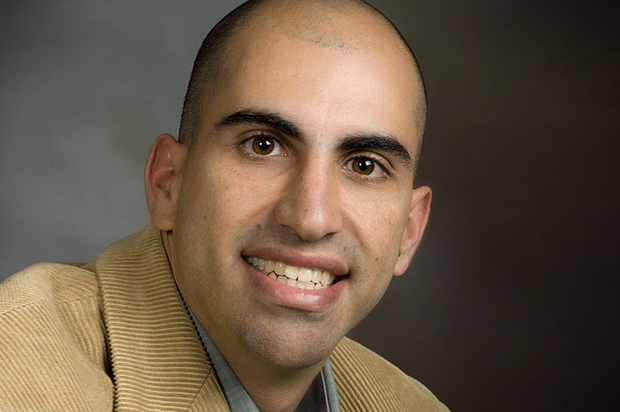

A few weeks ago Steven Salaita had reason to be pleased. After a full review by the University of Illinois at Urbana-Champaign, he had received a generous offer of a tenured, associate professor position there — the normal contract was offered, signed by the school, he had received confirmation of his salary, a teaching schedule, everything except the final approval of the UIUC chancellor.
In academia this is not at all unusual; departments and schools are told to go ahead with the offer, so as to be competitive with both the candidate’s current school and others that might be bidding for their talent. Salaita is a world-renowned scholar of indigenous studies (and also a frequent Salon contributor). At that point, as required by academic protocols, upon accepting the position he resigned the one he held at Virginia Tech.
But final approval never came. The Chronicle of Higher Education reports today that “Phyllis M. Wise, the campus’s chancellor, and Christophe Pierre, the University of Illinois system’s vice president for academic affairs, informed the job candidate, Steven G. Salaita, on Friday that they were effectively revoking a written offer of a tenured professorship made to him last year by refusing to submit it to the system’s Board of Trustees next month for confirmation.”
According to Inside Higher Education: “Sources familiar with the university’s decision say that concern grew over the tone of his comments on Twitter about Israel’s policies in Gaza. While many academics at Illinois and elsewhere are deeply critical of Israel, Salaita’s tweets have struck some as crossing a line into uncivil behavior.” Nevertheless, IHE goes on to report: “But as recently as July 22 (before the job offer was revoked), a university spokeswoman defended Salaita’s comments on Twitter and elsewhere. A spokeswoman told the News-Gazette for an article about Salaita that “faculty have a wide range of scholarly and political views, and we recognize the freedom-of-speech rights of all of our employees.”
With both the university and Salaita keeping quiet on the details of the firing at the moment, it’s hard to tell what exactly changed the university’s mind. But it would seem that Salaita would be doubly protected from summary firing. First of all, no matter how “uncivil,” “disagreeable” or even repugnant some of his tweets might appear to some people, they are nonetheless protected under the First Amendment. This holds true for all individuals. But Salaita is also protected by academic freedom, a concept enshrined in American institutions of higher education.
Not only that, Salaita would be protected as a tenured professor, had it not been for his being caught between resigning from Virginia Tech and being formally hired by UIUC. The concepts of academic freedom and tenure go hand in hand — both are aimed at guaranteeing professors the freedom to found new knowledge, which is often only possible by critically examining old knowledge and continually retesting norms and assumptions, without fear of reprisals from entrenched interests, or from those who might be threatened or offended. Besides the lofty ideals of the pursuit of knowledge, academic freedom and tenure have practical goals as well — they assure that no professor will lose their livelihood for taking unpopular stances. In sum, then, Salaita was on firm ground according to all the norms and protocols for both free speech and academic freedom.
But his tweets had indeed offended not a few, including the Simon Wiesenthal Center, which wrote to UI president Robert Easter accusing Salaita of being anti-Semitic and declaring that “such outrageous statements present a real danger to the entire campus community, especially to its Jewish students.” Here is where things start to blur, and to blur in ways that make this issue much more than simply a matter for the ivory tower. We see a deliberate confusion of a private individual’s thoughts and beliefs and their professional life. Despite the fears of the Wiesenthal Center, there has been no proof whatsoever that Salaita’s tweets would be required reading in the classroom. Or that his political views would be force-fed to the students. Furthermore, the “danger” mentioned here is extremely vague. What is deeply troubling in this case is the influence of outside agencies and organizations on a university decision, and the absolute lack of transparency on the part of the university.
As I have written elsewhere, some groups have attempted to use Title VI of the 1964 Civil Rights Act to wage legal battles against pro-boycott and pro-divestment protesters, precisely on the grounds that those protests “threatened” Jewish students:
Historically, the Act was used during the 1960s to desegregate public schools in the South. It prohibits discrimination based on race, color or national origin, but does not include religion. But in October 2010, US Secretary of Education Arne Duncan re-affirmed a set of guidelines initially promulgated in September 2004 that “applies Title VI … to the protection of Jewish students from anti-Semitism on campuses… Under the Department of Education guidelines, the Civil Rights Act can be invoked if anti-Jewish behavior is considered to be based on shared ethnic characteristics.”
After those new guidelines were put in place, several complaints were filed with the US Department of Education asserting that things like “Israel Apartheid Week” and divestment protests were anti-Jewish and anti-Semitic. Those filing the complaints argued that such events created a threatening campus climate for Jewish students, and were emotionally damaging. For example, at UC Santa Cruz Tammi Rossman-Benjamin filed a complaint, arguing that “As a result of their experiences with such university-sponsored, anti-Semitic expression, Jewish students at my university have expressed feeling emotionally and intellectually harassed and intimidated by their professors, isolated from their fellow students and unfairly treated by administrators. Some have even reported leaving the university, dropping classes, changing fields of study and hiding symbols of their Jewishness.”
Despite this and several other attempts to deploy the new guidelines, as noted in an article published in March of 2012 in The Jewish Daily Forward, “A year and a half after the federal government extended a landmark civil rights law to cover Jewish students, Jewish groups have yet to succeed in using this law against what they see as anti-Semitic anti-Israel activity on campus. A survey by the Forward has found that at least 10 anti-Semitism cases have been filed with either the Department of Education or in court under Title VI of the 1964 Civil Rights Act. In only one of these cases so far has the complainant been favored: a high school case in which Israel played no role.”
The determination letter written to UC Berkeley by the DOE contains the most succinct statement possible. It found that the kinds of protest events that were the basis of complaint “constitute expression on matters of public concern directed to the University community. In the university environment, exposure to such robust and discordant expressions, even when personally offensive and hurtful, is a circumstance that a reasonable student in higher education may experience.”
Thus, a case against Salaita based on the “danger” his tweets might pose to the university is vague and certainly not actionable.
But above and beyond this academic exercise, do we really want our tweets or other social media communications used against us in ideological witch hunts? Do we want to allow a cloud of suspicion to hang over our heads? Do we want to constantly be checking ourselves as we voice our opinions on social media, and worry that by advocating a certain political position our employment might be jeopardized? By not protesting this instance, we are opening ourselves up to a world in which these kinds of denials of employment will be acceptable. What use, then, will social media be but to be a platform for the most mild forms of expression and banality with regard to controversial subjects?
Such acts of intimidation based on possible “danger” reek of the McCarthyite era, where Americans were asked to sign loyalty oaths, when unpopular opinions were considered “un-American,” and when neighbor sold out neighbor in fear of being named themselves. People in the U.S. denounced others rather than being incriminated themselves. Indeed, some of the most prominent and courageous voices were in the entertainment and media industries, and many of them were Jewish, with socialist and communist interests. Lives were ruined, writers and intellectuals were blacklisted. Names like Bernard Gordon, Ruth Gordon, Leonard Bernstein, Lillian Hellman, Paul Robeson, Richard Wright, Abe Burrows, Lee J. Cobb, John Garfield, Harry Belafonte, Richard Attenborough show up on these lists. The end result is all the same: intimidation, silencing, censorship. Only this time the charge is not being a communist sympathizer, it is being a supporter of the Palestinian people. Again, do we wish to have social media used to denounce others?
Another deeply problematic issue in the Salaita case is the notion even if his tweets do not present a “danger,” they must be condemned because they are “uncivil.” And this incivility is especially troubling because it is taking place in social media, not in academic journals. While this might sound ridiculous, that is exactly the charge leveled against Salaita by UIUC professor Cary Nelson, who defended his university’s decision to fire Salaita.
The IHE article mentioned above notes:
Cary Nelson, a longtime English professor at Illinois and a past president of the American Association of University Professors, has defended many professors who hold unpopular views. But he has also in the past said that it was legitimate — at the point of hiring — to consider issues of civility and collegiality. In this case, he said, that would lead him to oppose Salaita’s appointment.
“I think the chancellor made the right decision,” he said via email. “I know of no other senior faculty member tweeting such venomous statements — and certainly not in such an obsessively driven way. There are scores of over-the-top Salaita tweets. I also do not know of another search committee that had to confront a case where the subject matter of academic publications overlaps with a loathsome and foul-mouthed presence in social media. I doubt if the search committee felt equipped to deal with the implications for the campus and its students. I’m glad the chancellor did what had to be done.”
What we find here is a mandatory litmus test of “civility and collegiality” at the point of hire. One really has to wonder how that might be tested, and the wonderfully diverse faculty that would result. In the Chronicle of Higher Education, Nelson goes even further:
“Academic freedom does not require you to hire someone whose views you consider despicable,” Mr. Nelson said. “It prevents you from firing someone from a job for their views.”
“When Salaita tweets, ‘If you’re defending Israel right now, you’re an awful human being,’” Mr. Nelson said, “he issues a judgment about his future students that would justify them believing they would be academically at risk in expressing pro-Israeli views in class.”
“It’s not a violation of academic freedom,” Mr. Nelson said, “to decide you don’t approve of someone’s publications or their public use of social media. It’s not a violation of academic freedom to decide not to hire someone with a deplorable role as a public intellectual.”
No matter that he was once president of the American Association of University Professors (AAUP — the organization that canonized “academic freedom” and “tenure” in the first place), this is an entirely idiosyncratic interpretation of academic freedom, which goes squarely against its ethos. Academic freedom is meant to guarantee the universities are bastions of diverse opinions, commensurate with the liberal vision of education. Indeed, as John Stuart Mill argued long ago, without vibrant disagreement and intelligent, knowledgeable diversity, societies become nothing more than complacent, conformist and dangerously single-minded.
Nelson’s contention that if a professor’s opinions are known then students will live in fear of having different ones are not restricted to Salaita’s case. This is probably true of some of Nelson’s students, in fact. The responsibility of a professor is to remain fair-minded, but not silent. Finally, Nelson reserves for himself alone the mantle of “acceptable” “public intellectual.” By determining which opinions are “civil” enough to be aired, he becomes the self-appointed censor of academia.
But equally bizarre is the notion that even though Salaita’s academic publications met the search committee’s standards, his tweets did not. Salaita’s scholarship was not only accepted by the university, he was offered a job on the basis of that scholarship and teaching record. Now, it seems, that even though Salaita’s academic publications met the search committee’s standards, his tweets did not; even though his book was considered excellent enough to help gain him a tenured appointment at the university, the opinions he made on social media were enough to fire him.
Fortunately, his colleagues are used to this kind of behavior on Nelson’s part: Anita Levy, associate secretary in the AAUP’s department of academic freedom, tenure and governance, on Wednesday said Mr. Nelson “does not speak for the association.” Furthermore, again from the story in today’s Chronicle of Higher Education: “John K. Wilson, a co-editor of the AAUP’s blog, Academe … argued that Mr. Nelson generally can be counted on to stick up for a faculty member in Mr. Salaita’s position, but the former AAUP president appears to have ‘a blind spot’ when it comes to the academic freedom of critics of Israel.” This is indeed the issue.
As Corey Robin points out, “incivility” is a strange charge coming from Cary Nelson, who in another life vigorously (and to my mind, rightly) protested against using “civility” as a litmus test. Robin writes: “A man who once wrote that ‘claims about collegiality are being used to stifle campus debate, to punish faculty, and to silence the free exchange of opinion by the imposition of corporate-style conformity,’ now complains about an anti-Zionist professor’s ‘foul-mouthed presence in social media.’” Here is where we really get to the heart of the matter.
As president of the AAUP Nelson actually defended (albeit belatedly) a professor who, after 9/11, wrote a manifesto declaring that the bombing of the World Trade Center was the proper retribution for America’s past deeds, and that those who perished there deserved to die because they were “little Eichmanns” working in the “techno-corps.” Yes, Cary Nelson argued for Ward Churchill’s reinstatement. So if he can do that for Ward Churchill, why can’t he for Steven Salaita? Easy — it’s simply because Salaita’s target is not U.S. foreign policy or global capitalism, it is Israel. One might forgive Nelson his base hypocrisy, if it were not for the fact that it comes at the expense of another person’s career and livelihood.
Fortunately, the Illinois AAUP has issued an unambiguous defense of Salaita:
The Illinois Conference Committee A on Academic Freedom and Tenure of the American Association of University Professors supports the honoring of the appointment of Steven G. Salaita in the American Indian Studies program at the University of Illinois at Urbana-Champaign. Reports that the university has voided a job offer, if accurate, due to tweets on the Palestinian-Israeli conflict would be a clear violation of Professor Salaita’s academic freedom and an affront to free speech that we enjoy in this country…Professor Salaita’s words while strident and vulgar were an impassioned plea to end the violence currently taking place in the Middle East. Issues of life and death during bombardment educes significant emotions and expressions of concern that reflect the tragedy that armed conflict confers on its victims. Speech that is deemed controversial should be challenged with further speech that may abhor and challenge a statement. Yet the University of Illinois cannot cancel an appointment based upon Twitter statements that are protected speech in the United States of America.
In the spirit of full disclosure, and to end this article on a fitting note, I co-authored a piece with Steven Salaita, I am proud to say. In it, we wondered why all those college and university presidents who wrote letters condemning the American Studies Association for endorsing the academic boycott of Israel, saying that it harmed academic freedom, were not writing similar letters condemning the Israeli government’s actual physical attacks on and closures of universities in the Occupied Territories — a much more real, violent, destructive denial of academic freedom. I’ll speak for myself here: All you university and college presidents, who cited the AAUP as your guiding light on that issue, what do you have to say now about the Salaita case?
If you wish to support Professor Salaita, here is a petition, which in 24 hours has gathered well over 6,000 signatures.
