On Monday, August 29, 2005, at about 6:00 a.m., Hurricane Katrina slammed into the coasts of Louisiana, Mississippi, and Alabama. A category 5 hurricane until just before landfall, it was one of the worst storms ever to hit the Gulf Coast. Kathleen Blanco, the governor of Louisiana, had been briefed extensively about what to expect when the storm hit, which was why, on the Friday night before the storm reached the coast, she signed papers declaring Louisiana to be in a state of emergency. Based on what she had been told by her advisers and what she knew from being a native Louisianan, she understood that Katrina, creeping gradually toward land with sustained winds of a strength rarely seen in a hurricane, could prove to be catastrophic for Louisiana, and particularly for New Orleans.
Over the weekend, Blanco and her staff monitored the storm from an emergency headquarters in Baton Rouge. As the storm was hitting on Monday morning, Michael Brown, the head of the Federal Emergency Management Agency, met with the governor and her staff. Brown had arrived in Louisiana the night before, supposedly ready to deal with the disaster. When he got to the headquarters that morning, Brown told Blanco he was prepared to help. "He showed up Monday morning," says Bob Mann, a senior aide to Blanco, "and gave us the feeling we would have everything we wanted and needed. He was nothing if not an effective bullshitter." Specifically, there was talk of FEMA buses. "Michael Brown told me he had 500 buses," Blanco says. "They were staged and ready to roll in."
Meanwhile, as a deadly storm of historic proportions ripped into three Gulf Coast states that Monday, Bush, on a working vacation at his ranch in Crawford, stuck to his schedule for the day. He traveled to Arizona, where he gave a stay-the-course speech about the war in Iraq. He even made himself available for a photo op after the speech, posing with a guitar next to someone wearing a sombrero, seemingly unaware that the Gulf Coast of the United States was in the throes of a horrific natural disaster perhaps unparalleled in the nation's history. For a president who often seemed to care more about developments in Iraq than those at home, here was a singular moment. Never had Bush appeared to be so out of sync, at least when it came to events unfolding in the homeland. To make matters worse, in this case the disaster was not happening on the other side of the world or even the other side of the country, but in a state next door to Texas.
On Tuesday, Bush was still out of touch with what was happening and seemingly unaware of the seriousness of the events unfolding on the Gulf Coast, especially in New Orleans. A major American city had filled up with water, but Bush had not departed from his planned schedule. In Coronado, California, at a naval base near the USS Ronald Reagan, Bush delivered a speech to commemorate the 60th anniversary of the defeat of the Japanese in World War II. But Bush used the occasion, as he had repeatedly of late, to give yet another stay-the-course speech about Iraq. On this day, he compared the ongoing military action in Iraq to the allied struggle against German fascism and Japanese imperialism in terms of its moral significance. "The terrorists of our century are making the same mistake that the followers of other totalitarian ideologies made in the last century," Bush said. "They believe that democracies are inherently weak and corrupt and can be brought to their knees." It was not terrorists who had brought three states in the American South to their knees, but an act of nature that, judging from his actions on Monday and Tuesday, had not fully engaged the attention of the president.
As it turned out, the federal government's attempts to respond to the storm and flooding appeared frozen by inadequacy and ineptitude. Thousands of people were stranded in their homes, unable to make a better escape than to their rooftops to wave for help and hope emergency personnel in helicopters might rescue them. Tens of thousands of refugees were holed up downtown in the Convention Center and the Superdome, yet FEMA was unable to bring in even food, water, or ice, not to mention buses to evacuate them. Touring the Superdome on Tuesday night, Blanco was disturbed by what she witnessed: in short, no federal assistance whatsoever. All she saw was the Louisiana National Guard and the Louisiana State Police -- certainly not enough of a law enforcement presence to be able to maintain order without additional guardsmen and troops.
If Bush had not seen what was taking place by Tuesday, Karl Rove had. The first evidence of Rove's involvement in the Katrina disaster occurred on Tuesday afternoon. "Rove understood what a nightmare this was for the president," Senator Mary Landrieu of Louisiana says, "so he went into high gear on the spin thing they're so good at in the White House. Rove had David Vitter, the Republican senator from Louisiana. I was at a press conference and David Vitter walked up to the mike and said, 'I just got off the phone with Karl Rove.' I looked at the governor and she looked at me, like, 'Why is David Vitter on the phone with Karl Rove?' I mean, he could have been talking to generals, the president himself, but Rove is just a political hatchet man."
Despite his expertise being politics, the administration had made Rove a central player in the handling of the disaster. "A light switch in the White House didn't get turned on without going through Rove," says Adam Sharp, an aide to Landrieu. "It was clear that Rove was the point person for the White House on this disaster."
That fact was proven precisely by what Vitter had done and said at the press conference. "As soon as Vitter said he had just gotten off the phone with Rove and other Republican officials," Landrieu says, "he started in on the first talking point to come out of the ordeal. I said to myself, 'Oh my God, I can't believe the White House has already given David Vitter talking points to talk about this.' We weren't going to blame anyone. We weren't going to blame the president. I mean, is there a Republican talking point for how to get people water? But that was Karl Rove."
Instead of supplying relief to the city, Rove had devised a scheme whereby he could blame the failure of government to take action on someone besides Bush. "They looked around," Landrieu says, "and they found a Democratic governor and an African American Democratic mayor who had never held office before in his life before he was mayor of New Orleans -- someone they knew they could manipulate. Ray Nagin had never held public office and here he was the mayor of New Orleans and it was going underwater."
In short, Rove was going to blame Blanco for the failure of the response in Louisiana, and to do that he was going to use Nagin. He had already set the plan in motion on Tuesday with Nagin, who, even though he was a Democrat, was so close to the Republican Party that some members of the African American community in New Orleans called him "Ray Reagan." In 2000, Nagin had actually contributed $2,000 to Bush's campaign when he ran for president.
Rove knew of Nagin's ties to the Republican Party, so more than likely Nagin could be convinced to level his criticism at Blanco and to support Bush when he could. Here was Rove's strategy: Praise Haley Barbour, the Republican governor of Mississippi; praise Michael Brown and FEMA; blame Blanco, the Democrat. It was not a stretch for Nagin. He and Blanco so disliked each other that in Blanco's last race Nagin had endorsed her opponent.
Rove and Nagin were communicating through e-mail. "I heard Nagin was bragging about being in touch with The Man," Blanco says. "Nagin took the position that they were the people who could help the most to do what he wanted. People get highly complimented when they have contact with the White House." In this case the trade-off for Nagin was his willingness to cooperate with Rove. "I knew Ray Nagin could be easily manipulated," Landrieu says. "I could feel it. We were all working together in a relatively small building. We were in close proximity. But I could see where Rove was going. Blame Blanco. Blame the levee board. Blame the corruption in New Orleans. 'The reason the city is going underwater is because the city is corrupt,' Rove was saying. 'But don't blame the Republicans or George W. Bush or David Vitter. We are the white guys in shining armor, and we are going to come in and save the city from years of corruption.' That was their story and they sold it very well."
Rove sold the story, as he had in the past, through the media. On Wednesday, while Blanco was trying to get help from the White House, her staff began receiving calls from reporters questioning her handling of the disaster, almost all of them citing as their sources unnamed senior White House officials.
"One story," Blanco aide Mann recalls, "would say the governor was so incompetent she had not even gotten around to declaring a state of emergency when she had actually done so three days before the storm. It was obvious to us who was behind this attack based on inaccurate information that was being shoveled to Washington reporters who were identifying their sources as senior Bush administration officials." Blanco adds, "People at Newsweek told me the White House called them to say I had delayed signing the disaster declaration. The assumption was that their source was the political director -- Karl Rove." Not only was the attack on Blanco in print, it was also on television. "All of a sudden," Blanco says, "a whole lot of talking heads showed up on television repeating the misinformation over and over, making it the truth."
On Wednesday afternoon, Blanco called Bush and told him she needed "everything you've got." Since Bush promised to help, Blanco believed that assistance was arriving in the person of Army lieutenant general Russel Honore, who met with the governor. After a long and cordial discussion, Blanco asked Honore how many troops he had brought with him to Louisiana at the order of the president. "Just a handful of staffers," Blanco heard him say, much to her amazement. "I am here in an advisory capacity."
On Thursday, as New Orleans remained underwater, with countless thousands of people stranded in their homes, on their rooftops, or at the Convention Center or Superdome, there was still no federal help. What continued unabated, though, was the assault on Blanco, questioning her handling of the disaster. "We were in life-and-death mode and every minute counted," Blanco says. "I found my staff having to do public relations in the middle of the most disastrous days Louisiana has ever experienced. The talking heads had been turned on. My staff was saying, 'My God, governor, they are crucifying you politically.' I finally pulled all of my staff together and said, 'We are wasting our energy. We do not have a stable of talking heads. We cannot control the national media. We have lifesaving missions to accomplish, so let's do it.' My staff was upset with me."
Blanco sought out Michael Chertoff. She found him in one of the emergency headquarters trailers. "Turn off the talking heads," she told him point-blank. "People are dying while you people are playing politics. Turn them off." It was Thursday, and so far the FEMA buses had still not arrived to help evacuate people from the Convention Center and Superdome, nor had Bush sent any federal troops, who were desperately needed in the search-and-rescue efforts. Instead of sending help, the administration had come up with a ploy. "I was on a conference call with the White House," Adam Sharp says, "where they were saying: If you want any help, you have to turn over all control of your state to the president. We won't help until you give us control of your National Guard and your law enforcement agencies, until Louisiana becomes a federal territory. They were using this as the excuse for their delaying on the issues. They kept trying to put it on Blanco. But no governor would ever give control of her state to the president."
On Friday, Bush finally traveled south. His first stop was Mobile, Alabama, where he met with Bob Riley, the Republican governor whose associates were engaged in a collaboration with Karl Rove to politically destroy Don Siegelman, the Democratic former governor. During the stop in Mobile, Bush went out of his way to congratulate Michael Brown, saying, "Brownie, you're doing a heck of a job." Bush was willing to make such a public statement in support of Brown, carefully staged in a holding area for a national press corps that included a wall of television cameras.
It was especially perplexing that he would make this statement now because the day before Bush had read a news report, handed to him by an aide, that contained information about events on the ground in New Orleans that Michael Chertoff had not shared with him that very morning in his briefing. Chertoff himself had been briefed by Brown. Worse still, Brown had at first been unaware that 25,000 people had gathered at the Convention Center -- a fact so disturbing that some Republicans had begun to call for his firing, a move Bush seemed unable to make. "Mr. Brown," the New York Times later reported, "had become a symbol of President Bush's own hesitant response."
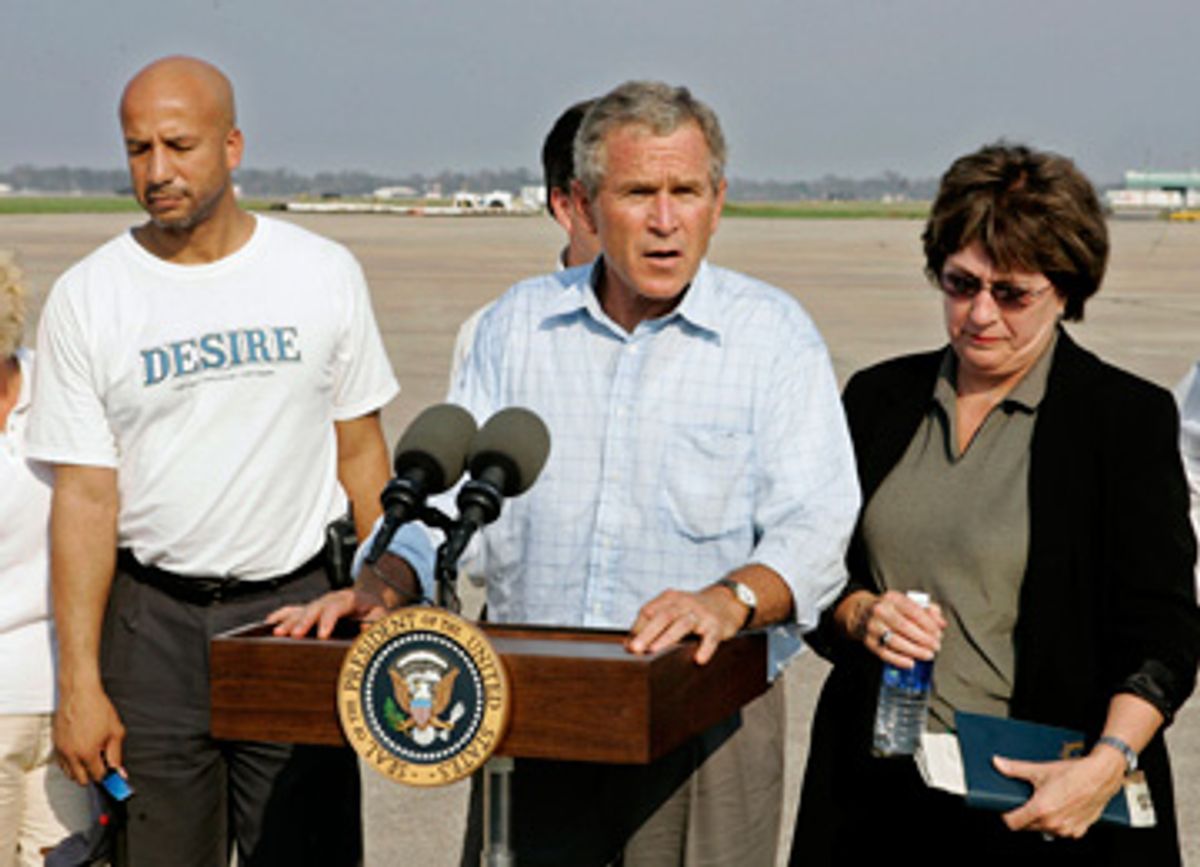
From Alabama, it was on to Mississippi for Bush. There, he met with an old friend, Haley Barbour, the Republican governor. Significantly, Bush had nothing but praise for Riley and Barbour, neither of whom he asked to consider federalizing their National Guard troops. Finally, Bush traveled to Louisiana, still in the throes of disaster five days into the crisis -- and still receiving no help from the federal government. In New Orleans, Bush met with Nagin and Blanco, along with other officials, aboard Air Force One at the Louis Armstrong international airport. The events aboard Air Force One began with a meeting of several officials, including Landrieu, Vitter, Nagin, and Blanco, as well as selected congressmen and staff members. Rove was onboard, too, "lurking," as Blanco would put it, "around the halls." In the meeting Nagin, extremely agitated, kept insisting, "Do something! Do something!" It was not clear exactly what he wanted done or who he wanted to do it, nor was it evident whether Nagin had any idea that his clandestine e-mail communications with Rove during the week may have contributed to the Bush administration's lack of response. They certainly had not helped. Finally, Bush asked to meet with Blanco alone in his office on Air Force One.
"Kathleen," Bush said in their meeting, which was attended by Joe Hagen from Bush's staff but no one from Blanco's staff -- a fact that troubled Blanco -- "I'm going to need you to sign a waiver that the Louisiana National Guard needs to be turned over to the federal government. I can't take them from you but I'm going to need you to federalize them."
Blanco had no intention of signing a waiver. She was concerned about a variety of legal ramifications that could result from her signing over her National Guard, but her main fear was that, without the leverage Blanco had as a free agent in what had now turned into a protracted negotiation with the administration, she would have no means to force Bush to provide any assistance at all. Blanco told Bush she would not sign a waiver. "You need to give General Honore some soldiers," Blanco told Bush. "Where has the federal government been for five days? If I sign this, it's going to look like I've been wrong."
Bush appeared to be confused by what Blanco was saying.
"Well, I have no intention of turning over my National Guard to you," Blanco said. "Anyway, the evacuation of the Superdome is now well underway and after that we will begin finishing the evacuation of the Convention Center." This was true. While the administration had bickered over politics, Blanco had expanded the size of her National Guard by accepting deployments of guardsmen from all of the other 49 states.
By federalizing her guardsmen, Blanco would have been admitting that it was the state that was unable to handle the disaster, not the federal government. The Bush administration could have argued that they had had to save the day for Blanco because she was not up to the task. However, if Blanco did not take the bait, the scheme was dead. Blanco wondered about Bush's confusion. Was he really confused or just trying to get her to sign the waiver?
It didn't matter. Not only did Blanco refuse to sign, she gave Bush a two-page letter detailing everything the state needed to cope with the disaster -- troops, buses, supplies, money, and more. It would not be until several days later, when Blanco's aides released the letter to the press and got frantic phone calls from Rove's aide Maggie Grant, that it became clear that Bush had taken the letter Blanco had personally handed to him -- and lost it.
Finally, that day on Air Force One, when it became apparent that Bush would not be able to manipulate Blanco, he ended the meeting. Then, he took a private meeting with Nagin, who had taken his first shower since the storm hit on Air Force One. Afterward, Bush was taken on a tour of the city by helicopter, which included a visit to the 17th Street Canal. Blanco accompanied Bush in his helicopter, along with Nagin. Landrieu, Vitter, and Rove had followed in a second helicopter. Behind them in a third was a pool of reporters from the national press corps.
"We landed at the 17th Street Canal," Landrieu says. "The story that day Karl Rove was feeding was: 'The president is on the job, the president has taken control, the president is going to rebuild, and despite the fact that the government and all these babbling fools down here can't do anything, the Corps of Engineers is on the job.' So we landed at the canal, five minutes from my house. I was so excited because they were finally doing something. The Corps of Engineers was there, and they had dump trucks and sandbags. All the cameras were there for the president, who was doing one of his famous press conferences about how he was going to do everything. So I thought, 'At least the guy is doing something, so show your manners and be good and smile.'"
On Saturday in the Rose Garden, Bush announced the deployment of federal troops to Louisiana -- without the benefit of Blanco signing a waiver. He also tried to backtrack to explain why his administration had botched the rescue effort so badly. "The magnitude," Bush said as Rove and Cheney stood nearby watching, "of responding to a crisis over a disaster area that is larger than the size of Great Britain has created tremendous problems that have strained state and local capabilities. The result is that many of our citizens simply are not getting the help they need, especially in New Orleans. And that is unacceptable."
While Blanco and her aides watched the federal government do little, they completed the rescues of thousands of people stranded at the Convention Center and the Superdome on their own by commandeering buses from around the state and transporting people from downtown New Orleans to various surrounding cities -- using only the National Guard under Blanco's command. When the federal troops finally did start arriving over the weekend, the refugees had been cleared out. The troops made a show for the media, but they were too late. The damage had been done.
After one of the most agonizing weeks in American history, with Bush and his key department secretaries embarrassed on national television, the blame, despite Rove's efforts to the contrary, ended up being placed firmly on the federal government. The administration, not Blanco and the state of Louisiana, took the hit, especially Michael Brown, who became a poster boy for ineptitude and was forced to resign from his job. Following Katrina, Bush's approval rating began to slip even more. "In the middle of the worst disaster in American history," Adam Sharp says, "the president was nowhere to be found and was still clearing brush on the ranch, when the previous iconic image people had of him was standing in the still-smoldering rubble of the World Trade Center 24 hours after the attacks and saying, 'I can hear you.' People were asking, 'Where is that moment here?'"
- - - - - - - - - - - - - - - - -
Of all of the stories and subplots, there would be one that, in many ways, symbolized the whole of Katrina, what it revealed about the Bush administration, and how it would affect the lives of so many people. On Friday, Mary Landrieu had been with Bush and Blanco as they toured the 17th Street Canal, where, at last, major work had commenced to repair the damage that had been caused when the levee broke. "Then, on Saturday," Landrieu says, "George Stephanopoulos called and asked to do an interview with me, and I said, 'George, I'm tired of doing interviews. I have to work. And nothing you are airing is accurately showing what's going on down here.' He wanted to go to the Superdome, and I said, 'We still have people stranded on their roofs. If you want to tell the right story, I will help you tell the right story. You get a helicopter and I'll go up and I will show you what is actually happening. It's awful what's happening at the Superdome, but the reason the people can't understand the story is because the entire region is under 20 feet of water. People can't get into the Superdome to help. They can't get out. People are drowning in their homes.'
"So George and I went up in the helicopter and for three hours his jaw was dropping. Then I said, 'George, before we finish I have to show you one positive thing because I can't send you back to Washington to produce a story that shows nothing but devastation and disaster.' So I told the pilot to tack right so I can show George the 17th Street Canal and the work that was going on there. I swear as my name is Mary Landrieu I thought that what I saw with the president was still there -- people working, trucks, sandbags, everything. Then I looked down and saw one little crane. It was like someone took a knife and stabbed me through my heart. I lost it." There, in the cabin of the helicopter, as they flew above the breached canal below them, Landrieu sat devastated.
"I could not believe that the president of the United States, staged by Karl Rove himself, had come down to the city of New Orleans and basically put up a stage prop. It was like you had gone to a studio in California and filmed a movie. They put the props up and the minute we were gone they took them down. All the dump trucks were gone. All the Coast Guard people were gone. It was an empty spot with one little crane. It was the saddest thing I have ever seen in my life. At that moment I knew what was going on and I've been a changed woman ever since. It truly changed my life."
Copyright © 2008 by Paul Alexander. Reprinted by permission of Modern Times/Rodale Inc. All rights reserved.
Shares