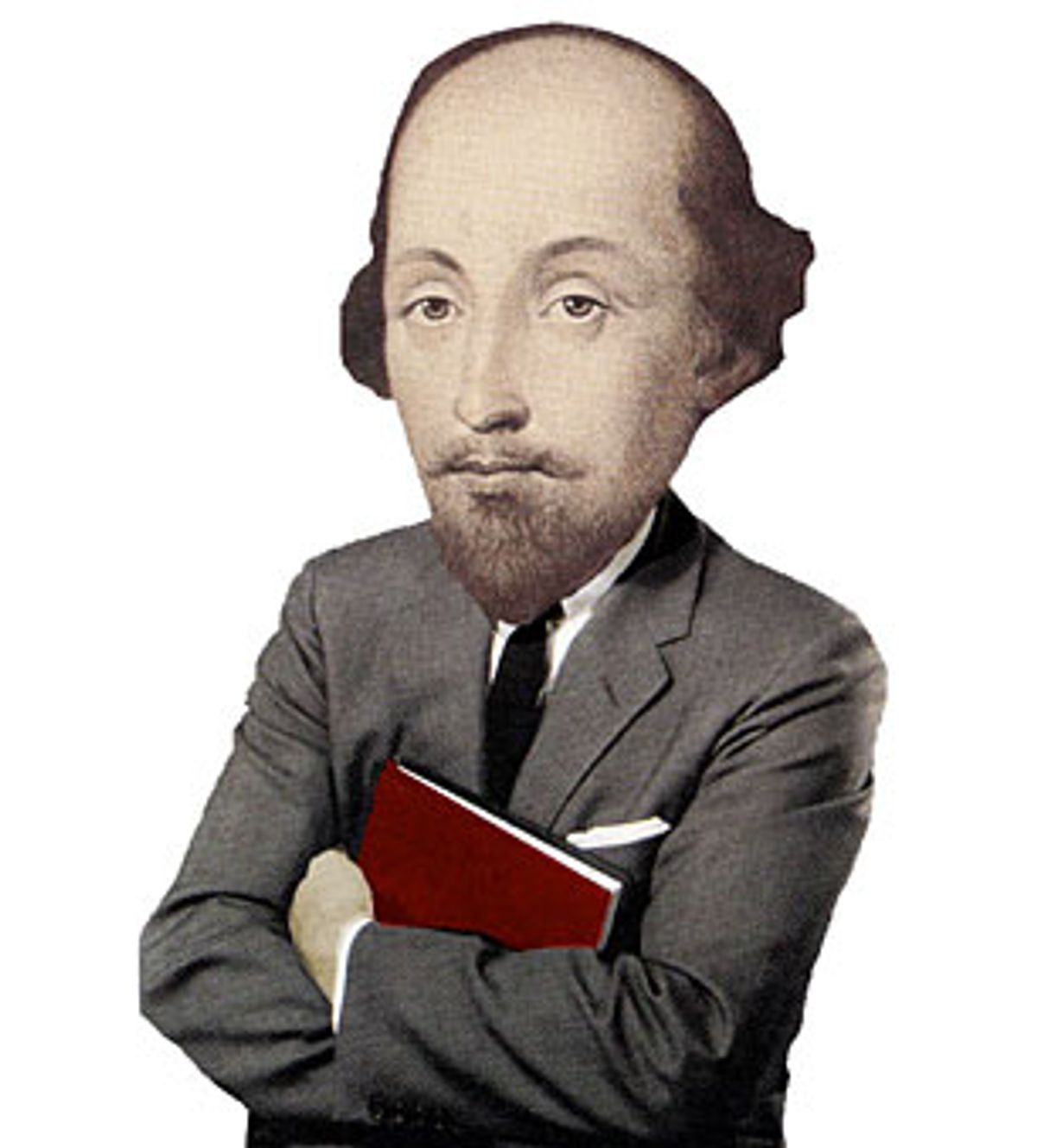
So what's next, after "Shakespeare in Charge: The Bard's Guide to
Leading and Succeeding on the Business Stage"? How about "Shakespeare in
Shape: Great Abs and Buff Bods From the Bard"? (You know, a dueling- and
jousting-based exercise program.) Or maybe "Shakespeare in Therapy," or "Shakespeare in Recovery: Twelve Steps to Turn Your Tragedy Into Comedy"? Or how about "Chicken Soup for the Shakespearean Soul"?
I could go on, and you could make up (and probably get a publisher for) your
own schlocky cash-in-on-the-Bard book. But that's a little unfair to this one. It's unfair to look upon it as merely a hurried effort by the Miramax
publishing division to extend the brand franchise of "Shakespeare in Love."
No, it's more than that. I think the best way to look at this book is as
the last gasp -- a kind of parodic consummation -- of academic postmodernist literary criticism of Shakespeare.
True, it seems on the surface to be targeted at non-academic types, at middle managers so desperate to "lead and succeed" they'll buy any kind of packaged malarkey if it comes, as this one does, with a blurb from the Great God, Warren Buffett. It seems to be targeted at the kind of guy who goes to "power leadership" seminars at airport hotels with Tony Robbins-type motivators.
And it's true the authors of "Shakespeare in Charge" don't seem like academic literary theorists, fools for Foucault. Corporate big-shot Norman Augustine was CEO of Lockheed and Kenneth Adelman was a Reagan-era arms control director and U.N. ambassador. But they have the exact same view of Shakespeare as neo-Marxist "cultural materialists" and New Historicists: They view Shakespeare as purely a handmaiden of power.
The big argument over Shakespeare in fashionable academic circles -- well, one of the big arguments -- is the contention by leftist acolytes of Michel Foucault that Shakespeare's plays should not be considered as works of literature so much as instruments of state power, one of the means by which the Tudor monarchy used spectacle to inculcate unquestioning reverence for established authority and to make rebellion seem futile. Shakespeare in this view was a propagandist for power; his plays were the aesthetic equivalent of brainwashing, implanting an ideology that bound spectators to the prevailing order with chains of pentameter lines.
Of course, this position is itself a narrowly ideological, reductive (not to mention tin-eared) view of Shakespeare. It's a position deaf to the voices in Shakespeare that encourage skepticism and doubt, that question "the hollow crown" of
established authority, question the intelligibility of the moral order of
the universe ("a tale told by an idiot, full of sound and fury, signifying nothing"),
question the purported benevolence of even the divine authority ("Fortune is a strumpet" and the gods are like "wanton boys" who tear the
wings off flies "for sport").
It's a stance insensitive to the complexity of the tragic, or to the subversiveness of the comic in Shakespeare. It's a view of Shakespeare -- a view of the world -- in which power is the only value. It's exactly the same reductive view our two "Shakespeare in Charge" authors take as they strip-mine the rich mother lode of Shakespearean language for petty lessons in
corporate climbing.
You almost wish it was a parody. It often reads like a parody, but, alas, I
think the authors are serious. Certainly they're serious about cashing in. The
sweaty haste with which this book was rushed into print is evident in the acknowledgments, which they
call, with a heavy-handed tip of the hat to Miramax movie culture, the
"Credits." They open the acknowledgments by modestly and tastefully "crediting"
themselves: "'Shakespeare in Charge' has been a series of wins for us."
They admit that in order to exploit "the current of Bardmania" they
decided to "double time" their book into print. Evidence for that can be found in their clumsy attempt to thank their editor (who deserves better), in a sentence they were in too much of a hurry to render grammatical: "Jonathan Burnham, not only a fine person who like Shakespeare has British blood in his veins, 'imagination bodies forth the forms of things unknown,' and 'turns them to shapes and gives to airy nothing a local habitation,' as
Theseus says in 'A Midsummer Night's Dream.'"
Gibberish yes, but not as bad as their grammatical but tasteless attempt to
pay tribute to their agent (who also deserves better), with a quote from a notorious
pimp: She "is a gifted literary agent and a particularly fine one ... 'Good
counselors lack no clients,' Pompey says in 'Measure for Measure.'"
Um, yes, Pompey does say that, but his "counselors" are diseased hookers; his "clients" are sleazy johns. But, hey, it's a quotation from Shakespeare, so it's a classy compliment,
right? This is the method they use throughout the book, ripping quotations out of context whenever they need some bardic citation to buttress some buy-low-sell-high truism about getting ahead in the corporate world. Repeatedly they seem unable to make the elementary distinction between what "Shakespeare says" and what one of his characters
says.
The book is divided into five "Acts," each section devoted to a single
play that Augustine and Adelman "analyze" for its go-go biz wisdom, mixing quotations from the play at hand with homilies and anecdotes from various corporate gurus and
New Economy poohbahs. It's hard to decide which of the five plays they misrepresent most
completely. In "Act I: On Leadership" we get an incredibly simplistic,
triumphalist vision of "Henry V" that makes the play all about winning,
ignoring those currents of irony (which Kenneth Branagh astutely brought out
in his film) that suggest a more complex reading.
Consider, for instance, Shakespeare's decision to focus closely and at length in the first act of "Henry V" on the corrupt bargain the newly crowned Henry makes with the church: sparing it a massive land seizure in return for the bishops' promise to legitimate Henry's ambiguous claim to the French throne. It's a claim Henry uses to justify the prosecution of a completely self-glorifying and unnecessary "Wag
the Dog"-type war in which thousands are slaughtered to bolster the monarch's personal prestige and power. Shakespeare's close focus on the corrupt foundations of the war suggests that his play is not merely the simple-minded jingoism some Marxist types (and of course our "Shakespeare in Charge" authors) see it as.
That complexity is lost on Augustine and Adelman. Instead, they treat Henry's corrupt bargain as a really smart move that turned a pointless slaughter into a "holy war."
"War offers a great opportunity" for "any new and especially young executive," they
advise us. (Aspiring Slobodan Milosevices, take note!) But "only if he
wins." There you have it: the Bard reduced to Vince Lom-bard-i. Their uncritical worship of strength and power threatens to cross the line from Foucault to fascist, but it's less Mussolini than Machiavelli: Winning justifies anything. To celebrate Henry's habit of summarily executing former allies and French captives, they throw in a line from "King Lear": "To be tender minded does not become a sword." They are evidently not bothered one bit that this comes from the mouth of one of Shakespeare's most heartless villains, Edmund, a ruthless schemer and murderer who manages to get his own father's eyes gouged out of his head. (Smart executive move -- Dad was in his way.)
It gets worse in "Act II: Confronting Change," when Augustine and Adelman focus on "The Taming of the Shrew" in order to celebrate the stratagems of the loutish Petrucchio, of all people. They fawn over his crude efforts to break the spirit of an independent woman as if these were the brilliant and admirable acts of a master biz whiz. But, hey, no problem with our guys; if it's in Shakespeare, if Petrucchio's the nominal hero, everything he does must be wise and good. He's the very "model for today's corporate executive who must initiate, guide and deal with change."
It's actually fun, after a while, to watch their fawning love of winners
above all else lead them (and the poor souls who turn to this book for
lead-and-succeed wisdom) deeper into confusion. So eager are they to
celebrate success -- no matter by who, no matter by what means or for what
ends -- that they start praising the "executive skill" of Cassius, leader of
the plot to murder Caesar. They treat the assassination of a head of state
as if it were some pep rally: "Cassius and his clique are pumped as they
head to the Capitol for their final dealing with Caesar" ("final dealing"?).
But wait, once the tide turns against the assassins, our fair-weather
authors jump hastily to the other side ("By now Cassius should be wondering
about his CEO's judgment"). Now we are told Mark Antony is the genius
management guy. ("Antony avoids three common errors of contemporary
corporate communications.") Grasping for quotes or scanning their concordance for lines, they reduce Shakespeare to a mouthpiece for the obvious. They perform a similar about-face on Richard II, at one point praising him for his "forthright manner" (thus twisting that hesitant, indecisive and impractical monarch's character beyond recognition). But then they turn around and savage poor Richard II in another section for failure to be forthright, for being too dreamy and wishy-washy.
Things get positively surreal -- and ugly -- in Act IV, when Augustine and Adelman try to tiptoe around the anti-Semitism in "The Merchant of Venice" in order to mine it for supposedly valuable business lessons about "Risk Management." The Shylock play, they tell us, "explores such volatile issues as
anti-Semitism and racial prejudice, ethnic stereotyping and gender restrictions" -- using the weasel word "explore" to make it sound like it's some high-minded after-school special. In fact, for many people this play causes problems not necessarily resolvable with a smiley-faced solution -- not because it "explores" anti-Semitism, but because its leading, most sympathetic characters exemplify it. The distinguished British critic John Gross (former lead daily book reviewer for the New York Times), in "Shylock: A Legend and Its Legacy," argues that anti-Semitism is inextricable, inseparable from the
character of the play, not just the characters in the play.
Thoughtful, principled people could disagree, but, hey, our guys don't even give it a second thought. They're all "pumped" to celebrate the brilliant management techniques Portia uses to humiliate the Jew Shylock. And so we get language like this: "Portia clamps the snare [on Shylock] tighter still ... Hearing this the courtroom crowd cheers as Shylock sinks lower ...
Beaten Shylock says he'll simply walk away ... In response [Portia utters] another soft but piercing 'Tarry, Jew' ... Shylock slinks away utterly defeated." Way to go, Portia! Way to beat the Jew! What a loser that Shylock is! Let's learn all the management wisdom we can from this heart-warming victory.
But the climactic reductio ad absurdum of the Augustine/Adelman method comes, appropriately enough, in the final "act," the one on "Hamlet": "Crisis Management." It's the one in which we are introduced to the authors' ultimate model CEO, the guy we can learn the most lead-and-succeed wisdom from. It happens to be a guy who is a multiple murderer, who kills his own brother and is responsible for the death of his wife and
nephew as well -- not to mention the entire family of his most loyal retainer.
Now it's not that multiple murderers don't have something to teach us: Some people might even find management wisdom in the works of Charles Manson. (After all, he got those young girls to do his killing for him for free!) But no, our guys have chosen a more distinguished-seeming multiple murderer to worship: Claudius. Listen to the compliments they lavish on "the bloat king," as that whiny loser Hamlet calls the man who
killed his father. Hamlet's definitely not a lead-and-succeed guy. He can't get into the spirit of things -- the spirit of things being that
Claudius is a winner! He exhibits "deft statesmanship." He "acts decisive." "Like any first class executive he has an instinctive grasp of public reaction." He knows how to "use bad news to make some good moves" (that is, asking the King of England to murder Hamlet for him). And he's very, very sincere: "Claudius conveys the fact to Laertes that he cares" about
Ophelia's death. Augustine and Adelman actually state that Claudius -- the emblem of deceit and coverup in Western culture -- "is the model of getting the truth out clearly and quickly." Excuse me, but was Claudius eager to get out the truth about murdering his brother "clearly and quickly"? Isn't covering up a murder a kind of lie? Do the authors know the difference?
Or maybe they're so enraptured with Claudius' brilliant management style that
they don't care. They describe Claudius plotting with Laertes to murder
Hamlet as "another of Shakespeare's magnificent depictions of a successful
business meeting." That Claudius, what a genius. The fact that he ends up
dead in a throne room piled high with dead bodies, losing not just his
queen and his life but the kingdom itself to a foreign power, is a little
glitch they don't mention in fawning over the great manager.
They're too busy dispensing heart-warming little contemporary stories about
crisis management, Claudius-style. Stories such as the one about how wise
the management of Detroit's newspapers was in planning to hire scabs and
union breakers before their employees went out on strike. In fact, after the lives of
thousands of union families were ruined by a prolonged strike, the newspaper management's tactics were ruled illegitimate by the National Labor Relations Board. Indeed, the authors are quite given to praising as brilliant management wisdom the tactic of making vulnerable workers pay for the stupid mistakes of management. They praise the "courage" it took for one CEO to fire thousands of workers and then sickeningly try to give this heartless act the sanction of Shakespeare by citing a line, out of context, about "lopping off branches" to make trees grow faster.
At moments like this in "Shakespeare in Charge," I thought, this is not just a
parody of the success-secret genre. And it's more than just a parodic
embodiment of Marxist-Foucault power-is-everything,
Shakespeare-as-tool-of-the-hegemony ideology. It makes you wonder whether these guys might actually be secret Marxists slyly using this book to show what heartless and oblivious fools capitalist big-shots can be.
It would be hilarious, I guess, if it weren't so depressing to read the
words of two grown men who claim to have read Shakespeare but who seem to
have been so utterly untouched by it -- untouched by the poetry, by the reflectiveness, by the beautiful melancholy of the tragedies, by a vision of human existence that goes beyond a simple-minded focus on winning and losing. Not only do they lack a tragic sense of life, they seem to view the tragic heroes of Shakespeare basically as
losers who failed at crisis management. If only Hamlet, Lear and Romeo had had the wisdom of the tough-minded CEOs in this book, they could have
been winners! Of course, we wouldn't have any of Shakespeare's great
tragedies, but what a small sacrifice to make at the altar of winning.
No, I finally came to believe that this book probably isn't a parody, that
it's meant very earnestly, and to understand it more fully in the context of American
culture we might have to revive a word that has gone out of fashion
recently, but perhaps deserves to be brought back: Babbittry.
It's a word that became a colloquialism in the decades following the publication
in the '20s of Sinclair Lewis' popular satirical novel about a Midwestern
businessman, George Babbitt. It became a shorthand way of describing a kind of
boosterish provincialism, a disdain for the arts, a smug self-congratulatory belief in prosperity
and success above all other values.
I was always a bit uneasy about the word "Babbittry" because it had become,
before it began to fade out of the language, an all too easy way for
equally smug leftists and bohemians to issue blanket condemnation of the
"bourgeoisie" or "middle Americans" in an equally self-congratulatory way.
But after finishing "Shakespeare in Charge," I went out and bought a copy of
"Babbitt," and flipping through it, I came upon a passage in which George
Babbitt's son asks his mother and father why "they give us this
old-fashioned junk like Shakespeare" in school.
"I'll tell you why you have to study Shakespeare and those," George Babbitt
says. "It's because they're required for college entrance and that's all
there is to it!" And "that's all there is to it" for our authors here:
Shakespeare for them, as for Babbitt, is something useful only for Getting
Ahead. Which is all there is to "Shakespeare in Charge": Babbittry about the Bard.
By the way, for anyone interested in reading a genuinely thoughtful book on the
subject of Shakespeare, power and money, I recommend a new work by
Frederick Turner called "Shakespeare's Twenty-First Century Economics: The
Morality of Love and Money." The first 10 pages or so, an examination of the meaning in Shakespeare of "bonds" -- the relationship between the bonds of love and the bonds of money -- contain more original thinking and more appreciation of the depth and complexity in Shakespeare than all five "acts" of "Shakespeare in Charge" -- which I now believe ought to be called "Shakespeare
in Despair." Or, if Shakespeare himself ever got a look at it from his vantage point in the Great Beyond: "Shakespeare in Tears."
Shares