

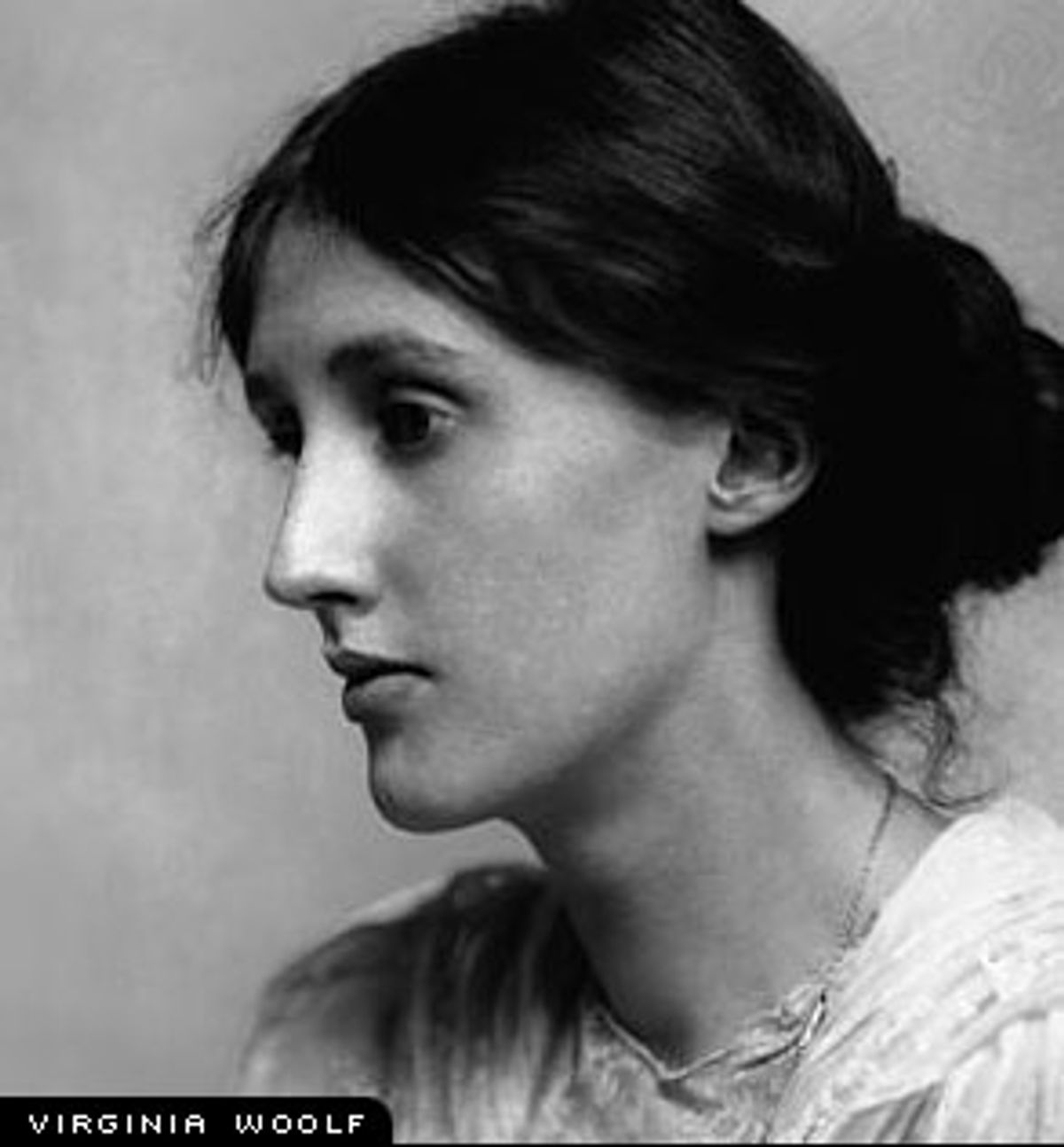
Virginia Woolf spent nine years writing "The Voyage Out," her first novel, beginning when she was 24 years old. No subsequent book would take her half as long or go through so many drafts. After "The Voyage Out" she produced the more conventional "Night and Day," which she wrote, in part, to demonstrate to herself and others that she could in fact write a conventional novel. Then she embarked upon a 25-year roil of troubled fertility during which she produced "Jacob's Room," "Mrs. Dalloway," "To the Lighthouse," "Orlando," "The Waves" and "Between the Acts," among other books.
To a greater extent than any novelist except Joyce, Woolf invented the modernist novel, a drastic departure from the traditional form, with its heroics and high emotions; its morality; its unwavering point of view and its unambiguous beginning, middle and end. The novel, in Woolf's hands, became prismatic, ambiguous, at least slightly chaotic, amoral and poetic, and concerned itself primarily with outwardly unremarkable people. It strove less to tell an uplifting tale and more to render life as lived, in its endless overlaps of the quotidian and the profound. Since Woolf's time, novels in the traditional mode have continued to be written by the boxcar load, but the novel as an art form has never been the same.
Woolf believed (these are my words, not hers) that the meticulously structured, often inspirational novels of her time had about as much to do with the world and those who live in it as did a boat full of colonials and missionaries venturing into a jungle determined to subdue it. It was one of Woolf's contributions to insist, in her fiction, that the world is too huge and mysterious, too impenetrably itself, for fiction as fiction is so often written; that any writer's attempt to clear the field of its vines and creepers, to frighten off the hostile animals so as to set up a table for tea and begin to demonstrate a proper sense of right and wrong, is unlikely to come to a good or useful end. In her fiction Woolf bore witness to the world, saw and recorded some of its patterns, but did not attempt to enforce upon it any particular order or demand that it produce an order of its own. For this innovation she has often been accused of writing about nothing at all.
"The Voyage Out" employs the oldest and most venerable of narrative devices, the journey. It specifically concerns the fate of Rachel Vinrace, whose vivacious and compelling mother died when she was 11, leaving her to be raised by her chilly father and two spinster aunts. Rachel is, at 24, almost pathologically unformed. She knows nothing whatever about sex, has had only a smattering of education and is hard put to hold up her end in an ordinary conversation. She is, however, a relatively accomplished pianist, and playing the piano is her one true passion. In her way she is the idealized Artist with a capital A -- incompetent at and largely indifferent to everything except her art.
The novel begins with an ocean voyage onboard a modest passenger steamer, the Euphrosyne (so named by Woolf as a private joke -- it was the title of a collection of solemn poetry she considered ridiculous, published by her husband and some of her friends). The ship is sailing from England to South America, and then sailing up the Amazon. Onboard, Rachel is befriended -- "adopted" might be more accurate -- by her aunt, Helen Ambrose, a forceful, unsentimental woman in her early 40s who is at least as central to the novel as Rachel.
They disembark at Santa Marina, a village on the South American coast, take up residence in a haphazard villa with a neglected garden and become involved with the denizens of the village's only hotel, among them two young men: St. John Hirst, who bears a strong resemblance to Lytton Strachey and who falls in love with Helen, and Terence Hewet, an aspiring novelist, who argues many of Woolf's own positions about writing and who falls in love with Rachel.
Ultimately, certain members of the group undertake a second voyage, up a river and into the jungle, and that is what changes everything.
"The Voyage Out" tells the tale of its doomed lovers amid a chorus of other stories, other points of view. An essential element of Woolf's genius, visible from the beginning of her career, is her insistence on a fictive world too large and complex to focus its exclusive attention on any individual life. Try to enter the consciousness of a person, any person, and you are led immediately to dozens of other people, each of whom is integral, each in a different way. Woolf understood that every character about whom she wrote, even the most marginal, was visiting her novel from a novel of his or her own, and that that other, unwritten novel had as its main concerns the passions and fate of this character -- this dowager or child or septuagenarian, this young woman who appears in the novel at hand only long enough to walk through a park.
Writing "The Voyage Out" was a struggle for Woolf -- she not only doubted her gifts but felt she was already rather old to be working on a first novel -- and from its initial conception to its finished state the book went through eight or nine drafts. Early in the effort she wrote to her friend Madge Vaughan:
My only defense is that I write of things as I see them; & I am quite conscious all the time that it is a very narrow, & rather bloodless point of view. I think -- if I were Mr. Gosse writing to Mrs. Green! -- I could explain a little why this is so from external reasons, such as education, way of life, &c. And so perhaps I may get something better as I grow older. George Eliot was near 40 I think, when she wrote her first novel, the Scenes [of Clerical Life].But my present feeling is that this vague & dream like world, without love, or heart, or passion, or sex, is the world I really care about, & find interesting. For, though they are dreams to you, & I can't express them at all adequately, these things are perfectly real to me.
But please don't think for a moment that I am satisfied, or think that my view takes in any whole. Only it seems to me, better to write of the things I do feel, than to dabble in things I frankly don't understand in the least. That is the kind of blunder -- in literature -- which seems to me ghastly & unpardonable: people, I mean, who wallow in emotions without understanding them.
Woolf was then and remains today unparalleled in her ability to convey the sensations and complexities of the experience known as being alive. Any number of writers manage the big moments beautifully; few do as much with what it feels like to live through an ordinary hour on a usual day. As she said when speaking to a reading group,
In the course of your daily life this week ... you have overheard scraps of talk that filled you with amazement. You have gone to bed at night bewildered by the complexity of your feelings. In one day thousands of ideas have coursed through your brains; thousands of emotions have met, collided, and disappeared in astonishing disorder.
She was revolutionary in her shunning of the outwardly dramatic (most famously when she dispatched Mrs. Ramsay in a single sentence in "To the Lighthouse"), and her insistence on the inwardly dramatic -- her implied conviction that what's important in a life, what remains at its end, is less likely to be its supposed climaxes than its unexpected moments of awareness, often arising out of unremarkable experience, so deeply personal they can rarely be explained.
If this belief seems only slightly unusual today, it was almost scandalous early in the century, when serious writers were expected to write about large and "serious" subjects. The generation of writers that immediately preceded Woolf -- prominent Edwardians like Arnold Bennett, John Galsworthy and H.G. Wells -- tended to scorn the younger Georgians -- like Woolf, Joyce and T.S. Eliot -- for what they considered inadequate attention to the histories and circumstances of their characters and for a more general lack of mythic scope and scale; a lack of "greatness," if you will. Woolf countered by insisting that everything one needed to know about human life was contained in every human action. It was contained, for instance, in two old women gossiping over their tea or in a sad young man wandering through London, more or less the way the blueprint for an entire organism is contained in each of its cells. The trick was to see those two women or that young man completely, and then to see the invisible lines that connected them to other people, and then others, until you had at least in theory the whole of existence laid out before you.
So Woolf was drawn, throughout her career, to unexceptional lives (barring "Orlando," which she wrote for the exceptional Vita Sackville-West), the better to see the enormity contained in them without the distractions of battle, quest or heroic romance. Her artists are never successful; her scholars and politicians have never gone as far as they'd hoped. She said in her 1924 lecture "Mr. Bennett and Mrs. Brown," about the experience of sharing a railway carriage with an elderly stranger:
The elderly lady ... whom I will call Mrs. Brown ... was one of those clean, threadbare old ladies whose extreme tidiness -- everything buttoned, fastened, tied together, mended and brushed up -- suggests more extreme poverty than rags and dirt. There was something pinched about her -- a look of suffering, of apprehension, and, in addition, she was extremely small. Her feet, in their clean little boots, scarcely touched the floor. I felt that she had nobody to support her; that she had to make up her mind for herself; that, having been deserted, or left a widow, years ago, she had led an anxious, harried life, bringing up an only son, perhaps, who, as likely as not, was by this time beginning to go to the bad ...Myriads of irrelevant and incongruous ideas crowd into one's head on such occasions; one sees the person, one sees Mrs. Brown, in the centre of all sorts of different scenes. I thought of her in a seaside house, among queer ornaments; sea-urchins, models of ships in glass cases. Her husband's medals were on the mantelpiece. She popped in and out of the room, perching on the edges of chairs, picking meals out of saucers, indulging in long, silent stares ... There she sits in the corner of the carriage -- that carriage which is travelling, not from Richmond to Waterloo, but from one age of English literature to the next, for Mrs. Brown is eternal, Mrs. Brown is human nature, Mrs. Brown changes only on the surface, it is the novelists who get in and out -- there she sits and not one of the Edwardian writers has so much as looked at her. They have looked very powerfully, searchingly, and sympathetically out of the window; at factories, at Utopias, even at the decoration and upholstery of the carriage; but never at her, never at life, never at human nature ...
I asked (the Edwardians) -- they are my elders and betters -- How shall I begin to describe this woman's character? And they said: "Begin by saying that her father kept a shop in Harrogate. Ascertain the rent. Ascertain the wages of shop assistants in the year 1878. Discover what her mother died of. Describe cancer. Describe calico. Describe --" But I cried: "Stop! Stop!" And I regret to say that I threw that ugly, that clumsy, that incongruous tool out of the window, for I knew that if I began describing the cancer and the calico, my Mrs. Brown, that vision to which I cling though I know no way of imparting it to you, would have been dulled and tarnished and vanished forever.
It is pure Woolf, then -- it could be Woolf herself speaking -- when Rachel says of her elderly aunts, who are still living their uneventful lives in England as she sails to South America:
And there's a sort of beauty in it -- there they are at Richmond at this very moment building things up. They're all wrong, perhaps, but there's a sort of beauty in it ... It's so unconscious, so modest. And yet they feel things. They do mind if people die. Old spinsters are always doing things. I don't quite know what they do. Only that was what I felt when I lived with them. It was very real.
Rachel appreciates the commonplace. She is intelligent (but not spectacularly so), perceptive (but not incisive). She is so naive as to be practically blank. In part because she is so guileless, Rachel is open to the forces of revelation that lay dormant almost everywhere. As she wanders along a river the day after a party -- the first truly exciting party to which she has ever been -- she passes flowering trees "which Helen had said were worth the voyage out merely to see. April had burst their buds, and they bore large blossoms among their glossy leaves with petals of a thick wax-like substance coloured an exquisite cream or pink or deep crimson." Most writers would be content with this: A girl walks among beautiful trees and thinks about her first real party, which has offered the possibility of love. Woolf, however, takes it considerably further:
So she might have walked until she had lost all knowledge of her way, had it not been for the interruption of a tree, which, although it did not grow across her path, stopped her as effectively as if the branches had struck her in the face. It was an ordinary tree, but to her it appeared so strange that it might have been the only tree in the world. Dark was the trunk in the middle, and the branches sprang here and there, leaving jagged intervals of light between them as distinctly as if it had but that second risen from the ground. Having seen a sight that would last her for a lifetime, and for a lifetime would preserve that second, the tree once more sank into the ordinary ranks of trees, and she was able to seat herself in its shade and to pick the red flowers with the thin green leaves which were growing beneath it.
Parties pale -- love itself pales -- beside a glimpse of the ineffable, what Flannery O'Connor would call "the very heart of mystery," and which O'Connor found, variously, in grandmothers, murderers, a stain on a ceiling and a sty full of pigs.
If O'Connor was a Catholic visionary, Woolf was a secular one. She searched for the quintessential; she strove to know (or invent) the world's secret names for itself. And so Rachel, her first heroine, is not so much a woman of actions or qualities as she is an engine of perception. At a picnic, early in the book, when Terence asks Rachel what she is looking at so intently, she answers, "Human beings." She is simple enough, strange enough, to say something like that, something so direct and wise yet so insufficient. It is part of the novel's business to keep showing her these human beings, and these singular and eternal trees, until she begins not only to see them but to take them in. The effort will ultimately kill her.
Although in her work Woolf ignored sex to the greatest possible degree, and was skeptical of mysticism, she believed in an immense connectedness. As a writer she was deeply concerned not only with the kinship of people (she became friendly with E.M. Forster, who gave us the phrase "Only connect") but with simultaneity; with the fact that the world is made up of beings, human and animal, all living at once; that all are both related and utterly strange to one another; and that what connects them, most importantly, is the medium of time -- the plain fact of finding themselves alive at the same moment; and then, somewhat altered, at the next moment; and the next and the next. She stringently rejected religion but flirted all her life with the notion of the soul or, if not the soul, a certain beingness that emanated from living and inanimate things, even from the earth itself. She made it her business to try to account not only for the movements of her characters' flesh but the existence and interactions of their spirits in a world that also possessed a life of its own.
"The Voyage Out" is saturated with the tension between Woolf's own desire to record the pure sensation of living, her desire to tell a story and her desire to use her fiction to make potent arguments about serious questions. It is hard to find 20 consecutive pages in "The Voyage Out" that don't contain some discussion between two or more characters on an issue of great import. She would in her later books more seamlessly manage the combination of art and argument.
"Jacob's Room," her elegy for her brother Thoby, is by implication an antiwar novel, as is "Mrs. Dalloway." "Mrs. Dalloway," the first of her great books, began in Woolf's mind not only as the story of a society woman who would die, either by accident or by her own hand, and as a novel about the aftermath of World War I, but as a general indictment of medical science and of the English social and political systems. The Prime Minister was to be a prominent (and, we assume, less than attractive) character, and the ham-fisted doctors were to play significantly larger parts.
It is a testament to Woolf as an artist that her interest in humanness, and her respect for the ambiguity of human existence, always won out, and the finished books are about complex people who consider themselves the heroes of their own stories. Still, it is rare to find in her work any instance of an intelligent, humane politician, a competent doctor or an adherent of religion who is not at least slightly deranged. Woolf lived, after all, through the devastation of World War I, which she called "a preposterous masculine fiction." She lived at a time when doctors treated mental disorders by extracting teeth (she herself had several pulled), in the belief that an infection of the teeth could somehow poison the brain.
The right of Woolf's novels to occupy the literary pantheon is undisputed. Still, there are to this day few major writers whose merits provoke so much argument. She is probably most widely criticized for being classbound -- for writing convincingly, and at length, only about members of the upper classes, the people she not only knew best but liked best. This is simply true -- it would be foolish to try to deny it -- though for those of us who admire her work what she did accomplish so far outstrips what she failed to accomplish that the failing sheds some of its weight. When the world produces a novelist able to write fully about everything and everyone, we will have no need of further novels.
Still, it seems pertinent to at least briefly discuss Woolf and class, particularly in regard to her first novel, where her strengths do not yet so entirely overwhelm her weaknesses. In "The Voyage Out," the only novel in which she would attempt to set the action in a place she had never been, the South Americans are not characters at all and the only one with any role to speak of is a murderously incompetent local doctor. If she was much concerned with questions of empire and subjugation while she wrote the book, she didn't noticeably address herself to the reactions of those most affected.
There is, at least to this North American reader, a surprisingly unquestioned torpor to the lives and acts of the complacently fortunate English people in the book. What, after all, are they all doing there, not for days or weeks but for months, sitting on verandas and complaining about one thing or another, arguing about the issues of the day over meals prepared and served by invisible servers? What are they resting from, or preparing for, that justifies such an enormous span of leisure?
Woolf's nephew Quentin Bell wrote, in his biography of her:
There was much in Good Society that she found hateful and frightening; but there was always something in it that she loved. To be at the centre of things, to know people who disposed of enormous power, who could take certain graces and prerogatives for granted, to mingle with the decorative and decorated world, to hear the butler announce a name that was old when Shakespeare was alive, these were things to which she could never be wholly indifferent. She was in fact a romantic snob.
Woolf, however, was nothing if not self-aware, painfully and sometimes even debilitatingly so. She could be hard on others, but she worried over almost everything it was possible to worry over in her own character. She knew she was a snob; she admitted she was a snob. She did not consider it one of her worst or most interesting failings.
Late in her life she did, in fact, deliver a humorous lecture on the subject, "Am I a Snob?" to the Memoir Club, in which she said:
Witness this letter. Why is it always on top of all my letters? Because it has a coronet -- if I get a letter stamped with a coronet that letter miraculously floats on top. I often ask -- why? I know perfectly well that none of my friends will ever be, or ever has been impressed by anything I do to impress them. Yet I do it -- here is the letter -- on top. This shows, like a rash or a spot, that I have the disease ... I want coronets; but they must be old coronets; coronets that carry land with them and country houses; coronets that breed simplicity, eccentricity, ease.
And so, there she stands.
Woolf's work is also criticized for a certain tea-table delicacy, for veering away from all matters concerning the flesh, even though it was written during a period when sex was considered, for the first time in centuries, a permissible subject. While Woolf was fully aware of the power of sexuality, she had little interest in going into its particulars.
"The Voyage Out" does contain an implied rape, in the form of a kiss forced on Rachel by Richard Dalloway, but Woolf would never again venture even that far into the physically violent possibilities between women and men. She would later depict a kiss, one with very different consequences, in "Mrs. Dalloway," when Sally Seton surprises the young Clarissa by kissing her, suddenly and unexpectedly, only once, while they are briefly separated from the incessant company of men. These are the two major sexual episodes in Woolf's entire body of work, and each involves one of the Dalloways, those emblems of all that Woolf found terrible and compelling in English society. Richard assaults Rachel, and Clarissa, in the later book, is assaulted, more kindly, by Sally. Interestingly, it is Clarissa who is more undone by the experience of being kissed.
Woolf did appreciate the complexity of sex -- its risks and marvels, its capacity to transform lives. Her characters' sexuality is always highly idiosyncratic and deeply personal; she understood, more fully than many authors who were far more explicit on the subject, that everyone possesses a sexual geography as particular to him or her as a fingerprint. Richard Dalloway's kiss excites Rachel even as it humiliates and terrifies her, and Sally Seton's kiss implies for Clarissa in "Mrs. Dalloway" a fleeting promise, lost almost as soon as found, that runs to depths far greater than those implied by questions of hetero- vs. homosexuality.
Since "The Voyage Out" appeared, 85 years prior to this writing, Woolf's reputation has risen and fallen and risen again. While she lived she became a bestselling author. The money she earned from the surprising success of her 1937 novel, "The Years," enabled her to buy the fur coat into the pocket of which she would, four years later, put a stone to drown herself. Her picture appeared in Vogue in 1926, and her likeness can still be seen in a mosaic on the floor of the foyer of the National Gallery in London, holding a pen and wearing a toga amid a gathering of gods, goddesses and muses.
After her death in 1941 she fell out of fashion, until her work was taken up by feminist scholars in the 1960s. She quickly became, in the popular imagination, at least as much a personality as she was an artist. For those who had read her, a cottage industry of sorts grew up, composed mainly of essays and books that claimed that her work, her character, her genius and her suicide could only be understood in light of her lesbianism, her enslavement to Leonard, her mental disorder, her oppression as a woman and/or the fact that she had survived incest.
Few figures have inspired such possessiveness, such rampant subjectivity. Those of us who care for her have always tended to do so ferociously. Monk's House, her country house, which is open to the public six months of the year, is usually full of people, many of them as hushed and attentive as if visiting a shrine. If one walks from Monk's House to the River Ouse, where Woolf drowned herself, one usually passes others either coming or going.
Woolf's reputation as an artist is somewhat difficult to parse from the popular romance that has grown up out of her life and death. In addition to the aforementioned quarrels about her focus on the upper classes and her reticence in matters of sex, she is widely known as a "difficult" writer; and while that may be true, the word "difficult" is often applied in a dismissive tone that differs noticeably from the tone the same word takes on when applied to a writer like Joyce. There is often a sense, even among serious readers, that Joyce is bracingly difficult and Woolf merely irritatingly difficult.
As someone who has written about Woolf, I find myself hearing from a number of people, generally in tones of pride or annoyance, that they simply can't read her. We are all, of course, entitled to our disinclinations, but I can't help wondering if these people would proclaim with the same righteous indignation their inability to read authors like Joyce, Kafka or Faulkner. I tend to feel that an inability to read Woolf should be presented as a problem with the reader, not the writer, though that opinion is by no means universal.
Some of the barriers set up against Woolf's full standing as a major artist arise not from her innovation or her difficulty, it seems, but from the fact that she was innovative, difficult and a woman -- a woman whose narratives tended to arise out of domestic situations, who insisted that domestic situations were at least as important to those who inhabited them as foreign wars and the deaths of kings. Clearly the battle Woolf took up has not yet been won, at least not at the beginning of the 21st century. Although she detested criticism I suspect she would not mind knowing that she remains a figure of controversy -- better that than hallowed and forgotten. Unlike many venerated authors, she is still read and discussed.
Great art contains not only its own questions but its own answers, and one of its more satisfying aspects is its way of outliving its detractors, of marching into time with all its beauties, excesses, subtleties, insights and deficiencies in full view. Battles lost or battles won, Woolf's work, from "The Voyage Out," which launched her, to "Between the Acts," which helped to kill her, is very much alive. Generations of readers come and go, fashions change, but we have Woolf's books, and will always have them. We have a passage like this, from "The Voyage Out":
The preliminary discomforts and harshnesses, which generally make the first days of a sea voyage so cheerless and trying to the temper, being somehow lived through, the succeeding days passed pleasantly enough. October was well advanced, but steadily burning with a warmth that made the early months of the summer appear very young and capricious. Great tracts of the earth lay now beneath an autumn sun, and the whole of England, from the bald moors to the Cornish rocks, was lit up from dawn to sunset, and showed in stretches of yellow, green, and purple. Under that illumination even the roofs of the great towns glittered. In thousands of small gardens, millions of dark-red flowers were blooming, until the old ladies who had tended them so carefully came down the paths with their scissors, snipped through their juicy stalks, and laid them upon cold stone ledges in the village church. Innumerable parties of picnickers coming home at sunset cried, "Was there ever such a day as this?" "It's you," the young men whispered; "Oh, it's you," the young women replied. All old people and many sick people were drawn, were it only for a foot or two, into the open air, and prognosticated pleasant things about the course of the world. As for the confidences and expressions of love that were heard not only in cornfields but in lamplit rooms, where the windows opened on the garden, and men with cigars kissed women with gray hairs, they were not to be counted. Some said that the sky was an emblem of the life they had had; others that it was the promise of the life to come. Long-tailed birds clattered and screamed, and crossed from wood to wood, with golden eyes in their plumage.
Copyright ) 2000 by Michael Cunningham. Excerpted from his introduction to "The Voyage Out" by Virginia Woolf, newly released this month by the Modern Library. All rights reserved.
Shares