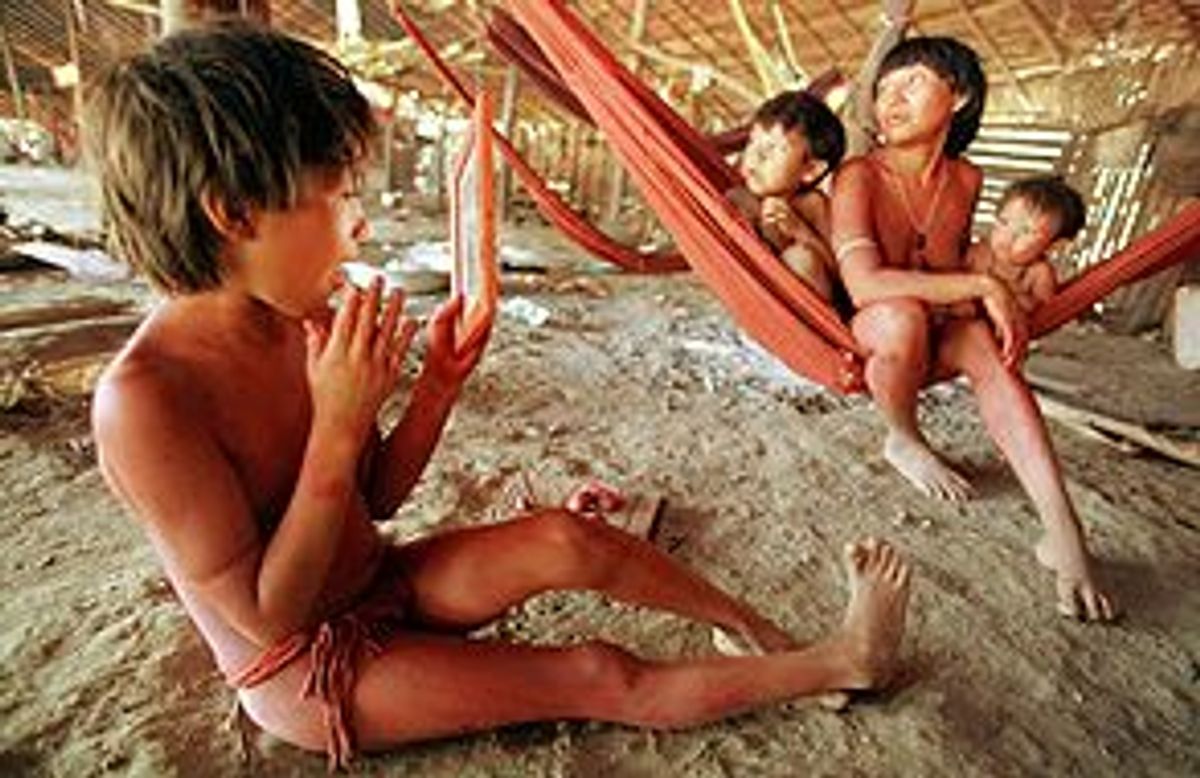
In an extraordinary "open letter" to the American Anthropological Association last week, Terence Turner of Cornell University and Leslie Sponsel of the University of Hawaii alerted the association -- and hundreds of participants on several e-mail lists who received the forwarded message -- to the upcoming publication of "Darkness in El Dorado: How Scientists and Journalists Devastated the Amazon," a book by investigative journalist Patrick Tierney. Turner and Sponsel grimly informed the AAA that the book was an "impending scandal" that would "arouse intense indignation" in the public mind. There was certainly indignation to spare in the letter itself: "In its scale, ramifications, and sheer criminality and corruption [the scandal] is unparalleled in the history of Anthropology."
Tierney's book, which is to be extensively excerpted in the New Yorker in early October, contains an extensive catalog of astonishing -- and, many say, incredible -- allegations against several highly regarded anthropologists who conducted detailed ethnographic studies in the jungle highlands of Venezuela and Brazil over the past 35 years. Most explosively, Tierney alleges that:
If true, these allegations would not only call these men's personal integrity into question but undermine the validity of their research, which has been influential in framing some popular assumptions about human evolution and behavior. Chagnon's work, in particular, has been widely cited as supporting the view that men are the engines of evolutionary improvement because they are inherently violent competitors for sexual access. In this view, the most aggressive "winners" in prehistory had the most sex with the most women, and passed on their superior fighting genes to the largest number of children. As a corollary, this theory says that our evolution was driven by hierarchical processes, so that the most "natural" human social system is one of dominance rather than cooperation.
The political implications of such views are obvious, and Neel and Chagnon have long come under fire because of the uses that could be -- and, in Chagnon's case, have been -- made of their work. Politics, Chagnon and his defenders say, is what is really behind Tierney's book and Turner and Sponsel's letter to the AAA. "The Turner letter is transparently an attempt to destroy a man's career and plow salt into the ruins," says journalist Andrew Brown, author of "The Darwin Wars." Chagnon himself called Turner and Sponsel's letter "extremely offensive" and said that Tierney, Turner and Sponsel have already accused him of many of these crimes, in print and verbally at academic meetings, repeatedly over the past decade. "This is just a more elaborate extension of their long vendetta against me," he said.
Chagnon, for his part, has not been shy about returning the salvos lobbed at him over the years. He portrays his professional enemies as "leftists" and "Marxists," politically correct bleeding hearts who are out to suppress the truth simply because they find it unpalatable. While Chagnon's critics can boast overwhelmingly higher numbers (including most Indian organizations, human rights groups, missionaries, environmentalists, researchers and government officials in Venezuela), Chagnon has a coterie of impressive, high-profile defenders and allies in the scientific community. Most of them declined to talk on the record, but their contempt for Chagnon's accusers was visceral. Turner, one Chagnon partisan told me, is a "swirling sophist."
Chagnon also has many sympathizers in the major media, perhaps because of the growing popularity of the cultural views that his research supports. In short, Chagnon seems to have considerably more famous firepower on his side, and that adds up to a significant public relations advantage in the United States and Britain. I soon discovered, when I began asking questions, that many of Chagnon's friends are certain, even before they have read Tierney's book, that the charges against Chagnon, Neel and other anthropologists will prove to be merely "ugly politics." They confidently frame the conflict as Chagnon's manly "hard evidence" against his softheaded critics' "emotional assertions."
So, are Tierney's red-hot allegations about Neel and Chagnon legitimate?
Tierney's most shocking suggestion -- played for all it was worth by Turner and Sponsel -- is that in 1968, Atomic Energy Commission geneticist Neel, his protigi Chagnon and a respected Venezuelan physician named Marcel Roche deliberately inoculated a sample population of Yanomami Indians with Edmonston B, a dangerous and totally inappropriate live-virus measles vaccine. Coincidentally with the vaccinations, and following the researchers' path, a full-blown measles epidemic broke out among the Yanomami. Tierney quotes several people who hint darkly that an epidemic might have been exactly what Neel was seeking.
Neel, who died in February, considered himself, as he titled his 1994 autobiography, a "Physician to the Gene Pool." He thought that modern culture, with its supportive interventions on behalf of the weak, was "dysgenic." It had strayed too far from humankind's original "population structures": small, relatively isolated tribal groups where men competed with one another -- violently -- for access to women. In these societies, Neel assumed, the best fighters would have the most wives and children, and pass on more of their genetic "index of innate ability" to the next generation, leading to a continual upgrading of the quality of the gene pool. But among modern humans, Neel wrote, the "loss of headmanship as a feature of our culture, as well as the weakening of other vehicles of natural selection, is clearly a minus."
Tierney never establishes what definitive data he thinks Neel's tiny research team could have hoped to obtain in the midst of a widespread, out-of-control epidemic. But there were things Neel would have been anxious to discover about Yanomami resistance to disease. Historically, small and isolated populations tend to become more and more susceptible to "contact diseases" from outsiders, and all those generations of genetic improvement might go for naught if a village could be wiped out in a matter of days by an intruding microbe. On the other hand, if the "best" males of Neel's ideal tribal societies also had better resistance to disease, an epidemic would be likely to further concentrate their superior genes.
Susan Lindee, of the Department of the History and Sociology of Science at the University of Pennsylvania, reviewed Neel's 1968 field notes on the epidemic immediately after hearing about Turner and Sponsel's letter to the AAA. "Neel was a Cold Warrior deluxe, and an elitist," she wrote in an e-mail summarizing her findings. He was "confident about his hierarchical rankings of races, sexes, civilizations, fields of knowledge production, and forms of social organization." She suggested that his confidence may even have extended to seeing the Yanomami as "primitives" who could be legitimately used for research into the conditions of human evolution.
But her review of Neel's notes indicates that the outbreak of measles caught Neel and Chagnon very much by surprise. Tierney himself found audiotapes in the National Archives, recorded by filmmaker Timothy Asch during the first days of the epidemic, that show that Neel and Chagnon were increasingly distressed and puzzled at the astonishing coincidence of their vaccinations and a virulent outbreak of measles. Putting Neel's field notes and Tierney's narrative together, it seems highly unlikely that Neel and Chagnon actually intended to start an epidemic. But that doesn't mean they didn't start it unintentionally.
By 1968 Edmonston B was considered by most immunization professionals to be out-of-date. Other, more modern vaccines were available, vaccines that used much weaker viruses and were cheaper and easier to administer. Even with an accompanying dose of gamma globulin to control the antibody response, the Edmonston B vaccine tended to cause extreme reactions. Without gamma globulin, as Neel himself wrote in a 1970 article on the epidemic in the American Journal of Epidemiology, the vaccine reaction was, "in some cases, as severe as the disease itself among Caucasian children."
But Neel wouldn't have been worried that the Yanomami would come to any permanent harm if he used the vaccine on them. Lindee stated that Neel's notes show that he visited the Centers for Disease Control to discuss the vaccination protocol some months before he went to Venezuela. Samuel Katz, a Duke University pediatrician and an acknowledged expert on immunization research and development, posted several facts about Edmonston B to the e-mail lists and Web sites discussing the Turner letter, facts that Neel would undoubtedly have been told when he consulted the CDC. Although some populations' reactions had been significantly greater with Edmonston B than with newer, more attenuated vaccines, there had never been any deaths associated with Edmonston B trials. And, Katz said -- perhaps most important for Neel -- even among sick and malnourished children in Nigeria and other underdeveloped countries, "there was never any transmission of vaccine virus to susceptible contacts."
In spite of Katz's assurances, it seems to me that the simplest explanation that fits all the documented facts in Tierney's book is that the live Edmonston B vaccine, contrary to all expectations, produced at least one transmissible case of measles in the Yanomami. Evidence pointing in that direction includes Neel's attempt after the fact to blame the outbreak on a dubious "subclinical" case at Ocama mission village, and his apparent concern about how the whole matter might be viewed by history. (The copies of his field notes Lindee reviewed were in a file marked "Yanomamo-1968-Insurance.") The lone transmissible case probably occurred among the first group of 40 people Chagnon immunized -- without suppressive gamma globulin therapy -- at Ocama on Jan. 22, 1968.
Hundreds of Yanomami died of measles in the 1968 epidemic. In his book, Tierney heavily overstates the possibility of genocidal conspiracy, and there is certainly no "smoking gun," but I'm not surprised that Neel felt the need for an "insurance" policy. The outbreak of a transmissible virus from the live vaccine was not something he could have anticipated, but using Edmonston B on a remote Amerindian population in the first place was unwise, and some of my e-mail correspondents -- who prefer not to be quoted by name -- consider it "ethnocidal" negligence.
Tierney's account of anthropological crimes goes on from there. In the same year as the measles epidemic, 1968, Chagnon, Neel's young protigi, was about to become famous for a popular and influential book he published about his earlier experiences among the Amazonian Indians of Venezuela. "Yanomamo: The Fierce People" sold millions of copies and has been used extensively in anthropology education ever since. Chagnon and filmmaker Asch also collaborated on a series of riveting and award-winning documentaries depicting Yanomami village life, bizarre hallucinogenic ceremonies and gut-wrenching Stone Age battles. The Yanomami soon became the best-known tribal people in the world, and the main thing people knew about them was that they were extraordinarily violent. Few undergraduates who saw "The Ax Fight" forgot the ugly thud at the peak of the struggle, apparently the sound of someone's head being struck with an ax.
Tierney makes a kind of running parable out of the vast amount of ethnographic filmmaking that went on in the late '60s and early '70s. The films contributed greatly to Chagnon's growing reputation, and at the same time portrayed a distorted image of the Yanomami to the outside world. Tierney reports on an article Asch wrote later that claimed Chagnon would become "bitter" if Asch tried to film anything other than aggressive behavior. Asch said that when he urged Chagnon to film women's activities, Chagnon "whipped around" and asked, "What makes you think there are any women's activities?"
But Chagnon didn't just edit out peacefulness from his exciting documentaries on the Yanomami. Many incidents and set pieces were actively staged, including Chagnon's own dramatic entrance into a native village. But even when the action was not being overtly choreographed, the presence of filmmakers and anthropologists probably altered the Yanomami's behavior. Tierney quotes Asch and several Yanomami participants in the films who said that it quickly became clear to the Yanomami that Chagnon would reward them with intensely desirable steel machetes and cooking pots for displays of violent behavior and fierce posturing.
Filming also exacerbated tribal tensions, altered the wealth structure of the society and, perhaps most important of all, introduced disease. "The protagonists of Chagnon and Asch's most famous films all met with disaster," Tierney asserts. "Chagnon's computer printouts, blood samples, ID photos, maps and films were all scientific supports for an American saga in which anthropologists triumphed over intransigent Indians and the Indians politely died off camera. Critics who garlanded these pictures really underestimated the artistry involved. They gave blue ribbons to the greatest snuff films of all time."
Tierney's tolling of anthropological sin continues in a lengthy chapter examining Chagnon's most famous and influential scientific paper, published in 1988. Chagnon burnished his already glowing reputation in this article in Science, outlining almost perfect scientific evidence that directly supported his mentor Neel's theories about human evolution. Based on the vast amounts of genealogy data and blood samples that he had laboriously collected from dozens of Yanomami communities, Chagnon announced that he had discovered an intriguing and statistically significant trend: Yanomami men who had killed other men tended to have more wives -- and more children -- than those who weren't killers.
This was an extraordinarily important finding. The idea that murderous violence enhanced Yanomami men's reproductive success definitively debunked what Chagnon had once called "all the crap about the Noble Savage." Perhaps, Chagnon's study implied, we really are an inherently violent and aggressive animal species, constrained toward peacefulness in our modern lives only by an "unnatural" veneer of dysgenic civilization. At least that's how many people interpreted it.
Tierney's book raises convincing and serious questions -- and makes some flat-footed assertions -- about Chagnon's necessarily intrusive and divisive research methods, his "checkbook anthropology" and the effects of his film shoots. He charges that Chagnon's own presence disrupted traditional cultural values, trade patterns and political balances of power, so that far more violence followed in his wake than was present before he arrived. But the questions he raises about this landmark study are perhaps the most crucial of all. If, in spite of all the allegations about Chagnon's behavior, he nevertheless provided valuable, honest and important information about the nature of human beings, shouldn't he be forgiven for breaking a few eggs on the way to his historic omelet? So how valid, ultimately, is Chagnon's most famous contribution to anthropological science?
One major problem Tierney reports, culled from the furious exchanges in the journal articles that followed Chagnon's article, was that Chagnon had no objective evidence of the homicides his "killers" had committed, but based his figures on the number of men who had undergone "unokaimou," a difficult ritual purification for murder. But "unokai," as men who had undergone the ritual called themselves, didn't undertake it solely for causing death in battle. Many unokaimou were performed for deaths men thought they had caused by spells, animal surrogates like jaguars or snakes or magical procedures such as "stealing footprints."
Even when it came to war, often a man did not know for sure if he had killed anyone, having perhaps only fired an arrow into a melee during a skirmish. But he would undergo the penance anyway, just to be sure. Figures on war deaths also showed that many more men claimed to have killed on their raids than had actually died in battle. In short, the relationship between actual physical homicide and unokai status in Chagnon's study was, at best, uncertain. If the men he counted weren't really murderers, were his conclusions valid?
Perhaps the most critical problem in a study that purported to show the differential reproductive success of killers -- or at least men who claimed to be killers -- was that Chagnon deliberately left out the living children of the men who were dead.
R. Brian Ferguson, an anthropologist at Rutgers University and author of "Yanomami Warfare: A Political History," thinks this was an important omission. His examination of the personal histories of a number of Yanomami war leaders indicated that there is ample reason to believe that the most warlike men were likely to be killed themselves, cutting short their reproductive years. Chagnon himself points out that retaliation and revenge are crucial factors in Yanomami violence. "Adding in deceased men and their offspring could lower the unokais' measured reproductive advantage," Ferguson notes in his book. "It is certainly within the realm of possibility that unokai men would be found to have fewer offspring than non-unokai men." Ferguson told me that it has been 11 years since Chagnon publicly promised that he would publish some new data that would answer Ferguson's question, but the data has not yet appeared.
Tierney himself examines some of Chagnon's data as it appears on the interactive CD of "The Ax Fight," and takes it apart in a convincing manner. "His charts on fertile killers looked good on paper," Tierney writes, "but there was no way to confirm or refute them. Not only were the 'killers' anonymous, so were the twelve villages they came from." Tierney says that he was finally able to "penetrate" Chagnon's data by combining his own visits to villages in the field with global positioning system locations and mortality statistics. From there he goes on to show that significant parts of Chagnon's data are misleading. I expect that this chapter will cause the most volcanic reaction among Chagnon's friends and supporters, because here Tierney, a mere investigative journalist with minimal "official" credentials, has fired on Chagnon's scientific Fort Sumter. Tierney has committed the ultimate act of academic war in accusing Chagnon of cooking his books.
Ultimately, for a variety of reasons that Tierney documents in eye-glazing detail, Chagnon was expelled from Yanomamo territory in 1993 by the government of Venezuela. One major cause of this ejection was that Chagnon apparently attempted -- with the help of Cecilia Matos, the mistress of Venezuela's later-impeached President Andris Pirez -- to get himself and his longtime friend, swashbuckling illegal gold miner Charlie Brewer Carmas, named as the sole administrators of a special "scientific reserve" segment of the Yanomami homelands.
"Getting involved with Charles Brewer Carmas is probably the worst mistake of Chagnon's anthropological career," says anthropologist Kim Hill of the University of New Mexico, a Chagnon defender who is also quoted in Tierney's book. Like others, Hill surmises that Chagnon hooked up with the disreputable adventurer out of desperation, when political storms and a relentless campaign of what Hill describes as "academic repression" induced the government of Venezuela to revoke Chagnon's permits to visit his beloved Yanomami. "Chagnon flipped out when they cut off access," says Hill.
Chagnon's ill-advised attempt to create what Tierney calls a "private jungle kingdom" outraged many Yanomami and their "bleeding heart" advocates. Tierney quotes Nelly Arvelo Jiminez, an American-educated Venezuelan anthropologist, who wondered how Chagnon could have "dared" to associate himself with "environmental predators and economic gangsters" like Brewer.
Over the years the Yanomami reputation for savagery, which Chagnon had elevated and celebrated, has clearly and directly encouraged violence against them -- including a horrific massacre by a gang of Brazilian gold miners in July 1993 -- as well as unjust treatment at the hands of their governments, which have made direct use of Chagnon's research as justification for isolating and partitioning Yanomami homelands.
If Chagnon's material, films and data paint honest pictures of the Yanomami, it would be totally unfair to blame him for the ugly uses that have been made of his work. Nevertheless, it seems the Yanomami themselves do blame him, and when Chagnon turned to corrupt wheeler-dealer Brewer for political help in maintaining access to his research subjects, he infuriated them and accelerated their determination to keep him out of their country.
Chagnon's supposed crimes will be formally investigated by the American Anthropological Association, starting at the group's annual meeting in November, and the organization's president assured the anthropological community, in another widely circulated open letter, that it would consider Chagnon's case fairly. But the AAA, one of Chagnon's friends told me, is "a joke." Another wrote to me in e-mail, "It is worth pointing out that the last time the American Anthropological Association was asked to engage in special pleading on behalf of a totemic matter was when there was a resolution actually passed against the work of Derek Freeman, who exposed Margaret Mead's work for the shabby confabulation it actually is."
The conjuring up of Mead is interesting under the circumstances. Some feel that the cultural potency of her classic -- and now discredited -- "Coming of Age in Samoa" was only surpassed by Chagnon's "The Fierce People." Mead made her major ethnographic blunders under the influence of the educational theories of her mentor Franz Boas and her own wish to see an idyllic native culture free of sexual taboo. She saw what she wanted to see, and the natives cooperated, telling her what she wanted to hear. Mead's error was in pressing her ethnography into the service of her politics and her preconceptions, a danger that most honest anthropologists acknowledge is ever present in all fieldwork, and that Tierney hints is the major reason Chagnon's science so conveniently coincided with his mentor's theories and his own romantic vision of manhood.
Tierney bought into that vision himself, originally. In the beginning, he says, he very much admired the audacious, Indiana Jones-style anthropologist. "He seemed preternaturally resourceful to me, a veritable hero -- as he was to many other undergraduate males in the late sixties and early seventies." But like so many other of Chagnon's friends and collaborators over the years, Tierney became disillusioned.
The most intriguing defection was that of filmmaker Timothy Asch, who first became upset with Chagnon over "Magical Death," a documentary Chagnon made on his own in 1971, which showed Yanomami men in a bizarre ceremony of visiting symbolic death on the children of their enemies and a ritualistic "eating of babies' souls." Asch considered that film especially prejudicial to the Yanomami, but he also had his doubts about his own films, feeling that they were biased and incomplete.
Tierney quotes from an interview Asch gave to a film magazine: "'Chagnon was so stuck in simple theories that, right away ["The Ax Fight"] became a real joke,' Asch said. 'It is funny with its simplistic, straight-jacketed, one-sided explanation ... I was feeling, you know, halfway into making the film, this great suspicion of the whole field beginning to fall apart before my eyes.'" In 1992 Asch also admitted that while editing "The Ax Fight" in a Massachusetts studio, it was he who created the awful thunking sound that became so emblematic of Yanomami violence -- by striking a watermelon.
Shares