

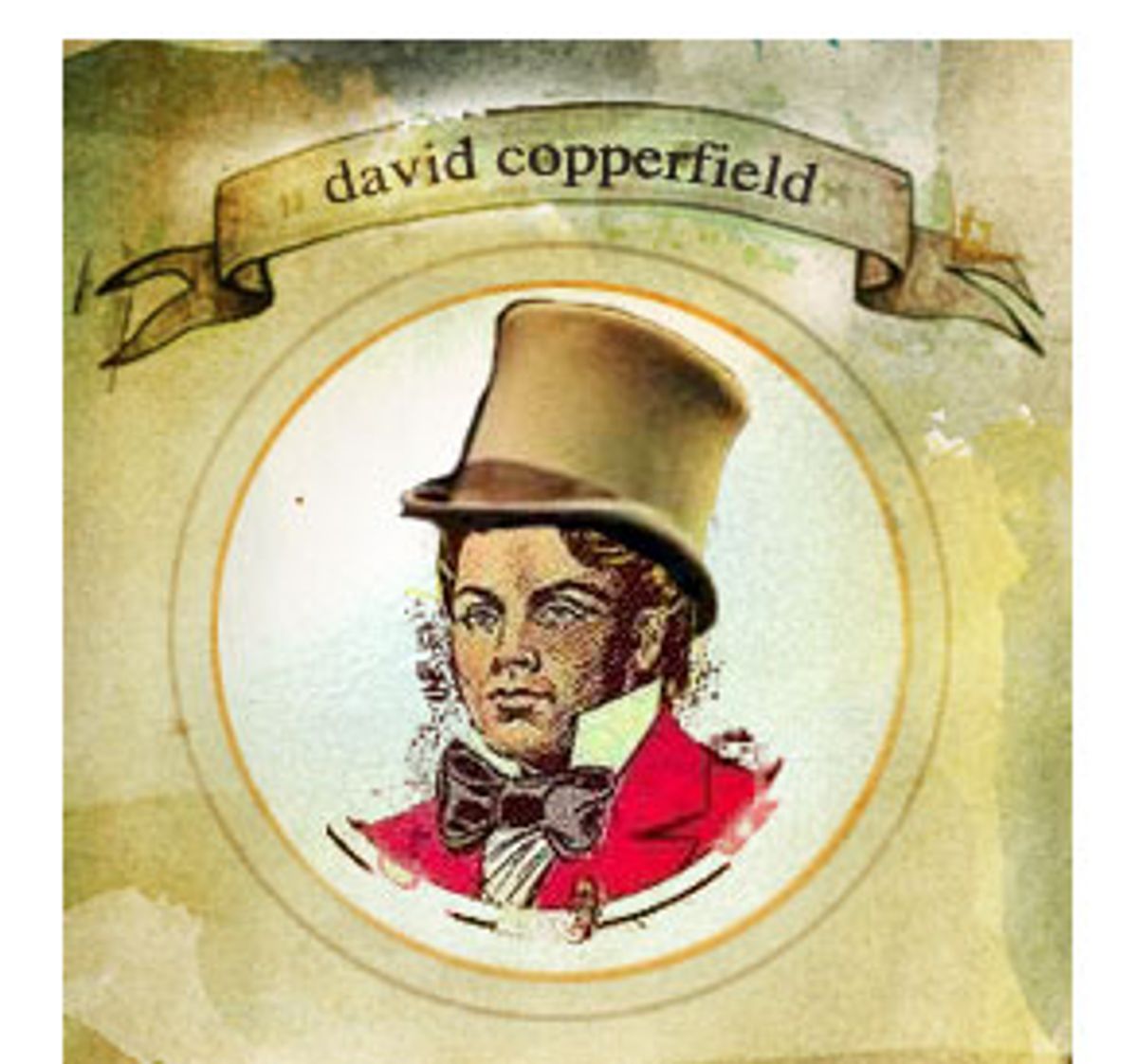
Back before literature hit that high-low fork in the road, leading on the one hand toward "Ulysses" and on the other toward "Gone with the Wind," "David Copperfield" was probably the most revered and the best loved novel in the English language. Everyone knows (or used to know) that Dickens himself called it the "favourite child" among his fictional progeny; but late in life he also acknowledged that it was the "best" of his novels -- a more purely literary judgment. Tolstoy, an impressionable 22 when "David Copperfield" was completed in 1850, considered it the greatest achievement of the greatest of all novelists.
So did just about every middle-class parent in the English-speaking world, who must have thought Dickens's alchemical gift for euphemism transmuted into opacity such episodes as Steerforth's seducing Emily, Jack Maldon's putting the moves on the married Annie Strong and the prostitute Martha's attempted suicide -- not to mention the schoolmaster Creakle's sadistic sexuality ("I am confident that he couldn't resist a chubby boy, especially") and the homoerotic bond between David and Steerforth (who calls him "Daisy" and wishes he had a "pretty, timid" sister). Whatever middle-class children made of the book, they grew up with its characters and language lodged deep in memory.
Samuel Beckett (born in 1906) appropriated a familiar line from Chapter III in his early story "A Wet Night," simply changing "I" to "we" and adding a vulgarism: "This may be premature. We have set it down too soon, perhaps. But let it bloody well stand." More ambitiously, P.G. Wodehouse (born in 1881) seems to have appropriated Steerforth's bloodlessly efficient manservant and pander Littimer in creating Jeeves, Bertie Wooster's comically omniscient "gentleman's personal gentleman" -- to whom he also gave something like Mr. Micawber's allusive orotundity. George Orwell (born in 1903) recalled that when he first read "David Copperfield," around the age of 9, he thought the account of David's childhood had been written by a child. (Another remark everybody used to know.)
What amazed Orwell was Dickens's empathy with children; what amazes me is that children could ever read "David Copperfield." Education has slipped between then and now. But "David Copperfield" has slipped, too. Harold Bloom, in his 1994 survey "The Western Canon," packs the current conventional wisdom into a single conjunction: "Dickens had enormous affection for 'David Copperfield,' but this was his 'Portrait of the Artist as a Young Man.'" But, not and. Got it. A warmup act for the masterworks.
These days even those of us who have enormous affection for Dickens tend to seek out less guilty pleasures among his books. The bursting-at-the-seams social novels -- "Bleak House" (by consensus, his masterpiece, though I don't consent), "Little Dorrit," "Our Mutual Friend" -- offer more in the way of high seriousness, if that's our idea of a good time. And "Great Expectations," Dickens's other great bildungsroman, is a comparatively modernist novel: it's tighter, less episodic, and its narrator-protagonist stews in guilt and anguish -- which really is our idea of a good time. Dickens wrote "David Copperfield" smack dab in the middle of his career: before all these books, and after the rowdy, exuberant, shamelessly weird, wildly uneven early work -- "The Pickwick Papers," "Oliver Twist," "Nicholas Nickleby," "The Old Curiosity Shop," "Martin Chuzzlewit" -- in which we gladly put up with all sorts of nonsense for the privilege of watching him become Charles Dickens.
"David Copperfield" is the absolutely typical Dickens novel; maybe Dickens, the hammiest of all great writers, loved it best because it was just so him. But its very centrality makes it easy to overlook or take for granted. Compared to the early work, its miscalculations seem less understandable, its moralizing less tolerable; shouldn't he have known better by this time? Compared to the late work, it seems too merrily "Dickensian."
I don't know, am I making heavy weather of this? Shouldn't it be enough to remind folks that this novel, and no other, is the one with Uriah Heep and Mr. Micawber and Mr. and Miss Murdstone and Aunt Betsy and Peggotty and Steerforth and Mr. Dick and Rosa Dartle? And the too-seldom-praised Mrs. Micawber, as heroically deluded as her husband and longer-suffering, who deserves an incomplete sentence all to herself. No writer since Shakespeare could have put together such a cast of scene-stealers -- as well as such supposedly minor characters as the respectable Littimer, the willin' Barkis, the lone and lorn Mrs. Gummidge, the Punch-like Mr. Spenlow and the volatile Miss Mowcher.
Even the less-than-minor characters are indelible: the nameless creditor who stakes out Mr. Micawber's lodgings ("Pay us, will you? Don't hide, you know; that's mean"), the monstrous and deranged shopkeeper who buys young David's waistcoat ("Oh, my lungs and liver, what do you want? Oh, goroo, goroo!") or the waiter who playfully, ruthlessly hijacks his dinner ("Come on, little 'un, and let's see who'll get most"). In fact, the comestibles themselves tend to stand out in your memory: the "stout pale pudding, heavy and flabby, and with great flat raisins in it," which David buys in the Strand, or the revolting sherry he's served in an inn at Charing Cross, poured from "the stale leavings at the bottoms of several small decanters" and with "more English crumbs in it than were to be expected in a foreign wine." Everywhere in this book, lifelike details leap at you, interrupting even the headlong melodrama of the shipwreck chapter: "A half-dressed boatman, standing next to me, pointed with his bare arm (a tattoo'd arrow on it, pointing in the same direction)." If ever a writer put words together to create in your mind something like virtual reality -- a fictive world you could swear you're inhabiting, teeming with people you could swear you know -- Dickens does it in "David Copperfield."
And he does more. The better to persuade you that this is all real, he contrives to let his narrator remain foggy about other details, which he could easily have invented and which a lesser writer would have. "I forget whether it was the Blue Bull, or the Blue Boar; but I know it was the Blue Something." That this narrator is himself a novelist gives the narration a metafictional frisson -- which Dickens absolutely intends, innocent though he is of our critical jargon.
Both he and his narrator David know and love "Tom Jones," in which Fielding teasingly calls attention to the novel's fictiveness by such devices as telling us he hasn't been able to find out what Tom had for dinner. But those gaps in David's memory are even trickier than that. Like Fielding, Dickens plays with your disbelief in fictional artifice, while simultaneously making that disbelief easier to suspend -- how improbable it would be, you realize, if David could remember every single thing -- while simultaneously calling your attention to how skillful an artificer Dickens must be to disguise his artifice so well.
Yet no writer ever needed artifice less. In his preface to the first edition of "David Copperfield," he claims that "no one can ever believe this Narrative, in the reading, more than I have believed it in the writing." The way the best scenes play in your head suggests that they were also squirmingly alive in Dickens's head: this gift is unfakeable. And he gets carried away by his belief just as you do. Late in the novel, when the Micawbers decide to emigrate, David tells us: "I think, now, how odd it was, but how wonderfully like Mr. Micawber, that, when he went from London to Canterbury, he should have talked as if he were going to the farthest limits of the earth, and, when he went from England to Australia, as if he were going for a little trip across the Channel." How wonderfully like Mr. Micawber: this isn't Dickens sneakily complimenting himself on how wonderfully he's managed to maintain a character's consistency. It's an uncalculated expression of admiration for a resilient eccentric whose reality, for the moment, Dickens doubts no more than David does.
And while we're on the subject of Dickens and David, let's talk about this portrait-of-the-artist business. I'm not sure I believe the critical commonplace that a sweet guy like David Copperfield could never have written "David Copperfield." (These sweet guys'll kill ya.) F.R. and Q.D. Leavis write that "David incarnates the kind of youth the age demanded -- sensitive, modest, upright, affectionate, but also resourcefully industrious and successful in rising in the world. Now whatever Dickens was, he was not a Daisy, and his habit of referring to himself as the Inimitable does not sound like David either. While Dickens was a colourful personality David is colourless, and intentionally uninteresting in himself -- only a type."
But I think his colorlessness actually makes David a more convincing representation of a writer -- certainly more so than writers might like to admit. He's suitably self-obsessed -- after his mother dies, he looks in a mirror "to see how red my eyes were, and how sorrowful my face" -- yet he lacks a stable identity. He answers to any name he's given: David, Davy, Mas'r Davy, Daisy, Doady, Copperfield, Master Copperfield, Mr. Copperfull, Trotwood, Trot.
It's glaringly odd that David's ostensible soulmate, Agnes, calls him Trotwood (the high-toned handle Aunt Betsy has bestowed) rather than his real name. And Dickens must have wanted that oddness: he knew that novelists live rich and strange secret lives behind their faces, and sometimes seem like pod-people to their nearest and dearest. The clueless Dora wistfully tells David he's "full of silent fancies"; Mrs. Dickens must have known just what she meant.
David's solitary childhood -- we never hear of his having a friend or playmate until he's sent away to Salem House -- and his obsessive reading sound writerly enough. So does his "distrust of myself, which has often beset me on small occasions." So does his tendency to retreat to an observer's distance at important moments: as sailors fight for their lives, he notes that arrow-shaped tattoo; when Dora's aunt consults the crucial letter he's written, asking permission for his courtship, he notes that the paper looks both "familiar" and "odd" in her hands.
And most writerly of all is his passivity -- about everything except his writing career. After he runs away to take shelter with his aunt, the big, splashy events happen to other people: for Emily, Steerforth, Mr. Peggotty and the Micawbers, he's a likable minor character. David spends the last 600-odd pages of the book that bears his name watching more extreme, dangerous and involving lives than his own, acting as confidant and go-between and letting his "good and bad angels," Agnes and Steerforth, duke it out for his soul. Toward the end of the book, David says he's devoted himself to writing "with my strongest earnestness" -- a word that keeps bobbing up like a Wagnerian leitmotif -- yet surely as a novelist he's better served in his silent fancies by something like Steerforth's chameleon duplicity than by Agnes's radiant integrity.
And that's what bothers me most about "David Copperfield": I suspect Dickens isn't always leveling with us or himself. Sophisticated readers can correct for the merely antiquated: the notion, which no one in this novel questions, that it's better to die than to have unrepentent sex, or the implication that Uriah Heep isn't merely villainous but underbred. These are the ground rules; we can play or not. I can even sit still for the cranky, tacked-on chapter about a model prison, which slows up the ending so unconscionably. (Dickens objects to solitary confinement, then considered a promising and enlightened reform, as coddling a bunch of no-goods.)
And I do my best simply to forget Mr. Micawber's wisecrack about bills of exchange as an invention of the Jews, "who appear to me to have had a devilish deal too much to do with them ever since." My serious mistrust kicks in when I hit David's lofty bloviations about the novel's moral exemplars: Mr. Peggoty, the Christlike seafarer, and Agnes, the celestially backlit hall monitor. "There was something so religious in it," David says of Mr. Peggotty's certainty that he'll find the fallen Emily, "so affectingly expressive of its anchor being in the purest depths of his fine nature, that the respect and honour in which I held him were exalted every day." And he thinks of Agnes's "sweet face and placid smile, as though they had shone on me from some removed being, like an Angel."
When Dickens gets into this mode -- and it is Dickens, I'm afraid, not just David -- I don't really know what the hell he's talking about anymore, except that he seems bent on repudiating the worldliness that nourishes his art. No matter what he thinks he believes, Dickens loves Uriah's villainy better than Agnes's virtue. Similarly, he relishes folly more than wisdom: compare his notoriously vague description of Dr. Strong's school ("very gravely and decorously ordered, and on a sound system") with his richly contemptuous account of that "progressive" prison and its inmates' bogus rehabilitation: "I found a great many foxes, disparaging whole vineyards of inaccessible grapes; but I found very few foxes whom I would have trusted within reach of a bunch."
And, despite the late-inning reformations he engineers, Dickens prefers Mr. Wickfield as an alcoholic wreck, Mrs. Gummidge as a self-pitying hypochondriac and -- best of all -- Mr. Micawber as an epicure of debt, cheesy eloquence and bipolar self-excitation. Well, so does everybody. The Mr. Peggotty of the early chapters, who roars in barely comprehensible Yarmouthese, likens himself to a "sea porkypine" and drinks at The Willing Mind, is at least an energetic invention. (Although the Leavises understandably find his dialect -- for which Dickens consulted a book called "Suffolk Words and Phrases" -- "irritating in its patronizing exhibition of the quaintness of the humble.") The later Mr. Peggotty, a fisher of women who talks about good deeds being "laid up wheer neither moth nor rust doth corrupt, and wheer thieves do not break through nor steal," is a pain in the butt. Dickens must have known it. And his refusal to know he knew it makes me want to shake him.
"David Copperfield" goes squishy and unctuous when Dickens stops following his storytelling instincts and starts listening to extraliterary imperatives: his dutiful religiosity, his class guilt (which he enterprisingly decided to confront in "Great Expectations") and -- in the case of the dwarf Miss Mowcher -- a cease-and-desist letter from a solicitor for the real-life model, a chiropodist and manicurist named Mrs. Hill. She recognized herself in one of the novel's monthly installments and objected to Dickens's apparent intention to use Miss Mowcher as a bawd; this explains the headsnapping transformation of a worldly wit in Chapter 22 ("If either of you saw my ankles, say so, and I'll go home and destroy myself") into a preachy paragon in Chapter 32: "Try not to associate bodily defects with mental, my good friend, except for a solid reason."
In Dickens's presentation of women, especially, he clearly felt constrained both as a Victorian Englishman in general and as Charles Dickens in particular. Nowadays you need either great sophistication or none at all to endure his heroines as they exhibit their virtue in unearthly patience and floribundant oration (Agnes, Annie Strong) or their sexuality in icky coquettishness (Dora, David's mother). I'm willing to think they played better then than they do now, but if Shakespeare -- and, earlier in Dickens's own century, Jane Austen -- could write women who were smart, good and sexy, what was up with the Inimitable?
He writes best about damaged, dark and dangerous women: in this book, the superbly brittle and edgy Rosa Dartle; elsewhere, the majestically embittered Edith Dombey, Estella, the conscience-stricken mantrap in "Great Expectations," and Miss Wade, the paranoiac crypto-lesbian in "Little Dorrit." I don't imagine I want to know why. Nor does it help, really, to learn that while the empty-headed, increasingly burdensome Dora is obligingly, even gladly, dying so David can marry Agnes, his ideal helpmeet, Dickens was regretting his own early and ill-judged marriage -- and naming his newborn daughter Dora, after the supposedly lovable character he was about to kill off. Okay, we always knew something was fishy. Now that we know more or less what, it's still fishy.
I've dwelt on these problems -- critics have pointed them out for years -- just in case anybody still feels crazy for noticing them, and because I might as well clear the air before saying that "David Copperfield" is a staggering piece of work anyway: a novel any writer could still learn from, and should still be intimidated by. It would be scary enough if he'd put it through years of rewrites; in fact, he wrote it as he did all his novels, by the seat of his pants for serial publication. Unthinkable. Was he a Martian?
Dickens's contemporaries, of course, recognized just as we do his visionary verisimilitude and his Olympian stock company of characters. Today it's easier to see his psychological acuity: half a century before Freud -- whose work would have scandalized him -- he knew by observation and imagination that people's irrational behavior made perfect sense. Of course David would marry a woman just like his mother, right down to the curly hair and the negligent housekeeping. Of course the fatherless Annie would love the geriatric Dr. Strong. Of course the stingy, taciturn Barkis would fixate on the explosively affectionate Peggotty. And of course sexuality can force its way to a hundred non-genital outlets: Uriah's writhing and handwringing, Dora's fingering the buttons of David's coat, Miss Murdstone's snapping shut her steel purse.
And Dickens's mastery of the full range of the English language may now be ... inimitable. He has what seems like a modernist taste for surreal comedy: "For anything that I can perceive to the contrary," says Mr. Micawber, "it is still probable that my children may be reduced to seek a livelihood by personal contortion, while Mrs. Micawber abets their unnatural feats by playing the barrel-organ." He has a postmodernist's taste for the absolutely trite: "Everything is like life, in my opinion," says the undertaker Mr. Omer, "if you look at it in that point of view." But what modernist or postmodernist writer would also risk the sheer loveliness of Emily's farewell letter to her never-to-be-husband Ham? "In another world, if I am forgiven, I may wake a child and come to you." Hard as I find it to take seriously the notion that Emily's transgression needs all this self-abasement, I can't read that without a lump in the throat.
Finally, it's the many-minded amplitude of "David Copperfield" that makes it both so formidable and so embraceable. Dickens thunders away by proxy about "earnestness," yet he permits Mr. Micawber to fly under (or soar above) his ever-vigilant moral radar. His villains, paradoxically, also belong to the world of pure play. Miss Murdstone, the celibate Wicked Stepmother, and Uriah Heep, the charity-school Iago, never make moral choices either: they're just bad, working their wills like two-year-olds while Dickens revels in their malice.
Yet the same novel can also accommodate a character as subtly drawn as Steerforth: the narcissist who charms everyone but himself, the seducer who half-wishes somebody was smart enough to thwart him, the too-knowing sophisticate who'd like to be as morally uncomplicated as the sailors he hangs out with, and eventually drowns with -- or as the fresh-faced schoolfellow who ends up writing about him. His creator surely put as much of himself into Steerforth as into David: Dickens gave David his own boyhood traumas (like his mortifying, terrifying stint at a shoe-blacking warehouse), and Steerforth his own adult suspicion of a spiritual void behind all that Inimitableness.
Every novel is probably a portrait of the artist, a cryptographic autobiography in which the trouble in its author's head is projected as an imaginary world, people and all. People especially. Scholars tell us Mr. Micawber grew out of Dickens's father, Dora out of his old sweetheart Maria Beadnell -- and his wife -- Tommy Traddles out of his friend Thomas Talfourd, and so on. Good to know. But "David Copperfield," more nakedly than any of his other novels, is all Dickens, all the time: his earnestness and his anarchic humor, his fears and his fantasies, his joy in his own generative powers. His guilt about his joy. But his joy anyway. No wonder he loved this book the best. No wonder some of us still do, deep down. The masterworks can wait.
Copyright ) 2000 by David Gates. Excerpted from his introduction to "David Copperfield" by Charles Dickens, recently published by the Modern Library. All rights reserved.
Shares