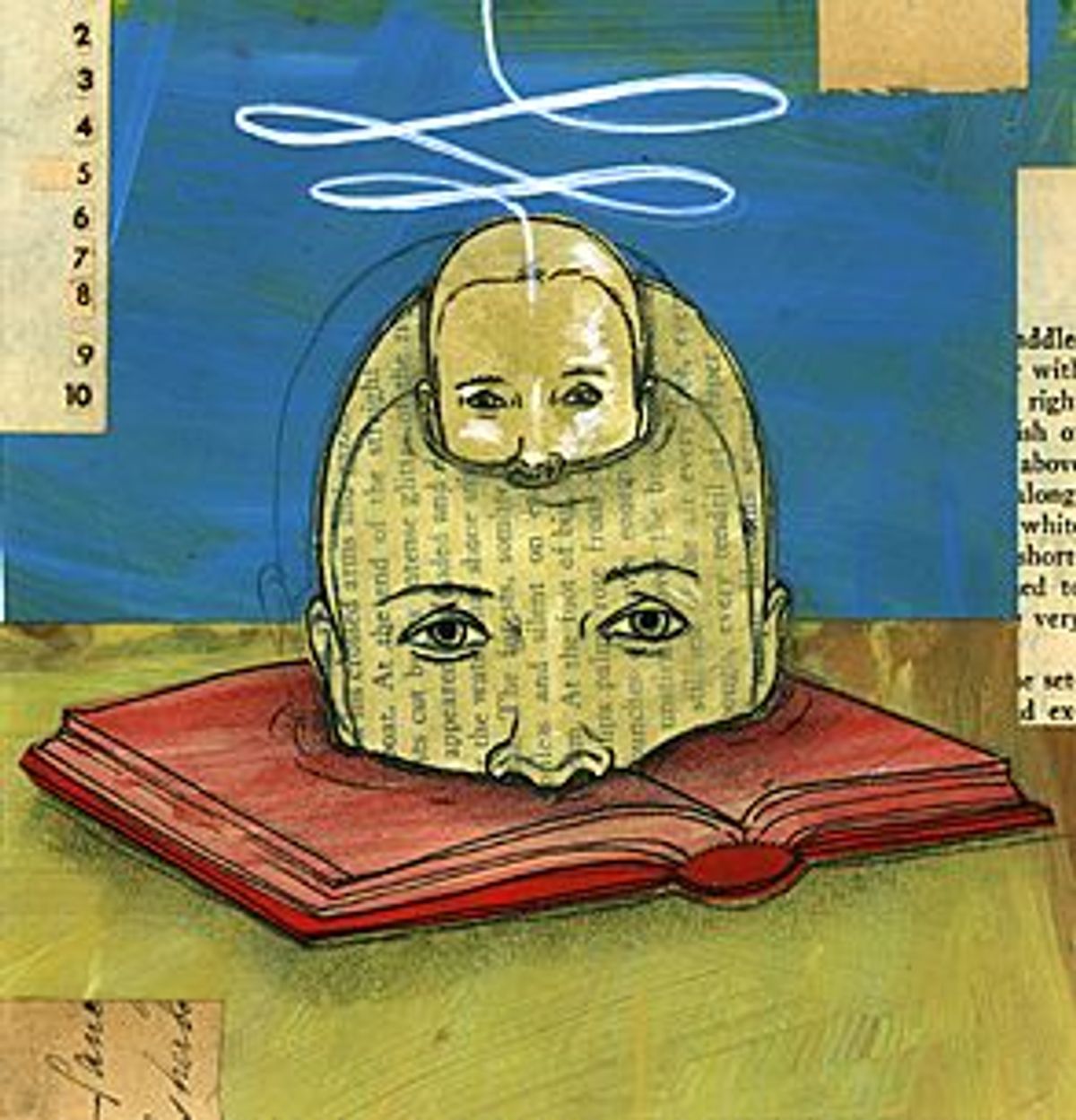
This year marks the fifth anniversary of the Salon Book Awards, with a bit of continuity (Laura Miller has participated all five years) and a bit of fresh blood (this is Maria Russo's first shot at it). On the following pages you'll find lists of our favorite books of fiction and nonfiction published in 2000 -- five of each.
Although almost everything else about Salon.com has changed (including that domain name) since we drew up our very first list in 1996, we're still sticking by the mission we set for ourselves back then. The 10 books we present to you here aren't necessarily the most critically acclaimed, or by the most widely revered authors, and you won't find many bestsellers among them, either. But we loved them, we couldn't put them down; we rifled through their pages like a thief through a jewel box, knowing that we'd found treasure.
To find them, we first gathered recommendations from Salon's staff, regular critics and friends. Then we sifted through piles of books so vast that Laura hasn't been able to close her office door for weeks, read until our eyes ached and our heads were numb, picked up each new volume feeling like we'd rather do just about anything else than open it. And in spite of the jaded state of our print-addled minds, a handful of books still had the power to enchant us. They made us forget our neglected friends and family, the tempting movies that came and went unseen, even the madness of the presidential election, and transported us to worlds both fabulous and familiar and introduced us to people we'll never forget. We hope they'll do the same for you.
F I C T I O N

Abe: A Novel of the Young Lincoln
By Richard Slotkin
Henry Holt, 478 pages
Cultural historian Richard Slotkin set himself the task of taking the handful of known facts about Abraham Lincoln's early life and imagining, in novel form, how Lincoln came to transcend the violence, inertia and racism of his "white trash" background. The result is, yes, partly an unstinting account of hardships and racial hatred among the 19th century American rural underclass, but it's also a grand frontier adventure (with a climactic trip down the Mississippi as a homage to "Huckleberry Finn"), starring the man who comes closer than any figure in American history to being a genuine folk hero brought to life.
For all his titanic inner struggles, his dark rages and his great destiny, Slotkin's Abe is tremendously endearing. Whatever we'd like to believe, history tells us that poverty and oppression tend to make people mean and small, not noble. Lincoln was one of the rare ones to take a higher path. Because of that, his heritage belongs to the whole of humanity, not just Americans. With this novel, Slotkin wipes the cosmetic sheen of patriotism off Abe's face, blows off the dust of portentous history and gives him back to us, fresh.
Excerpt | Order a copy | Original Salon review
- - - - - - - - - - - -

Being Dead
By Jim Crace
Farrar, Straus and Giroux, 196 pages
Joseph and Celice, two long-married zoologists in their 50s, are murdered during a romantic moment on an English beach. As their bodies lie decomposing, Joseph's hand still grasping Celice's ankle, Jim Crace's bold and affecting novel begins its work. Crace intertwines several threads: He looks backward over the happy moments, the disappointments and the compromises of Joseph and Celice's lives, reconstructs the events of the day on which they met their deaths, offers a naturalist's view of what's happening to the corpses and tells the story of how their sullen, still-rebellious adult daughter learns that they've been killed and reassesses her own life.
Written in an assured, thoughtful, canny voice, "Being Dead" glows with surprising humor, not least in the many zoological details Crace invents to fill out his protagonists' careers. This unique novel's focus on two deaths becomes, paradoxically, a way to celebrate life: This life may be all there is, Crace suggests, but if we allow ourselves to love and be loved, and to notice the teeming world around us, we're part of something larger than ourselves.
Excerpt | Order a copy | Original Salon review
- - - - - - - - - - - -

Lying Awake
By Mark Salzman
Alfred A. Knopf, 182 pages
A simple, uncluttered novel about the unfathomable challenges of the spiritual path, "Lying Awake" takes Sister John of the Cross, a Carmelite nun who lives cloistered in a Los Angeles monastery, through the hardest decision of her life. The nun suffers terrible headaches that give way to ecstatic mystical visions and manic bouts of writing. Her poetry and essays have brought her the respect of her fellow sisters and much-needed funds to the monastery itself; her books have become bestsellers. Then she learns that all of it -- headaches, visions and creative furor -- are the result of a form of epilepsy caused by a small but operable lesion on her brain. Should she agree to surgery that will end her increasingly unmanageable seizures but will also destroy their gifts? Does the bodily source of her visions nullify their spiritual significance?
Salzman sets Sister John's dilemma against the background of the carefully rendered routine of the cloister and a religious philosophy that views life as a series of often baffling tests. But "Lying Awake," written by a non-Catholic, is about more than just the trials of faith; it speaks to all who pledge their lives to a mystery -- whether it's art, or justice, or even something as commonplace as marriage -- and find themselves transformed as a result.
Excerpt | Order a copy | Original Salon review
- - - - - - - - - - - -

The Name of the World
By Denis Johnson
HarperCollins, 129 pages
This slim, nearly perfect novel is narrated by Michael Reed, a man who has been suspended in a state of grief in the four years since his wife and young daughter were killed in a car crash. He's at the end of a temporary appointment teaching history at a picture-perfect Midwestern university, and it's slowly sinking in that he's also at the end of his rope. Alternately drifting, stumbling and crashing through the final days of his brief academic career, he decides to start making contact with the people around him, including a raunchy, free-spirited female student who takes him into some unexpected territory.
Denis Johnson nimbly merges his serious themes -- loss, sorrow, the possibility of personal transformation -- with a feather-light satire of academic silliness and inertia. "The Name of the World" is so graceful and easygoing, its prose so full of charm and sly humor, that you barely register its great ambition; Johnson's poignant, devastating gravity sneaks up and taps politely on your shoulder.
Excerpt | Order a copy | Original Salon review
- - - - - - - - - - - -

White Teeth
By Zadie Smith
Random House, 448 pages
Zadie Smith's first novel is an exhilarating, hilarious fictional ride through contemporary London. Smith has created a large and irresistible cast of characters, chief among them the plodding, good-natured Archie and the crafty, proud Samad, a working-class white and a Bengali Muslim who are best friends from their World War II days. Archie's young Jamaican wife, Clara, who's escaped a strict Jehovah's Witness upbringing, manages to befriend Samad's fierce, shrewd wife, Alsana. The two couples' children, the half-black Irie and the Bengali twins Millat and Magid, navigate the social minefields of an adolescence unfolding between cultures, defying their parents' expectations in continually surprising ways. By turns whimsical, satirical and wise, always generous, "White Teeth" makes multiculturalism seem not just an inevitable outcome of British colonial history but a ticket to the kind of deeper awareness of human nature that makes us want to read novels in the first place.
Excerpt | Order a copy | Original Salon review
- - - - - - - - - - - -
N O N F I C T I O N

An American Story
By Debra Dickerson
Pantheon, 279 pages
A brainy, curious black girl growing up poor in the de facto segregation of north St. Louis enlists in the Air Force, becomes an officer and intelligence expert, moves on to Harvard Law School, then becomes a successful journalist: Debra Dickerson has had an "only in America" life, but her remarkable book is much more than a patriotic fairy tale. In a society where blacks and whites so seldom speak frankly about race, Dickerson has a voice you want to keep listening to.
As she details the evolution of her politics from an Ayn Rand-flavored neoconservatism to her current left-leaning stance, Dickerson, a former Salon staff writer, is always sharp, witty and intellectually honest. She says things no one else will say, calling out hypocrisy and self-interest wherever she sees it. She tells her close-knit family's story with a potent mixture of brutal candor and sympathetic warmth: her father's toxic blend of love and cruelty, her mother's struggle to raise six kids with an unstable and domineering husband and her siblings' battles to break free of the low expectations bequeathed to them as the descendants of sharecroppers. "An American Story" is both a moving account of an extraordinary woman's life and a deft wide-angle view of the American racial landscape.
Excerpt | Order a copy | Original Salon review
- - - - - - - - - - - -

The Blood Runs Like a River Through My Dreams: A Memoir
By Nasdijj
Houghton Mifflin, 216 pages
The story of a mixed-race son of nomadic alcoholic parents, a man who has suffered homelessness and mourns the death of his adoptive Native American son from fetal alcohol syndrome, this memoir sounds like the kind of guiltathon that liberal readers like to flay themselves with periodically. And make no mistake, Nasdijj doesn't think much of white people -- although he's only half Navajo himself and often finds himself rejected by Native Americans for looking white.
What he is, unquestionably, is a writer of tremendous power who seems to have taken apart the English language and put it back together again to make something rich, strange and utterly unique. There are echoes of ballads here, and fragments of the speeches of long-dead chiefs, but mostly this is a voice that matches the broken, lunar beauty of the Western landscape like no other. The passage in which Nasdijj huddles with his son in a forest cabin while a male grizzly kills a female and cubs nearby ("in the infinite moonglade darkness by the river") is alone worth the price of admission.
Excerpt | Order a copy | Original Salon review
- - - - - - - - - - - -

The Boxer Rebellion
By Diana Preston
Walker & Co., 352 pages
Despite its somewhat utilitarian title, Diana Preston's story of the siege and rescue of the diplomatic community in Beijing during the Boxer uprising is a nail-biting example of narrative history at its best. The muddled meaning of the peasant-initiated rebellion (partly the result of legitimate fears about foreign-led industrialization, partly inspired by fears that Christian missionaries were stealing Chinese body parts and fetuses) takes a back seat to the race against time as the international relief forces fight ambushes, crippling heat and conflicting political agendas on their way to liberate the captives.
Behind the barricades, cowardice and courage blossom in surprising places as food supplies dwindle (one chapter is called "Horsemeat and Hope") and the bombardment by the Chinese troops intensifies. The drama includes several memorable historical figures, from the young Herbert Hoover and his fearless wife to the formidably Machiavellian empress dowager, Tzu Hsi. Preston knows precisely which colorful details (the British lady who congratulates herself for not spilling the cup of tea she was handing to a patient when a shell flies right through the hospital, a valiant pony nicknamed "The Torpedo") will spice up this masterful mix of history, gossip, crystal-clear military strategy and ironic observations about colonial and imperial politicking -- and she keeps the pot at an irresistibly lively boil throughout.
- - - - - - - - - - - -

Pontius Pilate
By Ann Wroe
Random House, 384 pages
We'll probably never know much for certain about the identity of the man who sentenced Jesus to death, but Ann Wroe turns what few clues there are into an intoxicating meditation on an inadvertently colossal figure. She wrests telling details out of the few surviving historical accounts of Pontius Pilate's undistinguished stint as governor of Judea, and she teases out the essence of his character and personal dilemmas from his few recorded political acts and from his inability to figure out how to please both his Jewish subjects and his Roman superiors.
Her book abounds with small gems of observation, such as the sloppy lettering on a plaque Pilate had engraved with his name, which Wroe makes into an almost touching example of his vulnerability and incompetence. She also coolly and meticulously scrutinizes the biblical accounts of Pilate's encounter with Jesus, and she weaves into her tale the mythical and literary Pilates who have sprung up over the centuries. Besides shedding light on a fascinating historical mystery, "Pontius Pilate" is a feat of sheer intellectual derring-do: a biography forged from the slenderest material that gives the impression of fullness and amplitude.
Excerpt | Order a copy | Original Salon review
- - - - - - - - - - - -

The Social Lives of Dogs: The Grace of Canine Company
By Elizabeth Marshall Thomas
Simon & Schuster, 255 pages
We're not dog owners -- in fact, we wouldn't even call ourselves dog lovers -- but a few pages into Elizabeth Marshall Thomas' account of her "multi-species" household and we were hopelessly enthralled. A patient and intuitive observer, like all great naturalists, Thomas also shows a novelist's skill with character; her description of each dog that enters her family and negotiates its complex hierarchies blends a generous consideration for their intelligence (she maintains that they can understand jokes) with a respect for the peculiar rules of their tribe (a cardinal dog law: "The elders show the way").
These canines, under her attentive eye, emerge as full-fledged individuals, each with a fascinating and often conflicted bundle of traits, from the noble foundling Sundog to the insecure purebred Misty to the socially ambitious part-dingo Sheilah. Thomas never forgets that her mission is to justify the ways of Dog to Man, but in the process she makes the differences between the two seem less a source of confusion than of delight.
Excerpt | Order a copy | Salon author profile
- - - - - - - - - - - -
Shares