

One of the first lessons I learned as a journalist was that danger -- even the hint of it -- has immense erotic possibilities. It was the summer of 1994 and I was working as a reporter in Haiti, awaiting what ultimately became a feather-light U.S. invasion. The promise of "bang-bang," though, had drawn the roving international press corps: most of them men, many of whom were lodged at my hotel. This made for an interesting introduction to journalism, and I exploited it to the fullest.
I had a very good time -- exactly the kind of time my male colleagues were having. Unlike them, however, I paid a price -- in the sly winks, missed assignments and overall disrespect I received from certain members of the journalistic brotherhood. I was a young woman, a "babe" covering war. They were "the boys." And war, they reminded me, was their game.
I've had many more foreign assignments since then. I've also learned how to "handle" myself on the road -- a directive applied to women's behavior, not to men's. It involves embracing the danger, the adventure, the loneliness and, occasionally (and discreetly), the photographers or other roguish types who might come your way. It also involves playing by the rules, the primary one being: What happens on the road stays on the road.
Women journalists have come a long way since the days of Martha Gellhorn and Margaret Bourke-White, but after all is said and done, war is still a boys' game. Despite the successes of women such as Deborah Amos, Christiane Amanpour, Corinne Dufka and Susan Meiselas, women still constitute less than 10 percent of the foreign press corps; among combat photographers, only a handful are female. It's a hard, often dangerous and tremendously exciting life, and there is quite a lot to be said by, and about, the women who choose to live it. Unfortunately, it's also one of the last true "boys clubs" in the media -- or any other -- business, and while the annals of journalistic nonfiction bulge with "cowboy" memoirs, very few have been written by women.
Perhaps the first "cowgirl" memoir was Leslie Cockburn's "Looking for Trouble," a reflection of her highs (and occasional lows) over 25 years as a foreign correspondent and television producer. While filled with amusing insights, Cockburn's book, with chapter heads such as "Dinner With Drug Lords" and "Lunch With the Ayatollahs," rubbed many critics the wrong way. It suggested a blue-blood Yale graduate waltzing around war zones in designer bush-wear.
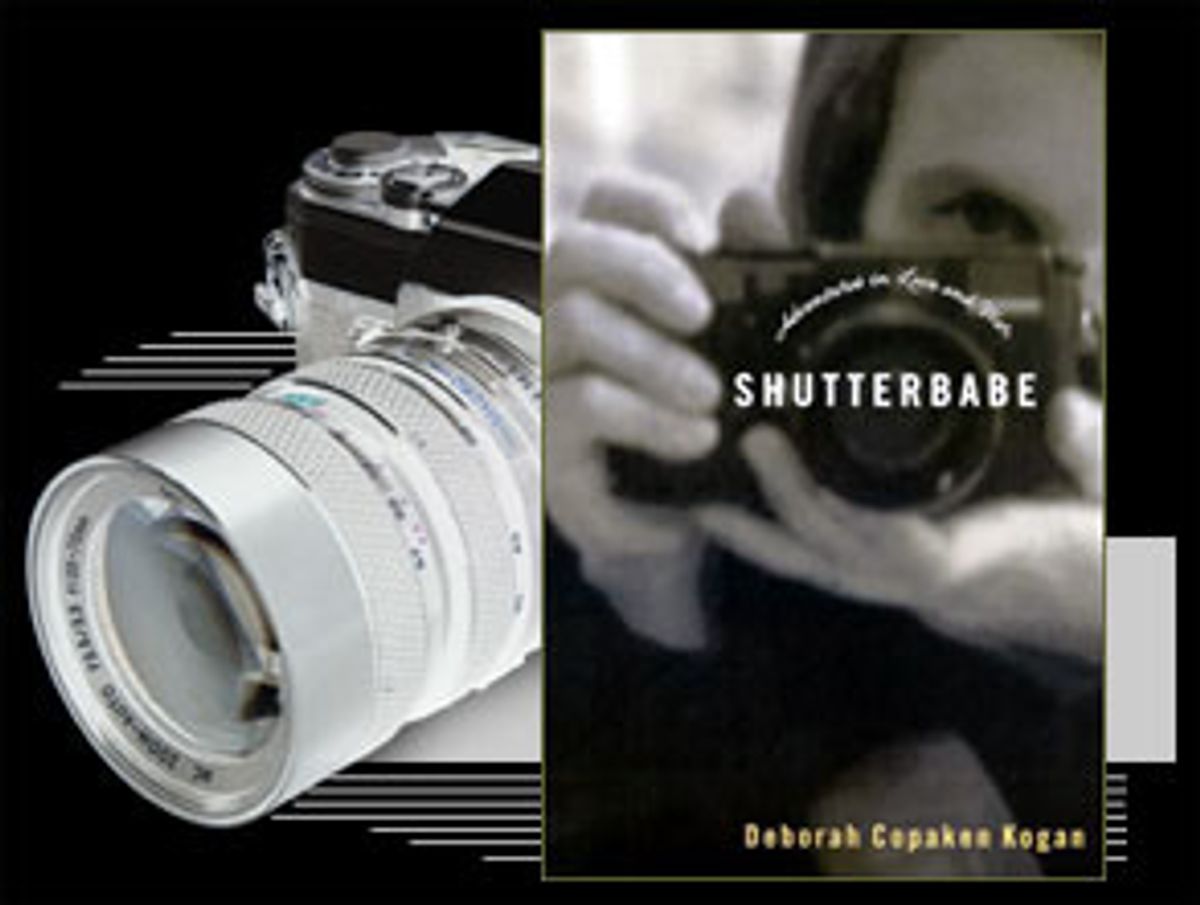
Now comes "Shutterbabe: Adventures in Love and War," Deborah Copaken Kogan's memoir about her life as a roving war photographer. It's an unfortunate title, but I was willing to give the book a shot given how rare young female war photographers are -- let alone those who write about the experience. Alas, "Shutterbabe" is not so much a cowgirl memoir as a "bang-bang" memoir: a self-aggrandizing story of the lusts and yearnings of a bored, post-feminist bad girl with a hankering to "see war."
"Shutterbabe" is not about war, nor is it about photojournalism. It's about sex -- or, rather, sex as sport, an integral part of boys-club culture that Kogan, a Harvard graduate, embraces as just as much her privilege as theirs. She finds abundant outlets for her passion over her brief, four-year career in photojournalism -- a whirlwind ride from Paris to Israel, Afghanistan, Zimbabwe, Romania and, finally, Russia. Between 1988 and 1992, she dodges a few bullets, faces down a tank or two and screws half the foreign press corps along the way.
Brava. Men in her position do it all the time; why shouldn't she? She has even done them one better and broken the sacred code and named names. (She uses first names, but those in the know might recognize a few.)
Still, it must be said that Kogan's brief experiences offer little premise for a book. Journalists who write about their lives generally have, like Cockburn, made some kind of a dent in the field; at a minimum they've had experiences that qualify them to speak authoritatively. Kogan was a minor player in photojournalism, barely remembered by the major photographers of that era. She began her career at age 22; at 26, she'd quit the business. A memoir written by an unknown young male photographer with an abbreviated, and unremarkable, résumé would never have made it past an agent's first read. That he screwed his way through a couple of wars would make it even more unappealing. Men boast of their conquests around the bar, but no serious male journalist would ever write about his affairs in such detail.
But a young woman journalist willing to write about having sex in war zones -- that's another story. Though Kogan's coming-of-age in journalism is far from unique, her story is, by the double standards of today's publishing world, "interesting." She has fired an AK-47 and she says "fuck" a lot.
She does it even more -- with male photographers who, she winks, also led her to stories and allowed her to tag along on their assignments. For all the romantic overlay she gives her story, Kogan makes it clear that she screwed strategically. "The plan ... was fairly simple," Kogan writes of Pascal, a French photographer who invites her to join him in Peshawar, Pakistan, in 1988. "Since he had most of his journey paid for with assignments from various French and German magazines, and I, the ingenue just starting out, had zero in the way of assignments, I would take advantage of his free hotel room (and it was understood, his warm body) before finding a group of mujahadeen to take us ... into the heart of Afghanistan, to bear witness to the atrocities of war. Or something like that."
In this passage she's clearly trying to underline her initial gullibility, but the attempt falls flat. Not only is the blasé tone she strikes here and elsewhere embarrassing, it's disrespectful to those of us who take ourselves, and our careers, seriously. Kogan, who left photojournalism for TV news in 1992, and then left journalism altogether in 1998 to become a full-time mom, is not, contrary to the media buzz around the book, some kind of neo-fem heroine to women journalists. If anything, "Shutterbabe" only reinforces the myth that women have worked hard to dispel: that we use our sexuality for access or entree because we lack the basic skills to do it on our own. "We've all had our share of relationships, but I don't think you should ever use it to get ahead," says Newsweek's Donatella Lorch. "What's necessary in the field is winning the respect of your colleagues -- male and female," says Lorch, who covered wars in Afghanistan, Somalia and elsewhere for the New York Times and later for NBC News.
Women have fought long and hard to be considered valuable in the foreign arena. "You prove yourself by proving you're capable and not a weight around anyone's neck," Lorch says. "You prove it by showing that when things get dicey, you can stand on your own."
To her credit, Kogan learns quickly how to hold her own on assignments, without unduly leaning on men. Then again, her lack of preliminary research is often astounding. At one point, Kogan is sent to cover the anti-poaching battle in Zimbabwe's Zambezi River Valley, and arrives -- having fought off the advances of her one African source, whose help, I assume, she'd counted on -- without a tent, a map, a compass or any idea where the war was being fought.
But no matter what assignment she's describing, her concerns always center on what being a woman has meant to her. She is condescended to, called "little girl" (she's 5-foot-2) and often dismissed by her male colleagues; she's nearly raped by one of her lovers, slapped and called a "slut" by another. "How many times did I regret the enormous trouble my body caused me," she writes, "the way it bled and attracted assaults and made me an easy target for any man with a gripe and a will to act upon it?" It's something many women ask themselves, and journalists are no exception. But rather than using these moments in her book to explore the broader issues of sexism, she reverts to solipsistic "victim" flashbacks: a date rape at Harvard, a mugging in New York, sexual harassment throughout her life.
It's true that being a woman in the boys club means rarely having the luxury of leaving your gender behind. This doesn't mean inwardly freaking out, as Kogan does, when your box of tampons is inadvertently squashed by an AK-47-toting guerrilla as you barrel across the Hindu Kush in Afghanistan. It means ignoring, or brushing off, the random, and unwelcome, erection rubbing against your back while you're trying to work; trying to control your anger over the lack of access or freedom of movement women have throughout much of the Arab world; dealing calmly with the disrespect women often receive from men in professional situations in most of rural Africa, as well as parts of Asia, Latin America and just about everywhere else.
Women journalists are shut out of the salons of power all the time. In some corners of the globe, we'd have better luck throwing ourselves against a brick wall than interviewing or photographing a powerful man without male escorts. I've weathered several interviews with African leaders whose answers to my questions were directed not to me but to the male photographer I happened to be working with. This isn't unusual: Women might call the shots as producers or lead reporters, even speak the local language fluently, but nevertheless, the negotiations -- for access, travel, interviews, even food -- are done by the men on their team. How do women function professionally in this environment? It's frustrating, but they manage, and not usually by flirting or its converse, casting oneself as the victim, as Kogan so often does. Negotiating in these circumstances takes savvy, a basic understanding of other cultures and a sense of humor.
It also means using your femininity, but not exploiting it, which is a very fine line. "Any attractive woman who gets somewhere in journalism is at some point accused, or suspected, of sleeping with her sources," says journalist Mark Dennis, who covered the Middle East and the war in the Balkans for Newsweek. "It's almost assumed among some guys, though of course men can have sex with whoever they want and no one says anything."
Stacy Sullivan, for example, who covered the wars in Bosnia and Kosovo for the New York Times Magazine, was suspected of sleeping with her primary source in the Kosovo Liberation Army -- how else could she have gotten that access? "Would that I was having as much romance as the press corps believed I was," she laughs. "The rumor quickly turned into 'common knowledge' and spread among the ranks of the Kosovo Liberation Army. My source, his wife and I just laughed, but I think many who covered the war still believe I slept my way into the story."
We all romance our sources in some way -- men do it at least as much as women, though they might refer to it as "schmoozing." Men, for example, freely engage in valuable all-night drinking sessions with male sources -- standard business practice -- while women often do not. Sometimes it's because they aren't invited; more often it's because we worry about the impression it might make were we to join in. The developing world is particularly challenging. "In countries where women have very limited roles, just standing there asking questions is unusual enough," says the Los Angeles Times' Anne-Marie O'Connor, who spent 15 years covering wars in Central and South America. "The goal is for your sources to respect you. You want them to view you as something of an honorary man."
Men in patriarchal cultures are fascinated by women journalists -- and disarmed by us. We're tough. We hike like the guys do under a beating hot sun. We look men in the eye when we speak. We wear perfume and a bit of makeup if we feel like it; we're also known to smoke, drink and, at times, laugh loudly. We're not normal by their estimation of normal. If we become honorary men, it's only because we lack power in a male world and so are less threatening to the arms trader, guerrilla leader or president we're hoping will spill his guts.
I'm thankful there are enough women reporters and photographers out there to provide some counsel and support. Sadly, Kogan seems not to have found them. To me, in fact, the oddest part of her book is the absence of women in almost any context. She seems to have met a few women who could have served as role models or mentors. The book describes several encounters with older, prominent and quite supportive women journalists, including the Times' Lorch, who offered Kogan guidance and a bit of mother-henning. So what happened? "Maybe no one liked her," a friend of mine suggests -- a woman photojournalist who herself was short on mentors. She's half-joking but, given the competition among photojournalists, not to mention among women in general, this wouldn't surprise me. Another uncomfortable reality: Young, attractive, enthusiastic women journalists often aren't very popular among slightly older ones, for the same reasons they aren't popular in any other profession in which women have had to claw their way to the top. Sometimes this is the result of sexual rivalry, but it's just as likely to be annoyance at witnessing their long-gone naiveté in a younger woman or the complex feelings that one-time professional "exceptions" have when they're suddenly sharing the field with others.
But just as the foreign press corps has many kind, responsible men, there are myriad vibrant, dynamic women correspondents and photographers of all ages who embrace the job's rough-and-tumble without pretending they have a penis, who are "hard" but also capable of expressing compassion, who don't dislike the women coming up and instead watch out for them.
I'm grateful to the women who took me under their wing, pointing out how nice those khakis and that sensible, and loose, white T-shirt looked on me, sharing their contacts and giving me assignments. Women, not men, taught me how to interview soldiers and how to hide, and then run, when someone is shooting at you. Most of all, they didn't let me quit when it all felt impossible, because, they told me, journalism needed smart, courageous women willing to dash off to who-knows-where against the advice of just about everyone to witness what most people will never know firsthand. The lessons they taught me have made me a better and more responsible journalist, and a stronger person.
Maybe if Kogan had met a few more of those women, she wouldn't have felt compelled to rely on men for guidance, support, love -- for everything. Meanwhile, the subjects of her work -- the war orphans, rebels, drug addicts and gang girls -- get barely a gloss other than when they're useful to further her own story. That, surely, is the saddest aspect of "Shutterbabe."
Someday, I hope, a book will be written by a young woman foreign correspondent whose self-worth, whatever her sideline dalliances, will be found in the devotion she brings to her job; who sees covering war as a kind of privilege and thrives on its ultimate challenge: trying to communicate the incomprehensible -- violence, famine, war crimes, human rights abuses -- to a jaded Western audience that by now has seen it all. For whatever extreme gene may have brought us to this job, it's our commitment to the stories that keeps most of us here.
Shares