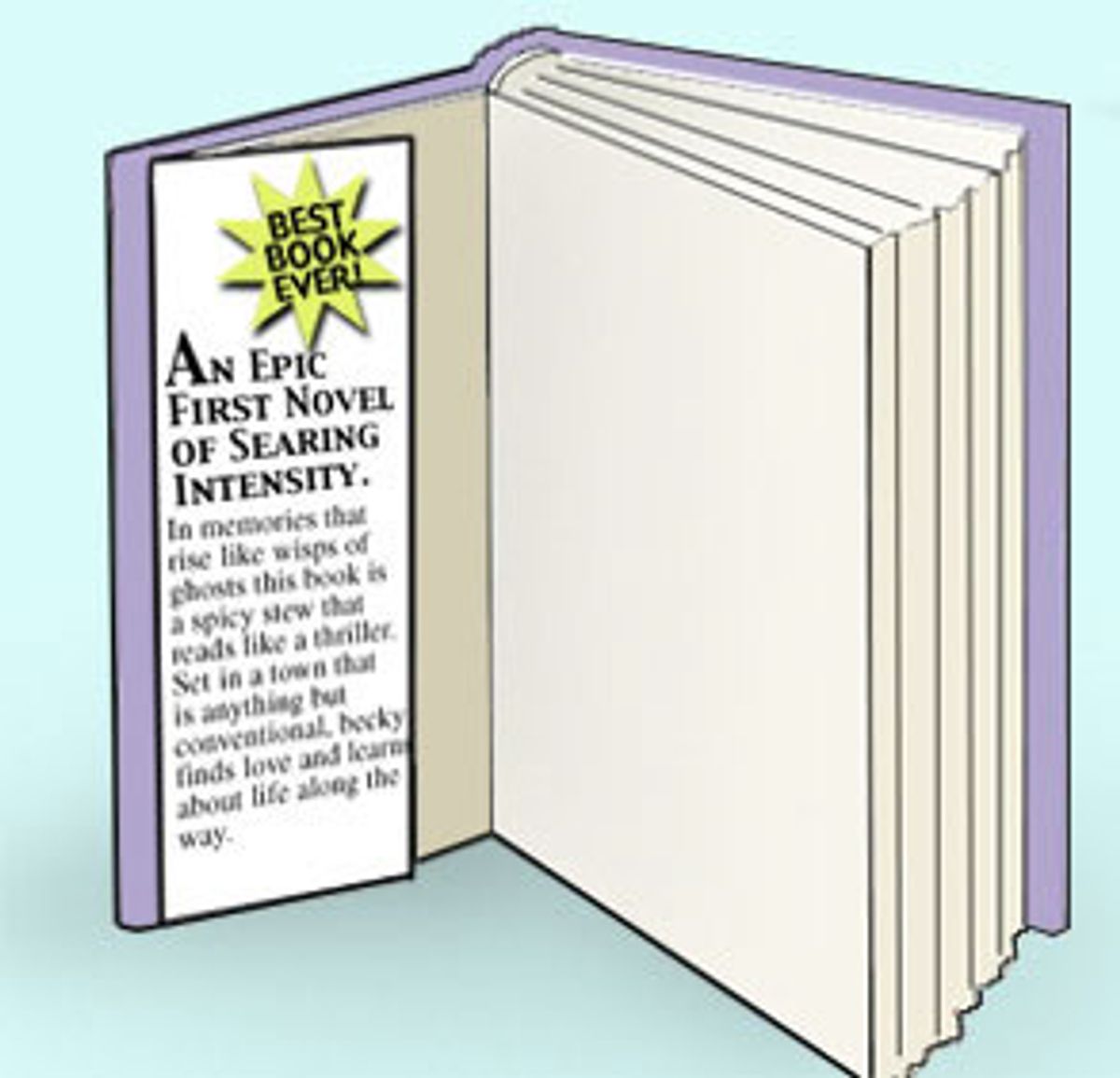
If I bothered to do the math, I'm sure I'd find that I've spent more time browsing in bookstores than I've spent actually reading. That doesn't bother me much. (After all, I've spent more time cooking than I have eating.) Reading is only part of loving books; sometimes it's enough to be around them, to be excited by the prospect of what you haven't read. It's the lust for something new that causes book lovers to while away hours browsing through display tables of new titles, that sends you back to browse some more in stores you visited just the day before.
Unless you head into a bookstore looking for a specific title -- something you've read about or that's been recommended to you by a friend -- there's no way on earth for most hardcore browsers to avoid scanning the new-titles table. And then you're at the mercy of jacket copy, most of which is awful. To be fair, jacket copy is written by editors or their assistants who are in the unenviable position of having to sell something quickly. They're like those hapless screenwriters in "The Player" pitching ideas by describing them in terms of something else. ("It's 'The Gods Must Be Crazy' with Goldie Hawn as the Coke bottle.") Call it the "In the tradition of ..." syndrome. If it's a historical mystery, you can be sure "The Name of the Rose" will get a mention. Any coming-of-age memoir that recounts the author's childhood hardships will suggest "Angela's Ashes."
We'd all like to flatter ourselves that we're immune to advertising. The truth is that we're all willing to be suckered -- just not always suckered into buying. Too much of the time jacket copy creates impressions, often false ones, but impressions that stick. All of the jacket copy that follows is from actual books. All have, for one reason or another, caused me to put the book back in its place and look for something else. (Since I have no idea if any of these books are any good, I won't name them.)
Sometimes all it takes is a phrase -- "Like Humbert Humbert ..."; "One of this generation's freshest voices"; "A devastating X-ray of American culture" -- to make me feel as if I've read each of those books already. I'm also not likely to continue perusing anything compared to "The Catcher in the Rye"; any multi-culti narrative described in terms of spices or a stew; anything scientific or historical that feels the need to proclaim that it "reads like a thriller" (yeah, one that could safely be read aloud in the cardiac care unit); anything set in a French or Belgian village where wine, chocolate, truffles or some other food plays a major role; and anything with a variation on the phrase "That fateful/memorable/tragic/magical/faraway summer."
Picking up anything with those words printed on its flap is like channel flipping late at night and coming upon a movie that I feel I've already seen -- whether I have or not. Essentially, we've all read "Dreaming of fame as a filmmaker, hungry for love and sex ...," and we've all learned the tolerance lessons awaiting us in "Eve has grown up in a decidedly unconventional family, one of seven multiracial children ..."
Authors have little or no control over their jacket copy. That doesn't stop me from wondering how good a novel can be when its description is so carelessly written. "In memories that rise like wisps of ghosts" suggests that the narrative is going to be even wispier. I mean, a ghost is already vaporous -- how the hell hard is the wisp of ghost to detect? Does the book come with special glasses, like the ones handed out at the William Castle movie "13 Ghosts," which enabled you to see the spooks?
Or what about this beauty: "Hector's half-brother Spud -- a down to earth dairy farmer [oh, good -- I hate those hoity-toity dairy farmers] and neighbor of the two -- finds the bodies shortly before the police discover that Spud and the wife were having an affair." A double murder sounds juicy, but am I going to have to read descriptions of somebody named Spud having sex?
When literary fiction is sold as if it were a good soapy read I get the giggles. "Four people in a small Vermont town are about to have their lives inexorably intertwined by the uncertainties of love ... and the apparent absolutes of gender." Quick, when was the last time you used the word "gender" in a discussion that wasn't about society or theory? It's just not a word that anyone attempting to interest you in a story should ever use.
Similarly, you can't promise "an epic first novel of stunning intensity" when the main action concerns a protagonist who "driven by arrogant faith in his ideals and convinced of his family destiny ... storm[s] into the village of Rajottama determined to build a model Buddhist society." Perhaps Martin Scorsese could reconcile those two strands: "From the director of 'Raging Bull' and 'Kundun' comes 'Raging Buddhist' starring Richard Gere."
And unless you're sure your book will never be picked up by a wiseass, it's best to avoid questions as an opening. "What do you do when you find a stranger in your closet?" Drive till you run out of gas and wire the landlord for your security deposit.
I feel a little more sympathy for this copywriter, trying like a trouper to convince you of the hothouse antics contained therein: "Fidelity is strained in the heated atmosphere that surrounds the expatriates who teach at the college at Kampala in the '70s." Is there anything more boring than contemplating the sex lives of academics? But wait, a little touch of foreign intrigue waits in the wings: "While looming over all is the imminent ascension to power of General Idi Amin." Given the size of Idi Amin, what wouldn't he loom over? The Grand Canyon, maybe. For sheer tactlessness, that rates with the publicist who a few years back tried to sell Nichelle "Uhura" Nichols' autobiography by writing that when Nichols was a Vegas dancer she "caught the eye of Sammy Davis, Jr."
Maybe years of inveterate browsing helps you to eventually tune out some of this stuff and get to the books themselves. Or just maybe the relationship between books and the readers who will love them is kismet waiting to happen. Look through your own shelves and I guarantee you'll find turnoff jacket copy on at least a few books you love.
Scanning my own books, I found the following examples: The "novel is an examination of lost paradises, politics without belief, the limits of memory, the redemptive power of love, and the existence of hope beyond reason." That's from the jacket copy of Sebastian Faulks' "Charlotte Gray," which is a hell of a lot more exciting, and a hell of a lot more vital, than anything in that description suggests. And Valerie Martin's "Italian Fever" is described as "Part mystery, part romance, part meditation on the maddening but redemptive power of art."
Are you starting to see a theme emerge? A book that I didn't wind up reading is described as "A luminous work of fiction that celebrates the uncommon in common lives, and the redemptive power of love." It would appear that there is more redemption going on in modern fiction than there is at a Billy Graham crusade. "Redemption" in this context is the word for "happy ending" for readers who are afraid that "literary" equals "depressing."
So is there such a thing as good jacket copy? Yes. It can be witty, or weird, enough to be intriguing. It can make comparisons to other authors or other titles without making a book sound like a photocopy of something that's come before. It should acknowledge difficult styles or subject matter but promise the reader that what's inside is comprehensible, and it shouldn't try to disguise difficult prose with red-alert phrases like "imagistic" or "impressionistic."
Most of all, it shouldn't waste time. Here's a perfect example of what to avoid: "This is a story about a spy. And a spy, by definition, lies. So how to write the life of a spy? Eschewing ..." I've already got a notion of what's eschewed -- getting to the point, for starters.
Maybe the best piece of jacket copy I've ever read is one that manages to be brief, weird and juicy all at once. It's from the original edition of Nicholson Baker's "The Fermata" and it reads, in toto: "Arno Strine likes to stop time and take women's clothes off. He is hard at work on his autobiography, 'The Fermata.' It proves in the telling to be a very provocative, funny, and altogether morally confused piece of work." Intriguing, ain't it?
Even when you learn to filter out the clichés and hyperboles and just plain bad writing of jacket copy, there are always books that you know are just not for you. For me, they include:
Second novels by writers whose praised first novel never interested me enough to buy it in the first place.
Novels written in pseudo-poetic language that's the literary equivalent of -- to borrow a phrase from Audrey Hepburn in "Charade" -- drinking coffee through a veil. (See "The English Patient.")
Biographies that appear too soon after the subject's death and suggest that the writer got his proposal to the publisher before the body was cold.
Anything about Americans or Europeans falling under the spell of an exotic climate to tragic or erotic effect. (See Rush, Norman; Bowles, Paul; Theroux, Paul, et al.)
Anything blurbed by people whose sensibilities do not mesh with mine. Any party that includes Ann Beattie, Philip Lopate, Susan Sontag or Arthur Golden isn't one I want to attend.
Perhaps the only way to get hip to jacket copy is to become so familiar with it that you can beat it at its own game. So, in closing, I offer an exercise designed to help us all gain the upper hand. The following description comes from the jacket of a recent book:
"He was a rabble-rousing New York high-school senior. She was a fiercely proud daughter of the Deep South. In 1969 these two strangers exchanged angry letters igniting a lifetime friendship and an extraordinary personal chronicle of our time."
Those first two sentences are so adaptable they can serve as the ideal template for almost any kind of book you care to imagine.
Romance: "He was a rabble-rousing New York high-school senior. She was a fiercely proud daughter of the Deep South. Their differences would become the spark of fiery passion in the Caribbean jungles where this dedicated doctor and nurse struggle to establish an orphanage and bring hope to the people of this beautiful but blighted island."
Mystery: "He was a rabble-rousing New York high-school senior. She was a fiercely proud daughter of the Deep South. When a prominent Southern lawyer is found murdered at a Baltimore police convention, these two opposites, the New York cop and the Secret Service agent, find themselves unlikely allies in uncovering a conspiracy that reaches to the top echelons of government and endangers their very lives."
Literary: "He was a rabble-rousing New York high-school senior. She was a fiercely proud daughter of the Deep South. The personal crisis that brings them into contact, conflict and conditional harmony is the basis of this remarkable debut novel in which the barriers of geography, ideology and gender are explored with startling insight and maturity."
Now it's your turn. Strangers, united by their love of literature, overcome the barriers of geography, ideology and gender to embark on the epic adventure of creating their own blurb and submitting it to the address link below, while looming over it all is a mysterious figure known only as "The Critic." The contest will test their wits before granting them a glimpse of the redemptive power of the imagination. Only a magazine with breadth of vision could conceive of such a thing. Only one with Salon's courage could attempt it. This literary exercise, by turns parodistic and challenging, proceeds with the breathlessness of a thriller. Promise.
Shares