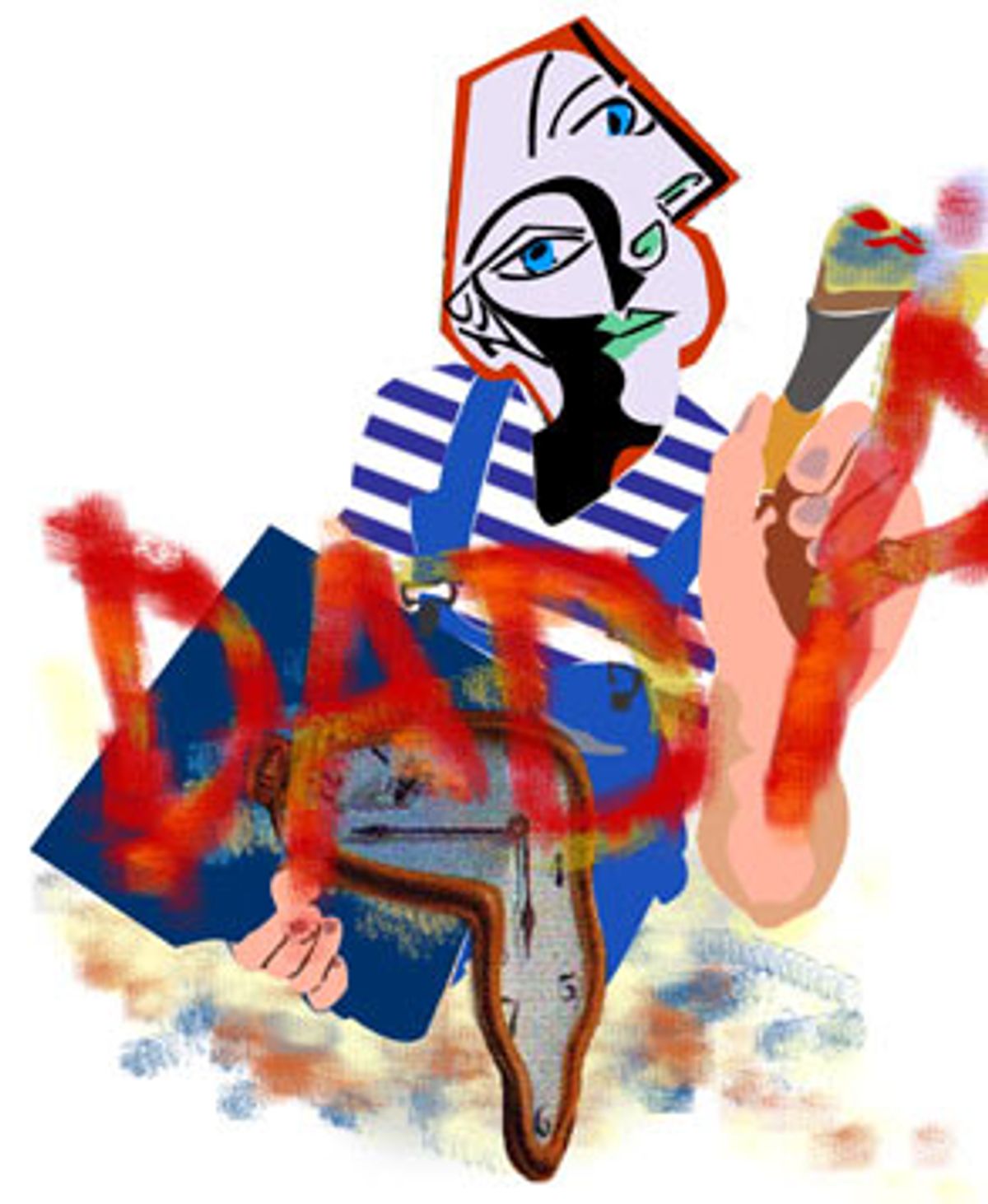
Between the years 1909 and 1924, the following demands and assertions were made:
-- That machinery and motors in cities be tuned like musical instruments, transforming every factory into "an intoxicating orchestra of noises"
-- That the art of "tactilism," which is particularly suited to "young poets, pianists, and stenographers," will enable anyone to recover the sensations of their past life "with freshness and complete surprise"
-- That the nude be totally suppressed in painting for 10 years
-- That flexible rubber tubes be connected to the udders of cows and connected to underground conduits leading to cities because "it is contrary to general human morale for different people to drink milk from the same pail"
-- That a "new race of men," inspired by the revolutionary language of the cinema, will rise up and crush palaces and prisons
-- That women must "become sublimely unjust once more, like all the forces of nature"
-- That "a racing car whose hood is adorned with great pipes ... is more beautiful than the 'Victory of Samothrace'"
-- That the authors, by the act of painting their faces, "will bear man's multiple soul to the upper reaches of reality"
-- That the right angle alone expresses the "primordial relation" of the universe, the "opposition of two extremes"
-- That the right angle, "which we consider passionless," be rejected
-- That all "cosmic faculties" should be opposed to "this gonorrhea of a putrid sun coming out of the faculties of philosophic thought"
-- That "men or women who are intelligent" can become masters of their "facial destiny" through "Auto-Facial-Construction"
-- That "Francis Picabia is an imbecile, an idiot, a pickpocket!"
-- That "the Past and Future are the prostitutes Nature has provided"
-- That "if we were sheep to the point of forming a collective school, this would surely be 'Showoffism'"
-- That "a great poet or painter must take over the directorship of all the great women's fashion houses" to create "illusionistic, sarcastic, sonorous, loud, deadly and explosive attire"
These utterances (click here for sources) are not the ravings of lunatics, or jokes dreamed up by overeducated buffoons. They are founding statements by the legendary figures who helped create modernism. It's hard to imagine just how shocking they must have been: The volcano-like eruption of modernism seems almost as distant, now that the Revolution has become a TV show, as the Renaissance. Its doctrines are exhausted, its once nerve-wracking fragments ensconced in museums, and the whole thing made sleepily irrelevant by the rise of mass media. But it was the Biggest Bang in the last 500 years of our cultural history, and if you lean over its crater you can still hear and feel it, the molten craziness and hurtling euphoria of that uncanny moment when for the last time High Art still mattered enough to hate.
"Manifesto: A Century of Isms," edited by Mary Ann Caws, gathers together the glorious, the histrionic and the just plain nutty pronouncements made by various artists and loudmouths at the outbreak of modernism. It is at once a fascinating thread running into that visionary labyrinth, an inspiring reminder of one of the great, weird moments in human history, and a sobering monument to a future that never arrived.
Caws, who teaches at the graduate school of the City University of New York and who is an expert on surrealism, has gathered every aesthetic "ism" in the 20th century, from the familiar to the delightfully obscure. The collection opens with James Abbott McNeil Whistler's "The Ten O'Clock" (1885), a celebrated art-for-art's-sake lecture that started at its unorthodox hour to give his fashionable London audience a chance to dine first, and concludes with a 1984 meditation by the poet Edmond Jabes on the idea of The Book. In between, it covers such well-known movements and ideas as cubism, futurism, expressionism, the scuola metafisica, dada, vorticism, suprematism and surrealism, as well as lesser-known ones like ultraism, rayonism, nowism, thingism, hallucinism and verticalism, along with a number of catch-all categories like "Thresholds," "Individualism and Personism," "Miscellaneous Manifestos" and "Writing and the Book." The heart of the book, what Caws calls the Manifesto Moment, covers that "ten-year period of glorious madness" stretching from 1909 (when F.T. Marinetti issued his first Futurist Manifesto) to 1919, with much attention also paid to the Surrealist movement in its heyday, the 1920s and '30s.
In her lively introduction, Caws nails the dead-serious goofiness of the Manifesto Moment:
At its most endearing, a manifesto has a madness about it. It is peculiar and angry, quirky, or downright crazed. Always opposed to something, particular or general, it has not only to be striking but to stand up straight ... The manifest proclamation itself marks a moment, whose trace it leaves as a post-event commemoration. Often the event is exactly its own announcement and nothing more, in this Modernist/Postmodernist genre. What it announces is itself. At its height, it is the deictic genre par excellence. LOOK! It says. NOW! HERE! The manifesto is by nature a loud genre, unlike the essay ... The manifesto makes an art of excess. This is how it differs from the standard and sometimes self-congratulatory ars poetica, rational and measured. The manifesto is an act of démesure, going past what is thought of as proper, sane, and literary. Its outreach demands an extravagant self-assurance. At its peak of performance, its form creates its meaning.
What's unique about these manifestos, as the admittedly extreme list of assertions above makes clear, is their inextricable blend of wisdom and silliness. Like a loudmouth in love, they're foolish -- but enviably foolish. Much of their silliness, as Caws indicates, derives from their overblown tone, which even ironic self-awareness somehow cannot curb; but their more profound and intriguing ridiculousness results from the imbalance between their grandiose mission and the actual artistic means intended to achieve it.
Again and again, the authors of these manifestos open with a mighty trumpet blast, issuing the most lofty and passionate denunciations of the imbecilic, stale, decadent, safe, bourgeois, vile, outmoded, mechanical, academic, etc. tradition they are rejecting. But when it comes time for them to reveal their epochal new vision, the mighty doctrine that will overthrow the past, turn art on its head and lead mankind into a dazzling new era of truth and beauty, it turns out to be, well, "spatial forms arising from the intersection of the reflected rays of various objects" (Rayonists Mikhail Larionov and Natalya Goncharov). Or a theater in which the actors read aloud from their parts (the Russian symbolist Fyodor Sologub). Or a placard proclaiming "No Girdle!" (The nunist Pierre Albert-Birot, who also incorrectly asserted that nunism is "an 'ism' to outlast the others.") Without discounting the originality of these ideas -- rayonist paintings are among the first abstract works ever executed, Sologub's theater anticipates Brecht, and Birot would have burned Andy Warhol in a game of one-on-one -- after the mighty windup, there's something banana peel-like about these aesthetic punchlines.
And yet, these manifestos inspire more than laughter. "The attraction of those initial or founding manifestos of violence was and is their energy and their potential for energizing," Caws notes, and their energy, their intensity, their passionate belief that art matters, that nothing is as important as finding a new, deeper, more modern way to paint or write or compose, is in the end what you take away from them.
You also take away a few pints of the finest avant-garde bile. The authors of these manifestos, like all self-consciously "advanced" thinkers -- and the Manifesto Moment was highly self-conscious -- engage in more backbiting than a Bakuninist cell. The first "ism" of them all, futurism, seems to wear the biggest "Kick Me" sign -- no doubt because its founder, F.T. Marinetti, had more than a touch of the P.T. Barnum about him, and also because his chest-beating program, with its worship of fast cars and tough guys, was so tempting a target. So here are the Russian constructivist brothers Naum Gabo and Antoine Pevsner whispering nasty nothings into futurism's chrome ear: "One had to examine Futurism beneath its appearance to realize that one faced a very ordinary chatterer, a very agile and prevaricating guy, clad in the tatters of worn-out words like 'patriotism,' 'militarism,' contempt for the female,' and all the rest of such provincial tags." Or the English vorticist R. Aldington -- whose own movement's doctrines were uncomfortably close to futurism, as is so often the case in these unpleasant affairs -- putting in his 2 cents' worth: "The artist of the modern movement is a savage (in no sense an 'advanced,' perfected, democratic, Futurist individual of Mr. Marinetti's limited imagination)." Or, returning again to Russia (Italo-Russo relations being apparently just as strained in 1913 as they are on "The Sopranos"), here are the Futurists Victor Khlebnikov and Alexey Kruchenykh piling on: "The Italians caught a whiff of these Russian ideas and began to copy them from us like schoolboys, making imitation art. They had absolutely no sense of verbal matters before 1912 (when their big collection came out), and none after ... These Italians have turned out to be noisy self-promoters, but inarticulate pipsqueaks as artists."
There's also a bit of unseemly scrambling to lay claim to the title of first dadaist, first cubo-futurist, etc. This isn't surprising: Just as the Old West was already a myth when Buffalo Bill took his Wild West show on the road, so the age of "isms" was legendary when it was still going on, and being first in line gave one the status of a minor art-deity. In light of this I-was-here-first-ism, one of the more charming manifestos is by the Brazilian Mario de Andrade, who in his "Very Interesting Preface" writes "If we are geniuses: we will point the road to follow; if we are jackasses: shipwrecks to avoid" and concludes, "So the poetic school of 'Hallucinism' is finished. In the next book I will found another school."
Such modest self-awareness is rare in these pages, and it's probably just as well: Like quarterbacks and divas, avant-garde artists pretty much have to be cocky. Of all the manifestos here, practically the only one that doesn't assert its utter originality is Jorge Luis Borges' Ultraist Manifesto of 1921, which states "The ultraists have always existed: they are those who, prescient for their times, have brought to the world new aspects of vision and expression." In this fire-breathing collection, this measured statement feels like Walter Mitty mumbling to himself at a party of gangsta rappers. (It may not be a coincidence, however, that Borges' artistic achievement is considerably greater than that of many of his noisier co-manifestoists.)
"Manifesto" includes pieces by writers as disparate as Guillaume Apollinaire, Salvador Dali, John Cage, Edvard Munch, Paul Klee (who demonstrates a higher artistic IQ than just about anybody else here), Willem de Kooning, Mina Loy (a fascinating American modernist whose aphorisms are hard-edged and memorable), Frank O'Hara and Blaise Cendrars (whose essay on film is stunning). The greatest pleasure in reading "Manifesto" is finding the unexpected prize -- and there are many, some of them Cracker Jack toys, some diamonds. Take Francis Picabia's "Dada Cannibalistic Manifesto" (1920), a masterpiece of free-associative invective:
[You are] Finally standing before DADA, which represents life and accuses you of loving everything out of snobbism from the moment that it becomes expensive.
Are you completely settled? So much the better, that way you are going to listen to me with greater attention.
What are you doing here, parked like serious oysters -- for you are serious, right?
Serious, serious, serious to death.
Death is a serious thing, huh?
One dies as a hero, or as an idiot, which is the same thing. The only word which is not ephemeral is the word death. You love death for others.
To death, death, death.
Only money which doesn't die, it just leaves on trips.
Other pieces dazzle with their mad showmanship. "The Trumpet of the Martians," by the Russian futurist Victor Khlebnikov and others, resembles something Heidegger might have written if he had dropped acid while watching "The War of the Worlds" after reading Ayn Rand:
"People of Earth, hear this! The human brain has been hopping around on three legs (the three axes of location!) We intend to refurrow the human brain and to give this puppy dog a fourth leg -- namely, the axis of TIME.
Poor lame puppy! Your obscene barking will no longer grate on our ears! [...]
Are we not gods? And are we not unprecedented in this: our steadfast betrayal of our own past, just as it barely reaches the age of victory, and our steadfast rage, raised above the planet like a hammer whose time has come? Planet Earth begins to shake already at the heavy tread of our feet!
Boom, you black sails of time!
And then there are statements that are simply, utterly weird. Here is the futurist Carlo Carra (before he met de Chirico and went metaphysical) waxing synaesthetic with psychotic precision on the colors that belong to various sounds and smells: "In railway stations and garages, and throughout the mechanical or sporting world, noises and smells are predominantly red; in restaurants and cafes they are silver, yellow and violet. While the sounds of animals are yellow and blue, those of a woman are green, blue and violet." Paging Oliver Sacks!
As Caws notes, the categories and labels attached to modernism are notoriously imprecise, and there's inevitably a fair amount of overlap and blurriness: "Expressionism" and "futurism," for example, include so many national variations as to be virtually meaningless terms. But Caws also introduces some confusion by including some "isms," like Primitivism and Individualism, that are not movements at all, but simply artistic tendencies or intellectual themes. She even makes up a category she calls "Thingism."
This editorial approach muddies the waters, but it does allow her to include essays that otherwise wouldn't have made the cut. A dubious, overly broad category titled "Nativism" gives Caws the opportunity to include superb essays by Marsden Hartley and Eudora Welty (although Caws also exhumes D.H. Lawrence's over-anthologized "The Spirit of Place.") The made-up "Thingism" makes room for a piece wonderfully titled "The Philosophy of Furniture" by that noted avant-garde theorist, Edgar Allan Poe. (Alas, the title is more interesting than Poe's essay.) In another place, Caws shoehorns Yeats into her chapter on symbolism. This is a stretch at best -- Yeats was beyond category -- but since it allows Caws to include a stunning excerpt from "Anima Hominis," who cares?
The fact that Caws essentially opens the field to all comers by including loose and baggy categories like "Individualism" and "Nativism," and essays that have little to do with art or aesthetics, invites the reader to second-guess her choices. Caws says that on principle she ruled out secondary, merely critical selections: the manifestos and statements included had to be "written by a practitioner of the particular art movement." But this artists-only rule is not absolutely enforced. And since the French feminists Helene Cixous and Catherine Clement are allowed in, why not a critic of much greater stature, Walter Benjamin, whose "The Work of Art in the Age of Mechanical Reproduction" was a far more influential 20th century text than their "Sorties"? Or T.S. Eliot's "Tradition and the Individual Talent"? Or Roland Barthes' "Writing Degree Zero"? Or Alain Robbe-Grillet's "For a New Novel"? Or even Susan Sontag's "Notes on Camp"? (Presumably, Cixous and Clement got in because the moralistic, feminist strain in their essay makes it more "manifesto-like" than the alternatives cited, which are mere lit-crit.) Other possible candidates include Evgeni Zamyatin's 1924 manifesto "On literature, revolution and entropy," Tom Wolfe's recent call for realism, one of Henry Miller's wild solos on literature, Gilles Deleuze and Felix Guattari's post-structuralist rantings, the cut-up theories of William S. Burroughs, a doctored Situationist comic strip, and one of the Fluxus or Happenings manifestos.
One could also question the high-cultural bias of Caws' selections. If, as Robert Hughes and many others have argued, mass media has replaced the fine arts as our culture's dominant force, one could make a case, as Greil Marcus implicitly did in "Lipstick Traces," that the true manifestos of our time are not documents by highbrow poets with academic sinecures but three-minute songs by angry, drug-addled punks. The Sex Pistols undoubtably changed the world more than the Language poets -- why isn't "God Save the Queen" in here?
A deeper problem -- though one that is to a large degree beyond Caws' control -- is the fact that, like modernism itself, "Manifestos" gets less interesting as it goes along. The last quarter or so of the book, after the chapter on surrealism, is far weaker than the earlier part. With a few minor exceptions like lettrism, after surrealism modernism simply didn't offer any more significant formal innovations (or, more to the point, chest-pounding bombast), and so the book simply runs slowly out of steam. The categories become ever more watery and eclectic: Does Whitman's "Song of Myself" really need to be in here? Does a category called "Individualism" mean anything? One chapter, "Thresholds," seems a perfunctory sop to bien-pensant academic trends.
The last cohesive modernist movement featured in the book is language poetry, a heavily theorized, frequently unreadable postmodern school celebrated in academia. In her introduction, Caws notes that "If the Postmodernist manifesto shrugs off [Modernist] nostalgia, it has often a kind of dryness that undoes its energy": her words certainly apply, not just to the language poets but to many of book's more contemporary manifestos.
Why is this? What's at issue is not just the status of postmodernism, but that of modernism itself. Is postmodernism a vital part of the great modernist tradition of rebellion and formal innovation, and thus worthy of inclusion in a book that confers upon it, by association, the heroic mantle of its predecessors? Is it merely a cul-de-sac, the playing-out of a dead end within modernism? Or was modernism a glorious but one-time-only explosion that has now exhausted itself, rendering futile all attempts to continue working in the same radically exploratory vein?
To answer these questions, we need to look more closely at the crisis that modernism responded to and the answers it gave. Modernism came into being at the precise moment when the relationship of art to life became problematic: It was an attempt to answer questions that had never before been posed with such force: What is art? Does it matter? How can it express a reality that is itself no longer known? The early modernists struggled mightily (and often, as we've seen, kookily) with these questions -- and were sometimes tortured by both the questions themselves and the answers they came up with.
Caws acutely notes that "some Modernist manifestos give off an odd aura of looking back, to some moment they missed." This sense of loss is, at bottom, spiritual -- it is the sense that God is dead and something that used to be called "art" has to take his place, and no one knows how that's supposed to happen. Much of the energy and tension of modernism derives from its attempt to replace God -- but that attempt is tortured by the artists' consciousness of its impossibility. (Much modernist bravado is a mask.) This impulse lies behind the disquieting need of so many of these movements to force various artistic forms to do what they by definition cannot do -- to make painting talk, music see, words sing. What can these doomed leaps into a formal void be if not attempts to force the world to become transfigured, holy, other?
Now that modernist works are safely enshrined in museums, they seem to exude the repose and calm of Olympian masterpieces. What many of them really are, in fact, is magnificent records of a struggle, not a victory -- attempts to shore up fragments against ruin, traces of prayers that didn't work, scaffolding built for an assault on heaven that collapsed. Yet even a spiritual journey that has not reached its goal can be an artistic success. By engaging with ultimate questions, the modernists kept the faith -- even if it was the faith of nonbelievers.
The founding struggle between "art" and "life" divides modernists into two camps. One group denigrates life -- or nature, or the "self" -- and exalts art. The vorticist R. Aldington writes, "The Vorticist does not suck up to life. He lets Life know its place in a Vorticist Universe!" Mondrian, with his metaphysical fetish of the right angle (Caws notes that while lunching with Jean Arp, the nature-hating Dutchman "requested a seat at the window so as not to have to look at the landscape"!) writes disparagingly that "In the natural, however, unity is manifested only in a veiled way." And Malevich writes, "the only obligation to nature which mankind has taken upon itself [is] to create art." The other group rejects art, or at least all previous art, in favor of the higher truth of life or nature. Thus Marsden Hartley: "We are most original when we are most like life. Life is the natural thing." Or the constructivists Gabo and Pevsner, who denounce beauty and write, "All is a fiction ... Only life and its laws are authentic."
In the end, it doesn't matter what side of this debate an artist is on; what matters is simply that he or she engages with it. Many answers emerged from that struggle: the mysticism of the Russian symbolist Vyacheslav Ivanov and Malevich's ascetic formal purity; the dreamlike rebuses of Magritte and the scientistic gravity of the constructivists Gabo and Pevsner; the audacious innovations of Picasso and Braque and the frightening masks of Artaud. Yet all these manifestations share a common element: an overarching belief that art matters, that it has something vital to say. That belief, carved out of a struggle with silence and expressed in a strenuous engagement with form, was the driving force behind the great artistic achievement of modernism.
We gaze upon that belief with disbelief, that enchantment with disenchantment. Inevitably, reading these fiery documents, which were written not so long ago, leads to nostalgia, to an acute sense of cultural loss -- the same sense, ironically, the moderns themselves felt when looking at primitive art. Where did that belief in art come from? What happened to it? And how can we get it back?
The short answer to the last question is: We can't, at least not in the same form. Modernism was the product of a uniquely cataclysmic change in society. In his study of modern art, "The Shock of the New," Robert Hughes quotes the French writer Charles Peguy, who said in 1913 "the world has changed less since the time of Jesus Christ than it has in the last 30 years." This accelerated change in all areas of society -- Einstein's rewriting of the laws of nature (which a recent book argues played a significant role in Picasso's development of cubism), the invention of the car, the plane, the phonograph, the triumph of industrialization, the city, bureaucracies and rationalized capitalism -- was unprecedented, and it will never happen again.
Modernism, which arose in reaction to those inconceivably rapid changes, was also unprecedented -- Hughes calls it "one of the supreme cultural experiments in the history of the world" -- and it, too, will never happen again. Perhaps the healthiest attitude we can have regarding modernism is to appreciate it as something rare, beautiful and very, very strange that came and passed -- a comet that streaked across our sky for an uncanny moment, then disappeared forever.
But to do that would not, I think, mean giving up our connection with what is enduring about modernism -- its drive to find forms that mirror our new sense of the old chaos, what Frank Kermode has called our "rage for order." In this regard, Paul de Man is right: every age is modernist. Or, as Borges said, "The Ultraists have always existed." But it does mean pruning out the dead part of modernism, the part we can't use -- and which is precisely the part that still holds us in a rigor mortis-like grip.
"Has Modernism Failed?" the critic Suzi Gablik asked. Yes and no. There is a strain within modernism -- its most absolute, nihilistic and Manichaean strain, its quintessential one -- that denies the value of art itself. It is found playfully in dada, elegantly in Duchamp, scarily in those pure varieties of futurism that exalted war because it made life into a work of art. And this part of modernism -- which was really postmodernism avant la lettre -- did fail. It had to, because it had nowhere to go. It led to the extreme, self-canceling gestures with which we are all too familiar: dice-toss art, silent art, readymade art -- all those cute, nihilistic table-trimmings for what Kermode called a "farcical apocalypse."
Recognizing this is a start in breaking modernism's dead grip on us. And it should open our eyes to its corollary: the heart-quickening idea that there is no progress in art.
So reading these manifestos inspires gloom, but it also instills hope. The passion of the documents gathered here is an unpleasant reminder that our own passion about art -- at least in our public pronouncements -- does not match theirs. But these credos also remind us that great art can be created in any historical situation, even one as glibly ironic and commodified as ours. All that is required is the belief in form, the inner tension required to investigate and mirror the world.
But can we still generate that belief, that tension, today? It's all well and good to say that there is no progress in art, but there does seem to be decline -- and history seems to work against the possibility of rejuvenation. Modernism drew its tension from its questioning of art itself, but at a time when that questioning still could be folded back into art's great, unbroken tradition: modernist masterpieces, whether Joyce's "Ulysses" or Picasso's "Les Demoiselles d'Avignon" or de Chirico's "The Disquieting Muses," derive their power from the collision of innovation and tradition, a collision in which destructiveness and creation are inextricably tangled. Once questioning becomes the tradition, which is the situation we now find ourselves in, all that is solid melts into air; the walls artists need to push against vanish. Artists still go through the motions of manipulating form, but their heart isn't in their subversions anymore -- nor can they return to the good old unconscious days when just imposing their own individual style on the style of the day was enough. Art always must move forward, find a new way to steal the old fire -- but after modernism, there is no forward. Nietzsche's fear that nihilism, "uncanniest of all visitors," would win has come true.
But to accept this is to give the accidents of history too much power over us. The true spirit of modernism -- not its dream of an end to art, but its search for forms that, in John Lennon's words, howl and move -- will endure. Yes, it was that intoxicating fork in history's road that unleashed the demons and angels of modernism, and that fork will never come again. But the road goes on.
If we listen to modernism itself, there is hope. Modernism teaches us that humans have an archetypal need to express, which primitive art reveals and which modern man shares. It teaches us that the struggle with form, with the materials given by the world which can be used to discover the world, always has the capacity to be heroic. It teaches us that, in the end, art matters. If these lessons are true, modernism's own towering achievement will not stand as an epitaph -- and a human activity that goes back to those magical bison painted on the walls of the caves of Altamira will not die.
It's true that things have changed. The old enemies are gone. This time, we will have to do without a God or a tradition to battle with: We will have to construct and create using only the tension of our own souls. But every generation faces the same unknown and radiant world. And if the triumph of the modernists is our triumph, there will be art.
Shares