

"It is the lack of (Albert Speer's) psychological and spiritual ballast and the ease with which he handles the terrifying technical and organizational machinery of our age which make this slight type go extremely far nowadays. This is their age; the Hitlers and Himmlers we may get rid of, but the Speers, whatever happens to this particular special man, will long be with us."
-- London Observer, April 9, 1944
"The attack of bombardment, by whatever means, of towns, villages, dwellings, or buildings which are undefended is prohibited."
-- Article 25, The Hague Convention, 1907
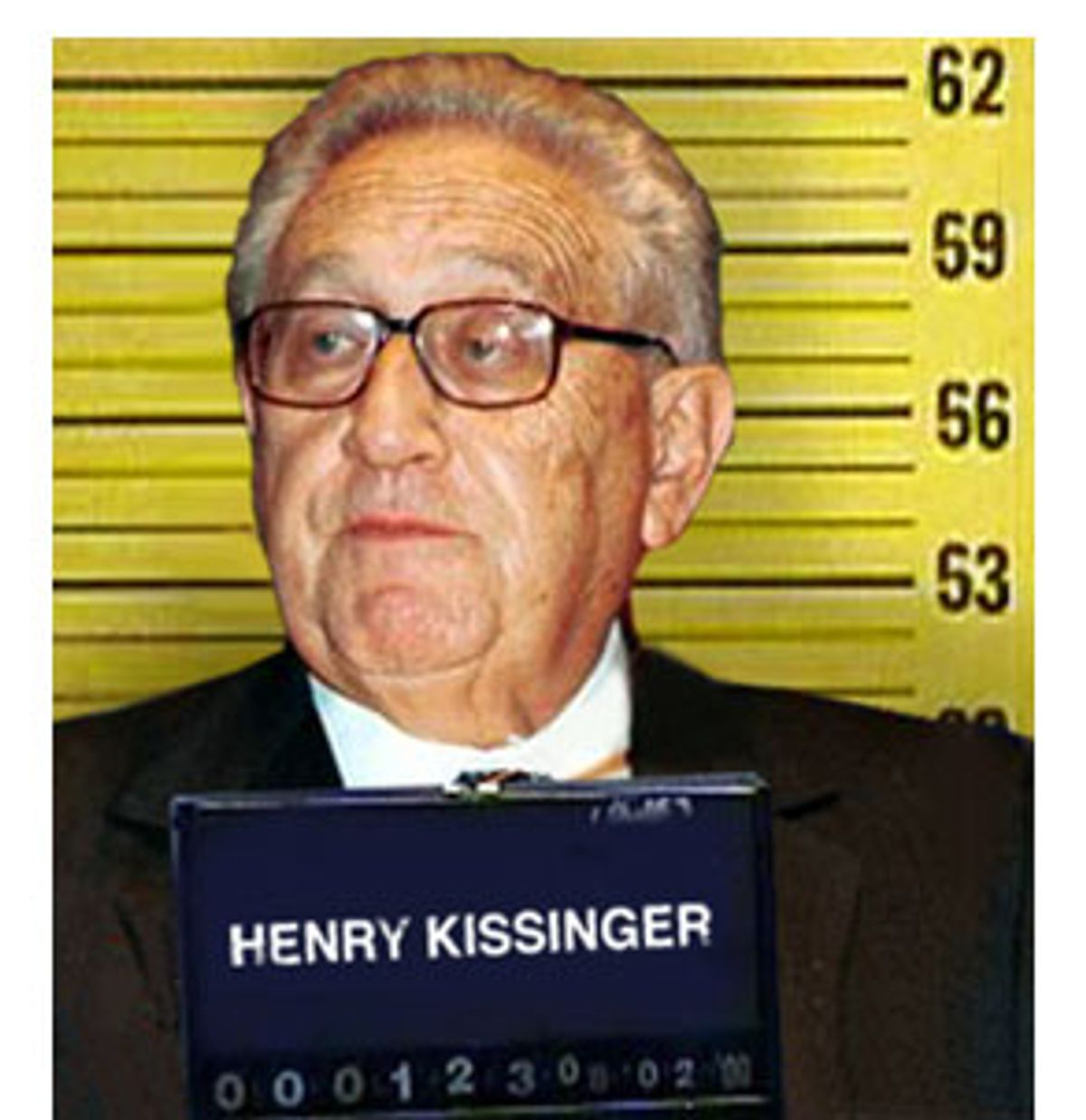
Henry Kissinger was a lightning rod for Vietnam War opponents from 1969 to 1975, when he served as national security advisor and secretary of state to Presidents Nixon and Ford. A quarter century after Kissinger left public service, the United States is still picking at the scars of Vietnam and grappling with the global resentments sparked by his realpolitik policies. And yet, despite a whiff of ignominy that still clings to him, Kissinger has grown jowly and prosperous off his connections and consulting services, and is feted in the most exclusive salons of Manhattan and Washington. His guttural pronouncements can be heard whenever there's a global crisis that needs explanation.
But some of us will never forget the Kissinger of the 1970s.
Several times a month, as I shave, I find myself looking deeply into my eyes -- and remembering theirs. It took a lot to create that haunted and broken look in the eyes of the peasants who had fled the Plain of Jars in northern Laos. I interviewed hundreds of these refugees from the illegal Nixon-Kissinger air war while working as a journalist and interpreter for TV reporters like Ted Koppel and Bernard Kalb between September 1969 and February 1971. I dispatched tapes of these interviews and photos to congressional committees in Washington and later appeared before a hearing chaired by Sen. Ted Kennedy. But while my efforts helped generate a flurry of attention for the victims of the illegal Laos air war -- the most brutal and sustained bombing campaign against a civilian population in history -- no one from the Nixon administration was ever brought to justice as a result.
They had names, these people: Thao, Bounphet, Khamphong, Loung. They had treasured wives and husbands, children and grandparents, buffaloes and homes, rice fields and temples. And they had dreams -- and as much right to these dreams as did any of the U.S. leaders who obliterated them.
It was a wrenching experience to hear these kind, decent human beings describe the extermination of revered grandmothers, burned alive by napalm before their eyes, to hear them weep as they remembered seeing a beloved 3-year-old daughter torn apart by anti-personnel bombs. Many of the children who survived carried the marks of the U.S. air war, burned flesh, missing limbs.
These people had voices, too, although they were rarely heard back in the United States. I collected their stories in a book called "Voices From the Plain of Jars." In it, one 33-year-old woman recalled, "We lived in holes to protect our lives. There were bombs of many kinds. I saw my cousin die in the field of death. My heart was most disturbed and my voice called out loudly. (The airplanes came) until there were no houses at all. And the cows and buffalo were finished. Until everything was leveled and you could see only the red, red ground."
The Nixon-Kissinger holocaust from above continued to afflict the peasant populations of Southeast Asia until the end of the war. Although these two remorseless executioners were finally forced by the growing antiwar fervor at home to withdraw U.S. ground troops, they vastly expanded their bombing operations across Vietnam, Laos and Cambodia. Their goal was not, as they claimed, to protect the American troop withdrawal. The North Vietnamese would have happily escorted U.S. troops out of the country. Rather, Nixon and Kissinger used the bombing to prop up local regimes and avoid being seen as responsible for "losing" Indochina.
It is important to separate the way the air war was conducted from the politics on the ground. Even if one believes U.S. support for local Indochinese regimes was warranted, this in no way justified the indiscriminate U.S. bombing that decimated hundreds of villages in violation of the most basic laws of humanity and international justice. Nor is it true, as Kissinger claims, that his bombing was supported by Congress. This supremely cunning man orchestrated an extraordinary coverup of the extent of civilian casualties. Had the full human consequences of the air war been brought before the American people, it's likely that support for U.S. bombing would have quickly evaporated.
Nearly 4 million tons of bombs were dropped on the people of Southeast Asia while Kissinger orchestrated the war, over 1 million tons more than was dropped during the presidency of Lyndon Johnson and twice the tonnage dropped on all of Europe and the entire Pacific theater in World War II. More than 1 million Indochinese perished and 10 million were wounded and made homeless.
Kissinger executed this massive aerial assault without any serious regard for the civilians below, as I discovered in an investigation of the bombing of Cambodia in the spring of 1973. On a research mission for Washington's Indochina Resource Center, I spent a day flying over a Khmer Rouge-controlled area that the U.S. Embassy estimated was inhabited by 2 million Cambodians without seeing a single sign of life. I had hitched a ride with an old acquaintance from Laos who was piloting a plane on contract for the CIA, dropping supplies to outposts of pro-U.S. Cambodian troops. He told me the people were hiding from the American bombing -- particularly the B-52s, which indiscriminately obliterated areas the size of football fields from 30,000 feet -- and that there was little if any evidence on the ground of legitimate military targets.
I used the pilot's radio the next day to listen in on raids, and discovered that U.S. pilots bombing Cambodia neither knew, nor checked with anyone to discover, if there were civilians in the area. Later I was informed by the U.S. Air Force "bombing officer" at 7th Air Force Headquarters in Nakhorn Phanom, Thailand, who was officially charged with making sure that no civilian targets were bombed, that in reality he only certified that no CIA teams were in areas under bombardment. He said he had no idea if civilians were present.
This wanton bombing of civilian populations was a direct violation of international law. And it is this wholesale slaughter of noncombatants that Christopher Hitchens cites in making his strongest case for the prosecution of Henry Kissinger as a war criminal in his provocative new book, "The Trial of Henry Kissinger." (Hitchens interviewed me for the book, distilling my reports into a two-page discussion of the bombing of Laos.)
Hitchens' book originated as a two-part essay in Harper's magazine in February and March 2001. The Harper's essay stirred no investigative interest in official Washington or corporate media circles, as did the recent Bob Kerrey revelations. But Hitchens did succeed in provoking a lively reassessment of Kissinger's record on the Internet and in campus forums. His book deserves much wider attention. If former Sen. Bob Kerrey's actions as a young Navy commando in Vietnam momentarily pricked the national conscience, Kissinger's Southeast Asia policies should haunt us to our graves if we do not come to terms with them.
If killing hundreds of thousands of innocent peasants by dropping million of tons of bombs on undefended civilian targets is not a war crime, then there are no war crimes. If Kissinger is not responsible for these crimes, then there are no war criminals.
Hitchens does not confine his case against Kissinger to the bombing of Indochina. He also focuses on the dark arts of Kissinger diplomacy, the aiding and abetting of murderous U.S. client states, such as the Pakistani regime whose violent repression of Bangladesh in 1974 resulted in the deaths of between 500,000 and 3 million people, the blood-soaked junta led by Augusto Pinochet in Chile and the Indonesian generals who killed 200,000 civilians in East Timor.
There is no question that Kissinger's support for such savage regimes will stain his name for many years to come. But it would be more difficult to indict Kissinger as a war criminal for these actions -- since other powers ordered the actual killing -- than for his actions in Indochina. There he was a prime architect of the massive bombing of undefended civilian targets. And international conventions endorsed by the U.S., such as the 1907 Hague convention quoted above, unambiguously forbid such bombing.
Not surprisingly, Kissinger shares few of Hitchens' concerns in his new book, "Does America Need a Foreign Policy?" which largely ignores Vietnam, Indonesia, Chile and many other Cold War battlegrounds to which he once devoted so much time. But Kissinger and Hitchens do share an interest in one subject: the Pinochet case, that is, the extent to which jurists in one nation have international jurisdiction over officials who have committed human rights violations in another. Writing of Spain's indictment of the former Chilean dictator on torture and murder charges, and his subsequent detainment in England, Hitchens notes that "Kissinger [has grasped] what so many other people did not: that if the Pinochet precedent became established, then he himself was in some danger."
Indeed Kissinger does seem worried when he addresses the subject in his book: "If the Pinochet case becomes a precedent, magistrates anywhere will be in a position to put forward an extradition request without warning to the accused and regardless of the policies that the accused's country might already have in place for dealing with these charges."
Fortunately for Kissinger, in his case, "the accused's country" has no such policies for dealing with the mass murder of civilians in Indochina. Not only are there no official means for dealing with Hitchens' charges against him, but he is lionized by the highest sectors of American society. As Hitchens notes, Kissinger is paid between $25,000 and $30,000 a speech and has grown wealthy by offering advice to Fortune 500 companies and catering to foreign clients like the Chinese dictatorship. His opinions are sought by Newsweek and the Washington Post; his new book is a Book of the Month Club selection. Kissinger's status tells us less about himself than it does about our society as it begins the 21st century.
Only a nation in deep spiritual and psychological disarray could honor a man with as much blood on his hands as Henry Kissinger. An entire generation was plunged into a moral abyss during the Vietnam War from which it has yet to emerge. This moral confusion was on stark display during the recent public agony over Bob Kerrey's wartime actions. Under what circumstances, if any, is it permissible to kill civilians? Should America ever engage in wars where military enemies and civilians cannot be separated? The fact that we are still struggling with these questions decades after we fled Vietnam shows how deeply unresolved they still are.
It is not necessary, however desirable, to say we were wrong in intervening in Indochina, or even to admit that we were responsible for the vast majority of the war's casualties. But we refuse at our peril to at least take responsibility for the millions of casualties we certifiably did cause, and seek to make amends to the relatives of those we killed. The Germans did so after World War II, not so much for the Jews as for themselves. Our failure to do so harms our society no less than that of the Indochinese.
Kissinger's new book highlights the central problem facing America today: the rise of a skilled but unfeeling class that has ascended to the heights of power as the new century begins. Kissinger's stance is that of the technocrat, above party and ideology, unselfishly pursuing the national interest. "On the left, many act as if America has the appropriate democratic solution for every society regardless of cultural and historical differences," he writes. "On the right, some believe ... that the solution to the world's ills is American hegemony. Either interpretation makes it difficult to elaborate a long-range approach to a world in transition."
But what exactly is the nonideological "long-range approach" we need? Kissinger never really says. His book is essentially a foreign policy travelogue, as he proceeds region by region around the world describing a variety of short-term issues -- supporting missile defense here, sanctions against Saddam Hussein there -- and making countless observations of stupefying banality. Even more striking than the vacuity of what he does say, however, is what he does not. America's top foreign policy imperative for the coming century is clearly to lead an international effort to save a biosphere now seriously threatened by global warming and other environmental ills. Kissinger gives the tersest of nods to this monumental global challenge, bundling it together with a hodgepodge of "New Age issues: proliferation, environmental, cultural and scholarly exchange, among many others."
It is almost banal to note Kissinger's banality. But his unique mixture of emptiness and celebrity, power and amorality, mystique and lack of principles, has made him one of the quintessential figures of the post-World War II era -- fulfilling the prediction made by the London Observer 57 years ago.
In the past we had most to fear from charismatic tyrants. Today it is the technocrats, the "slight types" who efficiently run our government and dominate our age. It is the Dick Cheneys, who manage our withdrawal from the Kyoto treaty on global warming and cut spending on conservation; the Donald Rumsfelds, who lead the charge for missile defense and space war and disturb the world's nuclear equilibrium.
With his unparalleled talent for bureaucratic intrigue and media manipulation, Henry Kissinger was among the first of these types to attain power in the post-war world.
He will not be the last.
Shares