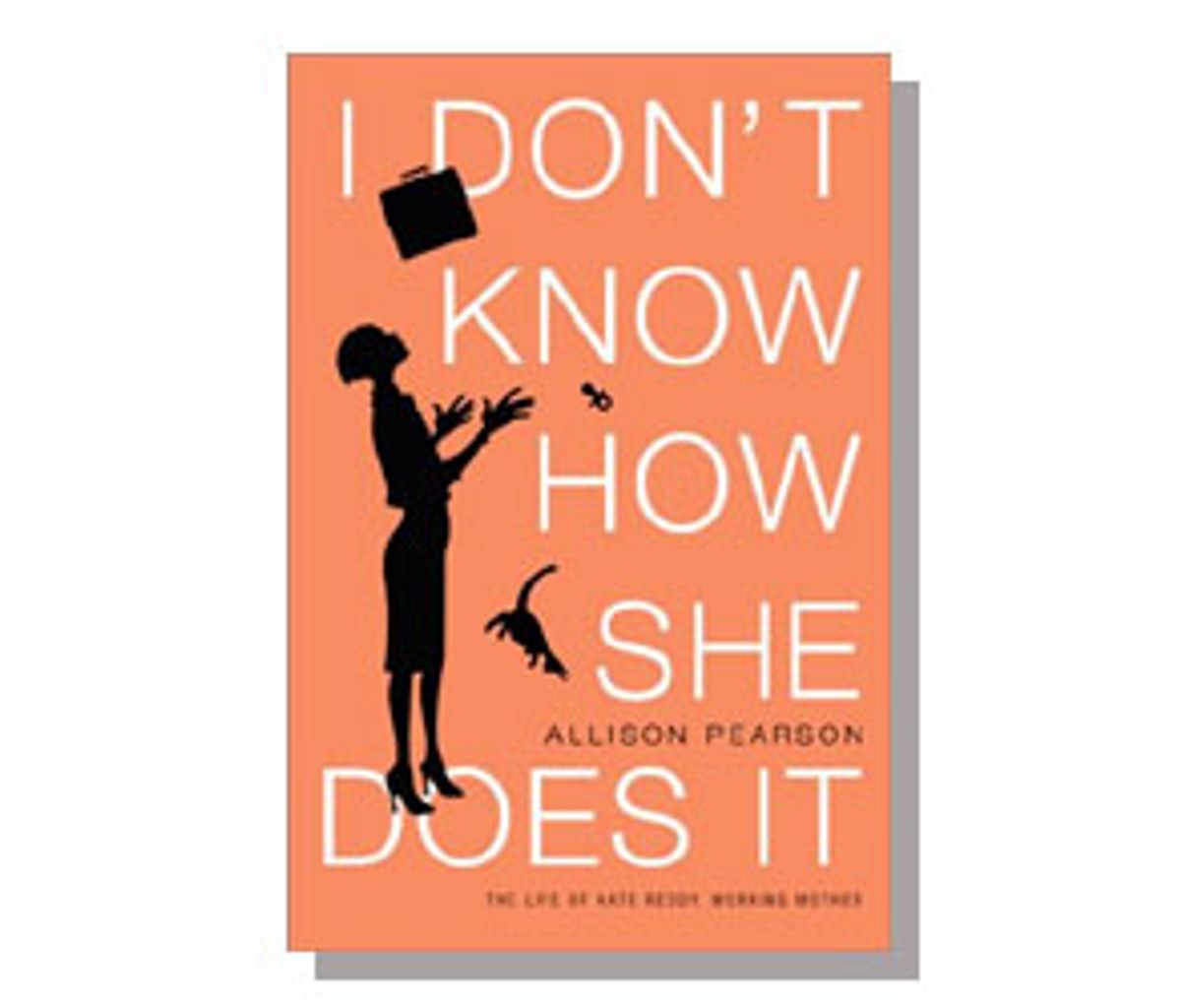
That women have broken through the glass ceiling is one of the best-kept secrets in America -- even better kept than their success in combining executive life with motherhood. You wouldn't know about either if all you had to go by was the defeatist tone of most chick lit, including the widely hyped new British import "I Don't Know How She Does It" by Allison Pearson. In this faux diary's alternate reality, sexist comments and attitudes dominate business culture, working life with children is a nightmarish struggle, and women are wise to throw in the towel for full-time motherhood or scaled-down ambitions.
I say "alternate reality," because Fortune recently published its annual roundup of the 50 most powerful women in American business, and the roster of powerful corporations with female CEOs includes Kraft Foods, eBay, PepsiCo, Avon, Ogilvy & Mather Worldwide, Hearst Magazines, Lucent, Sanford C. Bernstein, MTV Networks Music Group, Time and Xerox.
Pseudofeminists like Sylvia Ann Hewlett, the author of "Creating a Life: Professional Women and the Quest for Children," insist that these women have paid the price for their success with childlessness. But while Hewlett claims that 49 percent of women earning more than $100,000 per year are childless after 40, 71 percent of the 187 high achievers who attended Fortune's Most Powerful Women in Business Summit earlier this year have kids -- an average of 2.2 per woman. According to Fortune, "Lehman Brothers' Barbara Byrne notes that eight of 10 female managing directors in her investment-banking division have kids -- 'and most more than one.' Byrne herself has four."
Yes, girls, you can have it all -- or as much of it as the supermotivated, bright and lucky boys can have. And the key is a word you don't see very much in "feminist" novels or tirades: money. Lots of money. Hewlett's numbers don't match Fortune's because there's a huge difference between life on $100,000 a year and the $500,000 to $1,000,000 or more per year that the Fortune women make. Nannies and home staff start to be affordable long before you get to the middle number and are easy to manage at the highest. So is a nonworking spouse, and 30 percent of the Fortune Top 50 have househusbands.
"I Don't Know How She Does It" is all about money and the trade-offs we make between money and time, pleasure and family life, but you won't find much about the M-word between its covers. The book's meticulous realism about unimportant details -- where else can you read about the struggle to put the rain hood on a baby carriage? -- masks Pearson's lack of realism about the social landscape. "I Don't Know How She Does It" is fundamentally dishonest about the relationship between money and gender. Instead, it offers masochistic clichés of the "You can't have it all" variety. That's probably why it has been a bestseller in Britain and has been sold to the movies.
Money should play a leading role in "I Don't Know How She Does It" because Pearson has made her heroine, Kate Reddy, a hedge-fund manager at EMF, a prestigious investment bank in the City (London's financial district). That was probably a bad choice; it's hard to fake a knowledge of other people's jobs, and that of the financial industry may be the hardest to fake of all. Some of the details of Kate's life do ring true. She and her gentle architect husband, Richard, live in a townhouse and have a nanny who comes in daily. Kate buys four pairs of shoes at a time, takes a car service rather than mass transit to work when she's late, and wears Armani.
But the diary entries Kate writes tell a story of desperation and domestic chaos that doesn't match up. They're all about losing sleep to make store-bought pies look home baked for school events, finding rats and rot in her house and lice in her kids' hair, and living in an atmosphere she calls "medieval squalor." Kate's afraid of antagonizing her demanding, insubordinate nanny Paula, whom she sends on vacation to Morocco, and even of annoying her incompetent cleaner.
Nor are we told how much Kate makes; a minor character, a cabdriver, speculates "Fifty? A hundred?" Ridiculous, especially in London. The real Kate Reddys make 500,000 pounds a year -- around $750,000. The real Kate Reddys don't fake homemade pies at 2 in the morning -- they pay someone else to bake them.
Money isn't one of the items Kate mentions in her litany of what she loves about her job: "I love the blood rush when the stocks I took a punt on deliver the goods. I get a kick out of being one of the handful of women in the Club Lounge at the airport ... Most of all I love the work: the synapse-snapping satisfaction of being good at it, of being in control when the rest of life seems such an awful mess." You'd never guess that Kate is in a field that most people would say they stick with for the money, even for the sense of achievement they get from earning so much: "It's a way of keeping score" is the Wall Street cliché.
What Pearson is describing is life in a much less demanding job -- as a moderately successful newspaper columnist (Pearson's job), say -- one that pays a lot less money than her heroine is supposedly earning. And Kate is the kind of woman who wouldn't be likely to go to work in the City to begin with. Kate calmly accepts her boss's decision not to give her a bonus. In investment banking, that's a signal to switch firms -- but she doesn't have the authentic attitude, the pride or the swagger. While Pearson accurately notes investment bankers' class bias, she doesn't get at their self-identification as an aristocracy. When I used the term "former investment banker" to one of my bosses in corporate finance 20 years ago, it was as if I'd said, "a former duke." He snapped, "There are no former investment bankers."
In other words, Pearson has created a money manager who hardly cares about money and doesn't know how to use the money she has. Kate's life reflects those of many working women, but not those of hedge-fund managers. So why didn't Pearson just make Kate a middle manager? It wouldn't suit her ideological point, which seems to be that even the heights of worldly success aren't worth the sacrifices for a working mother. (This message also makes all the middle managers who don't seem likely to scale those heights feel better.)
Pearson doesn't want her heroine to like money because nice girls don't -- and because people socialized in publishing, like Pearson, are especially likely not to. But to make her points about family, Pearson stacks the deck. Kate endures the kind of domestic chaos her real-life counterparts don't have to -- and don't -- abide, and she doesn't enjoy the rewards of her career.
And when Richard briefly moves out (who wouldn't, with the filth and the rats and lice and the demanding nanny and the bitchy wife?), what brings him back is Kate's giving up her job. Doesn't make much sense -- God help an architect whose stay-at-home wife has a shoe habit -- but Pearson isn't trying to write a book about how such dilemmas are resolved. She's trying to convince us that women have a rough lot, no matter what they choose.
Kate is also given a singularly nasty bunch of male colleagues. There's a subplot involving Internet pornography and one particularly demonic banker, but even the one who seems to have a heart -- posh, gruffly kind Robin Cooper-Clark -- remarries six months after his wife dies of cancer. Sexist comments abound in a way completely untrue to the memories of my own investment banking days 20 years ago.
It could be objected that Pearson is criticizing the type of men who become bankers, or what happens to men who work at banks, but what we actually read on the page is that high-powered workplaces are hostile to women as women, not simply to women who don't subscribe to certain values. This just isn't true.
Investment banks are difficult environments characterized by brutal competition and backstabbing -- like lots of other human institutions. But unlike, for example, publishing houses or universities, they are also pretty damn meritocratic, as suggested by the recent ascension of black men to the position of COO at Merrill Lynch and head of investment banking at Credit Suisse First Boston. You may not approve of the merits selected for, but gender and race don't hinder those who have them.
Pearson also stacks the deck when it comes to divisions of responsibility in family life. We're told Kate's the main breadwinner. The real-life difference between a hedge-fund manager's income and an architect's is huge. It's even bigger when the architect, like Richard, is given to the "undercharging of clients he feels sorry for."
It never occurs to either one of them that if they are stretched too far as a working couple, Richard's the one who ought to quit working outside the home to be a full-time parent or scale down his hours. After all, despite all her guilt about "neglecting" them, Kate admits that after a weekend with her kids, "I'm screaming to be let out the house, but with Paula it's steady as she goes. Never raises her voice."
Still, Kate and Richard let Paula go and move to Derbyshire, where for some months Kate is a stay-at-home mom. Her house is still a mess and there's no sign that she is having much more fun or more time for herself than she did in London. At the end of the book, she admits to being bored, and it looks as though she'll go back to work again, somehow. She contemplates rescuing a struggling company, though how this will make for more family-compatible hours is anyone's guess.
"I Don't Know How She Does It" is a confused book, not just a book about a confused woman, and this is what makes it a sign of the times. Kate Reddy's problems are all solvable by money, which is why they're not really very interesting. (Compare, say, Kurt Andersen's "Turn of the Century" or Bruce Wagner's "I'm Losing You," business novels that treat money and wealth forthrightly and that raise more thought-provoking questions.) Pearson won't be honest about this, because then her slim pretext of a plot would dissolve utterly.
It's no coincidence that Pearson's confusion centers on money. Because we're no longer sure just what "femininity" and "masculinity" are, money has come to bear a disproportionate symbolic weight. If we're feeling particularly muddled about gender, we tend to fall back on money as a way to sort it out; when in doubt, daddy works and mommy stays at home.
And because having children has become a deliberate choice, rather than an inevitability for almost all heterosexual couples, the decision has to be recast as one of almost existential altruism. It has to mean everything. As Kate puts it: "Children are the proof we've been here ... They're the best thing and the most impossible thing, but there's nothing else." Nothing else? Really? Jane Austen's name lives on to prove that she was "here," even though she had no children; Lloyd's of London survives, but who knows whether Lloyd's descendants do?
Pearson won't even give us any characters who choose not to have kids, because if you take away the rationale that women must do most of the childcare, she wouldn't be left with any reason for women not to pursue conventional success. There are plenty of good arguments to be made against people spending their lives chasing money, or working in tense corporate jobs, but Pearson doesn't make them. We're just supposed to think that women are innately better than all that. And they're better because they can be moms.
It's hard to disentangle Pearson's dishonesty about the real issues of work and family life from her own choice to write a clone of another, better book, "Bridget Jones's Diary." While a fair amount of commercial calculation probably went into writing "Bridget Jones," Helen Fielding created vivid characters that readers cared about. Everyone in "I Don't Know How She Does It" besides Kate Reddy is a ghost or a one-liner. Bridget had the idiosyncrasies of the work of the human hand and heart, but this imitation has the feel of a product designed by committee. It's like one of those potato chips manufactured to look homemade.
Pearson, laughing all the way to the bank, might have given a thought to the implicit politics of her work and how most of the joke is on young, confused women who will take her book as yet another bit of "proof" that their place is not the workplace or the executive suite, and that capitalism is designed to keep women down. It's not. History suggests that financial success is the only way women will finally achieve not just legal equality with men but also power and respect. Female managing directors at Lehman make lots more money -- and more honestly -- than Pearson will from this exercise in victimology. And young women would be better off reading Fortune instead.
Shares