

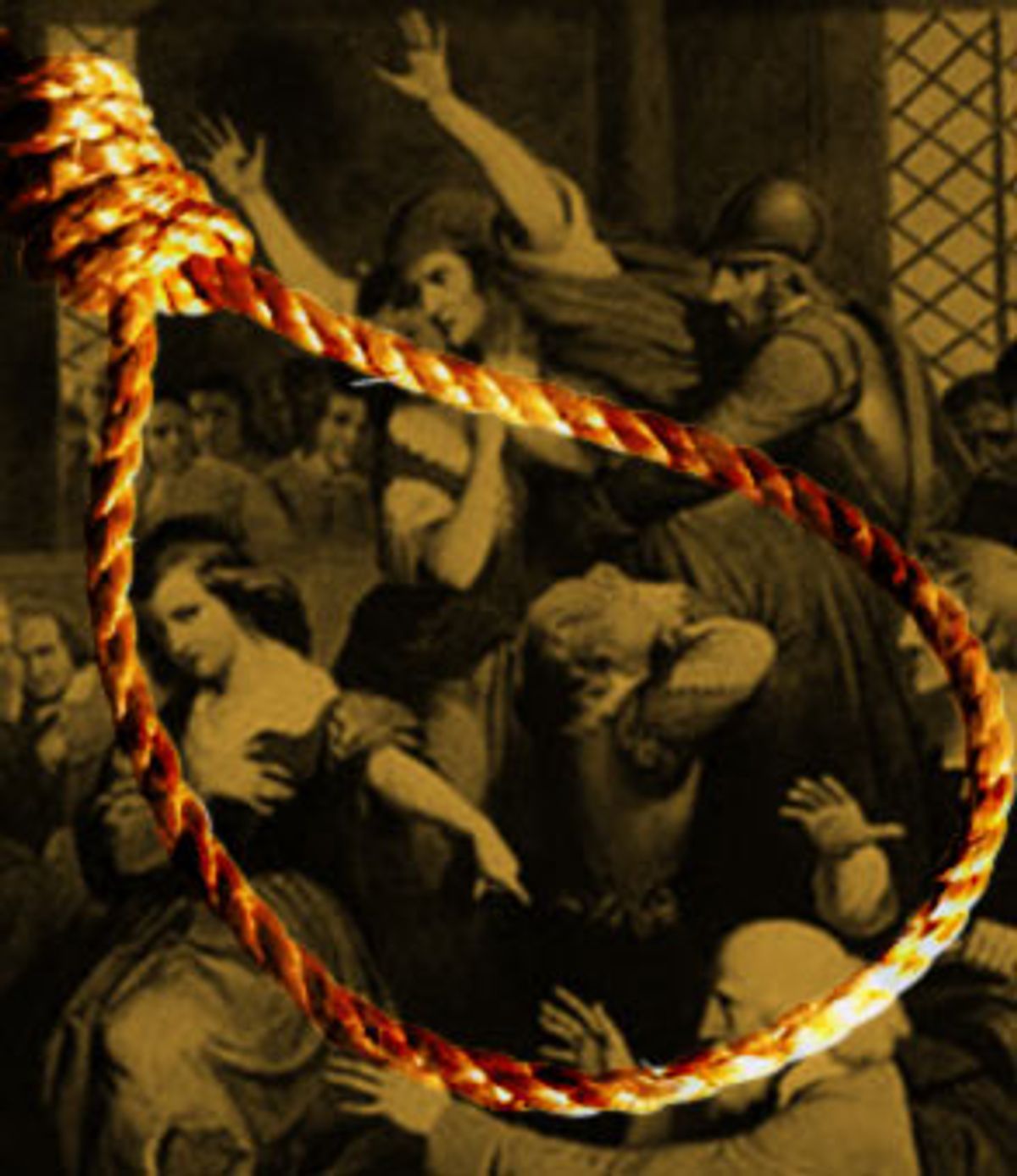
The Salem Witch Trials are America's original home-grown horror. The crisis happened over 300 years ago in a world very different from today's -- and to people seemingly very different from ourselves -- and yet so many of its elements keep cropping up again and again in our public life. A panic that spreads like a virus, intimations of a vile conspiracy, children and young women horribly abused, a fog of accusations, shocking confessions, sensational trials, reputations destroyed, culprits (or scapegoats) located and harshly punished, and an aftermath in which anyone with a conscience looks back and asks, "What just happened? Did we really do that?"
Salem, too, is a challenge to everyone, whether on the left or the right, who sentimentalizes or idealizes the Way Things Used to Be. Feeling nostalgic for the peace and safety of small town life? Convinced that what the world needs now is a return to Christian values? Think that the trouble with contemporary society is that we've lost our sense of community? Well, Salem was a small town, as Christian as they come, and it's got to be Exhibit A on the list of what sucks about living in a place where everybody knows your name.
At first glance, we seem in no danger of letting the memory of Salem fade. Fifty years ago, the Witch Trials served as a metaphor for McCarthyism in Arthur Miller's play "The Crucible." A decade or two later they provided fodder for cheesy horror movies starring Hope Lange in Pilgrim drag or Vincent Price with bushy sideburns. If you visit Salem today, you'll find a town so intent on using witch-oriented tourism to revive its faltering economy that it has enlisted such wax-museum-style attractions as Dracula's Castle, the Vampire Vortex and Boris Karloff's Witch Mansion, all of which, as David J. Skal observes in his book "Death Makes a Holiday," owe "more to Hollywood than to historical New England." The town throws a big, spooky Halloween celebration each year, even though Oct. 31 has no relevance to the Trials and meant nothing at all to the Puritans.
The trouble is, the ways we choose to remember the Salem Witch Trials bring us perilously close to forgetting them. The crisis was and is terrifying, but not because it had anything to do with the occult. It offers the bewildering and horrific spectacle of a small community plunging into senseless self-destruction -- as nightmares go, its closest cousins may have transpired in other small towns in Poland and the Ukraine during World War II or Rwanda in the 1990s. Worst of all, the institutions intended to provide Salem's people with justice ended up perpetrating hideous crimes, a spectacle not limited to the pre-modern world. The Salem crisis remains fundamentally mysterious, which may be one reason why historians keep coming back to it, telling the story over and over again, placing the emphasis on different factors each time, looking for an answer to a question that will probably never be satisfied: Why?
The bare bones of the story are as follows. In mid-January 1692, two girls living in the parsonage in the settlement of Salem Village began to have strange fits. When their condition did not improve, witchcraft was suspected and one of the household servants, a slave of Caribbean descent, attempted a counterspell with the intention of either relieving the girls or identifying the culprint. The fits worsened, but the girls named some local women as their tormentors, claiming these "witches" appeared in a spectral form visible to them alone.
Over the next few months, more people, mostly girls and young women, were afflicted, accusing an ever-increasing number of their neighbors of spectrally torturing and threatening them. The accused were arrested, questioned by magistrates, imprisoned in Salem and Boston and, in some cases, officially tried for witchcraft, a capital crime in colonial Massachusetts. During that summer, the afflictions and accusations multiplied at a fevered rate, spreading throughout Essex County. By the end of September, 19 of the convicted had been hanged and one man was pressed to death under heavy stones, an ordeal intended to get him to agree to a trial. Doubts about the proceedings began to well up at that point and the governor of the Massachusetts Bay Colony ordered the proceedings suspended. The crisis would take another year or so to entirely blow over, by which point an additional four accused persons had died in the region's jails, which were described by a visiting Englishman as "suburbs of Hell." The rest of the accused were gradually released.
The exact details of how this happened are difficult to pin down. Contemporary records are inconsistent and incomplete, and as Mary Beth Norton notes in "In the Devil's Snare," her new account of the crisis, descendants of some participants destroyed documents in an attempt to erase their family's role in what was soon regarded as a shameful debacle.
What's more, 17th-century people seldom set down the kind of information that seems meaningful to us. Contrary to what you might conclude from seeing Miller's "The Crucible," for example, virtually everyone believed that witches existed, even if not everyone thought that witchcraft was the source of the afflicted's troubles. They didn't psychologize, and their reasoning was frustratingly unsystematic. Salem's residents inhabited "a pre-Enlightenment world that had not yet experienced the scientific revolution, with its emphasis on the careful study of physical phenomena through controlled experimentation and observation." They believed in a vast, invisible reality populated by throngs of spirits. "Wonders of the Invisible World" was the title the famous Puritan cleric Cotton Mather chose for the book he wrote in defense of the Trials.
Salem's weren't the first witch hunts, either; many people were executed for witchcraft in medieval Europe as well as in England and Scotland no more than a few decades before the crisis in Massachusetts. What makes Salem extraordinary, as Norton points out, were the sheer numbers of accusers and accused, as well as the variety of people charged. Usually the people targeted as witches were what Norton calls the "usual suspects": quarrelsome older women of "dubious reputation." (The idea that witch hunts were church-run persecutions of wise old herbalists carrying on the remnants of pre-Christian woman-centered nature religions is regarded as wishful thinking by serious historians.) In Salem, many men were accused (and six were executed), as were prominent citizens and respectable, pious members of the church.
Also remarkable was the nature of their accusers, mostly young and female; the two girls who launched the crisis were 11 and 9. Most of the afflicted were in their teens, and only one was over 30, though Norton argues that their complaints of bewitchments were taken much more seriously when Ann Putnam, a 30-year-old wife and mother, joined their ranks. Although the afflicted were not the solid adult citizens who were the usual complainants in witchcraft trials, their charges were uncustomarily treated as very credible. And contrary to yet another popular misconception, there's no evidence that the afflicted had as a group engaged in any spell-casting of their own, although fortune-telling and countermagic (to protect against evil enchantments) were common, if forbidden, folk practices of the time. (And while we're at it, no one was burned at the stake in Salem, or accused of flying through the air on a broom.)
Historians have come up with at least a half-dozen explanations for what was wrong with those girls and why so many people around them were willing to see their neighbors hang for it. Feminists have called the Trials both a misogynist rampage (ignoring how many men were accused) or a rebellion on the part of young women, many of them servants (including Mercy Lewis, a 19-year-old whom Norton figures for the informal ringleader), who were disgusted with their dismal, powerless lot in life. Other scholars have dismissed this interpretation and claimed that the Trials actually constituted a proxy battle for contesting factions among the town's male leaders. Still others have suspected epidemics of ergot poisoning or encephalitis that supposedly induced the afflicted's fits and visions of spectral tormentors.
Norton (who writes that she began her history expecting to advance another feminist interpretation) offers the theory that the Trials were a displaced response to the trauma of the Indian Wars on the frontiers of the British settlements in New England. She traces the connections the various participants had to Maine, the location of some especially bloody conflicts with the Wabanaki tribes and their French allies. Today, knowing as we do that the Indians would ultimately lose everything, it's easy to forget how fragile those early British settlements felt to their residents, especially in 1692, when it seemed that the Indians and French were enjoying "continued and seemingly unstoppable successes," and the Indians were boasting that they'd soon have the continent to themselves again.
Norton traces some of the hideous spectral visions of the afflicted (witches were seen roasting human beings on spits, for example) to reports of similar Indian atrocities. Some of the afflicted girls saw friends and relatives tortured and killed before their eyes and were forced to become servants when they lost everything after Maine homesteads were attacked and had to be abandoned. Norton insists that revenge against the leaders who failed to protect them must have at least unconsciously motivated the afflicted girls. (Two of the high-status men accused were the reverend of a Maine congregation and a naval captain said to have sold arms to the Indians.) The judges and clergymen who accepted the girls' accounts were eager to blame their inability to defend their people on the evil designs of Satan, who was said to have sent both the Indians and the witches to destroy the Christian enclave of New England.
It's a persuasive argument, even if Norton does wind up pushing it too hard. She's more convincing when she's merely asserting that "the conflict created the conditions that allowed the crisis to develop as rapidly and extensively as it did," than when she appears to be presenting the Indian Wars as the primary cause of the crisis. It's easy to see how the threat at the frontier and the lack of clear-cut authority at home (Salem Village -- now the city of Danvers -- was still unhappily dependent on Salem Town, while the very governance of Massachusetts was in flux at that time, awaiting a new charter from London) made the prevailing atmosphere jumpy and irritable, a feeling the youngsters no doubt picked up on even it they didn't entirely understand it.
Yet however plausible Norton's theory, like the others, it doesn't feel quite complete. At the end of "In the Devil's Snare," there's an appendix in the form of a chart listing the cases heard by the court with the various relevant dates. Scanning down through the column marked "Outcome," the entries read "Hanged, July 19," "Hanged, Sept. 22," "Hanged, Aug. 19," "Pressed, Sept. 19" and so on -- a chill litany that speaks of some irreducible darkness in human nature that can't ever be fully explained. Norton's theory is an interesting part of a fascinating conversation, but it's not the last word. Furthermore, while Norton claims that her book is a straightforward chronological history of the crisis, in fact, "In the Devil's Snare" is a lamentably confusing and often tedious read. For the curious nonscholar, Marilynne K. Roach's new book, "The Salem Witch Trials," offers a more lucid "day-by-day chronicle," as promised by its subtitle, much better written, theoretically noncommittal and as gripping as, say, "Into Thin Air," another meticulous dissection of a catastrophe.
The truth is that even without a frontier war, ours is a nation peculiarly prone to hysterias and conspiracy theories. The Red Scare of the 1950s is not even the best example; Communists, at least, do actually exist. More than one observer has noticed the parallels between the Salem Witch Trials and the ritual satanic abuse panic of the 1980s, in which dozens of people (many of them childcare providers) were charged with crimes in connection with an alledged underground network of cultists who molested and even killed children in bizarre rituals. Eventually, the existence of any such conspiracy was thoroughly debunked by law enforcement officials, but not before innocent people were sentenced to long prison terms (most of them since overturned) and even a confession or two was elicited. (Several of the Salem accused confessed, an example of the unreliability of even this most apparently damning form of evidence.) All of this occurred without the influence of superstition and religious fervor, two factors that have also been blamed for the Salem crisis.
No one, fortunately, was executed for committing ritual satanic child abuse in the 1980s. To revisit Salem is to be reminded of how important the much-maligned principle of due process can be, how it's often the only thing standing between an innocent citizen and that irreducible darkness mentioned above. No monster movie or ghost story could ever be as scary as the surviving records of the Salem investigations (almost all transcripts of the actual trials have been lost). Frightened and baffled people try to defend themselves against the insane, circular logic of magistrates who've already decided they're guilty. The sizable crowd of onlookers always includes a pack of the afflicted girls, raving hysterically, claiming to be pinched and struck and threatened by specters (thus "proving" their charges) and reducing the proceedings to chaos. The voices of the accused as they desperately and vainly protested their innocence in the face of this certain and utterly pointless death should never be forgotten -- because whatever possessed Salem in 1692 will never entirely go away.
Shares