

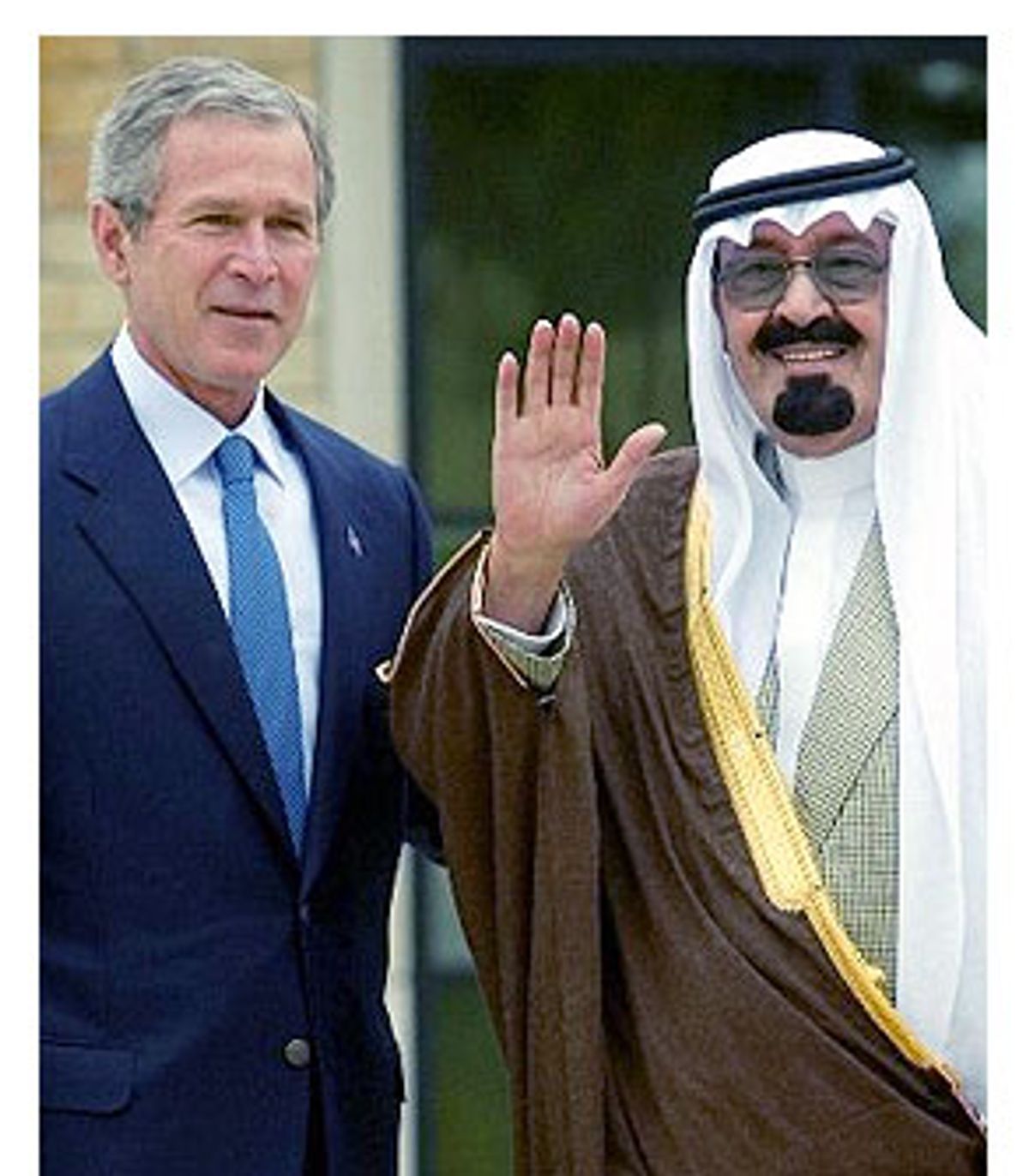
On March 12, 2000, Republican presidential candidate George W. Bush and his wife, Laura, met with Muslim leaders at a local mosque in Tampa, Fla. Among them was Sami Al-Arian, a Kuwaiti-born Palestinian who was an associate professor of engineering at the University of South Florida. George and Laura Bush had their photo taken with him at the Florida Strawberry Festival. Laura Bush made a point of complimenting Al-Arian's wife, Nahla, on her traditional head scarf and asked to meet the family. Nahla told the candidate, "The Muslim people support you." Bush met their lanky son, Abdullah Al-Arian, and, in a typically winning gesture, even nicknamed him "Big Dude." In return, Big Dude's father, Sami Al-Arian, vowed to campaign for Bush -- and he soon made good on his promise in mosques all over Florida.
But Al-Arian had unusual credentials for a Bush campaigner. Since 1995, as the founder and chairman of the board of World and Islam Enterprise (WISE), a Muslim think tank, Al-Arian had been under investigation by the FBI for his associations with Islamic Jihad, the Palestinian terrorist group. Al-Arian brought in Ramadan Abdullah Shallah, the No. 2 leader in Islamic Jihad, to be the director of WISE. A strong advocate of suicide bombings against Israel, Shallah was allegedly responsible for killing scores of Israelis in such attacks.
Al-Arian also bought to Tampa as a guest speaker for WISE none other than Hassan Turabi, the powerful Islamic ruler of Sudan who had welcomed Osama bin Laden and helped nurture al-Qaida in the early 1990s.
Al-Arian has repeatedly denied that he had any links to Islamic terrorism. But terrorism experts have a different view. "Anybody who brings in Hassan Turabi is supporting terrorists," said Oliver "Buck" Revell, the FBI's former top counterterrorist official, now retired and working as a security consultant.
Nor were those Al-Arian's only ties to terrorists. According to "American Jihad" by Steven Emerson, in May 1998 a WISE board member named Tarik Hamdi personally traveled to Afghanistan to deliver a satellite telephone and battery to Osama bin Laden. In addition, Newsweek reported that Al-Arian had ties to the 1993 attack on the World Trade Center. Among his claims to fame, the magazine said, Al-Arian had "made many phone calls to two New York-area Arabs who figured in the World Trade Center bombing investigation."
There were also Al-Arian's own statements. In 1998, he appeared as a guest speaker before the American Muslim Council. According to conservative author Kenneth Timmerman, Al-Arian referred to Jews as "monkeys and pigs" and added, "Jihad is our path. Victory to Islam. Death to Israel. Revolution! Revolution! Until victory! Rolling, rolling to Jerusalem!"
That speech was part of a dossier compiled on Al-Arian by federal agents who have had him under surveillance for many years because of suspected ties to terrorist organizations. In a videotape in that file, Al-Arian was more explicit. When he appeared at a fund-raising event, Timmerman says, he "begged for $500 to kill a Jew."
Finally -- a fact that Bush could not have known at the time -- Al-Arian would be arrested in Florida in February 2003 on dozens of charges, among them conspiracy to finance terrorist attacks that killed more than 100 people, including two Americans. The indictment alleged that "he directed the audit of all moneys and property of the PIJ [Palestinian Islamic Jihad] throughout the world and was the leader of the PIJ in the United States." The charges refer to the Islamic Jihad as "a criminal organization whose members and associates engaged in acts of violence including murder, extortion, money laundering, fraud, and misuse of visas, and operated worldwide including in the Middle District of Florida." Al-Arian is still facing prosecution.
Astonishingly enough, the fact that dangerous militant Islamists like Al-Arian were campaigning for Bush went almost entirely unnoticed. Noting the absence of criticism from Democrats, Bush speechwriter David Frum later wrote, "There is one way that we Republicans are very lucky -- we face political opponents too crippled by political correctness to make an issue of these kinds of security lapses."
Those who were most outraged were staunch Bush supporters and staffers like Frum. "Not only were the Al-Arians not avoided by the Bush White House -- they were actively courted," Frum wrote in the National Review more than two years later. "Candidate Bush allowed himself to be photographed with the Al-Arian family while campaigning in Florida ... The Al-Arian case was not a solitary lapse ... That outreach campaign opened relationships between the Bush campaign and some very disturbing persons in the Muslim-American community."
Nevertheless, Republican strategist Grover Norquist continued to build a coalition of Islamist groups to support Bush. On July 31, 2000, the Republican National Convention opened in Philadelphia with a prayer by a Muslim, Talat Othman, in which Othman offered a duaa, a Muslim benediction. It was the first time a Muslim had addressed any major U.S. political gathering. A third-generation American and a businessman from Chicago of Muslim-Arab descent, Othman was chairman of the Islamic Institute. He had also been the board member of Harken Energy representing the interests of Abdullah Taha Bakhsh, the Saudi investor who had helped Bush make his fortune by bailing out Harken in the late '80s.
When the convention ended on Aug. 3, after George W. Bush had formally been nominated for president, between his family's extended personal and financial ties to the House of Saud and his campaign's ties to Islamists, it could be said that he was truly the Arabian Candidate.
Not that Bush was alone in pursuing Muslim voters. Vice President Al Gore occasionally mentioned Muslims as well and met with Muslim leaders at least three times. But because of their unshakable ties to Israel, the Democrats rarely got more than a mixed reception. Hillary Clinton, who was then running for Senate, had won goodwill for endorsing a Palestinian state in 1998. But when she returned a $50,000 donation from the American Muslim Alliance, saying their Web site had offensive material, Muslims saw her as pandering to Jewish voters in New York. Later in the summer, the Democrats invited Maher Hathout, the senior adviser at the Muslim Public Affairs Council, to give a prayer at the Democratic National Convention. But the Gore team was always a step behind.
Meanwhile, Norquist associate Khaled Saffuri had been named national adviser on Arab and Muslim affairs for the Bush campaign. In September, Saffuri joined Karl Rove in his car as Rove was catching a ride to the airport and explained to him that the vote of Arab Americans -- both Muslims and Christians -- was still within Bush's grasp if he just said the right things. Rove, apparently, was happy to listen to Saffuri's suggestions.
As the campaign headed into the homestretch, the two candidates were neck and neck, but Bush, with his disarming, self-deprecating charm, was winning on issues of style. "I've been known to mangle a syll-obble or two," he told reporters. By contrast, Gore was stuffy and self-conscious. Mocked for repeatedly using the term "lockbox" to suggest that funding for Social Security and Medicare should be untouchable, Gore was caricatured, not without reason, as a finicky policy wonk. But the level of American political discourse was such that the media obsessed over trivial questions such as whether a character in the movie "Love Story" had been based on Gore and whether he was concealing a bald spot.
On Tuesday, Oct. 3, 2000, the first debate with Gore was a triumph over expectations for Bush, with his reputation for verbal missteps. Next to the vice president, who came off as a stiff, self-conscious, supercilious pedant, Bush appeared charming and at ease with himself. Afterward, thousands of articles appeared all over the country criticizing Gore for making irritating sighs and winces while Bush was speaking.
Two days after the debate, on Oct. 5, Bush was in Michigan to meet with GOP activist George Salem and several other Arab-Americans to help him prepare for the second debate with Gore. Along with Florida, Michigan was one of two crucial swing states with a big Muslim electorate. An attorney at the politically wired law firm of Akin Gump Strauss Hauer & Feld, Salem had played key roles for the 1984 Reagan-Bush campaign and the 1988 Bush-Quayle campaign, and helped Bush raise $13 million from Arab-Americans for the 2000 presidential campaign. In addition to being active in Arab-American affairs, Salem was the lawyer for Saleh Idriss, the owner of the El-Shifa pharmaceutical factory in Sudan, who was suing the U.S. government over the bombing of his factory. Now he was advising the son as he had once advised the father.
Salem made clear to Bush that two issues that would animate Muslim-American voters were the elimination of racial profiling at airports to weed out terrorists and the use of "secret evidence" against Muslims in counterterrorism investigations. The campaign against secret evidence -- i.e., the use of classified information in a court case -- was a pet project of Sami Al-Arian, the Florida Islamist campaigning for Bush, in part because Al-Arian's brother-in-law, Mazen Al-Najjar, had been detained on the basis of secret evidence for nearly four years.
On Wednesday, Oct. 11, the second presidential debate took place in Winston-Salem, N.C. The topic was foreign policy, a field in which Gore was thought to have a major advantage over a Texas governor who had rarely ventured abroad. The first questions had to do with when it would be appropriate to use American military force, especially with regard to the Middle East.
One might surmise that Bush's answers would be congruent with policy papers being drawn up by his advisers. Just a few weeks earlier, in September, the Project for a New American Century, with which so many key Bush advisers were associated, had released a new position paper, "Rebuilding America's Defenses," which dealt with precisely those questions and articulated a bold new policy to establish a more forceful U.S. military presence in the Middle East. The PNAC plan acknowledged that Saddam Hussein's continued presence in Iraq might provide a rationale for U.S. intervention, but it also asserted that it was desirable to have a larger military presence in the Persian Gulf -- whether or not Saddam was still in power and even if he was not a real threat. "The United States has for decades sought to play a more permanent role in Gulf regional security. While the unresolved conflict with Iraq provides the immediate justification, the need for a substantial American force presence in the Gulf transcends the issue of the regime of Saddam Hussein," the paper said.
The policy was so radical that even its authors realized that it would be impossible to implement "absent some catastrophic and catalyzing event -- like a new Pearl Harbor." In the pre-9/11 world, voters had not exactly been demanding war in the Middle East or any such radical change in foreign policy. As the presidential campaign neared its last stages, such issues had not even been put before the American electorate. Nor was such a policy likely to play well with the Muslim voters Bush was courting. So when it was Bush's turn to answer, he gave a far more moderate response. He repeatedly asserted that it was essential for the United States to be "a humble nation." "Our nation stands alone right now in the world in terms of power," he said. "And that's why we've got to be humble and yet project strength in a way that promotes freedom ... If we're an arrogant nation, they'll view us that way, but if we're a humble nation, they'll respect us."
More specifically, Bush dismissed the prospect of toppling Saddam because it smacked of what he called "nation-building." He chided the Clinton administration for not maintaining the multilateral anti-Saddam coalition that his father had built up in the Gulf War.
To the tens of millions of voters who had their eyes trained on their televisions, Bush had put forth a moderate foreign policy with regard to the Middle East that was not substantively different from the policy proposed by Al Gore, or, for that matter, from Bill Clinton's. Only a few people who had read the papers put forth by the Project for a New American Century might have guessed a far more radical policy had been developed.
After the Middle East had been discussed, moderator Jim Lehrer asked the two candidates a follow-up question from the previous presidential debate about whether they would support laws to ban racial profiling by police. The question referred to recent instances of racism directed at African-Americans, but Bush saw his opening. "There is [sic] other forms of racial profiling that goes on in America," he said. "Arab-Americans are racially profiled in what's called secret evidence. People are stopped, and we got to do something about that."
Bush was apparently somewhat confused. He had conflated two separate issues -- interrogating Arab-Americans at airports because people of Middle Eastern descent might be terrorists, and using secret evidence in court in prosecutions against alleged terrorists. But his onstage listeners did not seem to notice, nor did they point out that Bush's newly found civil libertarian stance ran counter to tendencies he had espoused in the past. Bush was renowned for being at odds with the American Civil Liberties Union. But now Bush was stealing a page right out of the ACLU playbook, arguing in effect that the use of secret evidence violated the constitutional right to due process of law. In fact, the ACLU had said the same thing in different words, asserting, "The incarceration and deportation of legal residents and others on the basis of secret evidence is a practice reserved for totalitarian countries, not the United States."
Bush's sudden about-face left the Democrats dumbfounded. But they were not about to attack him for adopting a civil libertarian position -- even though he was campaigning with people who were later charged with supporting terrorism. Al Gore scurried to adopt the same position against secret evidence -- but too late. Bush had been the first candidate to utter the code words -- "racial profiling" and "secret evidence" -- that unlocked Muslim-American support. "Within a few seconds I got 31 calls on my cell phone," said Usama Siblani, publisher of an Arab-American newspaper in Michigan. "People were excited." The American Muslim Political Coordination Council, an umbrella organization of Muslim political groups, said Bush had shown "elevated concern" over the matter.
George Salem was elated. "It is unprecedented in U.S. presidential debate history for a candidate for president of the United States to reference such support for Arab-American concerns, and to single out Arab-Americans for attention," he said.
Four days later, the American Muslim Political Coordination Council called a press conference in Washington and announced its endorsement of George W. Bush. The head of the group, Agha Saeed, explained why: "Governor Bush took the initiative to meet with local and national representatives of the Muslim community. He also promised to address Muslim concerns on domestic and foreign policy issues."
As an umbrella organization speaking for several major national Muslim groups, its endorsement meant thousands and thousands of votes to Bush on Nov. 7, 2000 -- especially in Florida, where Al-Najjar's imprisonment was very much a live issue. The cliché was that every vote counted, and this time it would have fresh meaning in the closest and most controversial election in American history.
Coming Tuesday -- "Lost in transition": After the election, Bush goes hunting with Prince Bandar, and Washington ignores the counterterror czar's warnings about al-Qaida.
Shares