

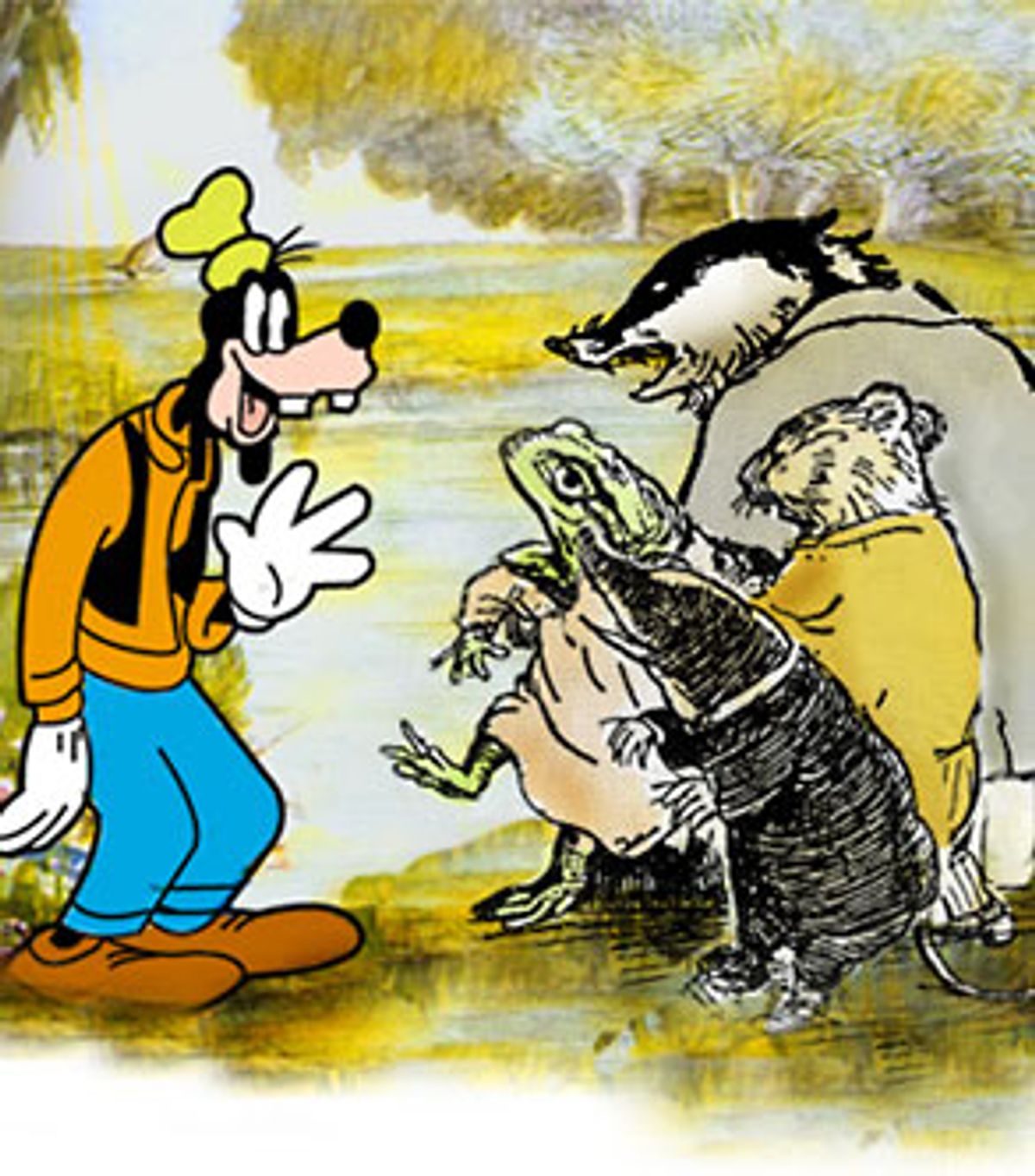
"She's being Toad, from 'The Wind in the Willows,'" I explain, as my 5-year-old daughter, Nora Jade, careens around the other children at the park, crying out, "O poop-poop!" and finally wrecking her invisible motorcar in a blast of sand and laughter.
"Oh, yes, 'Wind in the Willows,'" my friend smiles. "We just got that -- but we haven't started it yet."
"Did you get the original or the adapted version?" I ask.
My friend frowns. "Oh, is there a difference? My husband brought it home from Borders. I just saw it sitting on the coffee table."
I frown, too, wondering if the book on her coffee table exhibits the telltale white binding with red and black letters of the Great Illustrated Classics. When my daughter first started enjoying chapter books, I leapt at the chance to share with her my childhood favorites. I had the copies of Kenneth Grahame's "The Wind in the Willows" and E.B. White's "Charlotte's Web" that my mother had read me and my brother, along with the "Stuart Little" that her mother had also read her. One day at the library I searched for some of my other favorites, like "Heidi," "Black Beauty" and "The Secret Garden." Soon I figured out that the library almost exclusively carried children's classics in a particular series, and I scanned the shelves for the Great Illustrated Classics, greedily filling my arms with them.
At home, I curled up on the couch with my daughter and began reading "Black Beauty." But was it really this simple, this sparse, I wondered? My daughter's attention had waned and I stopped reading to search the back of the book for clues. Sure enough, although the front cover and the binding offered only the name of the original author, Anna Sewell, small letters on the back said: "In a specially adapted version by Diedre S. Laiken." And the front matter added another player: "Edited by Malvina G. Vogel." I flipped through "Black Beauty" and wondered: What was missing? What had been added?
When we returned our stack of denuded classics to the library I pulled out the Great Illustrated Classics edition of "The Wind in the Willows." I could hardly wait to do the comparison. I found it on the title page, in small print: "Adapted by Malvina G. Vogel." So let's see what the publishers paid their little elf to do this time.
I flipped to the moment when Toad first catches his mania for motorcars, the inspiration for my daughter's careening at the park. In the original, Grahame ignites Toad's dream thus:
"'Glorious, stirring sight!' murmured Toad, never offering to move. 'The poetry of motion! The REAL way to travel! The ONLY way to travel! Here to-day -- in next week to-morrow! Villages skipped, towns and cities jumped -- always somebody else's horizon! O bliss! O poop-poop! O my! O my!'"
Toad, in the hands of Malvina G. Vogel, starts out with a similar exclamation but then alters course:
"'... Wonderful, glorious sight!' he murmured dreamily. ... That's the REAL way to travel, the ONLY way to travel! Here today, gone tomorrow! And to think I never KNEW! I never even DREAMT! Oh, what clouds of dust I'll kick up along the road! Oh what horrid little wagons I'll fling into ditches!'"
Out with Grahame's "stirring sight" and "the poetry of motion." I had laughed out loud when my partner read aloud to us: "Villages skipped, towns and cities jumped -- always somebody else's horizon!" But our friendly adapter dumped this deliciously grandiose sentence in order to kick up dust along the road. With seven more words, the "abridged" version is actually longer. As I paged through I saw that the chapter was based on the original, in the sense that you can more or less match passage for passage, but the words were only sometimes Grahame's.
This got me curious. The night before, my partner had read to us the chapter about Ratty and Mole searching for the missing otter child Little Portly. I had been slipping into dreams as he read, but roused myself when he came to the end. Had Ratty and Mole really encountered the demigod Pan? Had Pan really cast a spell of forgetfulness on them, to spare them from spending the rest of their lives wondering if the transcendent encounter had really happened to them?
Yes, I was told. The chapter was called "The Piper at the Gates of Dawn." Wasn't that a Led Zeppelin album, I wondered? "No. Pink Floyd."
I didn't remember any demigods in this book and was frankly shocked that a children's classic veered off into such odd mysticism. It reminded me of my discomfort at the way E.B. White made Stuart Little unlikable in places, and boldly explored the cruel aspects of creatures who eat one another in "Charlotte's Web." The more I read classic children's literature as an adult, the more challenges to my assumptions I seem to find. Personally, I like to be challenged. What would the adapted classic do with Pan, I wondered?
But I had trouble finding Pan and kept getting distracted by the pictures. The boldly ugly illustrations of the Great Illustrated Classics edition were such a stark contrast to the original ones by the legendary Ernest H. Shepard (also the illustrator of A.A. Milne's Pooh books). In the opening pages of my copy, I found a preface by Shepard in which he discusses the spirit with which he approached his drawings:
"Kenneth Grahame was an old man when I went to see him. Not sure about this new illustrator of his book, he listened patiently while I told him what I hoped to do. Then he said, 'I love these little people, be kind to them.' Just that; but sitting forward in his chair, resting upon the arms, his fine handsome head turned aside, looking like some ancient Viking, warming, he told me of the river near by, of the banks where Rat had his house, of the pools where Otter hid, and of the Wild Wood way up on the hill above the river, a fearsome place but for the sanctuary of Badger's home, and of Toad Hall. He would like, he said, to go with me to show me the river bank that he knew so well' ... but now I cannot walk so far and you must find your way alone.'
"So I left him and, guided by his instructions, I spent a happy autumn afternoon with my sketch book. It was easy to imagine it all, sitting by the river bank or following the wake of little bubbles that told me that Rat was not far away ...
"I was to meet Kenneth Grahame once again. I went to his home and was able to show him some of the results of my work. Though critical, he seemed pleased and, chuckling, said, 'I'm glad you've made them real.'"
Staring at the pictures before me, I wondered what a Great Illustrated Classic was without great classic illustrations. As much as I searched these new renderings for something appealing, the misshapen animals in cute settings made me yearn for a crayon to scribble over them, coloring-book style. I tried to imagine Kenneth Grahame meeting with this defiler: Would the "handsome Viking" have made a projectile of the book? I averted my eyes from the illustrations as I flipped through the pages of fat print in search of last night's chapter.
My next discovery was even more unexpected: Little Portly was not just missing from the river, he was missing from the book entirely! No Piper piped at the Gates of Dawn, either. The chapter was nowhere to be found. In Grahame's original, Mole/Rat/Badger chapters alternate with the rousing chapters of Toad's motorcar adventures, increasing the suspense, providing key thematic counterpoints and showing Toad's faithful friends becoming more serious about putting a stop to his self-destructive exploits. But in the library's Great Illustrated Classic, one Toad chapter led to another. Most of the Ratty and Mole chapters were missing!
For another test, I compared the first paragraph in both books. Here is Grahame's:
"The Mole had been working very hard all the morning, spring cleaning his little home. First with brooms, then with dusters; then on ladders and steps and chairs, with a brush and a pail of whitewash; till he had dust in his throat and eyes, and splashes of whitewash all over his black fur, and an aching back and weary arms. Spring was moving in the air above and in the earth below and around him, penetrating even his dark and lowly little house with its spirit of divine discontent and longing. It was small wonder, then, that he suddenly flung down his brush on the floor, said 'Bother!' and 'O blow!' and also 'Hang spring-cleaning!' and bolted out of the house without even waiting to put on his coat."
And here is the New Improved Version:
"Mole had been working very hard all morning doing spring cleaning in his little home beneath a large meadow. He had been working with brooms and dusters and a pail of whitewash. When his aching back and weary arms couldn't lift the whitewash brush one more time, he flung it down and shouted out, "That's it! Hang spring-cleaning!" He rushed out his little door ..."
Some of these omissions can be forgiven if brevity is a priority, but how can you launch "The Wind in the Willows" without spring "moving in the air above and in the earth below and around him, penetrating even his dark and lowly little house with its spirit of divine discontent and longing"? Divine discontent and longing are at the heart of this book; they propel the action and motivate the characters. I have always loved how this magical sentence opens the book. Take it out and Mole is just sick of cleaning.
Ah, now I understand the choice of illustrations. Michael Hague, Arthur Rackham and a parade of talented artists have lent their talents to Grahame's characters over the years. But what better illustrations for the adapter's drivel than lively cartoon figures? Here we see Mole perched atop a stool with a brush held high, globules of whitewash flying out from his brush and splashing fetchingly out from his swinging pail. If we have sacrificed text it is to make space for a play-by-play set of cartoon illustrations that tell all. In one picture Mole is thinking of Badger; we know he is because he has his paw thoughtfully at his chin and there's a picture of Badger in a balloon over his head. Next to him on the table is a cup of tea (so English!) and we know it's hot because three curvy lines are sticking up out of it. Can't you just taste it? No? Me neither.
Speaking of the senses, this is one of Grahame's, the real Grahame's, specialties. Here is Mole when he first catches the smell of his home after being away since his escape from spring cleaning months ago; he and Rat are walking in the snow at night:
"Rat ... was walking a little way ahead, as his habit was, his shoulders humped, his eyes fixed on the straight grey road in front of him; so he did not notice poor Mole when suddenly the summons hit him like an electric shock.
"We others, who have long lost the more subtle of the physical senses, have not even proper terms to express an animal's intercommunications with his surroundings, living or otherwise, and have only the word 'smell,' for instance, to include the whole range of delicate thrills which murmur in the nose of the animal night and day, summoning, warning, inciting, repelling. It was one of these mysterious fairy calls from out the void that suddenly reached Mole in the darkness, making him tingle through and through with its very familiar appeal, even while as yet he could not clearly remember what it was. He stopped dead in his tracks, his nose searching hither and thither in its efforts to recapture the fine filament, the telegraphic current, that had so strongly moved him. A moment, and he had caught it again; and with it this time came recollection in fullest flood.
"Home! That was what they meant, those caressing appeals, those soft touches wafted through the air, those invisible little hands pulling and tugging, all one way! Why, it must be quite close to him at that moment, his old home that he had hurriedly forsaken and never sought again, that day when he first found the river! And now it was sending out its scouts and its messengers to capture him and bring him in. Since his escape on that bright morning he had hardly given it a thought, so absorbed had he been in his new life, in all its pleasures, its surprises, its fresh and captivating experiences. Now, with a rush of old memories, how clearly it stood up before him, in the darkness! Shabby indeed, and small and poorly furnished, and yet his, the home he had made for himself, the home he had been so happy to get back to after his day's work. And the home had been happy with him, too, evidently, and was missing him, and wanted him back, and was telling him so, through his nose, sorrowfully, reproachfully, but with no bitterness or anger; only with plaintive reminder that it was there, and wanted him.
"The call was clear, the summons plain. He must obey it instantly, and go. 'Ratty!' he called, full of joyful excitement, 'hold on! Come back! I want you, quick!'"
OK, so I'm not the best at abridging. It was all I could do not to paste in the whole chapter here. And the "adapted" version? Like so much of the text on Ratty and Mole, the adapted version gave this entire chapter, "Dulce Domum," a miss.
I remember hanging on every word when my partner read this turning point to me 10 years ago, under our quilt together on our child-free grad student futon. I asked him to read it twice. What a thrill to walk in Mole's paws and smell -- with his acutely sensitive snout -- home in all its nuances and messages. And then recently, when my partner was reading aloud to our 5-year-old daughter, our 2-year-old son and me, all snuggled in our patchwork of mattresses and covers, he said, "Hil, here comes your favorite passage." "Oh, I know it!" I said.
Now, did our daughter have the faintest idea what Grahame was talking about? Heck, no. As with the previous chapters, we had to give Nora Jade little catch-up summaries as we went along, sharing our feelings about what we were reading. And as with most other sections, this led to a biology tangent. She wanted to know why smell was so important to animals. (She was allowed to interrupt at any time, as long as it related to the book.) Do weasels eat toads? What do badgers eat? What's the difference between a weasel and a stoat? Why do some animals live underground? We went back to the library for a good book on mammals and pored over it with all of our newfound curiosity.
Early on, we had despaired of how much explaining we had to do to keep her abreast of the action, and we thought perhaps it was too early for her genuinely to engage with it. Sometimes we would chuckle over Grahame's sophisticated vocabulary ("What the heck is 'appurtenance,' anyway?") and take guilty pleasure in Grahame's lengthy and flowery contructions. Some suggest this book for "age 9 and up," and that 9-year-old should probably be a patient soul with a handy dictionary.
Gently we suggested that we put "Wind in the Willows" aside until she was older, and return to "House at Pooh Corner," the A.A. Milne version, of course, in which she had been immersed all summer and fall. "Noooo!" she cried. She was in the grip of it, somehow, or in the spell cast by her parents' enjoyment. She got the story twice, first from Grahame's own words flowing over her, and then from us. In the first case she was in rapt attention; in the second, an irrepressible participant. By midway through the novel, she herself was generating versions of the story, retelling her favorite parts, imagining possible outcomes as the adventure unfurled, sitting up and gripping her covers in her excitement. And on more and more nights, like someone learning to ice-skate, she would glide for several paragraphs in silent and flawless comprehension, only to stop us now and then to ask about a word that was new to her.
More and more, Nora Jade probed us for explanations of the animals' motivations. Grahame certainly gave her much to chew on. Take the example of Mole smelling "home" and calling for Ratty; his friend was too far ahead to hear him clearly, and only urged him to catch up. Mole faced a terrible choice.
"Poor Mole stood alone in the road, his heart torn asunder, and a big sob gathering, gathering, somewhere low down inside him, to leap up to the surface presently, he knew, in passionate escape. But even under such a test as this his loyalty to his friend stood firm. Never for a moment did he dream of abandoning him. Meanwhile, the wafts from his old home pleaded, whispered, conjured, and finally claimed him imperiously. He dared not tarry longer within their magic circle. With a wrench that tore his very heartstrings he set his face down the road and followed submissively in the track of the Rat, while faint, thin smells, still dogging his retreating nose, reproached him for his new friendship and his callous forgetfulness."
Mole finally catches up to Ratty, but his suppressed sob breaks the surface, and he tells the Rat of his suffering, concluding:
"'We might have just gone and had one look at it, Ratty -- only one look -- it was close by -- but you wouldn't turn back, Ratty, you wouldn't turn back! O dear, O dear!'
"Recollections brought fresh waves of sorrow, and sobs again took full charge of him, preventing further speech.
"The Rat stared straight in front of him, saying nothing, only patting Mole gently on the shoulder. After a time he muttered gloomily, 'I see it all now! What a PIG I have been! A pig -- that's me! Just a pig -- a plain pig!'
"He waited until Mole's sobs became gradually less stormy and more rhythmical; he waited till at last sniffs were frequent and sobs only intermittent. Then he rose from his seat, and, remarking carelessly, 'Well, now we'd really better be getting on, old chap!' set off up the road again, over the toilsome way they had come.
"'Wherever are you (hic) going to (hic), Ratty?' cried the tearful Mole, looking up in alarm.
"We're going to find that home of yours, old fellow,' replied the Rat pleasantly; 'so you had better come along, for it will take some finding, and we shall want your nose.'"
On second thought, maybe it's a wonderful thing that this passage was simply left out of the adaptation. I would hate to read a Hostess Ho-Ho version of this poignant moment in the Mole and Rat friendship.
Don't get me wrong. Grahame's writing is demanding enough that I'll freely concede it might be fun to have a version geared to young readers, to tide them over until they can manage the original on their own. It could issue a disclaimer in bold letters on the very first page, just like the Dalmatian Press Children's Classic editions do: "This is not the original version (which you really must read when you're ready for every detail)." And "The Wind in the Willows" could absolutely be made more young-reader-friendly without rewriting it. Since I have been unable to find such an edition, let's take another children's classic, Chapter 2 of Milne's "Winnie-the-Pooh," "In Which Pooh Goes Visiting and Gets Into a Tight Place."
I compared this to "Pooh Goes Visiting," a Puffin Book in the Easy to Read series, geared to readers ages 5 to 8. In this story, Pooh eats too much honey at Rabbit's house and gets stuck in the door. Like Grahame, Milne lives in the language. When Pooh realizes he must spend the week stuck in that hole, fasting until he slims down enough to be yanked out, he makes a tearful request of Christopher Robin: "Then would you read a Sustaining Book that would help comfort a Wedged Bear in Great Tightness?"
So say both books. Indeed, only by doing a line-by-line comparison was I able to find the words and phrases that were missing, and I was pleased to see that no new words had been added. In this case the adapter, Stephen Krensky, has his name in large print right on the cover. No one would assume this is identical to the original. It's an honest abridgment that honors the beauty of the writing, and that would be Sustaining for anyone Wedged in Great Tightness or otherwise needing a Good Read.
Furthermore, it's clear that the cartoonification of both the text and illustrations of "The Wind in the Willows" is no accident, no amateur mistake. Taken as a whole, it appears the Great Illustrated Classics has a mission, that being to make all the classics as accessible, and ultimately as vacant, as a third-rate comic book. There must be good marketing in that, since commerce and busy parents don't always have time for art.
It's painfully ironic that today's children -- whose alarmingly low reading rates are the subject of endless educational debates -- are nonetheless willy-nilly expected to read the classics to themselves earlier than children of any previous generation. The publishers of Great Illustrated Classics have created a self-perpetuating marketing niche. The more parents buy their series, the less reading aloud will go on, so the more children will fail to gain the sophisticated literacy it would take to read the original for themselves, so the more they will need watered-down versions. Even if these watered-down versions go unread, there will be well-meaning parents who will buy them anyway, hoping.
There's another force to be reckoned with in this process, and that is the Walt Disney Co.
If the Great Illustrated Classic of "The Wind in the Willows" is actually faithful to anything, that would be the many animated versions that have spun off from Grahame's book over the years. When Disney ate Milne's treasure, the evidence was everywhere. There are the trademark cartoon figures; there is the text that retells the popular cartoon more than Milne's stories. Fittingly, the Disney versions are to be found under "D" in our library's children's section. Under "M" you may, if you are lucky, find "The Complete Tales and Poems of Winnie-the-Pooh," by Milne himself, intact and full of their original wit.
But the Disneyfication of "The Wind in the Willows" is more insidious. Because, as Evil Clones are wont to do, Disney's Toad has gone back to wipe out the original, replace it with himself and cover his tracks. Only those who know to poke around will discern the plunder, and by that time the real treasure may be long gone. When our library's vintage copies of "The Wind in the Willows" finally wear out, the Great Illustrated Classic, with its sturdy library binding will be all that's left. And the only hint of the desecration will be the ambiguous but friendly "adapted by" bit on the title page. We'll find Mole sick of cleaning. Toad flinging horrid little wagons. Mole sitting in his chair with a bubble of Badger over his head. Cleansed of "divine discontent and longing," bereft of "poetry of motion," with Mole never taking time out to smell Home, Little Portly neither lost nor found, and no Pan pipes to be forgotten by Rat or reader. Greatly diluted and poorly illustrated "classics" will be the literary legacy left to our children.
Oddly, A.A. Milne himself may have set the hatchet of progress in motion. When "The Wind in the Willows" first came out in 1908 it didn't exactly receive a standing ovation. Shepard's illustrations helped. But not until 1929, when Milne adapted it for the stage, did "Wind in the Willows" become launched as a popular children's work. To blow up the action and streamline it for his audience, Milne stripped it down to the Toad story and called it "Toad of Toad Hall." In 1949, Disney put Toad on the big screen. Again, we can thank Milne for encouraging Grahame in this direction. In a letter to Grahame he wrote: "I expect that you have heard that Disney is interested in it? It's just the thing for him, of course, and he would do it beautifully."
Well, is it beautiful? And if it is mere parody, what is wrong with that? For one, how do you think our daughter gets to hear an hour of reading and discussion of literature with both parents every night? When it's real literature, we show up and celebrate it with her. If it's going to be dumbed down, we might as well pop in the DVD.
But if my child is going to dive into a world of someone's creation, let it be an artist's, not a corporation's. Great children's literature is written by an artist answering an urgent personal call, and the artist's magic can touch the reader in places that a cheap imitation can never reach with its sugar-sticky fingers.
While idly surfing the Internet with Kenneth Grahame in mind I discovered that "The Wind in the Willows" came from stories Grahame had told his only child, a boy named Alistair, and whom he called Mouse. When at 7 years of age Mouse refused to go on vacation for fear of missing the stories, Grahame promised to write installments to him by post; published much later, in 1989, as "My Dearest Mouse: The Wind in the Willows Letters," these missives to his son became the basis for his classic novel. These were no idle bedtime stories, though. One Web site hints that Alistair had passions not unlike Mr. Toad, and his worried father sought to temper his son's excesses. While an undergraduate at Oxford, Alistair killed himself, somehow using a train, two days before his 20th birthday.
Suddenly it clicked. I called my mother.
"Toad was bipolar," I told my mother. We knew bipolar. My brother had been bipolar and suffered from manias not unlike Toad's, although after his manias for such toys as motorcycles he eventually gave in to a passion for prescription drugs. Like Toad, his grandiose self-image goaded him into terrible mischief, and he could contrive magnificent deceptions without the slightest hint of conscience. Like Toad, he could be heartbreakingly contrite when confronted, only to get that grandiose glint back in his eye and go on to outdo himself.
Even after being imprisoned for stealing motorcars, even after having escaped prison, and even after having spent a bitterly cold night in a hollow tree, incorrigible Toad is capable of the most delicious grandiosity. Now, the adapted version simply says, "Shaking the dry leaves out of his hair, [Toad] crept out of the hollow and marched off, confident and hopeful, though a little hungry."
Grahame, on the other hand, treats us to Toad's view of his situation:
"He was warm from end to end as he thought of the jolly world outside, waiting eagerly for him to make his triumphal entrance, ready to serve him and play up to him, anxious to help him and to keep him company, as it always had been in the days of old before misfortune fell upon him ... the green fields that succeeded the trees were his own to do as he liked with; the road itself, when he reached it ... seemed, like a stray dog, to be looking anxiously for company."
I read this passage to my mother and we laughed as we reviewed the Toad Dynamic in light of our own bizarre, but now strangely archetypal, experiences with my brother. It was so easy to laugh about Toad, while we heard unspoken echoes of my brother's narrative. The most painful things yield the most laughter when played by an artist. My brother thought he could drive to northern Virginia on tranquilizers. Then he thought the arresting cop had failed to realize it was a prescription drug, a prescription. Having his license taken away just meant that he had to drive without a license -- what else was he supposed to do? And the number of pills he would take, well, he had a much higher tolerance than other people, much higher. We didn't understand how high his limits were, he assured us.
"Grahame wrote 'Wind in the Willows' to appeal to his son," I told my mother. "I think he was hoping to save him from himself." Ratty and Mole's friendship is so carefully and urgently rendered, and stands in such stark contrast to Toad's rather frail grasp of relationship. Indeed, as my daughter would ask after Toad had betrayed his friends yet again, "Why do Ratty and Mole keep wanting to be friends with Toad?" Then I remembered that Badger was originally friends with Toad's late father. Toad was a surrogate son to Badger, and Badger needed to save him, just like Grahame needed to save Alistair, and my mother lived to save my brother.
At the end of "The Wind in the Willows," Badger has triumphantly gotten through to Toad at last. Grahame in his authorial omnipotence provides Toad further protection by forgetting about the police soon after Toad's jailbreak, an unlikely plot device that even my 5-year-old kept decrying. ("But why don't the police think to look for him at Toad Hall?" We said we didn't know and to stop asking us.) But despite his desire to provide us with a redeemed and safe Toad, Grahame undercuts this notion, offering ample hints that he knows darn well Toad is doomed to go back to his Toady ways, just like he surely had ample reason to suspect that Alistair was destined to live a short life, and we suspected that my brother was destined to down one too many pills.
"Oh," my mother sighed. "He wrote it to save his son, his only son." A pause. "But he couldn't."
The next day my mother called to say that she found it oddly consoling to know that Grahame had had Toad for a son, just like her, and had been no more able to save him than she had been. "It makes it less personal, in a way," she said. "An archetype. Not a personal failure."
I don't think she would have gotten that from the Great Illustrated Classic.
Childhood is a sweet time, and an innocent one. But my child knows pain, sorrow, desires and their restraint, friendships tested and found true, people who let you down again and again and you love them anyway. Kenneth Grahame spoke from his heart, bestowing a gift that my daughter can open more and more fully each year. My daughter deserves nothing less than the gifts of artists. What I want for her is precisely what the Great Illustrated Classics wants to leave out. The unfathomable mystery of intimacy and glimpses of its inner workings. A taste of the dangers of the world. The jaw-dropping beauty of language. The heartbeat of the artist.
Beware the white binding with the red and black letters.
Editor's note: This story has been corrected since its original publication.
Shares