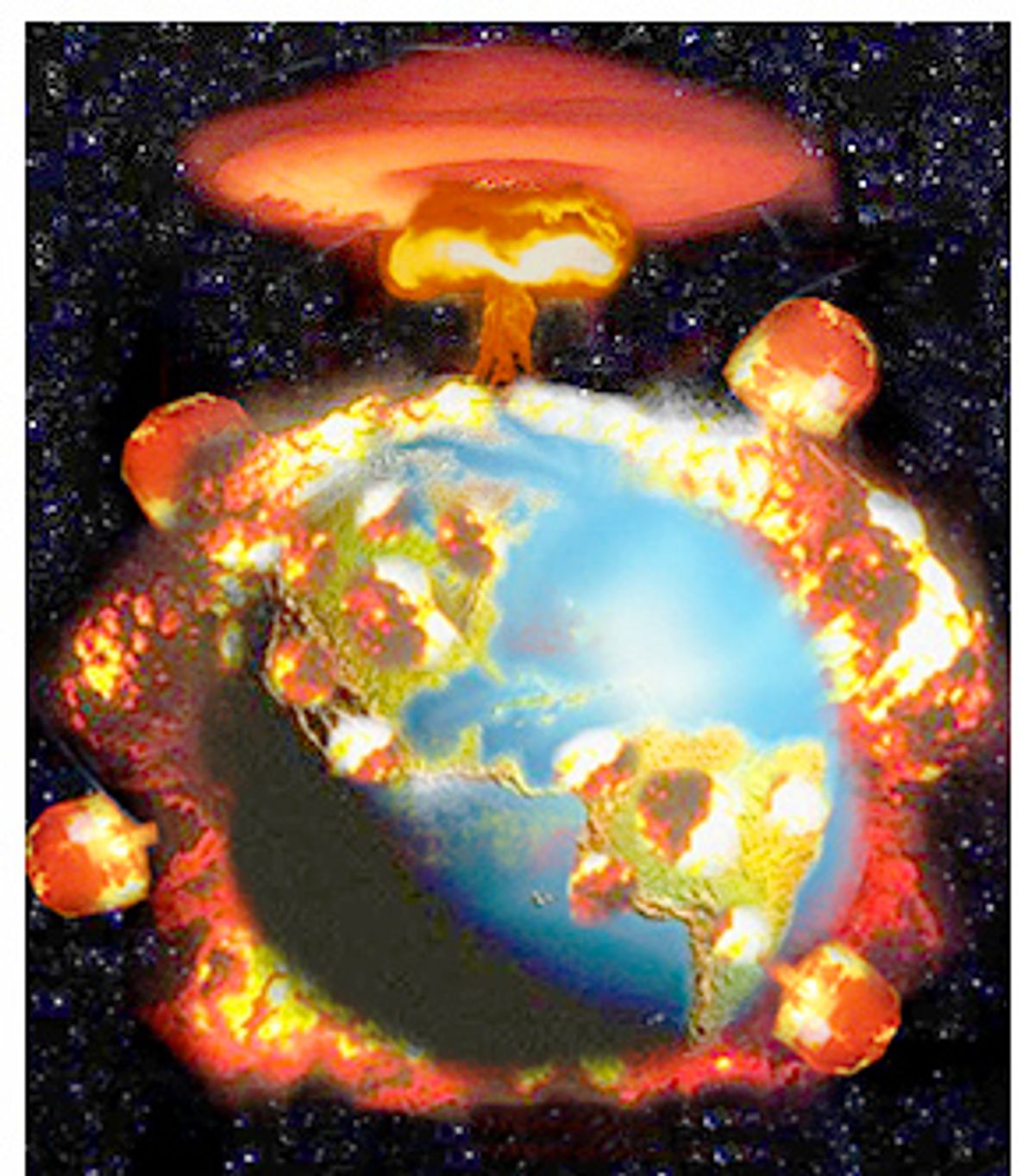
This summer marks the 60th anniversary of the dropping of two nuclear bombs on the Japanese cities of Hiroshima and Nagasaki, and with it come a half-dozen or so books. The books may be new, but they tell the same old story. There's a definitive biography of J. Robert Oppenheimer, the ambivalent physicist who led the Manhattan Project, and "East Palace Avenue," an account of the support workers at Los Alamos, the secret city where the bomb was created during World War II. Two more titles, "Before the Fallout: From Marie Curie to Hiroshima" by Diana Preston and "The Bomb: A Life" by Gerard DeGroot, take a wider view, but the territory is still familiar. Part Frankenstein, part Faust, it's a tale of science (and American know-how) caught up in a frenzy of intellectual enthusiasm and patriotic necessity, finally reaching the coveted goal, only to look on in horror at what it has done.
But this is also the year that everyone born in 1989, the year the Berlin Wall fell and the Cold War began to wind down, turns 16. For the first time in six decades, a generation is leaving behind a childhood that hasn't been overshadowed by the threat of global nuclear annihilation. A dark era has quietly passed away. This story is harder to tell, and that may be why no one is telling it. It's not a tale of progress, exactly, since war certainly hasn't disappeared from the planet, and neither have nuclear threats on a less catastrophic scale. Still, anyone who's lived under the nuclear shadow of the Cold War (that is, most of us) can testify that nothing else has ever felt quite like it.
Histories of the bomb tend to focus either on intrigues and brinksmanship among scientific and political leaders or on the often silly ways pop culture dealt with the deadly new technology. Both approaches come across as weirdly detached from the actual experience of living through those years. The current crop is no exception. Among them, DeGroot's "The Bomb" makes the best effort to describe the Cold War's shifting moods, but even he never quite manages to do justice to the tangle of guilt, dread and helplessness the average citizen felt. (This could be because he lives in Scotland, although he seems to have spent some of his childhood in the U.S.) On one page of "The Bomb," DeGroot will condemn the public for its "apathy" toward the arms race; on the next he's mocking the futile efforts of those activists who did protest it. But if DeGroot can't quite settle on what the "right" response to the nuclear menace would have been, he has lots of company.
"The Atomic Cafe," a documentary released in 1982, during an outbreak of high nuclear anxiety, is another example of this confusion. The movie stitches together '50s newsreels and "informational" films of the duck-and-cover school, all offered as camp, blackly humorous examples of postwar naiveté on the order of "hygiene" filmstrips warning teenagers of the dangers of heavy petting. We are so much wiser now, etc.
But, as DeGroot points out, even in the 1950s few people bought into the idea that nuclear weapons could be so easily survived. "One consistent theme emerged from opinion polls," he writes: "the public thought civil defense futile ... Most people understood what the bomb could do." The newsreels, drills, bomb shelter publicity stunts and magazine articles pretending to educate Americans on how to make it through a nuclear attack amounted to little more than "a carefully stage-managed performance." It was propaganda, a representation of what the authorities wanted people to believe, not necessarily what they actually did believe.
The real popular history of the Cold War, if represented as a graph, would show a steady level of fear punctuated by irregular peaks and mesas of near-terror. Some of these spikes were triggered by real-time geopolitical events, like the Cuban missile crisis of 1962. Others were set off by a combination of historical and cultural triggers. On Aug. 31, 1946, in the first issue of the New Yorker entirely given over to a single story, John Hersey reported on the experiences of six survivors of Hiroshima, including the effects of radiation sickness, at that time little understood. The 30,000-word essay caused a sensation, was published as a book within weeks and was dramatized for ABC radio. (It's also still in print.) This was the first inkling many people had that nuclear weapons were more than just really big bombs.
While the government tried to float cheerful scenarios of sitcom-style families surviving a nuclear attack in their comfortably appointed bomb shelters, pop culture (always a better indicator of the public's attitude) took a dimmer view. Even Hollywood's wackier imaginings -- giant mutant spiders on the rampage -- had more truth in them than the average civil defense brochure.
In 1957, everyone was talking about Nevil Shute's bestselling novel "On the Beach," the grim story of a handful of survivors in Australia, watching the slow approach of a deadly cloud of fallout from the war that has already devastated the Northern hemisphere. (The movie, starring Gregory Peck, Ava Gardner and Fred Astaire, came out two years later.) At a dinner party in France, Winston Churchill said he planned to send a copy of "On the Beach" to Khrushchev, but that Eisenhower was too "muddle-headed" to appreciate the book. "I think the earth will soon be destroyed," he added.
That sense of doom was pervasive, and what "The Bomb" makes clear is that many world leaders (not just decommissioned ones like Churchill) felt it, too. What DeGroot denounces as "apathy" was really a kind of paralysis. Nobody was comfortable with the nuclear face-off between the U.S. and the Soviet Union, but hardly anyone (and certainly no one in power) wanted to gamble on stopping or scaling back.
The stakes were too high. Each side, afraid that the other would develop first-strike capability, kept a frantic pace of arms buildup that the other side inevitably saw as an attempt to establish first-strike capability requiring that it, in turn, continue stocking its nuclear arsenals, and so on. By DeGroot's account, nearly every superpower leader saw the race as insane (as well as ruinously expensive) but also inescapable. Mutually Assured Destruction (MAD), though aptly acronymed, was, they concluded, the only way to secure the peace.
If the people in charge felt helpless to stop nuclear escalation, it's no wonder the general populace alternated between trying to ignore the situation (pretty much the only way to function) and freaking out about it. Relations between the superpowers improved for a while in the 1970s, but the election of Ronald Reagan in 1980 brought on the last great outbreak of Cold War nuclear paranoia.
For most Americans under 40, the dread that saturated the 1980s is indelible. It was part of the fabric of their childhood. One friend recently rediscovered a little booklet of poems and stories she'd written in the second grade. "About half of them," she says, "mentioned nuclear war and how scared I was that I was going to die. The specter of nuclear war absolutely terrorized me when I was young and I think it's to blame for the fact that I had horrible insomnia from the ages of about 5 to 12."
It wasn't just children who were scared. In 1982, Jonathan Schell published "The Fate of the Earth," another book that originated as a long and much-discussed essay in the New Yorker. It described what some scientists considered the likely outcome of a full-scale war involving the thousands of thermonuclear devices the two superpowers had aimed at each other. The astrophysicist Carl Sagan with four other colleagues had recently speculated that the dust and smoke raised by so many detonations would cover the earth in darkness, causing temperatures to drop as low as minus 13 degrees Fahrenheit for weeks, if not months. Most plant life would be killed off due to lack of sunlight, and any human survivors would starve. This climatic catastrophe was dubbed nuclear winter.
Schell vividly described what the world would become after nuclear winter and widespread radioactive fallout had done their worst. Mass extinctions and the destruction of ecosystems would quite possibly wipe out the human race and many animals and plants as well. The U.S. would be left, he wrote, "a republic of insects and grass." "The Fate of the Earth," like "Hiroshima" and "On the Beach," became a bestseller. (Strangely enough, although I recall the book as being inescapable, stacked next to every bookstore cash register, it isn't even mentioned in "The Bomb." )
The dread reached its pinnacle on Nov. 30, 1983, with the broadcast of "The Day After," an ABC TV movie starring Jason Robards and John Lithgow that depicted the effects of a nuclear war on a small town in Kansas. "The Day After" was a nationwide event on a level seldom seen today. The publicity in the weeks leading up to the broadcast intensified when the White House complained of the movie's anti-nuclear "bias" and of the filmmakers' refusal to blame the Soviets for the fictional war. ABC handed out a half-million "viewer's guides" and groups were organized to discuss the film, including one featuring Secretary of State George Schultz, broadcast on ABC directly afterward. In the end, "The Day After" had the biggest audience for any television movie up to that date, 100 million viewers -- half the adult population of the U.S.
Although DeGroot (unfairly) dismisses "The Day After" as "a thermonuclear version of 'The Waltons,'" he acknowledges that it "had a profound effect on the American people." At the very least, the movie is remarkable, as a product of the mainstream American entertainment industry, for its uncompromising bleakness. While many echoed DeGroot's criticism that "The Day After" "treads lightly over the aftermath -- the disease and starvation of nuclear winter," every major character either dies or is clearly shown to be dying from radiation sickness by the movie's end. Perhaps the most piercing moment comes when a pregnant woman gives birth in a hospital crammed with disintegrating survivors and weeps with despair.
"The Day After," for all its dated special effects and insufficiently blasted landscapes, is branded in the imaginations of millions of Americans. The reader reviews posted on the film's Amazon and IMDb pages testify to its harrowing effect on many young minds. (Ironically, those kids whose parents didn't allow them to watch it may have found speculating about it even more terrifying.) But there was one viewer in particular who was moved by the film in an especially momentous way.
A screening of "The Day After" is listed by DeGroot as one of three events that led to a "strange transformation" in late 1983. "Reagan the warmonger morphed into Reagan the peacemaker," he explains; the president began to tone down his bellicose posture toward the Soviets. The other two factors in this change were the downing of a Korean airliner mistaken for a hostile aircraft by a Soviet pilot and an incident when the Soviets almost responded aggressively to a NATO exercise that at first appeared to be preparation for a nuclear strike. These real-world accidents showed Reagan that the Soviets sincerely believed the U.S. to be capable of an unprovoked attack and how easily a fatal error could be made.
It took "The Day After" to impress on Reagan just how dire the consequences of an exchange of nuclear weapons would be for average Americans. "By all accounts," DeGroot writes, the film "left Reagan severely depressed and determined to 'do all we can ... to see that there is never a nuclear war.'" There's something grotesquely comic about the power Hollywood movies had over Reagan, but it also goes a long way toward explaining why he had such rapport with the American public. It was a susceptibility they shared with him. The intelligentsia could wring their hands over "The Fate of the Earth," and Middle America had "The Day After."
We complain today of fear-mongering in the media and the government: news reports that create the false impression that crime is rampant when it's not and vague homeland security alerts that accomplish little more than raising the general anxiety level. It's worth remembering that the nuclear fears of the Cold War were qualitatively different.
A terrorist, even one equipped with a dirty bomb, might succeed in poisoning a city and even in killing hundreds of thousands of people over time, as the effects of the bomb's radioactive fallout emerge. But knowing this just isn't the same as knowing that a superpower has a vast phalanx of intercontinental ballistic missiles armed with thermonuclear warheads pointed at your entire nation and all of its allies. Or that your nation is pointing even more missiles back at the enemy and their allies. When, in "The Day After," a spooked college student suggests that rural Kansas, "the middle of nowhere," might go relatively unscathed, Lithgow's character reminds him that they're surrounded by missile silos. "There is no nowhere," he says bitterly.
He didn't know how right he was. In the last stretch of the arms race, as new, more powerful weapons were added to arsenals already capable of destroying the enemy several times over, the older ones were re-aimed at lower-priority targets. Even so steely a hawk as Dick Cheney, then secretary of defense, was "shocked" in 1991 to discover the "idiotic redundancy" in the targeting of these bombs, their massive firepower directed at innocuous radar stations and even shoe factories. As part of the policy of MAD, these missiles were kept on a sort of hair trigger, set to automatically launch even if command centers and major cities had already been vaporized. It was widely known that human or computer error might accidentally set off this system. In yet another Hollywood movie from 1983, "War Games," Matthew Broderick plays a teenage computer whiz who inadvertently begins the automated sequence and has to shut it off again before the world is destroyed.
Ironically, an individual Westerner is probably more vulnerable to politically motivated violence now than during the Cold War. The nuclear weapons of the former Soviet Union -- as well as the scientists and technicians who built them -- are indifferently tended. Fortunately, as DeGroot notes, "bombs have a limited shelf life." But if the weapons themselves are decaying into uselessness (we think -- no one really knows what happens to aging bombs), the fissile material within them is another matter. "All the plutonium from all the dismantled weapons is still stored in bomb-ready form," DeGroot writes, and figuring out what to do with it is a puzzle that so far no one's been able to solve to everyone's peace of mind.
Rogue nations, religious fanatics, bizarre cultists like Japan's Aum Shinrikyo, these are just a few of the bad actors who have tried to get their hands on nuclear devices. Most are still trying. They are more menacing than the Soviet Union because we can't assume their behavior is ruled by rational self-interest. And if one of them does decide to, say, smuggle a dirty bomb into a major U.S. port via the largely unpoliced container shipping industry, retaliation is a lot trickier than it used to be. "The terrorist," DeGroot points out, "has no return address." As mad as MAD seemed at the time, there are some situations even madder.
Nevertheless, today's maniacs would count themselves fortunate to get their hands on a single suitcase nuke; commanding an arsenal of missiles, bombers and nuclear submarines like that of the former Soviet Union is beyond their grasp. It's one thing to know that, as a New Yorker or a Washingtonian or an Angeleno, you might be killed in a terrorist attack, or even that your city might be poisoned. It's another to realize that your nation might be destroyed. And it is yet another order of fear to realize that human civilization, possibly the human race itself, could be obliterated in a day or two. This is dread on a supraexistential, species level, and even beyond this fear, we glimpsed the nightmare of Earth rendered uninhabitable by anything but cockroaches.
Are second-graders still filling their poems and stories with visions of the end of the world? Probably not, or not as often, and however urgent lesser threats may be, that's a change for the better. Another nuclear superpower and a new Cold War may emerge. If not, the day will eventually come when the last person to remember what it felt like to believe a nuclear apocalypse might come at any moment will die, just as the last survivors of the Holocaust are dying now. Global nuclear war was a holocaust that didn't happen, but since the future offers no guarantees, the lesson is still the same: Never forget.
Shares