

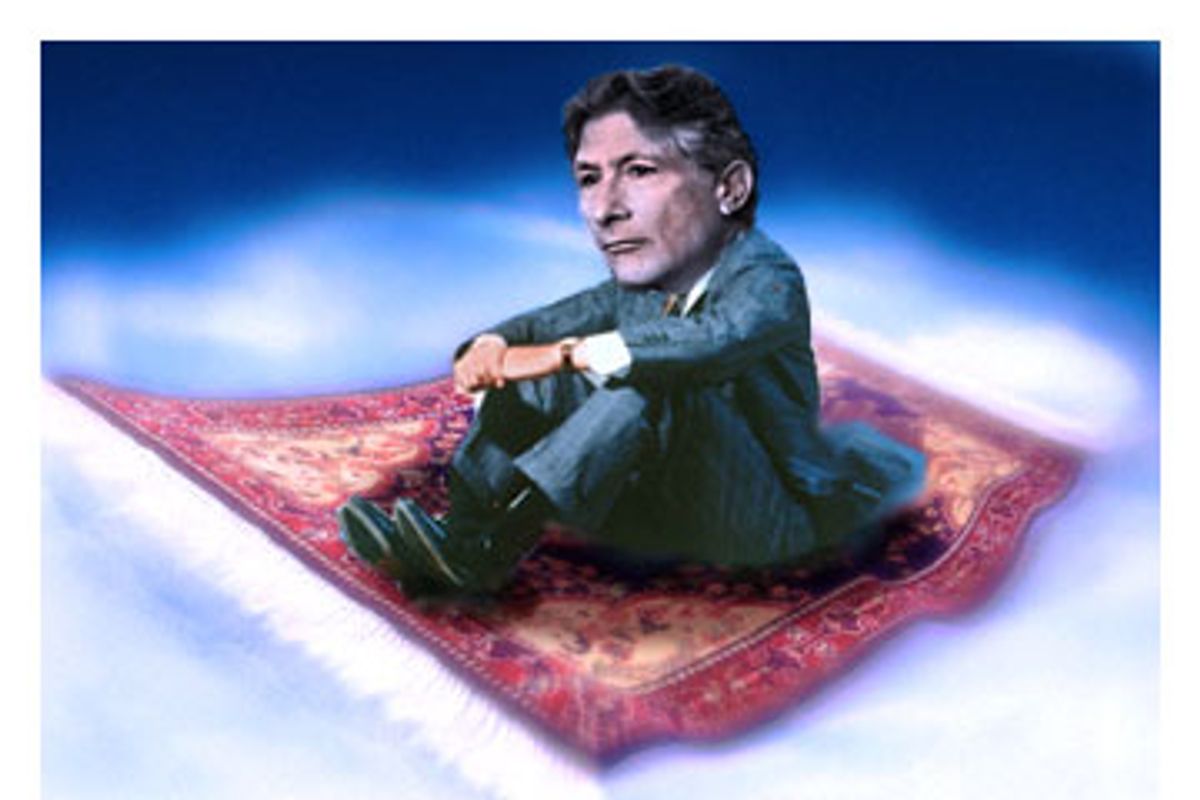
Edward Said's "Orientalism" was a cultural bombshell that has become a landmark -- some would say a crater. One of the most popular and influential academic books ever written, it inspires condemnation and praise in equal measure. Published in 1978, "Orientalism" not only was a founding text for the academic fields of postcolonial theory and subaltern studies, but also remains one of the most-cited works in what we can broadly call the "oppositional canon." It has been translated into 36 languages, and it continues to be cited, discussed and taught throughout the world.
Said, who died in 2003, was born in Jerusalem, moving to the United States as a young man. A professor of English literature at Columbia University, he was also an outspoken advocate for the Palestinian cause, which made him extremely controversial. He sat on the Palestinian National Council but became an increasingly bitter critic of Yasser Arafat and resigned in 1991. (Said was probably the only person who could claim both that his office had been fire-bombed by right-wing Zionists and that his writings had been banned in the occupied territories by Arafat.) In "Orientalism," Said argued that from the beginning of Western civilization, Europeans have seen the East -- and in particular the Middle East -- as an alien and threatening Other, and have constructed a mythical and self-serving version of it. Said maintained that this version of the Arab world, which flowered in the work of British and French scholars in the late 18th century and continues to be accepted today, provided a justification for the Western imperialist projects that started with Napoleon's invasion of Egypt in 1798. Far from being objective, Said wrote, the scholars of the 18th and 19th centuries served the interests of power.
This Orientalist discourse, he maintained, is racist, condescending, controlling, dehumanizing, feminizing and "essentialist" -- that is, it asserts that there is a mysterious "essence," invariably religious, that defines the Arab world. That supposed essence, Said argued, is completely mythical and artificial, based not on actual knowledge or experience of the Arabs but purely on the West's imaginary construction. In other words, Orientalism is an enclosed system, impervious to reality and indeed designed to ignore it.
This monolithic assertion of Western villainy is based on a theoretical framework that Said derived from the French philosopher Michel Foucault. The key idea is "discourse," which Foucault defined as a system of thought that defines what can be "known." This system is inextricably linked to power in all its forms -- hence Foucault's famous formulation "power/knowledge." For Foucault and Said, it was a naive illusion to believe that knowledge can exist independent of power. Because Orientalism is a discourse, no one can really escape it: it is a trans-subjective phenomenon. But Said became dissatisfied with Foucault because his theory did not allow a way out. The other thinker to whom Said was indebted, the Italian theorist Antonio Gramsci, provided the concept of "hegemony," which allows for the possibility of resistance to inviolable discourse.
In "Orientalism," Said ranged far and wide, from famous scholars like Louis Massignon and Sir Hamilton Gibb to literary greats like Flaubert and Nerval to hosts of unknown travelers and writers. He unearthed countless examples of grandiose statements made by Westerners about the mysterious, threatening, promiscuous, God-obsessed, immutable East. These statements were not coincidental or contingent, Said argued, but reflected a universal imperialist discourse that historically governed everything any Westerner could say or think about the Arab world. As Said put it in reference to the 19th century, "It is therefore correct that every European, in what he could say about the Orient, was consequently a racist, an imperialist, and almost totally ethnocentric." To the end of his life, he believed that this view of the Arab world still held sway.
Said's book provoked a furious controversy that still rages today. With America trapped in Iraq, and with the Middle East on the verge of a regional crisis, the debate about "Orientalism" is not a merely academic one. Bush's entire "war on terror," and in particular his bizarre decision to invade Iraq, could be seen as driven by Orientalist beliefs and assumptions. Moreover, ominously and quite predictably, "Orientalist" ideas in Said's sense are beginning to pop up in the national discourse. One of the peculiar ironies of the Iraq war is that its architects used politically correct pieties to justify it. Bush and former deputy defense secretary Paul Wolfowitz repeatedly used nameless skeptics, "who say the Arab world isn't ready for democracy," as straw men to give an idealist gloss to their plans for war. Today, disillusioned and angry conservatives are beginning to rebel against these pieties. Rush Limbaugh, as usual, gave crude voice to the inchoate beliefs of millions when he said that we should just "blow the place up." As the Iraq nightmare deepens, these opinions are likely to become louder.
At this fraught historical moment, a new book, Robert Irwin's "Dangerous Knowledge: Orientalism and Its Discontents," launches the most formidable assault on Said yet. Irwin has impeccable scholarly credentials: He teaches at the School of Oriental and African Studies in London, has written on Arabic literature and art, and is the Middle East editor of the Times Literary Supplement. Irwin's book is a hybrid, both a history of the academic field of Orientalism and an all-out assault on Said's most famous book.
Irwin maintains that Said's thesis is false, the arguments he made for it dishonest, distorted and weak, and his theoretical framework self-contradictory and evasive. He charges that Said engaged in a counterfactual rewriting of history, attacking figures from earlier eras because they did not say or do what Said thought they should have. Said's entire project, in his view, is "a work of malignant charlatanry in which it is difficult to distinguish honest mistakes from wilful misrepresentations."
Irwin takes pains to point out that, politically, he is on Said's side. "I have no significant disagreements with what Said has written about Palestine, Israel, Kipling's 'Kim,' or Glenn Gould's piano playing." This strengthens Irwin's position, as some of Said's supporters have argued that much of the opprobrium heaped on "Orientalism" has come from those opposed to Said's outspoken support for the Palestinian cause, thus serving as an example of the very Orientalist bigotry Said attacks. No such charge can be leveled against Irwin.
Irwin's strategy for demolishing "Orientalism" is to focus on the major figures in the field and to show that who they were, what they believed, and what their scholarship and attitudes were toward the Arab world bear no resemblance to Said's version. He devotes only one chapter to a direct critique of Said's book and in the final one considers other critics of Orientalism. The rest of "Dangerous Knowledge" presents the rich and complex history of Orientalist scholarship and the often eccentric men (and they were almost all men) who engaged in it. His goal is to use reality to dissolve the abstract and tendentious cloak of villainy that Said drapes over an entire scholarly field. It's on this empirical battleground, not in the lofty clouds of theory, that Irwin battles Said. He uses the history of Orientalism and the careers of Orientalists as a needle to let the hot air out of Said's 30,000-feet-above-facts balloon. And the result is one of the more spectacular deflatings since the Hindenburg.
Contrary to Said, Irwin reveals, the towering figures of Oriental scholarship tended to be unworldly, solitary figures, who, far from demonizing the Arab world or Islam, were sympathetic to it and were often regarded as suspiciously un-Christian by their contemporaries. Many were opposed to Western imperial designs on the Near East. Like scholars through the ages, they spent most of their time working diligently on often dry-as-dust textual or linguistic problems. They were also often slightly loony. The father of Orientalism, Guillaume de Postel (1510-1581), was, Irwin notes, "quite barmy": The "foremost expert on Arabic and Islam in Europe" also believed that a woman named Johanna was the angelic pope, the new Eve, the mater mundi who possessed X-ray vision that allowed her to "see Satan sitting at the center of the earth." Postel's weird ideas led the Inquisition to investigate him, but the Holy Office, in a kinder, gentler moment, decided that he "was not a heretic, merely insane."
Irwin acknowledges that a handful of Orientalists suffered from a conflict of interest because they worked on imperialist state projects, but the vast majority did not. Similarly, although a few, like Ernst Renan and Joseph-Arthur de Gobineau, were explicitly racist, most were not. They were genuinely fascinated by the Arab world and Islam, and though some of their scholarship may have suffered from received ideas and prejudice, there is no evidence to support Said's overwrought thesis that all of it did. And even if some of them were working in bad faith, Irwin argues, that did not necessarily mean their scholarship was bad. Above all, there was no unitary, unchanging Orientalist discourse. Like any other academic field, "Orientalism advances ... through disagreement and criticism rather than comfortable consensus."
Moreover, Irwin argues that Said grossly oversimplified the complex historical encounter between East and West. For much of its history, he points out, Europe either ignored Islam or regarded it as a form of Arianism, the ur-heresy that denied the divinity of Christ and was rejected by the Council of Nicaea in 325. Far from turning Islam into a menacing Other, for centuries most Europeans couldn't care less about it, being much more concerned with demonizing rival Christian sects. Nor did the West always hold the upper imperialist hand over the East: The European powers were fearful of the mighty Ottoman Empire for centuries. In short, the relationship between East and West, rather than being one of simple dominance and submission, was far more nuanced.
No one denies that the West ultimately dominated the Orient and colonized it, or that its often racist domination affected the way Westerners thought about the East. Yet Irwin points out that the history of Orientalism simply doesn't track with the history of imperialism. Some Orientalists in the imperialist heyday held strikingly enlightened and nuanced views; others were myopically "essentialist" when the Mideast was of no political or economic concern to the West whatsoever.
Against Said, who insisted that Orientalism remained frozen in place, Irwin shows that the field progressed, that knowledge increased. He believes in the possibility (not always attained, of course) of objective scholarship. He argues that academic inquiry is not merely a handmaiden of power, but has its own logic and internal development, and that successive generations of Orientalists criticized, built on and transformed the work of those who came before. "There are such things as pure scholars," Irwin writes. "I have even had tea with a few of them." This view is regarded as sentimental, naive and retrograde in certain circles, but at least you can argue for or against it on the basis of evidence. We really do know more about the textual history of the Koran than we did before, for example.
Said's radically skeptical position, by contrast, was so abstract and chameleonic that it was impossible to disprove it, since it constantly dissolved (and hid behind) a multitude of deconstructive readings. The eminent Middle East expert Fred Halladay made a telling point when he argued that the close literary analysis of texts, Said's specialty and his primary analytic technique in "Orientalism," may not be applicable to social science.
Irwin also makes the devastating critique -- one that even Said's defenders don't really attempt to rebut -- that Said ignored examples that don't fit into his theoretical framework. One of the most glaring examples was his almost complete failure to engage with German Orientalists. Said peremptorily dismissed critics who raised this issue, saying their point was "superficial or trivial" and that there was "no point in even responding to them." But if Orientalism is inseparably bound with political power, as Said posited, then German Orientalists should be of minimal importance, as Germany had no imperial stake in the Arab world. In fact, as Irwin points out, German Orientalists dominated the field for a long time. Similarly, Said completely ignored the Russian Orientalists, who in fact did serve an imperial empire in Muslim Asia. The reason is obvious: The German and Russian Orientalists didn't support Said's thesis.
The most eminent of all the German scholars of the Arab world, and indeed a figure whom Irwin calls the "greatest of the Orientalists," was a Hungarian Jew named Ignaz Goldziher. Shaped by "the overlapping worlds of the German and Jewish Enlightenment," Goldziher rejected the racist essentialism of Renan, who had "previously generalized grandly on the intrinsic monotheism of the Semitic spirit and the incapacity of the Jews and Arabs to generate any kind of mythology. Goldziher considered all that to be racist nonsense: 'There is no such thing as a psychology particular to a given race.'" Goldziher revolutionized Islamic studies, breaking major ground with his research on the hadiths (sayings of the Prophet) and exploring Islamic revivalist movements. "He believed in the future of Islam and its ability to revive itself from within. As has been noted, he was hostile to colonialism and the Westernization of the Near East. He had supported the Egyptian nationalist revolt of Arabi Pasha (in 1881-2). In 1920, he wrote a letter to a Christian Arab friend in Mosul: 'I have lived for your nation and for my own. If you return to your homeland, tell this to your brothers.' A year later Goldziher was dead."
The great scholar Albert Hourani, author of the magisterial "A History of the Arab Peoples," said "Goldziher shaped our view of what Islam is more than anyone else." Irwin writes that "a book on Middle Eastern and Islamic studies that gave no account of Goldziher's work in the field would not be worth the paper it was printed on."
And what did Said have to say about this towering figure? He mentioned Goldziher twice in passing. The first comes in a list of other scholars; in his only slightly more substantive discussion, which consists of a single sentence, he wrote, "Yet Ignaz Goldziher's appreciation of Islam's tolerance toward other religions was undercut by his dislike of Muhammad's anthropomorphisms and Islam's too-exterior theology and jurisprudence." Said concluded that the crucial fact about Goldziher's work was his belief in Islam's "latent inferiority." For Said, it seemed axiomatic that merely to express negative opinions about any aspect of Islam or the Arab world was to be a biased, racist, essentialist Orientalist. By those standards, Said himself might well have qualified, since as Irwin points out, he himself seemed to have had no sympathy for or interest in Islam.
It should be said that Said's failure to engage with Goldziher was not driven by any kind of bigotry. As is clear from his political writings -- which are much more lucid than his attempts at grand cultural theory -- Said was bitterly opposed to anti-Semitism in all its forms; he denounced terrorism and always insisted that justice for the Palestinians must be accompanied by Arab acceptance of the Holocaust and respect for the historically unprecedented sufferings of the Jewish people. The charge raised by some of his opponents that he was anti-Semitic is scurrilous. However, that fact does not excuse Said's tendentious and distorted use of historical evidence in "Orientalism." Said ignored Goldziher not because he was Jewish but because his exemplary career gave the lie to Said's thesis.
Another of Irwin's key criticisms is that Said was hopelessly confused about what the Orientalist discourse actually was. At times, he wrote about it as if it were inescapable and the Orientalists merely victims of a system of thought they were powerless to resist. But at other times, he explicitly blamed the Orientalists for being racist and imperialist. This structural ambiguity, which, Irwin acutely points out, originated in the tension between the views of Foucault and Gramsci, fatally weakened Said's argument (although it allowed him to slip out of all criticism).
Finally, as Irwin reveals, Said's convenient poststructuralist position that the Orient did not exist, but was a Western construction, ignored reality. Different regions of the world do share certain cultural traits, and it is absurd to deny that Islam plays a major role in the societies and culture of the Middle East -- and that it is a role significantly different from Christianity's in the West. To say this is not to "essentialize" those societies or reduce them to religious caricatures, but merely to acknowledge the obvious. Perhaps Said's most compelling argument, as Mike Jay notes in one of the smartest reviews of Irwin's book, is that Orientalists, obsessed with their caricature of exotic Islam, ignored the political and economic reality of the Arab world and rarely paid much attention to individual Arabs. This is true, but it is not necessarily evidence of bigotry: It took scholars in all fields a long time to understand the importance of such unglamorous realities. In any case, it's hardly surprising that Islam, the most obvious marker of difference between Europe and the Middle East, should have interested European scholars. Said cited Western pronouncements about Islam as if they were prima facie evidence of essentialist racism, when in fact they mostly seem to have been attempts -- admittedly often rather purple and unconvincing -- to make sense of it. As with many poststructuralist arguments, there is an emperor's new clothes aspect to Said's outrage at the attention that Orientalists paid to Islam.
"Dangerous Knowledge" pretty much demolishes Said's attack on academic Orientalists. But does Irwin demolish Said's larger point that Western imperialism has generated a racist and condescending discourse about the Arab world, one that still operates today? The British literary critic Terry Eagleton argues that he does not, that Said was wrong about details but right about what really mattered. Eagleton mocks Irwin's "gentle, ivory-tower" belief that Orientalism "is mostly a story of individual scholars" and derides what he claims is Irwin's inability to comprehend Foucault's ideas: "He gives the impression that he could recognise an ideological formation about as readily as he could identify Green Day's greatest hits." Eagleton writes that "the current debacle in Iraq ... has rekindled a rabid Islamophobia in the west" and that "all Irwin needs to do to recognise the broad truth of Said's thesis is turn on the television set."
To attack Irwin for being unable to recognize "ideological formations" is to beg the question (that is, to assume the very point being debated), since Irwin's entire, meticulously argued point is that Orientalism was not such a formation. Eagleton's point that the current Islamophobia vindicates Said's thesis is more interesting. In a penetrating and largely favorable review of "Dangerous Knowledge" in the Times Literary Supplement, Christopher de Bellaigue argues that "Irwin's reluctance to expose his discipline to Said's charges of collusion in Empire, post-colonial domination and, more specifically, brutalities committed in the name of Zionism, is the main flaw in an otherwise meticulous and impressive book."
De Bellaigue gives some specific historical examples of such collusion and justly criticizes Irwin for ignoring them. He also makes a legitimate point that Irwin erred by ignoring the contemporary influence of the eminent Middle East scholar Bernard Lewis, who, Bellaigue notes, has used his academic authority to push his support for Bush's "war on terror" and to issue "mischievous and misleading" pronouncements about an inevitable war with fundamentalist Islam. A strong supporter of Israel who has published widely in popular journals, Lewis was invited to the White House by Dick Cheney to discuss Mideast strategy. Lewis is, in effect, Said's right-wing counterpart -- but those who hold Said's views are never invited to the White House. (Jimmy Carter, a former president whose new book is critical of Israel, isn't even supported by his own party.) The wide acceptance of Lewis' neoconservative ideas in America, and their implementation by the Bush administration, support the idea that a racist "ideological formation" which sees the Arab/Muslim world as depraved and violent does indeed exist.
Irwin's book would have been stronger if he had grappled with these issues. But the (brief) triumph of neoconservative ideology in the United States does not prove Said's thesis. Lewis may be a one-man pinup for Orientalism, but he is the exception that proves the rule, at least in the academy and among specialists. The truth is that most experts on Islam and the Arab world are appalled at the Bush administration policies. Public prejudice against Arabs and Muslims exists, of course, but it is not the clanking monolith Said described. Public support for the "war on terror" (now rapidly dwindling) has had more to do with a visceral public reaction to 9/11, and the anomalous, single-issue sacred cow of Israel, than with a historic bias against the Middle East and Arabs that allegedly goes back to Aeschylus.
Ironically, Said himself recognized this. Criticizing the Arab world's crude polemics against America, he wrote, "It is not acceptable to sit in Beirut or Cairo meeting halls and denounce American imperialism (or Zionist colonialism for that matter) without a whit of understanding that these are complex societies not always truly represented by their governments' stupid or cruel policies." It is striking how little Said, the practical Palestinian politician, dealing with real-world issues, sounds like the grand theoretician of "Orientalism."
At the end of "Dangerous Knowledge," Irwin asks why "Orientalism" has been so successful. "It is a scandal and damning comment on the quality of intellectual life in Britain in recent decades that Said's argument about Orientalism could ever have been taken seriously," he writes. "If Said's book is as bad as I think it is, why has it attracted so much attention and praise in certain quarters?" His answer: resentment of established Orientalists by partisans of new disciplines like cultural studies and sociology; anti-Americanism and anti-Zionism; the allure of trendy figures like Foucault and Gramsci; and general Western "hand-wringing and guilt about its imperialist past."
There is no doubt that the same reasons apply to certain quarters in the United States. The larger question raised by the success of "Orientalism" is the venerable one of ends and means. Its defenders say that the West really does have much to feel guilty about, and they argue that Said's book, though flawed, is praiseworthy because it has forced the West to be more self-critical.
But this position is a slippery slope, only a step removed from defending Stalinist realism and other "dialectically justified" hack work. An unflinching look at America's imperialist past -- and the crude stereotypes about the Middle East, ignorant hostility and out-and-out racism that underlie much of our current foreign policy and helped pave the way for the Iraq war -- is indeed necessary. But Said's everything-but-the-kitchen-sink approach is counterproductive. It may have swelled the ranks of subaltern studies programs and provided grist for numerous postcolonial studies Ph.D. theses, but that doesn't make his argument correct. In the end, bad books are just bad books, and when they are canonized for instrumental reasons, the result is a coarsening of thought and an ever-widening and unhealthy divide between the academy and mainstream culture. Indeed, there is reason to believe that such sweeping indictments produce a public backlash and result in more bigotry, not less. Demands that villains du jour -- whether males, white people, the West, heterosexuals or thin people -- reflect on their guilt do not seem to lead to greater enlightenment.
In this regard, Irwin's refusal to genuflect before a hopelessly flawed work simply because it is politically correct is part of a salutary trend on the left to be willing to criticize propagandistic or tendentious works, no matter how "right thinking" they are. In America, this trend has manifested itself in the largely victorious (at least in mainstream culture, if not in the academy) counterattack, led by Robert Hughes, Arthur Schlesinger Jr., Todd Gitlin, C. Vann Woodward and others, against the cruder forms of multiculturalism and identity politics.
As America tries to figure out how to deal with the Arab and Muslim world, and to educate the American people so that catastrophes like Iraq don't happen again, it is vital that a full spectrum of opinions be heard. The long history of Western imperialist meddling in the Middle East, the West's consistent stifling of Arab attempts at political reform, and many other such matters must be discussed. But it is equally important that the role of religion and culture be acknowledged, and that historical and even anthropological analyses of Middle Eastern societies not be ruled out by the left simply because they lead to certain conclusions that may make bien-pensant intellectuals uncomfortable. (The role of tribes and the importance of honor and revenge in Arab culture are two examples.) All of these complex issues must be put on the table and given a full national discussion -- for our sake, for the Middle East's sake and for the world's sake.
Said argued that Western knowledge about the Middle East serves only Western interests. Against that dark view, we need to insist that knowledge is always good. As we struggle not just to extricate ourselves from Iraq but also to forge a more humane and enlightened policy toward the Middle East, we need more Orientalism, not less.
Shares