
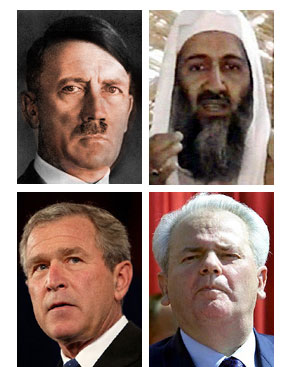

“Fascism”: No word has been used more freely by people who have so little idea what it means — and that includes “postmodernism.” “Fascist!” was for years the preferred epithet hurled at anyone engaged in authoritarian behavior, racial stereotyping or even certain kinds of design. Then, for a while, the insult, suffering from a kind of rhetorical inflation, lost its bite; if used at all, it made the person using it seem like a hysteric, and it was exiled to the shadowy edges of extremism, where conspiracy theorists and other Cassandras shriek their prophecies and tote up their lists of correspondences too terrifying to be ignored.
In today’s ever more polarized political climate, “fascist,” the accusation, is making a comeback. Plug the word into Google and the first item you get is an essay by Anis Shivani titled “Is America Becoming Fascist?” in which the chief argument seems to be that if “left-liberals” don’t take the question very seriously, the answer must be yes. Two entries submitted to a MoveOn contest seeking ads that “tell the truth” about George W. Bush compared the president to Adolf Hitler, providing right-wing pundits with another luscious opportunity to play martyr to a gang of slanderous leftist know-nothings. How could anyone reasonably propose such a comparison, the right demands; how can anyone not, cries Shivani with equal fervor, since the “similarities” are so “remarkable”?
Neither side sheds very much light on exactly what a fascist is and how such a person or regime might be identified; it’s assumed everyone already knows. In truth, the introduction of Hitler into most conversations is a sign that passions have flared to a point that civility has become impossible. (Hence, Godwin’s famous Law of Nazi Analogies, formulated by Internet free-speech advocate Mike Godwin to describe particularly heated exchanges: “As an online discussion grows longer, the probability of a comparison involving Nazis or Hitler approaches one” — that is, becomes inevitable.) “Hitler was a vegetarian!” is only the most gratuitous example of this sort of gambit.
It turns out, though, that even those who have devoted themselves to studying fascism can’t quite agree on what it is. Robert O. Paxton, a former professor of social sciences at Columbia University and longtime historian of the political movement, sets out to formulate a working definition in his new book, “The Anatomy of Fascism.” According to Paxton, there have only been two true fascist regimes, Nazi Germany and Italy under Mussolini, the man who gave fascism its name. And some of what you think you know about them is wrong.
Paxton argues that most theories about fascism focus on what the leaders of “the major political innovation of the 20th century” said or wrote, rather than on what they actually did. Big difference. For example, in their early stages (and most fascist movements never make it out of those early stages), fascist leaders and thinkers attacked “international finance capitalists” and the “soft” bourgeoisie, promising to defend the rights of workers, artisans and peasants. Once in power, if they got that far, they jettisoned such plans, except for a few strategic concessions.
“The Anatomy of Fascism” takes readers step by step through the budding, flowering and withering of these two nightmare states, in the process comparing them with other less successful efforts to set up similar governments in Spain, France and some non-European nations. Only at the end does Paxton reveal what he’s settled on as an acceptable definition. Here it is:
“… a form of political behavior marked by obsessive preoccupation with community decline, humiliation or victimhood and by compensatory cults of unity, energy and purity, in which a mass-based party of committed nationalist militants, working in uneasy but effective collaboration with traditional elites, abandons democratic liberties and pursues with redemptive violence and without ethical or legal restraints goals of internal cleansing and external expansion.”
You don’t have to build concentration camps to be a fascist (Mussolini didn’t) by this definition, but you do need to come from somewhere outside the hallways of established power, as both Mussolini (a former teacher) and Hitler (a failed artist) did. George W. Bush, for example, belongs to what Paxton would call America’s “traditional elite,” the part of society that grudgingly collaborated with fascist parties rather than founding them.
Paxton lays out the generally accepted sociopolitical cocktail that provided Europe’s fascist regimes with fuel to grow. Take one nation demoralized and economically devastated by a massive war. Add two political forces that have failed to offer a solution to this mess: conservatism and liberalism. (Paxton uses the classic definition of “liberalism,” meaning an outlook favoring a free-market economy and a vision of citizenship based on individual rights with minimal state interference in most aspects of life.) Add to that the threat of revolution from the left. “It is essential to recall how real the possibility of communist revolution seemed in Italy in 1921 and German in 1932,” Paxton writes. The mostly liberal parliamentary governments running Europe at the time seemed impotent in the face of the Red Menace, and the conservatives, believers in old-fashioned hierarchies, didn’t have the constituency to fight back.
Into this situation introduce a white-hot political party that can mobilize lots of people from all classes and that fiercely opposes communism. Fill it with young, angry men more than willing to show up and bust a few heads if necessary. Conservatives didn’t like a lot of things about the coarse, violent, riffraffish fascists, but if teaming up with Hitler or Mussolini was the only way to protect their property and station in life from the Bolsheviks, they were willing to cut a deal or two. Plus, they believed they could control their wild-eyed new friends, who had so little savoir faire and experience in the subtle arts of governance. This, to put it mildly, was a big mistake.
Paxton details how several other key elements of a fascist regime work — a charismatic leader, for example, can keep the party faithful onboard even as the party elite make various compromises with the conservatives, for example. But one of his most important points is that fascism is less a plan for governing — the Nazis and Italian Fascists were perfectly willing to eject parts of their stated programs if they interfered with forming fortuitous alliances with the rich and powerful — than it is a strategy for seizing power. To do that you have to collect lots of enthusiastic followers. The first modern campaigners, fascists realized that for the less educated and attentive classes, politics was a matter of feeling not ideas. So, as Paxton writes, “Fascism was an affair of the gut more than the brain.”
Some basic themes remained consistent: the need for every person in society to sacrifice himself to the greater good of the nation and the drive to cast out impure or feeble “elements.” In exchange you got a rush, “the warmth of belonging to a race now fully aware of its identity, historic destiny and power; the excitement of participating in a vast collective enterprise; the gratification of submerging oneself in a wave of shared feelings and of sacrificing one’s petty concerns for the group’s good; the thrill of domination.” Both modern and primitive, populist and authoritarian, it was, Paxton writes, a “movement that despised thought.” The Nazis didn’t think twice about making mutually exclusive campaign promises to two different constituencies. As long they could fulfill the public’s craving for purpose and the conservative’s desires to hold onto their pots, the fascists could rappel their way into power.
Not all fascist regimes are anti-Semitic or secular or opposed to avant-garde art, though some were. As Paxton puts it, they use the cultural materials at hand: “while a new fascism would necessarily diabolize some enemy, both internal and external, the enemy would not necessarily be Jews.” Paxton sees the Ku Klux Klan as a classically proto-fascist organization, whereas in Russia a smart fascist uprising would be “religious, anti-Semitic, Slavophile and anti-Western.” To be fascist they need to be more than authoritarian and committed to dismantling civil liberties, however. The average dictatorship doesn’t dare to “unleash the popular excitement of fascism,” which is why they’re stable and fascism isn’t; most fascist regimes burn out.
The big question, how to recognize the birth of a new fascism, is one of the most perplexing questions raised by this book. Paxton gives us a fluid concept to work with, then shoots down a laundry list of potential candidates because they don’t meet one specific criterion or another. They didn’t build “parallel structures,” party agencies that replicated and then replaced parts of the legitimate government, a crucial fascist tactic. Or they gave up too much to labor, or the leader eventually stifled the party and turned the state into a conventional dictatorship. Then there’s the collapse of the communist menace, which can no longer shove conservatives into the arms of a new fascist movement. Maybe that in itself has made fascism obsolete.
Regarding the most compelling contemporary candidate, Slobodan Milosevic, he writes, “It must be admitted that Serbian nationalism displayed none of the outward trappings of fascism except brutality,” even though Milosevic tapped into nationalist passions, tried to “purify” the population of “undesirables” and championed the use of violence. Milosevic doesn’t count because he was “a sitting president” who “adopted expansionist nationalism as a device to consolidate an already existing personal rule,” a distinction from Hitler the chancellor that is hard to follow.
Paxton also eliminates another contemporary contender for the label, Islamist militancy, condemned as the new totalitarian threat by conservatives and some left-leaning American thinkers such as Paul Berman, who endorsed the current Iraq war as a blow against this new danger. Paxton argues that fascism only arises in states where democracy is failing miserably to solve the nation’s woes and the public can be persuaded to give up their liberties to regain a sense of power, momentum and purpose. The Islamists who took over Iran or who keep trying to take over Algeria didn’t live in democracies to begin with. The Taliban stepped in where there was essentially no state at all, and militants elsewhere in the Arab world have little real political power.
Perhaps, but if fascism is as culturally opportunistic as Paxton says, it is already adapting itself to new conditions. And in the non-Western world, those conditions could include a religion that is inseparable from the state. If the mullahs of Iran aren’t expansionist (prosecuting war is the fascist’s favorite way of stoking ecstatic national unity), Osama bin Laden certainly dreams of restoring the Caliphate: Both embrace an idealized pre-modern vision of the nation of Islam that they aim to achieve with the use of the latest technology, in classic fascist style. Maybe fascism will mutate from an ultra-nationalistic rebellion against failed Western liberal democracy into an ultra-pious revolt against failed Arab nationalism. Perhaps then it won’t be fascism anymore, but it’ll look a whole lot like it.
Closer to home, using Paxton’s definition, is George W. Bush a fascist? Nah. America in the early 2000s doesn’t resemble Germany in the 1930s much at all, really. But that doesn’t mean this administration’s encroachments on civil liberties, cheap appeals to patriotism in launching an ill-conceived and ineptly executed war in Iraq, or efforts to conduct government business in excessive secrecy aren’t extremely disturbing. The comparisons of Bush to Hitler don’t shed much light on his policies, but they do show just how much fury he’s provoked. Usually, when Americans call a politician they don’t like a “fascist” it’s not because we know he’s got an extra-governmental squad of jackbooted thugs ready to sic on his enemies. It’s because it’s the worst thing we can think of to call anyone. But you can be a bad leader who does bad things without deserving comparisons to the Nazis and ominous references to the “thin end of the wedge.” We’ve all heard the poem by the German who didn’t speak out when they came to get this group and that, but let’s face it, it’s just not effective political vigilance to cry “Hitler” at every provocation. Because most of the time it’s not Hitler, and should the day finally come when it is, we want to make sure people are still listening.
