

Jonathan Lethem's seventh novel, "You Don't Love Me Yet," is a parable of sorts about the ways in which art is created and commodified by a process of borrowing, stealing and transformation. Set in Los Angeles, the novel concerns four indie rock musicians closer to their 30th birthdays than they are to success. The fetching bass player, Lucinda, strikes up a friendship with an anonymous caller to her day job, a complaint line funded by an art gallery. The man, appropriately dubbed the Complainer, happens to have a genius for words. Lucinda passes the Complainer's musings on to Bedwin, the band's lyricist, who transforms them into songs that finally get the band some attention. Things get tricky when the Complainer demands a different sort of compensation for his work: Rather than cash payment, he wants to join the band.
Last week, Lethem, author of the best-selling "Motherless Brooklyn" and "The Fortress of Solitude," proposed an equally inventive, though much more generous, approach to releasing the film rights to his novel. On his Web site, he offered an option on the film rights free to the filmmaker who presents him with the best proposal by May 15. In return, the filmmaker will agree to pay Lethem 2 percent of the film's budget when the film receives a distribution deal, and allow the rights to the novel to return to the public domain -- for the free use of anyone, including other filmmakers -- within five years of the film's release.
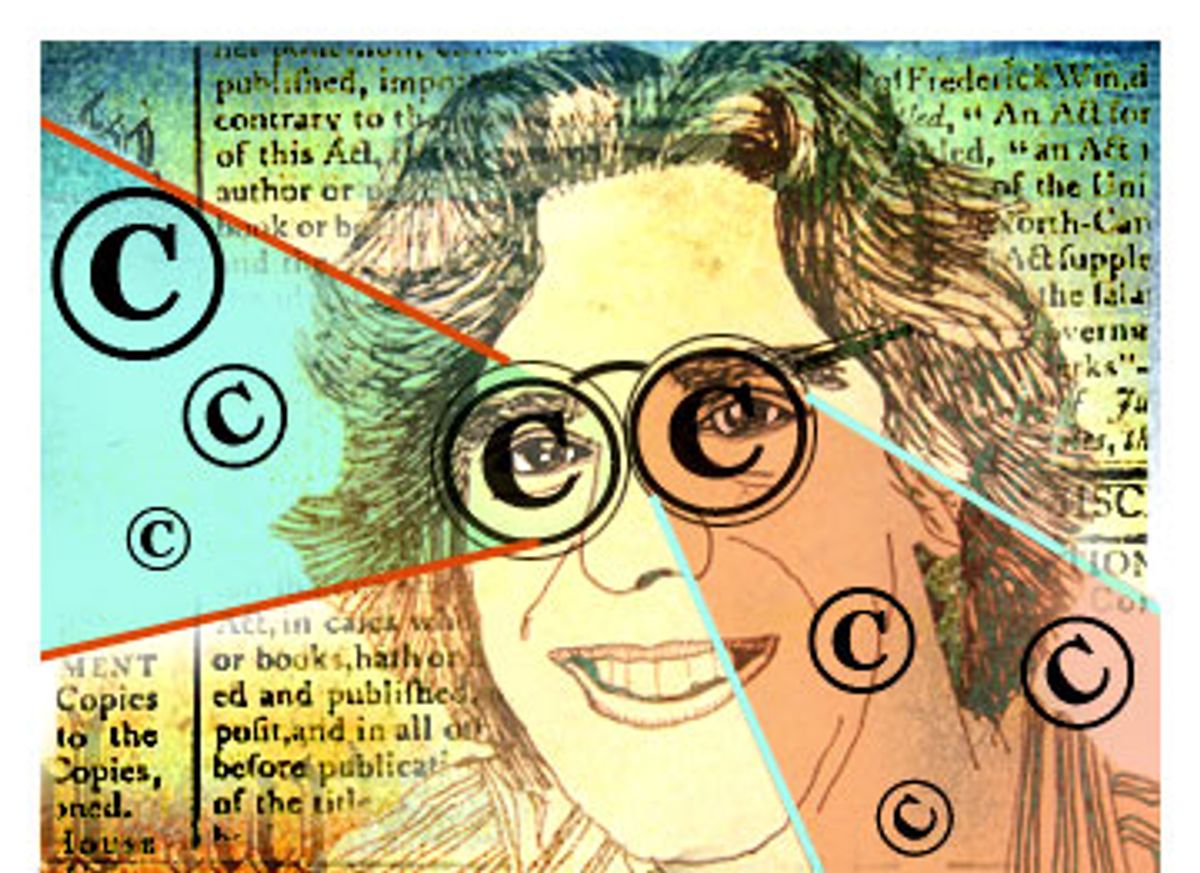
Lethem also wrote an essay for the February issue of Harper's called "The Ecstasy of Influence," in which he argues for a new approach to copyright law, based on the recognition that "appropriation, mimicry, quotation, allusion and sublimated collaboration consist of a kind of sine qua non of the creative act." It's based on the recognition that all works of art are, in a sense, a collaboration between artists and the culture at large. I spoke to Lethem about the copyright theme in his new novel and essay at his home in Brooklyn, N.Y.
"You Don't Love Me Yet" is about low-rent indie musicians with day jobs. Musicians like that often have little or no label support behind them and find themselves on a perpetual tour wagon, earning most of their cash through selling T-shirts -- that is, selling the byproducts of their lovely songs. When I jump on my pro-copyright horse, I have to say these musicians may be wrecking their personal relationships by touring all the time, and then when they enter their elderly years, which for an indie band may be their 30s...
Yes, yes, they have no intellectual property to help them out in the old age home. The first thing I want to say is that it's entirely a fiction of what I'll call, for the sake of this argument, the opposition -- corporate, copyright absolutists -- that to question the present privatization craze in any way is to vote for some anarchic abolition of copyright.
I make my living by licensing my copyright. Everything I've tried to say, in the Harper's essay and elsewhere, is that there is an enormous middle ground. It becomes one of those issues like, "If you don't favor wiretapping in the U.S., you must be for the terrorists." What I'm seeking to explore is that incredibly fertile middle ground where people control some rights and gain meaningful benefits from those controls, and yet contribute to a healthy public domain and systematically relinquish, or have relinquished for them, meaningless controls on culture that impoverish the public domain.
Having said that, there's no simple description. There's an enormously intricate series of judgments, given technological variations and the differences between different mediums. There's no simple standard to apply. It's a matter of understanding the needs of a healthy public domain and a healthy creative incentive in every field in deep and intricate specifics.
But I will say this: Problems of artists, musicians, writers, anyone getting paid for doing their most free and creative and independent kind of work, are not new ones. The present realm of corporate-instigated maximization of the intellectual property concept doesn't seem to have kept indie bands from touring.
I'm a very lucky artist. I make my living from it. I didn't know if I ever would. I'm very persuaded by the image that Lewis Hyde offers of an artist who is, by definition, in whatever medium, or whatever level of success or whatever culture, in the practice of culture-making; participating in culture by making stuff is inherently a gift transaction and a commodity transaction. And it always will be. The question is how do we affirm and clarify this relationship? Because it's a very weird one -- making commodities that are also gifts.
Presumably one is in a better position to make gifts of one's work later in one's career.
Ironically, yes! I'm in a better position than I was before. But the truth is, the agitation for it is mostly left to artists at the outset of their careers, or artists who have discovered the futility or frustration of hoping to make a living. It's left to people who are mostly doing it as a kind of volunteer impulse from the margins.
We've seen in our recent lifetimes examples of people making some pretty commercially viable work who had the legs knocked out from under them, like Hank Shocklee of Public Enemy, almost the inventor of a new musical language, who saw it essentially outlawed -- or made so impossible through the application of licensing laws that it might as well have become outlaw art. I feel that artists can't stand by and watch that happen in good faith.
I do speak from a weirdly princely position. I don't mean that in terms of my personal finances, which go up and down. I mean that in terms of a novelist being largely immune to these issues. I've expressed irritation when I've tried to quote a Brian Wilson lyric in a novel and it turned out that I couldn't afford to do it. Or when some copy editor goes and systematically capitalizes the word "band-aid" in my pages, and it seems to me objectionable, because I've used it, and my characters have used it, as a noun. It just is. I'm sorry, but that word has become a noun.
But the truth is, I could write a whole book detailing the plot of a "Simpsons" episode, describing Homer's yellow skin and protuberant eyes, and no one would ever be able to block my choice as an artist there, or make it too expensive for me to do it. But if a visual artist or a filmmaker or a digital montage maker tried to capture that image, which is just part of a visual language that is floating around, they don't have my freedom.
What if you were to transcribe the script from the episode? Wouldn't that be the equivalent of taking the language without alteration?
You'd probably reach an aesthetic point of diminishing returns before you'd get anyone excited about your copyright violation. But the point is: Are any of these things rivalrous with an episode of "The Simpsons" on television? Probably not. Why have we gotten so mystical about certain corporate holdings, which is what we are really talking about. Or certain business models? People speak of these rights as if they have this tangible moral power, comparable to the Ten Commandments. But they are very local and convenient corporate notions. All sorts of things can't be moved from one location to another freely by people wanting to talk about them, or depict them, or make fun of them, or smash them together with other things.
This is high and low. Talk to scholars of James Joyce, who have seen themselves tied in horrific knots by excessively zealous literary executors who won't let them quote from the works. There's an epidemic of this kind of control. Everyone can get up in arms, saying Samuel Beckett shouldn't have to see "Waiting for Godot" staged with Samurai costumes in his lifetime. It feels quite appropriate that he squashed things like that because he was such a severe and intense fellow. But for his heirs to make it seem as though there's an eternal injunction against recontexualizing the things he offered into our culture, well, all we have to do is apply the same standard to Shakespeare to see how impoverishing that would be.
You received a $6,000 advance for three years of work on your first novel, which is, sadly, pretty typical. Clearly, if you were still making that kind of money, it would be pretty tough to continue making art at all, much less conduct this kind of social experiment.
Sure, but it wasn't strengthening of copyright control that allowed me to make more money after that; it was because I found some readers. Even if my rights were Kryptonite and lasted 1,000 years, if no one read my books, they wouldn't be worth a penny. The economy of human attention is a very precious one, much scarcer than any other. I'm lucky to be in the position of having anyone notice that I've given something away in the first place.
In your essay, you used the blues as a model of "open source" material. You mentioned Led Zeppelin copping from blues musicians. Or you could take Brian Eno and David Byrne, models of good behavior as they are, lifting from other musical cultures. Or Picasso lifting from "African primitives." When you have a person or culture in power lifting from a person or culture with less power, especially when they make a crazy profit on the exchange, that's when people get extremely uncomfortable.
I agree. That's why I brought up those examples. I wanted to grant that there are an incredible array of relationships that artists can have to sources. Some of them make us uncomfortable; some of them even cross over into the deplorable and/or pathetic, like "Opal Mehta." But I think there are innate standards that people are applying by instinct, whether they can articulate it or not.
One is the value-added question. David Byrne may have seemed like a bit of a tourist, but he applied a transformative genius to the works he glommed onto, as did Picasso. Carlos Mencia doesn't seem to have added value to the jokes that other comics claim he has lifted from him. He just lifted them. So that's one standard.
Another is deception. People don't like to feel fooled. There's some degree, if not of citation, then suggestion, that there are sources. The third is the Led Zeppelin issue: Oh wait, you just cashed in enormously on this. It was un-copyrighted blues and you just slapped a copyright on it? That's the Disney/Led Zeppelin action. Those creators could both pass the value-added test quite nicely. But it still seems a little disproportionate, the amount of printing money that went on in relationship to sources that were relatively non-commodified before that time.
That's what makes people afraid of making their material available without a copyright.
I think right now there's a very lively culture of public shaming that would take care of those types. But sure, there are two sentiments that are not always completely in agreement. That's one reason I didn't call this an open-source project. Open-source projects require that any subsidiary use perpetuate the non-commodifiability. And I decided that was not a control that I wanted to impose. Part of what I wanted to celebrate was the non-controlled aspect of my gift transaction.
For example, I've put lyrics from my new novel on my Web site. And I'm not saying, "Don't have a hit song and make money with these lyrics." I don't know if anyone could, but if someone did, I would just be happy for them. For me, just writing them and being engaged is more than enough. In that area, I'm not seeking reward and I'm not seeking to prohibit someone else from seeking reward. So that's a little different from the open-source description.
That goes to the Samuel Beckett sentiment, or, perhaps better, the Margaret Mitchell estate [who sued for copyright infringement over "The Wind Done Gone"]. If you make stuff, it is not yours to command its destiny in the world. God help you, you should be grateful if it has one. It's fantastic if anyone cares. Every artist should be constantly reminding themselves how lucky they are if people are even bothering in the first place. If people do something that is not as interesting as I'd hoped with my work, or if they go and make a lot of dough, that's part of accepting that I've made a gesture whose conclusion is not mine to command.
But to be totally obvious, lyrics and even film projects are not novels. One thing I would always retain is the rights to my novels. With my new novel, I'm inviting some filmmaker to take a lover's leap with me, saying that five years after the release of a film, we make it a stage play or a comic book or a musical or make a sequel. I wouldn't probably choose to do that with every one of my novels. With some of them, some degree of control is still appealing to me. With this one I felt I would really enjoy giving that away. And it's my choice. That's the key. This proceeds from my choice. But I don't think 50 or 100 years after my death, someone should still have say over what someone makes of this stuff. It certainly doesn't follow. As Lawrence Lessig likes to point out, you can't provide incentive to a dead creator to make more art by offering him a copyright.
I'm curious what happens when you reverse that value-added test. Let's use the woman who claimed to have invented Muggles before J.K. Rowling, or the example you raised about the guy who wrote a bad version of "Lolita." If making good art legitimizes borrowing, is the corollary true? If you make bad art, do you fail that value-added test and suddenly have your artistic failure become illegal too?
Bad art is never unethical. It's desperately important to clarify that because every artist makes a lot of bad art before they make any good art, and often, at intervals, will make more bad art over the course of making good. It has to be as freely encouraged as the making of the good.
It seems very gutsy to invent a band in fiction.
Yeah, it often doesn't work very well. I think I ducked the test in some ways by, first of all, inventing a half-assed band. They're not meant to persuade you that they are going to take over the world. To make up a fictional artwork that seems that it will tip the world back on its heels always feels very fake.
If someone were to fictionalize the kinds of things that do succeed, they wouldn't sound right either. Instead of doing that, I invented something like the avant-garde film in "Fortress of Solitude"; I made up art that no one cares about. That's much easier to persuade people of, because there is so much of that.
The other thing I did that wasn't a conscious strategy -- though after I did it, I realized it was an unconscious strategy -- is I didn't actually commit to the full lyrics of the song. I always hate when there are fictional lyrics to the entirety of a song. It makes me cringe. I don't think a lot of real lyrics are very persuasive on the page, even to songs you would like. So I always just gave a fragment or a line -- even in the case of "Monster Eyes," I just give a chorus. Even so, it still frees you to believe that the song is something you'd like if you heard the whole thing.
A lot of the Complainer's lines could be ad slogans. It draws an interesting parallel between pop songs and advertising jingles.
It's true. I was very interested in how so many great pop songs are made out of initially indifferent or seemingly ruined language. There are all these great soul songs that take popular advertising slogans of the day, or dumb witticisms, like "Don't scratch where it don't itch," or "I'd rather fight than switch," or Buddy Holly grabbing on to the line "That'll be the day" from "The Searchers." Even within the film, one of the embarrassing things about it is that John Wayne says that phrase too often. You feel like they are trying to brand it. So Buddy Holly catches on to this and makes this immortal song out of his excitement for that phrase.
These things are floating around and don't quite belong to anyone, at least not the people who use them. They're not just vernacular, but they feel like tawdry things, like someone has just picked up a chewing gum wrapper and put it into a painting. I wanted to get some of that bumper-sticker quality into this.
But the Complainer is this kind of idiot savant. He has this way of being irritating and impossible to dismiss that's like the bad side of a catchy song; when pop succeeds and you wish it hadn't. It has a viral quality. This is where advertising and a great pop hook converge -- the noise in your brain that you can't quite get away from.
This fall I interviewed Edward Norton and we talked some about his adaptation of "Motherless Brooklyn," which he plans to write and star in. How's that going now?
Well, you've probably got a much better idea of where that project stands than I do. I haven't spoken to him about it in awhile and even then, it was in passing. So you tell me.
We also only spoke about it in passing. But what he did say is that he had decided to make it a noir -- set it in an earlier time period.
That's true. Although when people say "noir" you think 1948 to the mid-'50s. I think he's interested in New York in the Robert Moses era, the very early '60s. But it's not a project I'm involved in. I am a well-compensated cheerleader for it, though, which suits me. I've broken that pattern recently. Amy [Barrett, a filmmaker and his wife] and I are working with the director, Josh Marston, who did "Maria Full of Grace," on "Fortress of Solitude." But even that feels like an exception to me. I'm so responsive to film. And my books incorporate that excitement in the work. I think that's one of the reasons filmmakers have optioned my books. They can feel that I'm thinking in those terms. But on the other hand, I don't have the temperament to make them myself.
The offer for the film rights to "You Don't Love Me Yet" has been up for a week. Anything good come in thus far?
At the moment, I've seen six. I always assumed it would take at least some of the more credible or thoughtful offers time to figure out what the hell I was on about and what, if anything, they could envision themselves doing -- not to cast any shade on the ones that have already come in, which I haven't had a chance to look at yet.
You've already optioned films under traditional means. What do you hope will be different?
Well, I'm ready to be surprised. When I felt my way into this decision, one of the things I felt happiest about is that I could picture the material in this book being, well, not camera-ready, because you can never shoot the book. That's always a big mistake when people read a book and say, "Oh! It's a film!" You adapt it and it's hopeless and it doesn't work in a million ways.
But it's contemporary. It's a young ensemble cast. There's no tour de force character that would require a star, like, say, Lionel Essrog in "Motherless Brooklyn" really wants to be Edward Norton. But you could see this thing being made in an early Richard Linklater in Austin, Texas, or Andrew Bujalski manner of work. It could be done with unknowns, and not so much money. I don't mean to suggest that anyone shouldn't call their friend Brad Pitt and make an expensive movie out of it.
Not to discount the Brad Pitts of the world who may be swooping in as we speak, but are you tempted to be biased toward first-time or small filmmakers, given that you have the potential to lure investors to people who couldn't otherwise raise the cash on their own?
Oh, I guess it would be a bigger gift, not just to the person, but to the world at large, if this got someone to do something they wouldn't have been in the position to do otherwise. If Steven Soderbergh comes calling, that would be hard to say no to, especially if he is very nice and says good things. But I wouldn't be giving Steven Soderbergh any new opportunities.
I guess I'm in a similar position to those giving out grants or awards in the art world. It's very pretentious to think of this as an award. But in the same way, if two equally interesting and charming proposals are made to me, and one is someone who could probably make their next movie easily anyway and the other is someone who might not otherwise get to make a film, you're right. I should probably tip toward the latter. But this is all getting so ahead of myself.
Well, I bet whoever you choose will find it easier to raise money for the film than they would for a story by an unknown writer.
I have this weird little thing to lend out in a way. Even more peculiar is this episode has already gotten some attention. One of the weird things about being a novelist who has any relationship at all to the film industry is that what everyone says -- consolingly almost, because they're all envisioning hugely successful movies that are disastrous adaptations of your book, and already feeling sorry for you in advance for these nonexistent movies --- they all say, "Well, at least it will sell some books."
That's true. And if someone made a very big movie, or even a medium-size movie, out of one of my books, whether it was good or bad, or whether I liked it or not -- which is two different things -- the one certainty is that it would sell books. But even the film options sell books. People talking about the idea of making a movie sells books. And here I've taken this situation to the ultimate absurdity: There isn't even a deal, and yet here we are, talking about the movie.
You have a band covering your songs in New York in about a week. Have you heard any of these tunes yet?
Oh, yes, it's a great version of "Monster Eyes." The band is called Night Time. I wish you could hear it. It's not on my site yet, but it will be soon. [But it's on Salon's site.]
And if they do blow up and making a killing on the song?
I'll be Andy Warhol to their Velvet Underground. I'll be their Complainer.
Shares