

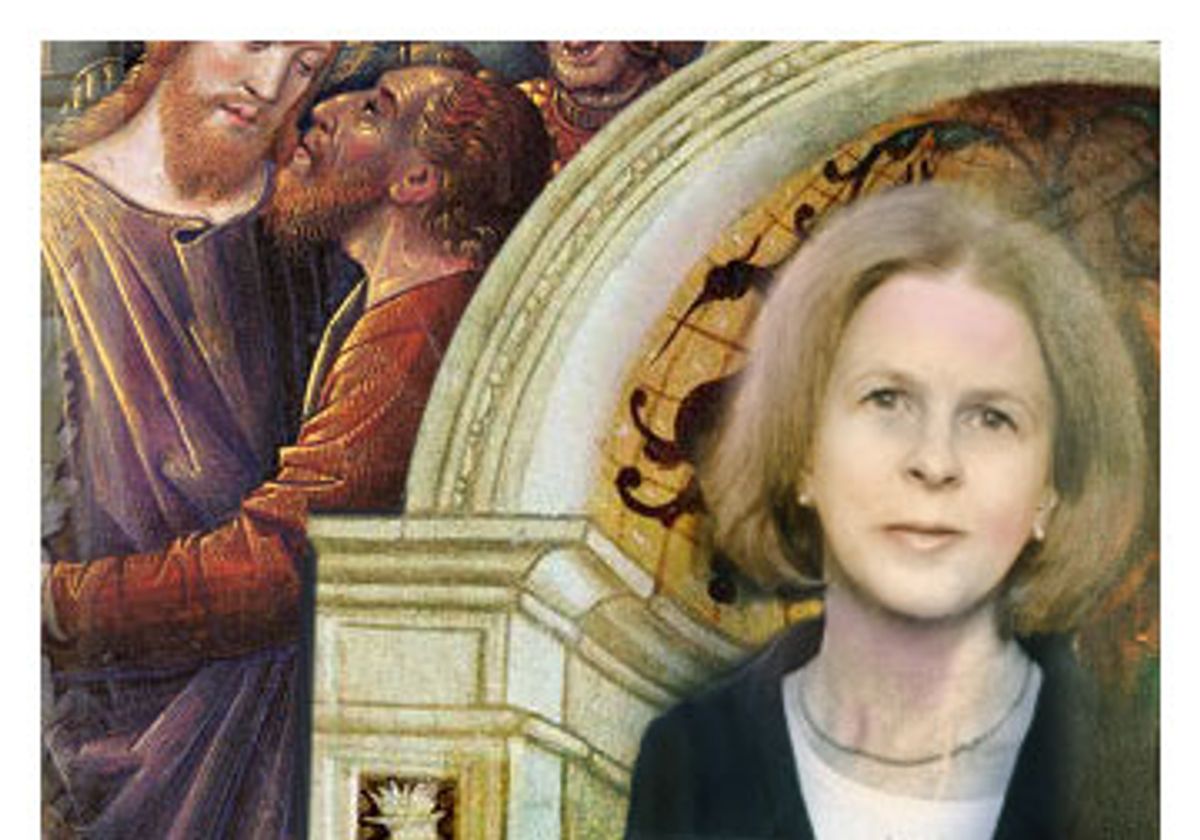
As almost every child knows, Judas was the disciple who betrayed Jesus, selling his life for 30 pieces of silver. If there's an arch villain in the story of Jesus, it's Judas Iscariot. Or is it? The newly discovered Gospel of Judas suggests that Judas was, in fact, the favorite disciple, the only one Jesus trusted to carry out his final command to hand him over to the Romans.
Rumors about the gospel have circulated for centuries. Early church fathers called it a "very dangerous, blasphemous, horrendous gospel," according to historian Elaine Pagels. We now know that the manuscript was passed around the shadowy world of antiquities dealers, at one point sitting in a safe deposit box in a small town in New York for 17 years. Pagels herself was once asked by a dealer in Cleveland to examine it, but he only showed her the last few pages, which revealed little more than the title page. She assumed there was nothing of significance. Finally, the manuscript was acquired by the National Geographic Society, which hired Pagels as a consultant to study it.
More than any other scholar, Pagels has brought the lost texts of early Christianity to public attention. A Princeton historian of religion, she wrote the 1979 bestseller "The Gnostic Gospels" -- the book that launched the popular fascination with the Nag Hammadi manuscripts found by Egyptian peasants in 1945. That book, which won both the National Book Award and the National Book Critics Circle Award, was later chosen by the Modern Library as one of the 100 best nonfiction books of the 20th century. Pagels went on to write a series of acclaimed books about early Christianity and, along the way, recounted her own personal tragedies -- her young son's death after a long illness and, just a year later, her first husband's death in a hiking accident. It's no surprise that Pagels has felt compelled to wrestle with some of religion's thorniest subjects, like how to make sense of suffering and evil.
For much of her career, Pagels has straddled two worlds -- the academic and the popular. She's often the go-to expert when a magazine needs a comment on the latest theory about Mary Magdalene or some other bit of revisionist Christian history. But her standing among the scholars who study early Christianity is more complicated. Conservative scholars tend to dismiss the Gnostic texts as a footnote in Christian history, hardly worth all the hype that's been generated by "The Da Vinci Code" and other racy stories. Not surprisingly, these scholars have questioned Pagels' interpretations of early Christian texts.
With Harvard historian Karen L. King, Pagels has written a new book, "Reading Judas: The Gospel of Judas and the Shaping of Christianity." The authors argue that this recently discovered gospel offers a new understanding of the death of Jesus. I spoke with Pagels by phone about the bitter quarrels among early Christians, why it's a bad idea to read the Bible literally, and the importance of this new discovery.
When was the Gospel of Judas written?
As far we can tell, probably at the end of the first or early second century.
So it's clearly not written by Judas himself, or even dictated by Judas.
That's right. And most New Testament scholars would say the gospels in the New Testament -- all of them attributed to disciples or followers of disciples -- were probably not written by the people whose names are on them. If you say, "the Gospel according to Matthew," you might not be pretending to be Matthew if you wrote it. You might be saying, this is the gospel the way Matthew taught it, and he was my teacher. So these are certain followers of Jesus who collected and transmitted his teaching.
Does this Gospel of Judas reveal something new about early Christianity?
Yes, the Gospel of Judas really has been a surprise in many ways. For one thing, there's no other text that suggests that Judas Iscariot was an intimate, trusted disciple, one to whom Jesus revealed the secrets of the kingdom, and that conversely, the other disciples were misunderstanding what he meant by the gospel. So that's quite startling.
It's shocking to suggest that Judas wasn't just one of the disciples but was actually the favorite disciple of Jesus.
That's right. And also the idea that he handed over Jesus to be arrested at the orders of Jesus himself. This wasn't a betrayal at all. In fact, it was obedience to a command or request that Jesus had made.
But how do we reconcile this with all the other stories we've ever heard about Judas? He's the symbol of treachery and betrayal.
Well, he has become the symbol of treachery and betrayal. But once you start to look at the gospels one by one, you realize that followers of Jesus were trying to understand what had happened after he was arrested and killed. They knew Judas had handed him over to the people who arrested him. The earliest gospel, Mark, says Judas handed him over, but it doesn't give any motive at all. The people who wrote after Mark -- Matthew's and Luke's gospels -- apparently felt that what was wrong with the Gospel of Mark was that there was no motive. So Matthew adds a motive. Matthew says Judas went to the chief priests who were Jesus' enemies, and said, "What will you give me if I hand him over to you?" And they agree on a certain sum of money. So in Matthew's view, the motive was greed. In Luke's gospel, it's entirely different. It says the power of evil took over Judas. Satan entered into him.
I think Luke is struggling with the question, If Jesus is the son of God, how could he be taken by a mere trick, by a human being? And Luke is trying to show that all evil power was concentrated in Judas. So they are very different stories. However, other gospels, like John's, suggest that Jesus not only anticipated what was going to happen but initiated it. The Gospel of John says that he told Judas to go out and do what he had to do, which Jesus knew was to betray him. So the Gospel of Judas just takes the suggestion one step further. Jesus not only knew what was going to happen but initiated the action.
There's something else that's striking about the Gospel of Judas. The writer is very angry, and he's especially angry at the other disciples.
Yes, that's where we realized that it's not just a story about Jesus and the disciples. It's a story about this follower of Jesus -- the Christian who's writing this story, maybe 60 years after the death of Jesus. Even using the name of Judas is a slap in the face to the tradition. You realize that whoever wrote it was a very angry person. And we were asking, What's going on here? Why is he so angry? And we discovered that it's very dangerous to be a follower of Jesus in the generations after his death. You know, they say his disciple Peter was crucified upside down. And Paul was probably beheaded by the Romans. James was lynched by a crowd, and so were Stephen and other followers. So leaders of this movement were in great danger. And other Christians were also in danger of being arrested and killed because they followed Jesus. The question for many of them was, What do you do if you're arrested?
And to acknowledge that you were a Christian would probably kill you.
Exactly. All you had to do is say no. Or you can try to escape or bribe the people persecuting you. And many did. The only answer that most Christians agreed was right was to say, "Yes, I'm a Christian." You defy them and you go heroically into the lions. So we've always thought of Christianity as a religion that glorifies martyrdom. Now we realize that we've had that impression because the people who weren't in favor of martyrdom had their writings buried and burned and trashed and ridiculed. And they were called cowards and heretics.
So the Gospel of Judas is a kind of protest literature. It's challenging leaders of the church. Here the leaders are personified as disciples who are encouraging people to get killed, to "die for God," as they called martyrdom. This gospel is challenging them and saying, when you encourage young people to die for God, you're really complicit in murder.
Are there also theological issues at stake? This gets at the meaning of suffering, and the nature of evil as well.
It does. This was at a time when all followers of Jesus were struggling with the question, Why did Jesus die? What does it all mean? In the New Testament, the gospels say he died as a sacrifice. Paul says Christ, our Passover lamb, was sacrificed for us. Why? Well, to save us from sin.
But this author is saying, wait a minute. If you think God wants his son to be tortured and killed before he'll forgive people their sins, what kind of God do you have in mind? Is this the God who didn't want animals to be sacrificed in the temple anymore? So this author's asking, isn't God a loving father? Isn't that what Jesus taught? Why are we saying that God requires his son to die for the sins of the world? So it's a challenge to the whole idea of atonement, and the idea that Christians -- when they worship -- eat bread and drink wine as if it were the body and blood of Christ. This person sees that whole thing as a celebration of violence.
You can see why some early Christians would have attacked this gospel. This is very threatening to other Christian accounts of why Jesus died.
It contradicts everything we know about Christianity. But there's a lot we don't know about Christianity. There are different ways of understanding the death of Jesus that have been buried and suppressed. This author suggests that God does not require sacrifice to forgive sin, and that the message of Jesus is that we come from God and we go back to God, that we all live in God. It's not about bloody sacrifice for forgiveness of sins. It suggests that Jesus' death demonstrates that, essentially and spiritually, we're not our bodies. Even when our bodies die, we go to live in God.
Does this raise questions about how we should think about the Resurrection? In orthodox Christian accounts, this is considered a resurrection of the flesh.
That's right. The idea that Jesus rose in the flesh is very important for a lot of Christians. And certainly for the martyrs. When people were going to get themselves killed, some of them were asked, Do you believe that you're going to be raised from the dead in your body? And many of them said yes, of course we do. That's why we're doing this. So those promises of bodily resurrection and heavenly rewards were very important for many Christians.
Some of the things we're talking about would seem to have great resonance in the Islamic world. Do you see any parallels between this Christian history and what we're seeing among Muslim martyrs today?
I do. The author of the Gospel of Judas wasn't against martyrdom, and he didn't ever insult the martyrs. He said it's one thing to die for God if you have to do that. But it's another thing to say that's what God wants, that this is a glorification of God. I think he would have spoken in the way that an imam might today, saying those who encourage young people to go out and supposedly die for God as martyrs are complicit in murder. The question of the uses of violence is very much at the heart of the Gospel of Judas. If you have to die as a martyr, you do because you don't deny Christ. But you don't go around encouraging people to do it as though they would get higher rewards in heaven.
Can you put the Gospel of Judas in perspective, alongside some of the other Gnostic texts that have come to light in recent decades -- the Gospel of Thomas, the Gospel of Mary Magdalene? Do these really change our understanding of early Christianity?
Before, we had a puzzle with just a few pieces. Now we have many more pieces. We begin to see that in the early Christian movement, people discussed and struggled with all the issues that we now think of as normative Christianity, like, What does the death of Jesus mean? There wasn't one kind of understanding of Jesus in the early Christian movement. Actually, there were many.
In recent years, there's been a huge debate over what to make of the Gnostic Gospels. And plenty of Christian scholars and theologians say there's good reason they were not admitted into the Christian canon. They say the Bible presents the most reliable story of Jesus based on eyewitness accounts. For instance, Ben Witherington has written, "The four canonical gospels have stood the test of time and other apocryphal gospels and texts have not ... This is because the canonical gospels are our earliest gospels and have actual historical substance, while the later gospels have none."
Well, Witherington has a particular point of view to prove. I would say it's very hard to date these other texts. Some of them are as early as the gospels of the New Testament, like the Gospel of John. But what's different is the emphasis. Let me give you an example. The Gospel of Thomas says that all who recognize that they come from God are also children of God, instead of teaching that Jesus is the only son of God through whom one must be saved. It's a teaching that is akin to what the Quakers and some other Christian groups teach, including some Greek and Russian Orthodox groups. The divine is to be found in everyone, and we can discover, at some level, that we're like Christ. It's not a complete contradiction, but it is somewhat different.
But aren't there crucial doctrinal issues at stake in terms of what it means to be a Christian? For instance, was Jesus the son of God? Was the return of Jesus an actual resurrection of the flesh?
In the fourth century, the Council of Nicaea established certain doctrines about what it means to be orthodox: belief in one God, maker of heaven and earth, and one Jesus Christ, his only son and Lord. So Jesus Christ is the only one who brings salvation to the whole world. There are, of course, Christians who believe in Jesus but also wonder whether people can't find God in other religions -- if they're Jews or Muslims or Buddhists and so forth. There's nothing Jesus himself said that contradicts that, as far as I can see. But fourth-century Christian orthodoxy did set out the doctrines you're talking about.
Some people say the historical study of early Christianity really doesn't matter to a person's faith. Being a Christian means you believe in certain things, like the Resurrection, like the Virgin Birth. These are matters of faith, not of historical research. You can choose not to believe those things, but then you're not part of the Christian creed. How do you respond to that argument?
Well, it's absolutely true that the Virgin Birth and the Resurrection can't be verified historically. On the other hand, if you start to look at it historically, you find out that there are plenty of people who call themselves Christians who see those very things differently. There have been Christians from the beginning -- St. Paul is one of them -- who say the Resurrection is not a matter of this kind of body. Paul talks about resurrection as a matter of being transformed. Yes, it's about the body, he said, but it's more like a body of the stars or the moon or the sun -- a body of light. So there are many ways that people have understood themselves to be Christians.
This has huge implications for so many people today, especially those who simply can't accept these kinds of miracles. It does raise the question of whether you can be a Christian if you don't believe any of the Bible's supernatural stories.
I don't think you have to discard all the supernatural stories. The Bible is really about what is beyond the natural. But there are other ways of understanding. For example, the Gospel of Philip, which some people called a heretical text, actually says Jesus had human parents as you and I do. His parents were Mary and Joseph. But when he was born of the spirit, he became the son of the Heavenly Father and the Holy Spirit. In Syriac and Hebrew, the spirit is spoken of in feminine forms, so metaphorically, one could speak of her as a divine mother, just as one speaks of God as a divine father. So there are Christians who didn't reject the Virgin Birth, but said wait a minute, why would you take it literally? Why don't you take it as an image for spiritual reality?
You have spent decades studying early Christian history. Do you consider yourself a Christian?
Yes, I do. And the reason I can is that I understand that there are countless people who've been Christians for 2,000 years, in many different ways. It's not a matter of one version, you must believe this exactly the way I tell it to you. Christian theologians have always said that the truth of God is beyond our understanding. And so we speak in metaphors. Paul said we see through a glass darkly.
I've heard that you didn't grow up in a religious family.
Well, it was a Protestant family, nominally. We went to church, but my father had rejected the Bible for Darwin. He decided the Bible was a bunch of old fables and that evolution was right. So I was brought up to think the Bible was just kind of irrelevant. I grew up and became deeply and passionately interested in it and went to a church and was born again. I was 14 or 15. It was quite wonderful, and I loved what I found there.
Even though your father was a confirmed atheist.
It did shock him, yes. Of course, that's one way adolescents like to shock their parents. I didn't do it for that reason, but it had that effect. The power and the passion of that kind of evangelical Christianity was very real for me. And it was a discovery of something very important -- a spiritual dimension in life that I was not able to ignore. On the other hand, after a year of living in that church, one of my friends in high school was killed in an automobile accident. The people at the church asked, was he born again? And I said, no, he wasn't. And they said, well, then he's in hell. And I thought to myself, I don't believe that. That doesn't match up with what I'd heard about God. So at that point, I decided I had to find out for myself what I could about the early Christian movement, what I believe about it, and what is being said in the name of Jesus that I found not true.
That's fascinating. Basically, it was because you couldn't buy into that fundamentalist version of Christianity that you launched your career as a historian of Christianity.
That's the truth, yes.
Well, this does raise the question of what we mean by God and what we mean by transcendence, and whether there is a transcendent reality out there. Is that discussion of transcendence meaningful to you?
Oh, certainly it is. If we don't understand how important spiritual life is to people, I don't think we're going to understand human beings or the 21st century. There are many people who said religion is essentially over now, and everyone will become rational. They don't understand that the way humans are has a lot to do with religious experience.
Your late husband, the eminent physicist Heinz Pagels, wrote very eloquently about the mysteries of science. Did he influence your thinking about this intersection between science and religion?
Oh yes, he was deeply interested in philosophy and religion and science, and understood how profound and complicated those issues are. When you're dealing with science, for example, you're dealing all the time with metaphors. So to assume that religious language isn't metaphor doesn't make sense to me.
There's a big debate right now over whether religion and science are two totally different domains, as Stephen Jay Gould once said, or whether they overlap. Where do you come down on that?
That's a very tough question. I think religion and science both have a lot to do with understanding and imagination, but they certainly explore the world in very different ways. For example, when the eminent physicist Stephen Weinberg wrote in his book "The First Three Minutes," "the more we know about the universe, the more we know it's pointless and meaningless," my late husband said, "That doesn't make any sense." Einstein thought the more we knew about the universe, the more we knew about the divine intelligence. There are many ways to make inferences from physics. And inferences like that are not scientific at all; they're philosophic.
Of course, there's still a huge debate about whether Einstein was religious or not. The atheists want to claim him for their camp, but religious people say he was actually quite open to religious ideas.
Part of the problem is that Einstein used the language about God as a metaphor. When he said, "God does not play dice with the universe," he meant the universe is not put together in an accidental way. It does show a kind of intelligent process in it. Einstein was speaking about God in the way that physicists would -- aware that language like that is always going to be metaphorical, speaking beyond our understanding. But many people took him literally and said he's a religious man. Scientists said he was just using language carelessly.
Isn't that part of the problem that we get into when we talk about metaphor and the religious imagination? If you don't take scripture literally, how do you take it?
You can take scripture seriously without taking it literally. If you speak about the Resurrection of Christ, all we know historically is that after Jesus died, his followers became convinced that he was alive again. Now, what does that mean? They told many stories. Some of them said, I saw him with my own eyes, I touched him, he actually ate food, he was not a ghost. That's in Luke's gospel. And others said, I saw him for a moment and then he faded -- the way many people say they've seen people they knew who died. What I'm saying is there are many ways that people who believe in the Resurrection speak about Christ being alive after his death without meaning that his body got out of the grave and walked.
It sounds like you're saying that it's perfectly possible to take the Bible very seriously, to be a Christian, and yet not to believe in the supernatural miracles that so many people simply cannot accept.
Well, that may be. I don't dismiss all supernatural miracles, like a healing that can't be explained. Those do happen sometimes.
You've been studying these texts for decades. Has your scholarly work deepened your own faith?
Yes. And the scholarly work is part of the spiritual quest. Opening ourselves to exploring as much as we can about this can be, in fact, an act of faith. At Princeton, there's a course in the study of New Testament that some evangelical students were warned not to take. They called it "Faith Busters 101." And some of them come just to flex their muscles and see if they can sit there and stand it while somebody teaches them about how the gospels were written. But what they usually discover is that learning about those things doesn't change the fundamental questions about faith.
Does faith necessarily involve some leap into mystery, into something that can't be explained?
I think it does. Earlier this year, I was asked to do an interview with somebody who had written a book to demonstrate that Jesus had been raised bodily from the dead. And they expected me to say that was impossible. But I can't say it's impossible. From a historical point of view, there's no way you can comment on that. It's just not susceptible to that kind of analysis. So there's a lot that history can't answer and that science can't answer. I mean, there's a lot about all of our lives that we have no rational understanding of. And so faith comes into our relationships with the people we love, and our relationship to our life and our death.
There seems to be a rather vigorous movement among scientists to try to explain the origins of religion. I'm struck by how often these theories come from atheists. And I think the underlying impulse is to demystify the divine. But can religion really be explained from the outside, by people who are not themselves religious?
Probably not. For example, suppose you found the basic brain chemistry that explains religious perceptions. In fact, there are neurologists in New York trying very hard to understand precisely that. And you find that when people who've clinically died say they've had a near-death experience, they've gone into a brilliant light and then they've come back from some place. This is the flashes of light on the brain as it expires. Well, it may be. And it may not be. Is this a trick that our brain plays on us? Or is this intimations of some other kind of reality? I don't think science is going to answer that question.
Isn't there an inherent limitation to any of those brain-imaging studies? Because there's the whole question, Are we just imagining this? Or is there really some contact with the divine?
Exactly. For example, there's a study now at New York University about epilepsy. We know that epileptics often have an experience of seeing an aura. They can have an epileptic convulsion and they have a kind of vision. It was understood in ancient times to be demonic possession. So if people then say, epilepsy has a certain relationship to electrical activity in the brain, and that's what precipitates these experiences, does that mean that they are not real? I don't think that answers the question.
What do you make of the recent claim by the atheist Richard Dawkins that the existence of God is itself a scientific question? If you accept the idea that God intervenes in the physical world, don't there have to be physical mechanisms for that to happen? Therefore, doesn't this become a question for science?
Well, Dawkins loves to play village atheist. He's such a rationalist that the God that he's debunking is not one that most of the people I study would recognize. I mean, is there some great big person up there who made the universe out of dirt? Probably not.
Are you saying that part of the problem here is the notion of a personal God? Has that become an old-fashioned view of religion?
I'm not so sure of that. I think the sense of actual contact with God is one that many people have experienced. But I guess it's a question of what kind of God one has in mind.
So when you think about the God that you believe in, how would you describe that God?
Well, I've learned from the texts I work on that there really aren't words to describe God. You spoke earlier about a transcendent reality. I think it's certainly true that these are not just fictions that we arbitrarily invent.
Certainly many people talk about God as an ineffable presence. But if you try to explain what transcendence is, can you put that into words and explain what it means?
People have put it into words, but the words are usually metaphors or poems or hymns. Even the word "God" is a metaphor, or "the son of God," or "Father." They're all simply images for some other order of reality.
There's one aspect of the Bible that's especially troubling. What do you make of the many passages that condone violence? Killing infidels seems to be what God wants.
You mean in the Hebrew Bible?
Yes, I'm particularly thinking about the Hebrew Bible.
Well, yes. When you read the discussion of holy war in the Hebrew Bible, it's violent, definitely. This was a war god, identified with a particular tribe, with particular kinds of religious war. Christians often don't read that now. But when I talk with Jewish leaders, they say, yes, we remember that very well because we remember the Crusades. And the Muslims of course say the same. They say, why are you talking to us about violence? Christians have done violence in the name of Christ for nearly 2,000 years.
So how should we read those passages that are so violent?
That gets us back to the question, Can you read the Bible seriously without reading it literally? There are parts of the New Testament which encourage slaves to remain slaves. Do we take that literally? Those were fighting words during the Civil War when some Christians said slavery was part of God's plan and some people should live and die as slaves. I think few would agree with that now. But it was a position that one could seriously take on the basis of many biblical passages.
You're saying that we have to understand context.
I think we do. You were saying that some people believe faith has nothing to do with history. The fact is, somebody wrote those texts. They wrote them in a world in which slavery was taken for granted. That's a different world. So if we don't understand that, well, it says, Slaves, obey your masters, for this is right.
Shares