

For fans of the literary con, it's been a great few years. Currently, we have Richard Gere starring as Clifford Irving in "The Hoax," a film about the '70s novelist who penned a faux autobiography of Howard Hughes. We've had the unmasking of James Frey, JT LeRoy/Laura Albert and Harvard's Kaavya Viswanathan, who plagiarized large chunks of her debut novel, forcing her publisher, Little, Brown and Co., to recall the book. Much has been written about the slippery boundaries between fiction and nonfiction, the publishing industry's responsibility for distinguishing between the two, and the potential damage to readers. There's been, however, hardly a mention of the 20th century's most successful literary trickster: Carlos Castaneda.
If this name draws a blank for readers under 30, all they have to do is ask their parents. Deemed by Time magazine the "Godfather of the New Age," Castaneda was the literary embodiment of the Woodstock era. His 12 books, supposedly based on meetings with a mysterious Indian shaman, don Juan, made the author, a graduate student in anthropology, a worldwide celebrity. Admirers included John Lennon, William Burroughs, Federico Fellini and Jim Morrison.
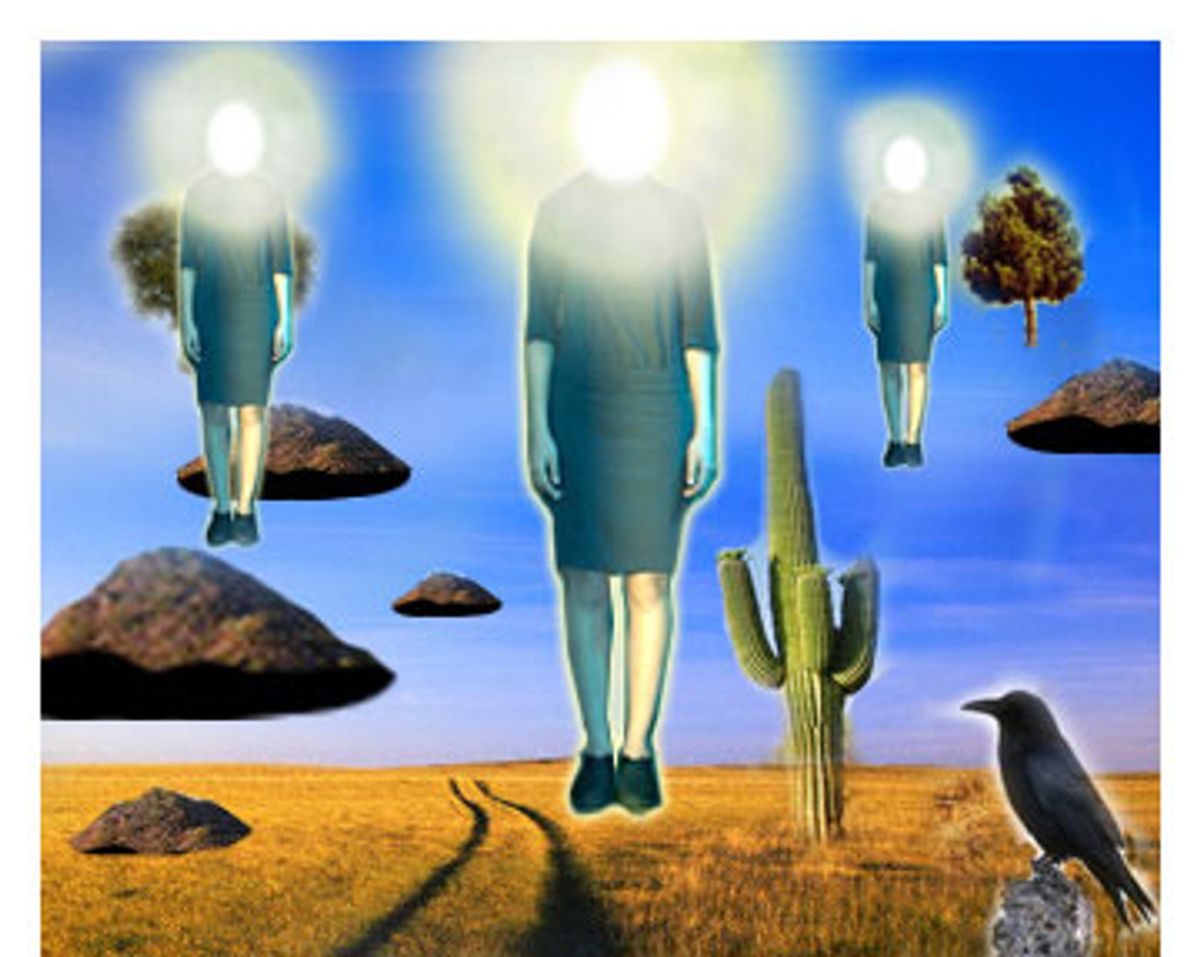
Under don Juan's tutelage, Castaneda took peyote, talked to coyotes, turned into a crow, and learned how to fly. All this took place in what don Juan called "a separate reality." Castaneda, who died in 1998, was, from 1971 to 1982, one of the best-selling nonfiction authors in the country. During his lifetime, his books sold at least 10 million copies.
Castaneda was viewed by many as a compelling writer, and his early books received overwhelmingly positive reviews. Time called them "beautifully lucid" and remarked on a "narrative power unmatched in other anthropological studies." They were widely accepted as factual, and this contributed to their success. Richard Jennings, an attorney who became closely involved with Castaneda in the '90s, was studying at Stanford in the early '70s when he read the first two don Juan books. "I was a searcher," he recently told Salon. "I was looking for a real path to other worlds. I wasn't looking for metaphors."
The books' status as serious anthropology went almost unchallenged for five years. Skepticism increased in 1972 after Joyce Carol Oates, in a letter to the New York Times, expressed bewilderment that a reviewer had accepted Castaneda's books as nonfiction. The next year, Time published a cover story revealing that Castaneda had lied extensively about his past. Over the next decade, several researchers, most prominently Richard de Mille, son of the legendary director, worked tirelessly to demonstrate that Castaneda's work was a hoax.
In spite of this exhaustive debunking, the don Juan books still sell well. The University of California Press, which published Castaneda's first book, "The Teachings of Don Juan: A Yaqui Way of Knowledge," in 1968, steadily sells 7,500 copies a year. BookScan, a Nielsen company that tracks book sales, reports that three of Castaneda's most popular titles, "A Separate Reality," "Journey to Ixtlan" and "Tales of Power," sold a total of 10,000 copies in 2006. None of Castaneda's titles have ever gone out of print -- an impressive achievement for any author.
Today, Simon and Schuster, Castaneda's main publisher, still classifies his books as nonfiction. It could be argued that this label doesn't matter since everyone now knows don Juan was a fictional creation. But everyone doesn't, and the trust that some readers have invested in these books leads to a darker story that has received almost no coverage in the mainstream press.
Castaneda, who disappeared from the public view in 1973, began in the last decade of his life to organize a secretive group of devoted followers. His tools were his books and Tensegrity, a movement technique he claimed had been passed down by 25 generations of Toltec shamans. A corporation, Cleargreen, was set up to promote Tensegrity; it held workshops attended by thousands. Novelist and director Bruce Wagner, a member of Castaneda's inner circle, helped produce a series of instructional videos. Cleargreen continues to operate to this day, promoting Tensegrity and Castaneda's teachings through workshops in Southern California, Europe and Latin America.
At the heart of Castaneda's movement was a group of intensely devoted women, all of whom were or had been his lovers. They were known as the witches, and two of them, Florinda Donner-Grau and Taisha Abelar, vanished the day after Castaneda's death, along with Cleargreen president Amalia Marquez and Tensegrity instructor Kylie Lundahl. A few weeks later, Patricia Partin, Castaneda's adopted daughter as well as his lover, also disappeared. In February 2006, a skeleton found in Death Valley, Calif., was identified through DNA analysis as Partin's.
Some former Castaneda associates suspect the missing women committed suicide. They cite remarks the women made shortly before vanishing, and point to Castaneda's frequent discussion of suicide in private group meetings. Achieving transcendence through a death nobly chosen, they maintain, had long been central to his teachings.
Castaneda was born in 1925 and came to the United States in 1951 from Peru. He'd studied sculpture at the School of Fine Arts in Lima and hoped to make it as an artist in the United States. He worked a series of odd jobs and took classes at Los Angeles Community College in philosophy, literature and creative writing. Most who knew him then recall a brilliant, hilarious storyteller with mesmerizing brown eyes. He was short (some say 5-foot-2; others 5-foot-5) and self-conscious about having his picture taken. Along with his then wife Margaret Runyan (whose memoir, "A Magical Journey With Carlos Castaneda," he would later try to suppress) he became fascinated by the occult.
According to Runyan, she and Castaneda would hold long bull sessions, drinking wine with other students. One night a friend remarked that neither the Buddha nor Jesus ever wrote anything down. Their teachings had been recorded by disciples, who could have changed things or made them up. "Carlos nodded, as if thinking carefully," wrote Runyan. Together, she and Castaneda conducted unsuccessful ESP experiments. Runyan worked for the phone company, and Castaneda's first attempt at a book was an uncompleted nonfiction manuscript titled "Dial Operator."
In 1959, Castaneda enrolled at UCLA, where he signed up for California ethnography with archaeology professor Clement Meighan. One of the assignments was to interview an Indian. He got an "A" for his paper, in which he spoke to an unnamed Native American about the ceremonial use of jimson weed. But Castaneda was broke and soon dropped out. He worked in a liquor store and drove a taxi. He began to disappear for days at a time, telling Runyan he was going to the desert. The couple separated, but soon afterward Castaneda adopted C.J., the son Runyan had had with another man. And, for seven years, he worked on the manuscript that was to become "The Teachings of Don Juan."
"The Teachings" begins with a young man named Carlos being introduced at an Arizona bus stop to don Juan, an old Yaqui Indian whom he's told "is very learned about plants." Carlos tries to persuade the reluctant don Juan to teach him about peyote. Eventually he relents, allowing Carlos to ingest the sacred cactus buds. Carlos sees a transparent black dog, which, don Juan later tells him, is Mescalito, a powerful supernatural being. His appearance is a sign that Carlos is "the chosen one" who's been picked to receive "the teachings."
"The Teachings" is largely a dialogue between don Juan, the master, and Carlos, the student, punctuated by the ingestion of carefully prepared mixtures of herbs and mushrooms. Carlos has strange experiences that, in spite of don Juan's admonitions, he continues to think of as hallucinations. In one instance, Carlos turns into a crow and flies. Afterward, an argument ensues: Is there such a thing as objective reality? Or is reality just perceptions and different, equally valid ways of describing them? Toward the book's end, Carlos again encounters Mescalito, whom he now accepts as real, not a hallucination.
In "The Teachings," Castaneda tried to follow the conventions of anthropology by appending a 50-page "structural analysis." According to Runyan, his goal was to become a psychedelic scholar along the lines of Aldous Huxley. He'd become disillusioned with another hero, Timothy Leary, who supposedly mocked Castaneda when they met at a party, earning his lifelong enmity. In 1967, he took his manuscript to professor Meighan. Castaneda was disappointed when Meighan told him it would work better as a trade book than as a scholarly monograph. But following Meighan's instructions, Castaneda took his manuscript to the University of California Press' office in Powell Library, where he showed it to Jim Quebec. The editor was impressed but had doubts about its authenticity. Inundated by good reports from the UCLA anthropology department, according to Runyan, Quebec was convinced and "The Teachings" was published in the spring of 1968.
Runyan wrote that "the University of California Press, fully cognizant that a nation of drug-infatuated students was out there, moved it into California bookstores with a vengeance." Sales exceeded all expectations, and Quebec soon introduced Castaneda to Ned Brown, an agent whose clients included Jackie Collins. Brown then put Castaneda in touch with Michael Korda, Simon and Schuster's new editor in chief.
In his memoir, "Another Life," Korda recounts their first meeting. Korda was told to wait in a hotel parking lot. "A neat Volvo pulled up in front of me, and the driver waved me in," Korda writes. "He was a robust, broad-chested, muscular man, with a swarthy complexion, dark eyes, black curly hair cut short, and a grin as merry as Friar Tuck's ... I had seldom, if ever, liked anybody so much so quickly ... It wasn't so much what Castaneda had to say as his presence -- a kind of charm that was partly subtle intelligence, partly a real affection for people, and partly a kind of innocence, not of the naive kind but of the kind one likes to suppose saints, holy men, prophets and gurus have." The next morning, Korda set about buying the rights to "The Teachings." Under his new editor's guidance, Castaneda published his next three books in quick succession. In "A Separate Reality," published in 1971, Carlos returns to Mexico to give don Juan a copy of his new book. Don Juan declines the gift, suggesting he'd use it as toilet paper. A new cycle of apprenticeship begins, in which don Juan tries to teach Carlos how to "see."
New characters appear, most importantly don Juan's friend and fellow sorcerer don Genaro. In "A Separate Reality" and the two books that follow, "Journey to Ixtlan" and "Tales of Power," numerous new concepts are introduced, including "becoming inaccessible," "erasing personal history" and "stopping the world."
There are also displays of magic. Don Genaro is at one moment standing next to Carlos; at the next, he's on top of a mountain. Don Juan uses unseen powers to help Carlos start his stalled car. And he tries to show him how to be a warrior -- a being who, like an enlightened Buddhist, has eliminated the ego, but who, in a more Nietzschean vein, knows he's superior to regular humans, who lead wasted, pointless lives. Don Juan also tries to teach Carlos how to enter the world of dreams, the "separate reality," also referred to as the "nagual," a Spanish word taken from the Aztecs. (Later, Castaneda would shift the word's meaning, making it stand not only for the separate reality but also for a shaman, like don Juan and, eventually, Castaneda himself.)
In "Journey to Ixtlan," Carlos starts a new round of apprenticeship. Don Juan tells him they'll no longer use drugs. These were only necessary when Carlos was a beginner. Many consider "Ixtlan," which served as Castaneda's Ph.D. thesis at UCLA, his most beautiful book. It also made him a millionaire. At the book's conclusion, Carlos talks to a luminous coyote. But he isn't yet ready to enter the nagual. Finally, at the end of "Tales of Power," don Juan and don Genaro take Carlos to the edge of a cliff. If he has the courage to leap, he'll at last be a full-fledged sorcerer. This time Carlos doesn't turn back. He jumps into the abyss.
- - - - - - - - - - - -
All four books were lavishly praised. Michael Murphy, a founder of Esalen, remarked that the "essential lessons don Juan has to teach are the timeless ones that have been taught by the great sages of India." There were raves in the New York Times, Harper's and the Saturday Review. "Castaneda's meeting with Don Juan," wrote Time's Robert Hughes, "now seems one of the most fortunate literary encounters since Boswell was introduced to Dr. Johnson."
In 1972, anthropologist Paul Riesman reviewed Castaneda's first three books in the New York Times Book Review, writing that "Castaneda makes it clear that the teachings of don Juan do tell us something of how the world really is." Riesman's article ran in place of a review the Times had initially commissioned from Weston La Barre, one of the foremost authorities on Native American peyote ceremonies. In his unpublished article, La Barre denounced Castaneda's writing as "pseudo-profound deeply vulgar pseudo-ethnography."
Contacted recently, Roger Jellinek, the editor who commissioned both reviews, explained his decision. "The Weston La Barre review, as I recall, was not so much a review as a furious ad hominem diatribe intended to suppress, not debate, the book," he wrote via e-mail. "By then I knew enough about Castaneda, from discussions with Edmund Carpenter, the anthropologist who first put me on to Castaneda, and from my reading of renowned shamanism scholar Mircea Eliade in support of my own review of Castaneda in the daily New York Times, to feel strongly that 'The Teachings of Don Juan' deserved more than a personal put-down. Hence the second commission to Paul Riesman, son of Harvard sociologist David Riesman, and a brilliant rising anthropologist. Incidentally, in all my eight years at the NYTBR, that's the only occasion I can recall of a review being commissioned twice."
Riesman's glowing review was soon followed by Oates' letter to the editor, in which she argued that the books were obvious works of fiction. Then, in 1973, Time correspondent Sandra Burton found that Castaneda had lied about his military service, his father's occupation, his age and his nation of birth (Peru not Brazil).
No one contributed more to Castaneda's debunking than Richard de Mille. De Mille, who held a Ph.D. in psychology from USC, was something of a freelance intellectual. In a recent interview, he remarked that because he wasn't associated with a university, he could tell the story straight. "People in the academy wouldn't do it," he remarked. "They'd be embarrassing the establishment." Specifically the UCLA professors who, according to de Mille, knew it was a hoax from the start. But a hoax that, he said, supported their theories, which de Mille summed up succinctly: "Reality doesn't exist. It's all what people say to each other."
In de Mille's first exposé, "Castaneda's Journey," which appeared in 1976, he pointed to numerous internal contradictions in Castaneda's field reports and the absence of convincing details. "During nine years of collecting plants and hunting animals with don Juan, Carlos learns not one Indian name for any plant or animal," De Mille wrote. The books were also filled with implausible details. For example, while "incessantly sauntering across the sands in seasons when ... harsh conditions keep prudent persons away, Carlos and don Juan go quite unmolested by pests that normally torment desert hikers."
De Mille also uncovered numerous instances of plagiarism. "When don Juan opens his mouth," he wrote, "the words of particular writers come out." His 1980 compilation, "The Don Juan Papers," includes a 47-page glossary of quotations from don Juan and their sources, ranging from Wittgenstein and C.S. Lewis to papers in obscure anthropology journals.
In one example, de Mille first quotes a passage by a mystic, Yogi Ramacharaka: "The Human Aura is seen by the psychic observer as a luminous cloud, egg-shaped, streaked by fine lines like stiff bristles standing out in all directions." In "A Separate Reality," a "man looks like a human egg of circulating fibers. And his arms and legs are like luminous bristles bursting out in all directions." The accumulation of such instances leads de Mille to conclude that "Carlos's adventures originated not in the Sonoran desert but in the library at UCLA." De Mille convinced many previously sympathetic readers that don Juan did not exist. Perhaps the most glaring evidence was that the Yaqui don't use peyote, and don Juan was supposedly a Yaqui shaman teaching a "Yaqui way of knowledge." Even the New York Times came around, declaring that de Mille's research "should satisfy anyone still in doubt."
Some anthropologists have disagreed with de Mille on certain points. J.T. Fikes, author of "Carlos Castaneda, Academic Opportunism and the Psychedelic Sixties," believes Castaneda did have some contact with Native Americans. But he's an even fiercer critic than de Mille, condemning Castaneda for the effect his stories have had on Native peoples. Following the publication of "The Teachings," thousands of pilgrims descended on Yaqui territory. When they discovered that the Yaqui don't use peyote, but that the Huichol people do, they headed to the Huichol homeland in Southern Mexico, where, according to Fikes, they caused serious disruption. Fikes recounts with outrage the story of one Huichol elder being murdered by a stoned gringo.
Among anthropologists, there's no longer a debate. Professor William W. Kelly, chairman of Yale's anthropology department, told me, "I doubt you'll find an anthropologist of my generation who regards Castaneda as anything but a clever con man. It was a hoax, and surely don Juan never existed as anything like the figure of his books. Perhaps to many it is an amusing footnote to the gullibility of naive scholars, although to me it remains a disturbing and unforgivable breach of ethics."
After 1973, the year of the Time exposé, Castaneda never again responded publicly to criticism. Instead, he went into seclusion, at least as far as the press was concerned (he still went to Hollywood parties). Claiming he was complying with don Juan's instruction to become "inaccessible," he no longer allowed himself to be photographed, and (in the same year the existence of the Nixon tapes was made public) he decided that recordings of any sort were forbidden. He also severed ties to his past; after attending C.J.'s junior high graduation and promising to take him to Europe, he soon banished his ex-wife and son.
And he made don Juan disappear. When "The Second Ring of Power" was published in 1977, readers learned that sometime between the leap into the abyss at the end of "Tales of Power" and the start of the new book, don Juan had vanished, evanescing into a ball of light and entering the nagual. His seclusion also helped Castaneda, now in his late 40s, conceal the alternative family he was starting to form. The key members were three young women: Regine Thal, Maryann Simko and Kathleen "Chickie" Pohlman, whom Castaneda had met while he was still active at UCLA. Simko was pursuing a Ph.D. in anthropology and was known around campus as Castaneda's girlfriend. Through her, Castaneda met Thal, another anthropology Ph.D. candidate and Simko's friend from karate class. How Pohlman entered the picture remains unclear.
In 1973, Castaneda purchased a compound on the aptly named Pandora Avenue in Westwood. The women, soon to be known both in his group and in his books as "the witches," moved in. They eventually came to sport identical short, dyed blond haircuts similar to those later worn by the Heaven's Gate cult. They also said they'd studied with don Juan.
In keeping with the philosophy of "erasing personal history," they changed their names: Simko became Taisha Abelar; Thal, Florinda Donner-Grau. Donner-Grau is remembered by many as Castaneda's equal in intelligence and charisma. Nicknamed "the hummingbird" because of her ceaseless energy, she was born in Venezuela to German parents and claimed to have done research on the Yanomami Indians. Pohlman was given a somewhat less glamorous alias: Carol Tiggs. Donner-Grau and Abelar eventually published their own books on sorcery.
The witches, along with Castaneda, maintained a tight veil of secrecy. They used numerous aliases and didn't allow themselves to be photographed. Followers were told constantly changing stories about their backgrounds. Only after Castaneda's death did the real facts about their lives begin to emerge. This is largely due to the work of three of his ex-followers.
In the early '90s, Richard Jennings, a Columbia Law graduate, was living in Los Angeles. He was the executive director of Hollywood Supports, a nonprofit group organized to fight discrimination against people with HIV. He'd previously been the executive director of GLAAD, the Gay and Lesbian Alliance Against Defamation. After reading an article in Details magazine by Bruce Wagner about a meeting with Castaneda, he became intrigued. By looking on the Internet, he found his way to one of the semi-secret workshops being held around Los Angeles. He was soon invited to participate in Castaneda's Sunday sessions, exclusive classes for select followers, where Jennings kept copious notes. From 1995 to 1998 he was deeply involved in the group, sometimes advising on legal matters. After Castaneda's death, he started a Web site, Sustained Action, for which he compiled meticulously researched chronologies, dating from 1947 to 1999, of the lives of Patricia Partin and the witches.
Another former insider is Amy Wallace, author of 13 books of fiction and nonfiction, including the best-selling "Book of Lists," which she co-authored with her brother David Wallechinksy and their father, novelist Irving Wallace, also a client of Korda's. (Amy Wallace has contributed to Salon.) She first met Castaneda in 1973, while she was still in high school. Her parents took her to a dinner party held by agent Ned Brown. Castaneda was there with Abelar, who then went under the name Anna-Marie Carter. They talked with Wallace about her boarding school. Many years later, Wallace became one of Castaneda's numerous lovers, an experience recounted in her memoir, "Sorcerer's Apprentice." Wallace now lives in East Los Angeles, where she's working on a novel about punk rock.
Gaby Geuter, an author and former travel agent, had been a workshop attendee who hoped to join the inner circle. In 1996 she realized she was being shut out. In an effort to find out the truth about the guru who'd rejected her, she, along with her husband, Greg Mamishian, began to shadow Castaneda. In her book "Filming Castaneda," she recounts how, from a car parked near his compound, they secretly videotaped the group's comings and goings. Were it not for Geuter there'd be no post-1973 photographic record of Castaneda, who, as he aged, seemed to have retained his impish charm as well as a full head of silver hair. They also went through his trash, discovering a treasure-trove of documents, including marriage certificates, letters and credit card receipts that would later provide clues to the group's history and its behavior during Castaneda's final days.
During the late '70s and early '80s, Jennings believes the group probably numbered no more than two dozen. Members, mostly women, came and went. At the time, a pivotal event was the defection of Carol Tiggs, who was, according to Wallace, always the most ambivalent witch. Soon after joining, she tried to break away. She attended California Acupuncture College, married a fellow student and lived in Pacific Palisades. Eventually, Wallace says, Castaneda lured her back.
Castaneda had a different version. In his 1981 bestseller, "The Eagle's Gift," he described how Tiggs vanished into the "second attention," one of his terms for infinity. Eventually she reappeared through a space time portal in New Mexico. She then made her way to L.A., where they were joyously reunited when he found her on Santa Monica Boulevard. In homage to her 10 years in another dimension, she was now known as the "nagual woman."
Wallace believes this was an incentive to get Tiggs to rejoin. According to Wallace and Jennings, one of the witches' tasks was to recruit new members. Melissa Ward, a Los Angeles area caterer, was involved in the group from 1993 to 1994. "Frequently they recruited at lectures," she told me. Among the goals, she said, was to find "women with a combination of brains and beauty and vulnerability." Initiation into the inner family often involved sleeping with Castaneda, who, the witches claimed in public appearances, was celibate.
In "Sorcerer's Apprentice," Wallace provides a detailed picture of her own seduction. Because of her father's friendship with Castaneda, her case was unusual. Over the years, he'd stop by the Wallace home. When Irving died in 1990, Amy was living in Berkeley, Calif. Soon after, Castaneda called and told her that her father had appeared to him in a dream and said he was trapped in the Wallace's house, and needed Amy and Carlos to free him.
Wallace, suitably skeptical, came down to L.A. and the seduction began in earnest. She recounts how she soon found herself in bed with Castaneda. He told her he hadn't had sex for 20 years. When Wallace later worried she might have gotten pregnant (they'd used no birth control), Castaneda leapt from the bed, shouting, "Me make you pregnant? Impossible! The nagual's sperm isn't human ... Don't let any of the nagual's sperm out, nena. It will burn away your humanness." He didn't mention the vasectomy he'd had years before.
The courtship continued for several weeks. Castaneda told her they were "energetically married." One afternoon, he took her to the sorcerer's compound. As they were leaving, Wallace looked at a street sign so she could remember the location. Castaneda furiously berated her: A warrior wouldn't have looked. He ordered her to return to Berkeley. She did. When she called, he refused to speak to her.
The witches, however, did, instructing Wallace on the sorceric steps necessary to return. She had to let go of her attachments. Wallace got rid of her cats. This didn't cut it. Castaneda, she wrote, got on the phone and called her an egotistical, spoiled Jew. He ordered her to get a job at McDonald's. Instead, Wallace waitressed at a bed and breakfast. Six months later she was allowed back.
Aspiring warriors, say Jennings, Wallace and Ward, were urged to cut off all contact with their past lives, as don Juan had instructed Carlos to do, and as Castaneda had done by cutting off his wife and adopted son. "He was telling us how to get out of family obligations," Jennings told me. "Being in one-on-one relationships would hold you back from the path. Castaneda was telling us how to get out of commitments with family, down to small points like how to avoid hugging your parents directly." Jennings estimates that during his four years with the group, between 75 and 100 people were told to cut off their families. He doesn't know how many did.
For some initiates, the separation was brutal and final. According to Wallace, acolytes were told to tell their families, "I send you to hell." Both Wallace and Jennings tell of one young woman who, in the group's early years, had been ordered by Castaneda to hit her mother, a Holocaust survivor. Many years later, Wallace told me, the woman "cried about it. She'd done it because she thought he was so psychic he could tell if she didn't." Wallace also describes how, when one young man's parents died soon after being cut off, Castaneda singled him out for praise, remarking, "When you really do it, don Juan told me, they die instantly, as if you were squashing a flea -- and that's all they are, fleas."
Before entering the innermost circle, at least some followers were led into a position of emotional and financial dependence. Ward remembers a woman named Peggy who was instructed to quit her job. She was told she'd then be given cash to get a phone-less apartment, where she would wait to hear from Castaneda or the witches. Peggy fled before this happened. But Ward said this was a common practice with women about to be brought into the family's core.
Valerie Kadium, a librarian, who from 1995 to 1996 took part in the Sunday sessions, recalls one participant who, after several meetings, decided to commit himself fully to the group. He went to Vermont to shut down his business, but on returning to L.A., he was told he could no longer participate; he was "too late." He'd failed to grasp the "cubic centimeter of chance" that, said Kadium, Castaneda often spoke of. Jennings had to quit his job with Hollywood Supports; his work required him to interact with the media, but this was impossible: Sorcerers couldn't have their pictures taken.
But there were rewards. "I was totally affected by these people," Jennings told me. "I felt like I'd found a family. I felt like I'd found a path." Kadium recalls the first time she saw Tensegrity instructor Kylie Lundahl onstage -- she saw an aura around her, an apricot glow. Remembering her early days with the group, she remarked, "There was such a sweetness about it. I had such high hopes. I wanted to feel the world more deeply -- and I did."
Although she was later devastated when Castaneda banished her from the Sunday sessions, telling her "the spirits spit you out," she eventually recovered, and now remembers this as the most exciting time of her life. According to all who knew him, Castaneda wasn't only mesmerizing, he also had a great sense of humor. "One of the reasons I was involved was the idea that I was in this fascinating, on the edge, avant garde, extraordinary group of beings," Wallace said. "Life was always exciting. We were free from the tedium of the world."
And because, as Jennings puts it, Castaneda was a "control freak," followers were often freed from the anxiety of decision-making. Some had more independence, but even Wallace and Bruce Wagner, both of whom were given a certain leeway, were sometimes, according to Wallace, required to have their writing vetted by Donner-Grau. Jennings and Wallace also report that Castaneda directed the inner circle's sex lives in great detail.
The most difficult part, Wallace believes, was that you never knew where you stood. "He'd pick someone, crown them, and was as capable of kicking them out in 48 hours as keeping them 10 years. You never knew. So there was always trepidation, a lot of jealousy." Sometimes initiates were banished for obscure spiritual offenses, such as drinking cappuccino (which Castaneda himself guzzled in great quantities). They'd no longer be invited to the compound. Phone calls wouldn't be returned. Having been allowed for a time into a secret, magical family, they'd be abruptly cut off. For some, Wallace believes, this pattern was highly traumatic. "In a weird way," she said, "the worst thing that can happen is when you're loved and loved and then abused and abused, and there are no rules, and the rules keep changing, and you can never do right, but then all of a sudden they're kissing you. That's the most crazy-making behavioral modification there is. And that's what Carlos specialized in; he was not stupid."
Whether disciples were allowed to stay or forced to leave seems often to have depended on the whims of a woman known as the Blue Scout. Trying to describe her power, Ward recalled a "Twilight Zone" episode in which a little boy could look at people and make them die. "So everyone treated him with kid gloves," she said, "and that's how it was with the Blue Scout." She was born Patricia Partin and grew up in LaVerne, Calif., where, according to Jennings, her father had been in an accident that left him with permanent brain damage. Partin dropped out of Bonita High her junior year. She became a waitress, and, at 19, married an aspiring filmmaker, Mark Silliphant, who introduced her to Castaneda in 1978. Within weeks of their marriage she left Silliphant and went to live with Castaneda. She paid one last visit to her mother; in keeping with the nagual's instructions, she refused to be in a family photograph. For the rest of her life, she never spoke to her mother again.
Castaneda renamed Partin Nury Alexander. She was also "Claude" as well as the Blue Scout. She soon emerged as one of his favorites (Castaneda officially adopted her in 1995). Followers were told he'd conceived her with Tiggs in the nagual. He said she had a very rare energy; she was "barely human" -- high praise from Castaneda. Partin, a perpetual student at UCLA and an inveterate shopper at Neiman Marcus, was infantilized. In later years, new followers would be assigned the task of playing dolls with her.
In the late '80s, perhaps because book sales had slowed, or perhaps because he no longer feared media scrutiny, Castaneda sought to expand. Jennings believes he may have been driven by a desire to please Partin. Geuter confirms that Castaneda told followers that the Blue Scout had talked him into starting Cleargreen. But she also suggests another motivation. "He was thinking about what he wanted for the rest of his life," Geuter told me. "He always talked about 'going for the golden clasp.' He wanted to finish with something spectacular."
Castaneda investigated the possibility of incorporating as a religion, as L. Ron Hubbard had done with Scientology. Instead, he chose to develop Tensegrity, which, Jennings believes, was to be the means through which the new faith would spread. Tensegrity is a movement technique that seems to combine elements of a rigid version of tai chi and modern dance. In all likelihood the inspiration came from karate devotees Donner-Grau and Abelar, and from his years of lessons with martial arts instructor Howard Lee. Documents found by Geuter show him discussing a project called "Kung Fu Sorcery" with Lee as early as 1988. The more elegant "Tensegrity" was lifted from Buckminster Fuller, for whom it referred to a structural synergy between tension and compression. Castaneda seems to have just liked the sound of it.
A major player in promoting Tensegrity was Wagner, whose fifth novel, "The Chrysanthemum Palace," was a finalist for the PEN/Faulkner prize (his sixth, "Memorial," was recently released by Simon and Schuster). Wagner hadn't yet published his first novel when he approached Castaneda in 1988 with the hope of filming the don Juan books. Within a few years, according to Jennings and Wallace, he became part of the inner circle. He was given the sorceric name Lorenzo Drake -- Enzo for short. As the group began to emerge from the shadows, holding seminars in high school auditoriums and on college campuses, Wagner, tall, bald and usually dressed in black, would, according to Geuter and Wallace, act as a sort of bouncer, removing those who asked unwanted questions. (Wagner declined requests for an interview.) In 1995 Wagner, who'd previously been wed to Rebecca De Mornay, married Tiggs. That same year his novel "I'm Losing You" was chosen by the New York Times as a notable book of the year. John Updike, in the New Yorker, proclaimed that Wagner "writes like a wizard."
In the early '90s, to promote Tensegrity, Castaneda set up Cleargreen, which operated out of the offices of "Rugrats" producer and Castaneda agent (and part-time sorcerer) Tracy Kramer, a friend of Wagner's from Beverly Hills High. Although Castaneda wasn't a shareholder, according to Geuter, "he determined every detail of the operation." Jennings and Wallace confirm that Castaneda had complete control of Cleargreen. (Cleargreen did not respond to numerous inquiries from Salon.) The company's official president was Amalia Marquez (sorceric name Talia Bey), a young businesswoman who, after reading Castaneda's books, had moved from Puerto Rico to Los Angeles in order to follow him.
At Tensegrity seminars, women dressed in black, the "chacmools," demonstrated moves for the audience. Castaneda and the witches would speak and answer questions. Seminars cost up to $1,200, and as many as 800 would attend. Participants could buy T-shirts that read "Self Importance Kills -- Do Tensegrity." The movements were meant to promote health as well as help practitioners progress as warriors. Illness was seen as a sign of weakness. Wallace recalls the case of Tycho, the Orange Scout (supposedly the Blue Scout's sister). "She had ulcerative colitis," Wallace told me. "She was trying to keep it a secret because if Carlos knew you were sick he'd punish you. If you went for medical care, he'd kick you out." Once Tycho's illness was discovered, Wallace said, Tycho was expelled from the group.
- - - - - - - - - - - -
If Castaneda's early books drew on Buddhism and phenomenology, his later work seemed more indebted to science fiction. But throughout, there was a preoccupation with meeting death like a warrior. In the '90s, Castaneda told his followers that, like don Juan, he wouldn't die -- he'd burn from within, turn into a ball of light, and ascend to the heavens.
In the summer of 1997, he was diagnosed with liver cancer. Because sorcerers weren't supposed to get sick, his illness remained a tightly guarded secret. While the witches desperately pursued traditional and alternative treatments, the workshops continued as if nothing was wrong (although Castaneda often wasn't there). One of the witches, Abelar, flew to Florida to inspect yachts. Geuter, in notes taken at the time, wondered, "Why are they buying a boat? ... Maybe Carlos wants to leave with his group, and disappear unnoticed in the wide-open oceans."
No boats were purchased. Castaneda continued to decline. He became increasingly frail, his eyes yellow and jaundiced. He rarely left the compound. According to Wallace, Tiggs told her the witches had purchased guns. While the nagual lay bedridden with a morphine drip, watching war videos, the inner circle burned his papers. A grieving Abelar had begun to drink. "I'm not in any danger of becoming an alcoholic now," she told Wallace. "Because I'm leaving, so -- it's too late." Wallace writes: "She was telling me, in her way, that she planned to die."
Wallace also recalls a conversation with Lundahl, the star of the Tensegrity videos and one of the women who disappeared: "If I don't go with him, I'll do what I have to do," Wallace says Lundahl told her. "It's too late for you and me to remain in the world -- I think you know exactly what I mean."
In April 1998, Geuter filmed the inner circle packing up the house. The next week, at age 72, Castaneda died. He was cremated at the Culver City mortuary. No one knows what became of his ashes. Within days, Donner-Grau, Abelar, Partin, Lundahl and Marquez had their phones disconnected and vanished. A few weeks later, Partin's red Ford Escort was found abandoned in Death Valley's Panamint Dunes.
Even within the inner circle, few knew that Castaneda was dead. Rumors spread. Many were in despair: The nagual hadn't "burned from within." Jennings didn't learn until two weeks later, when Tiggs called to tell him Castaneda was "gone." The witches, she said, were "elsewhere."
In a proposal for a biography of Castaneda, a project Jennings eventually chose not to pursue, he writes that Tiggs "also told me she was supposed to have 'gone with them,' but 'a non-decision decision' kept me here." Meanwhile, the workshops continued. "Carol also banned mourning within Cleargreen," Jennings writes, "so its members hid their grief, often drowning it in alcohol or drugs." Wallace, too, recalls a lot of drug use: "I don't know if they tried to OD so much as to 'get there.' Get to Carlos." Jennings himself drove to the desert and thought about committing suicide.
The media didn't learn of Castaneda's death for two months. When the news became public, Cleargreen members stopped answering their phones. They soon placed a statement, which Jennings says was written by Wagner, on their Web site: "For don Juan, the warrior was a being ... who embarks, when the time comes, on a definitive journey of awareness, 'crossing over to total freedom' ... warriors can keep their awareness, which is ordinarily relinquished, at the moment of dying. At the moment of crossing, the body in its entirety is kindled with knowledge ... Carlos Castaneda left the world the same way that his teacher, don Juan Matus did: with full awareness."
Many obituaries had a curious tone; the writers seemed uncertain whether to call Castaneda a fraud. Some expressed a kind of nostalgia for an author whose work had meant so much to so many in their youth. Korda refused comment. De Mille, in an interview with filmmaker Ralph Torjan, expressed a certain admiration. "He was the perfect hoaxer," he told Torjan, "because he never admitted anything."
Jennings, Wallace and Geuter believe the missing women likely committed suicide. Wallace told me about a phone call to Donner-Grau's parents not long after the women disappeared. Donner-Grau had been one of the few allowed to maintain contact with her family. "They were weeping," Wallace said, "because there was no goodbye. They didn't know what had happened. This was after decades of being in touch with them."
Castaneda's will, executed three days before his death, leaves everything to an entity known as the Eagle's Trust. According to Jennings, who obtained a copy of the trust agreement, the missing women have a considerable amount of money due to them. Deborah Drooz, the executor of Castaneda's estate, said she has had no contact with the women. She added that she believes they are still alive.
Jennings believes Castaneda knew they were planning to kill themselves. "He used to talk about suicide all the time, even for minor things," Jennings told me. He added that Partin was once sent to identify abandoned mines in the desert, which could be used as potential suicide sites. (There's an abandoned mine not far from where her remains were found.) "He regularly told us he was our only hope," Jennings said. "We were all supposed to go together, 'make the leap,' whatever that meant." What did Jennings think it meant? "I didn't know fully," he said. "He'd describe it in different ways. So would the witches. It seemed to be what they were living for, something we were being promised."
The promise may have been based on the final scene in "Tales of Power," in which Carlos leaps from a cliff into the nagual. The scene is later retold in varying versions. In his 1984 book, "The Fire From Within," Castaneda wrote: "I didn't die at the bottom of that gorge -- and neither did the other apprentices who had jumped at an earlier time -- because we never reached it; all of us, under the impact of such a tremendous and incomprehensible act as jumping to our deaths, moved our assemblage points and assembled other worlds."
Did Castaneda really believe this? Wallace thinks so. "He became more and more hypnotized by his own reveries," she told me. "I firmly believe Carlos brainwashed himself." Did the witches? Geuter put it this way: "Florinda, Taisha and the Blue Scout knew it was a fantasy structure. But when you have thousands of eyes looking back at you, you begin to believe in the fantasy. These women never had to answer to the real world. Carlos had snatched them when they were very young."
Wallace isn't sure what the women believed. Because open discussion of Castaneda's teachings was forbidden, it was impossible to know what anyone really thought. However, she told me, after living so long with Castaneda, the women may have felt they had no choice. "You've cut off all your ties," she said. "Now you're going to go back after all these decades? Who are you going to go be with? And you feel that you're not one of the common herd anymore. That's why they killed themselves."
On its Web site, Cleargreen maintains that the women didn't "depart." However, "for the moment they are not going to appear personally at the workshops because they want this dream to take wings."
Remarkably, there seems to have been no investigation into at least three of the disappearances. Except for Donner-Grau, they'd all been estranged from their families for years. For months after they vanished, none of the other families knew what had happened. And so, according to Geuter, no one reported them missing. Salon attempted to locate the three missing women, relying on public records and phone calls to their previous residences, but discovered no current trace of them. The Los Angeles Police Department and the FBI confirm that there's been no official inquiry into the disappearances of Donner-Grau, Abelar and Lundahl.
There is, however, a file open in the Marquez case. This is due to the tireless efforts of Luis Marquez, who told Salon that he first tried to report his sister missing in 1999. But the LAPD, he said, repeatedly ignored him. A year later, he and his sister Carmen wrote a letter to the missing-persons unit; again, no response. According to Marquez, it wasn't until Partin's remains were identified that the LAPD opened a file on Amalia. "To this day," he told me, "they still refuse to ask any questions or visit Cleargreen." His own attempts to get information from Cleargreen have been fruitless. According to Marquez, all he's been told is that the women are "traveling." Detective Lydia Dillard, assigned to the Marquez case, said that because this is an open investigation, she couldn't confirm whether anyone from Cleargreen had been interviewed.
In 2002, a Taos, N.M., woman, Janice Emery, a Castaneda follower and workshop attendee, jumped to her death in the Rio Grande gorge. According to the Santa Fe New Mexican, Emery had a head injury brought on by cancer. One of Emery's friends told the newspaper that Emery "wanted to be with Castaneda's people." Said another: "I think she was really thinking she could fly off." A year later, a skeleton was discovered near the site of Partin's abandoned Ford. The Inyo County sheriff's department suspected it was hers. But, due to its desiccated condition, a positive identification couldn't be made until February 2006, when new DNA technology became available.
Wallace recalls how Castaneda had told Partin that "if you ever need to rise to infinity, take your little red car and drive it as fast as you can into the desert and you will ascend." And, Wallace believes, "that's exactly what she did: She took her little red car, drove it into the desert, didn't ascend, got out, wandered around and fainted from dehydration."
Partin's death and the disappearance of the other women aren't Castaneda's entire legacy. He's been acknowledged as an important influence by figures ranging from Deepak Chopra to George Lucas. Without a doubt, Castaneda opened the doors of perception for numerous readers, and many workshop attendees found the experience deeply meaningful. There are those who testify to the benefits of Tensegrity. And even some of those who are critical of Castaneda find his teachings useful. "He was a conduit. I wanted answers to the big questions. He helped me," Geuter said. But for five of his closest companions, his teachings -- and his insistence on their literal truth -- may have cost them their lives.
Long after Castaneda had been discredited in academia, Korda continued to insist on his authenticity. In 2000, he wrote: "I have never doubted for a moment the truth of his stories about don Juan." Castaneda's books have been profitable for Simon and Schuster, and according to Korda, were for many years one of the props on which the publisher rested. Castaneda might have achieved some level of success if his books had been presented, as James Redfield's "Celestine Prophecy" is, as allegorical fiction. But Castaneda always insisted he'd made nothing up. "If he hadn't presented his stories as fact," Wallace told me, "it's unlikely the cult would exist. As nonfiction, it became impossibly more dangerous."
To this day, Simon and Schuster stands by Korda's position. When asked whether, in the face of overwhelming evidence to the contrary, the publisher still regarded Castaneda's books as nonfiction, Adam Rothenberg, the vice president for corporate communication, replied that Simon and Schuster "will continue to publish Castaneda as we always have." Tensegrity classes are still held around the world. Workshops were recently conducted in Mexico City and Hanover, Germany. Wagner's videos are still available from Cleargreen. According to the terms of Castaneda's will, book royalties still help support a core group of acolytes. On Simon and Schuster's Web site, Castaneda is still described as an anthropologist. No mention is made of his fiction.
Shares