

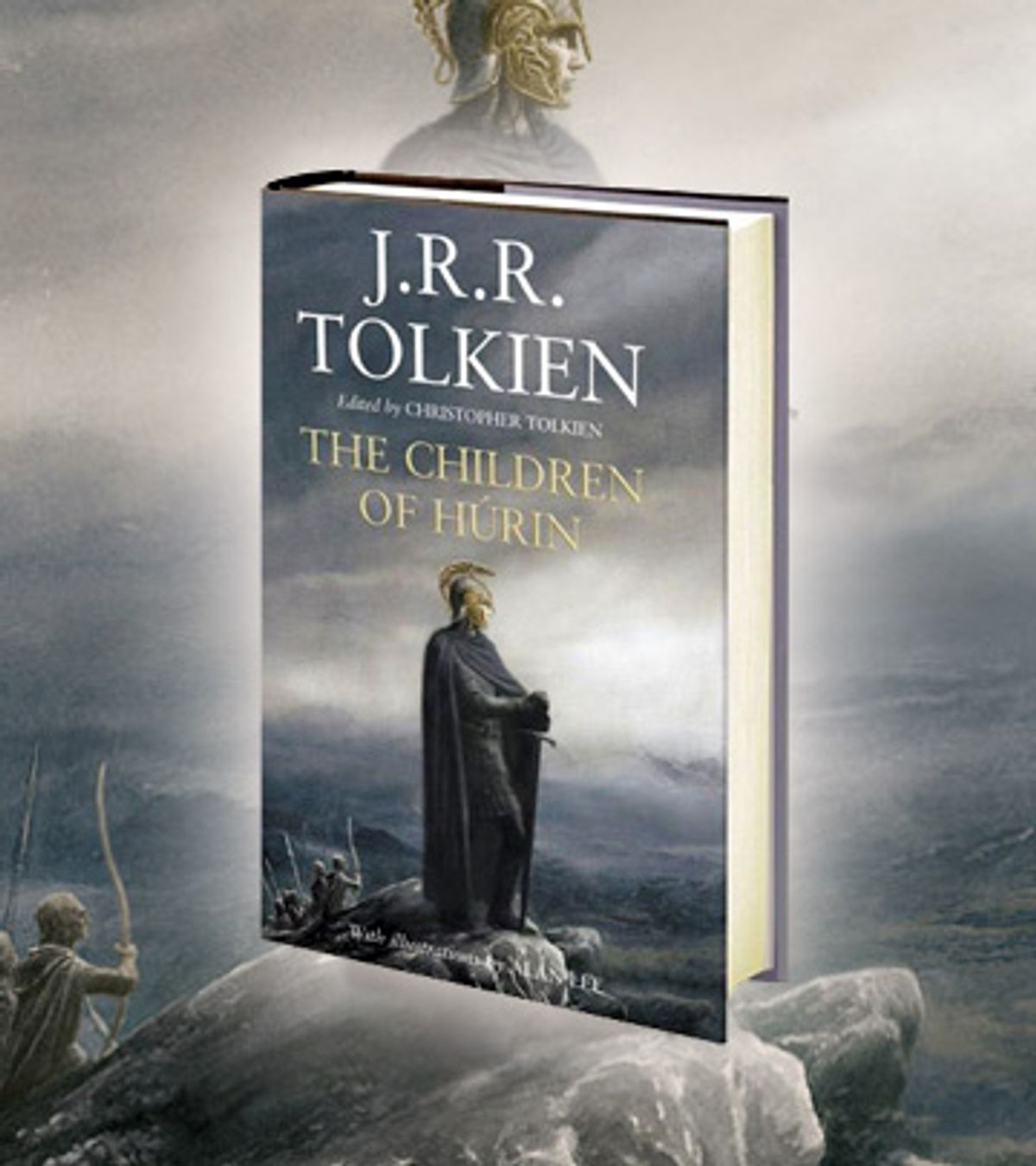
A few chapters into the narrative of "The Children of Húrin," the more-or-less new book more or less written by J.R.R. Tolkien, a crippled woodcarver named Sador regards his abandoned handiwork with mixed emotions. Sador is a trusted servant of Húrin, lord of the House of Hador in the land of Dor-lómin, and he has been carving a great chair for his master. But months earlier, Húrin rode off to a battle that ended in terrible defeat. He did not return, and his lands have been conquered and pillaged by outsiders. So Sador has quit work on the chair and it has been "thrust unfinished in a corner."
While debating whether to break up the chair for winter firewood, Sador talks to Túrin, the young son of Húrin who will soon be sent into exile and become the wandering, accursed hero of this gloomy, gory and highly compelling tale. "I wasted my time," Sador says of his long labors, "though the hours seemed pleasant. But all such things are short-lived; and the joy in the making is their only true end, I guess."
It's impossible not to hear John Ronald Reuel Tolkien reproaching or consoling himself with these words. On his death in 1973, Tolkien left behind the unpublishable ruins of a vast body of legendary literature, encompassing an entire imaginary history of the world from its creation nearly until modern times. That history's grand heroic episodes -- the elements he believed were most important -- he wrote only in summary or in fragments, despite numerous attempts to craft them into prose narrative or epic poetry. He had significant academic success as an Oxford linguist and philologist, but most of his literary career was spent frittering away his energies on projects he never completed. He was plagued by writer's block, black moods and numerous changes of direction. He thrust many chairs unfinished into the corner.
Tolkien might still be remembered that way, by some tiny cadre of admirers, if it weren't for the one piece of his history -- in his mind a relatively inconsequential one, drawn from the latter stages of his "legendarium," but one that had a uniquely intimate and personal focus -- that he did expand into a full-scale narrative. He was 62 when he published the first volume of his genre-defining fantasy masterpiece "Lord of the Rings," and well past 70 when its explosive 1960s popularity made him rich and famous. By any accounting the story of Frodo the hobbit and his plucky band of companions, who undertake a dangerous voyage with the One Ring of the Dark Lord Sauron, is among the most beloved books ever published. Inevitably, for most of its readers the enormous body of lore behind it is nothing more than a colorful backdrop, full of incomprehensible genealogies, invented languages and unpronounceable names.
Yet as the universe of hardcore Tolkien fans -- not such a tiny universe, in fact -- is well aware, the author had imagined and examined every detail of his creation, just as closely as had Ilúvatar, the Jehovah-equivalent who made the Earth and brought Elves and Men to life in it. (Tolkien's language, and worldview, is never gender-neutral.) No author in fantasy or any other genre has ever constructed a world of such linguistic and historical density; it almost seems that this immense architectural work exhausted Tolkien, and with the sole exception of the "Lord of the Rings" narrative he had no energy left to tell its stories.
For more than 30 years, Christopher Tolkien, who serves as his father's literary executor, has been bringing forth bits and pieces from the vault, rather like some Dwarvish smith trying to reforge a great Elven sword from discombobulated needles and splinters. Although "The Silmarillion" was a bestseller upon publication in 1977, for instance, only the hardiest of Tolkien fans have waded through its dry, haughty summaries of great deeds of the distant past. Christopher Tolkien has himself written, in characteristic circumlocutory fashion, that "the compendious or epitomizing form and manner of 'The Silmarillion,' with its suggestion of ages of poetry and 'lore' behind it, strongly evokes a sense of 'untold tales,' even in the telling of them; 'distance' is never lost. There is no narrative urgency, the pressure and fear of the immediate and unknown event. We do not actually see the Silmarils as we see the Ring."
Christopher Tolkien is now 81, the same age his father was when he died, and one supposes that "The Children of Húrin" is his last, best shot at telling one of Tolkien's great "untold tales" in something close to a complete form. He has labored long and hard to patch together bits of manuscript that apparently go back as far as 1918, when Tolkien first conceived the tale, and continue to almost the end of his life. The story of Húrin of Dor-lómin, his son Túrin and their doomed struggle against Morgoth (the "Great Enemy" of Elves and Men, Sauron's lord and master) has been told twice before, first in "The Silmarillion" and again in the Christopher-edited volume "Unfinished Tales" (1980). It emerges here for the first time as a full-fledged adventure yarn, complete with narrative urgency, fear of the unknown and recognizably human characters.
"The Children of Húrin" will thrill some readers and dismay others, but will surprise almost everyone. If you're looking for the accessibility, lyrical sweep and above all the optimism of "Lord of the Rings," well, you'd better go back and read it again. There are no hobbits here, no Tom Bombadil, no cozy roadside inns and precious little fireside cheer of any variety found here. This is a tale whose hero is guilty of repeated treachery and murder, a story of rape and pillage and incest and greed and famous battles that ought never to have been fought. If "Lord of the Rings" is a story where good conquers evil, this one moves inexorably in the other direction.
While casual readers of "Lord of the Rings" may be put off, "The Children of Húrin" does not require "Silmarillion"-grade geekery. Any midlevel Tolkien fans with an appetite for the stranger, darker corners of his realm will rapidly be caught up in the fiery saga of Húrin, who defies the dreaded Morgoth and is mercilessly tortured, and Túrin, the legendary warrior whose great deeds drag everything and everyone he loves toward total disaster. At least, they'll get swept up in it if they can plow through the first few pages.
Initially, "The Children of Húrin has that ye-olde-homework feeling of Tolkien at his most laborious. Here is the third sentence of Chapter I: "His daughter Glóredhel wedded Haldir son of Halmir, lord of the men of Brethil; and at the same feast his son Galdor the Tall wedded Hareth, the daughter of Halmir." (Furthermore, none of the people in that sentence ever reappear.) I still had to refer to Christopher Tolkien's thorough and helpful maps, indexes and appendixes every few pages to keep the geographical and genealogical nomenclature straight -- and I went back to "The Silmarillion" a couple of times to figure out the historical context -- but I minded that less and less as the hours grew longer and Túrin's fell struggle against innermost and outermost evil grew ever more dire.
Túrin's adventures are set in the "First Age" of Tolkien's Middle-earth, some 6,000 years before Bilbo Baggins comes upon the One Ring, so beyond a few references to Morgoth's lieutenant Sauron, there is almost no intersection between this story and "Lord of the Rings." (I said almost; pay attention!) He is born into a world at war, when the ancient alliance of Elves and Men is gradually losing ground in a long struggle with Morgoth, who has rolled out from his fortress at Angband the ancient world's equivalent of WMD. He has conjured or created or perverted a race of lethal demons called Balrogs (one of whom appears in "The Fellowship of the Ring"), and unveiled a great dragon named Glaurung, whose weapons include both fire and sarcastic dialogue. (He is probably the father or grandfather of Smaug, whom Bilbo meets in "The Hobbit.") Soon after Húrin's forces and the other great armies of Elves and Men are routed by Morgoth in the Nirnaeth Arnoediad ("The Battle of Unnumbered Tears"), the Western world is engulfed in chaos. (We're still very early in the book and I have issued no major spoilers. But check out now if you want no further plot details.) A few hidden Elvish kingdoms remain protected, including the fortress of Nargothrond, the secret city of Gondolin and the forest of Doriath -- a sort of precursor to Lothlórien in "Lord of the Rings" -- but the realms of Men are overrun by Morgoth's forces.
Sent away from his mother and unborn sister as a young boy, Túrin becomes the foster son of Thingol, the Elven King of Doriath, and grows to manhood as a fierce warrior. But immortal Elves and mortal Men do not mix easily, and even Thingol does not yet know that Morgoth, who is holding the defiant Húrin in bondage, has placed his entire family under an awful curse. Morgoth, mind you, is not just your typical fantasy-novel demon; he was in origin the greatest of the Ainur, the divine spirits who sang with Ilúvatar and made the world. "The shadow of my purpose lies upon Arda [the Earth]," Morgoth tells Húrin, "and all that is in it bends slowly and surely to my will."
Unlike Sauron in "Lord of the Rings," Morgoth appears in "The Children of Húrin" as a malevolent but sophisticated physical being, rather as the gods of Greek and Norse mythology can appear to human beings. Indeed, this entire story presents a dark, visceral view of life, much closer to the fatalism of early European myth than to the rural, commonsensical Englishness of the hobbits that forms the moral bedrock of "Lord of the Rings."
Part of this stems from the fact that "The Children of Húrin" is primarily a story about human beings, always the most morally ambiguous figures in Tolkien's universe. Although distinctly the hero of this story and a great warrior of his age, Túrin cannot adequately be described as good or evil. Like Oedipus or Siegfried or the hero of the Finnish epic "Kalevala" (one of Tolkien's models), he is defined by the dark cloud of doom hanging over him. He has been cursed by a power too great for him to defeat or outrun, but his own temperament only makes things worse, like a fly wiggling its way into a spider web. He is arrogant, headstrong, short-tempered and prone to violence, and those who love and befriend him are sucked into his dark vortex.
Túrin becomes a famous Elf-friend, a slayer of Morgoth's Orcs, and at the end of the book he performs a deed of legendary heroism, the kind of thing people are still singing lays about in Frodo's time. But along the way he also becomes an outlaw who tolerates banditry and brutality among his men, a trusted advisor whose words lead only to perdition, a man who kills one of his best friends and then steals the beloved of another. (She turns out, of course, to be exactly the wrong woman for him, the one who will seal the doom that's been a long time coming.) It's not clear that Morgoth really needs to curse this guy; he does a pretty good job of damning himself at every step.
I came away from "The Children of Húrin" with a renewed appreciation for the fact that Tolkien's overarching narrative is much more ambiguous in tone than is generally noticed. As has been much discussed, he was a devout Catholic who tried, with imperfect success, to harmonize the swirling pagan cosmology behind his imaginative universe with a belief in Christian salvation. Salvation feels a long way off in "The Children of Húrin." What sits in the foreground is that persistent Tolkienian sense that good and evil are locked in an unresolved Manichaean struggle with amorphous boundaries, and that the world is a place of sadness and loss, whose human inhabitants are most often the agents of their own destruction.
Shares