It was noon on a Friday at the end of May, and strangely dressed people drifted through the streets of New Orleans' French Quarter.
On Canal, a teenage girl in a shirt reading "Support Severus" stared goggle-eyed at a storefront displaying shirts with slogans like "FEMA Evacuation Plan: Run, bitch, run!" Around the corner at the Walgreen's, an adult woman in black robes was buying hair gel. "Congratulations," said a cashier. It was Tulane's graduation weekend. "Oh, I'm not graduating," said the woman. "I'm Hermione today."
It felt like the first chapter of the first Harry Potter book, "Harry Potter and the Sorcerer's Stone," in which wizards who usually hide their identities from the muggle (i.e., non-magical) population are in such a tizzy over the supposed demise of the Dark Lord Voldemort that they carelessly appear in public in their wizarding robes. Except this wasn't Little Whinging, the dreary suburb where J.K. Rowling's fictional orphan grows up before discovering his magical abilities; this was New Orleans, La., and it was 83 degrees out. Besides, there's no such thing as wizards.
But I didn't mention that to these Potter fans, who had come to the Crescent City for Phoenix Rising, a four-day conference with more than a thousand attendees. Organizers chose New Orleans because of the city's history of rising from ashes; phoenixes are crucial to Potter lore, and never more so than at this juncture. (Warning: This story is lousy with spoilers for the first six books, so if you don't want to know, turn back here.)
In two months, readers around the world will have in their hands the seventh and final of Rowling's Potter books, "Harry Potter and the Deathly Hallows," a book so long that it may need to be sold with its own sherpa, but which nevertheless must eventually -- after some noisy crying and maybe a quick reread -- end. With it will go the arresting world of witches, wizards, animagi, metamorphmagi and thestrals that Rowling has been doling out in hotly anticipated installments for a decade.
New Orleans, still reeling from the devastation of Hurricane Katrina, seemed an appropriate setting for Phoenix Rising, since locals are very good at turning a funeral into a party. Potter-heads had come here to form a second line -- the group of musicians that follows mourners in a traditional New Orleans funeral -- to celebrate the books to which they were about to bid adieu.
- - - - - - - - - - - -
In the belly of the convention -- the Sheraton Hotel -- participants fluttered busily along corridors, sporting shirts that read things like "Ron + Hermione: Isn't It Obvious?" and "Voldemort Stole My T-shirt." Lots of people were also wearing buttons reading "Severus, please," which I initially read as a crowd-inappropriate parody of "Nigga, please," until I realized that these were, of course, the troublingly enigmatic last words of beloved headmaster Dumbledore in Book 6.
Most everyone was gearing up for that night's open-bar affair on Bourbon Street where four wizard rock groups would be playing.
Wizard rock is booming. The genre's ur-band, Harry and the Potters, began performing in 2002. Now dozens of acts, including the Moaning Myrtles, the Hinky Punks, Hollow Godric, and the Hermione Crookshanks Experience, play libraries all over the country. For wizard rockers, these late May days are the dawning of their Age of Aquarius, their Woodstock, their summer of love.
By 9:30, sloppy wizards and witches hung over the balcony, playing bead-toss with street-bound revelers, who were charmed to be getting attention from people in pointy hats.
Onstage, the Whomping Willows -- aka one guy named Matt Maggiacomo -- were playing to a crowd of screaming ladies. Behind him, the amp bore a sign: "Fight Evil: Read Books."
Many wizard bands perform as a Potter-themed persona. Maggiacomo often sings as "Whompy," his vision of the bellicose Whomping Willow into which Ron and Harry drive a flying car in Book 2. Maggiacomo's imagined Whompy yearns to take human form and become a wizard rock star; he also wants Harry's brainy friend Hermione to give him a call: "Five years it's been since we first met/ Now you're kicking it with house elves/ And you're every teacher's pet," sang Maggiacomo, a sturdy fellow in a grey pullover and a striped scarf. He continued, "Why don't you come and check out/ One of my rock shows/ I'll take you to the after-party/ And you can get familiar/ With my human body."
This tree-on-girl action was emblematic of wizard rock's broad view of human (and non-human) sexuality. It's not every day that you see a bunch of twenty-something musicians singing ambisexual songs while women bellow their lusty adoration. Maggiacomo also sang a duet with gangly heartthrob Alex Carpenter (aka the Remus Lupins, also on the evening's bill) in which the two men crooned at each other, "You touch me in my special place," and one ditty about mortal enemies Draco and Harry, "f-a-l-l-i-n-g in love." The crowd was also ambi-nerdy, and yelped its approval when the Whomping Willows mixed things up with a Tolkien tribute about "Tree-beard, the greatest tree who ever lived!"
The concert ended with a girl band, the Parselmouths, who play their roles as bratty teens in the Slytherin house to mane-tossing, eye-rolling, pouty perfection. They performed their hit "What Kind of Name Is Hermione?" and the crowd favorite "Not Half Bad" about the compensations of being sorted into Slytherin ("We get to wear green/ Are expected to be mean!").
The universe created by Potter fans is remarkable in part because of its distance from the texts in which it is rooted. Rowling's books are chock-full of adolescent angst and sexual confusion, sure. But aside from some werewolf-human lovin', they have been pretty hetero-normative. Fan imaginations and perhaps a healthy dose of transference have lent sexually omnivorous appetites to Rowling's creations.
Did she ever envision her texts being crafted into songs about arboreal embrace? Probably not. But authorial intention be damned, there was something refreshing about hearing a crowd of young people gathered at the nexus of the frat-boy universe, cheering equally for straight and gay matchups, for Rowling and for Tolkien. Perhaps you really can fight evil by reading books.
On a hung-over Saturday morning, the sexual attitudes of some factions of the fan community came into sharper relief at the 9 a.m. session, "Shipping the Velvet: Slash Fandom, Convergence, and Why You Should Care About Harry Potter Mpreg."
The session was about fan fiction, original narratives written by fans about Rowling's characters, and, more specifically, about "slash fiction," in which characters who have either been explicitly described as straight, or whose orientation is unestablished, are written as gay. "Mpreg" is a radical subset of slash, in which male characters can get pregnant. As Henry Jenkins, head of MIT's comparative media department, explained to the audience, the history of "slash fic" dates back to "Star Trek" fans' fevered fantasies about Kirk and Spock.
Fan fic has exploded in the last decade. It's been written about "Star Wars," "The X-Files" and probably every other piece of mass-produced popular narrative. It may now be more common to find slash fic -- most often written about men by female writers for an audience of female readers -- than it is to find "het fic." Aja, a revered slasher sitting on the "Shipping the Velvet" panel, noted that these days, "We don't question our right to make these characters our own."
They certainly don't. I found myself bristling when Aja brought up the subject of Rowling's romantic pairing of young witch Nymphadora Tonks with graying werewolf Remus Lupin in "The Half-Blood Prince." Apparently, prior to the publication of Book 6, it was widely believed in segments of the fan community that Lupin might have been in love with a male character, Sirius Black.
"I think that a lot of us felt that Remus-Tonks came out of nowhere," Aja said to the audience. "Whether you were a Remus-Sirius shipper" -- someone who believes in a particular couple -- "or not, when Remus and Tonks got together in the canon it was like: Huh?" In these climes, Rowling's books are referred to, sometimes with surprisingly disdainful sniffs, as "canon," while fan fiction is "fanon." Aja's scorn for Rowling's choices rubbed me the wrong way. Rowling created the world; she is allowed to do what she wants with her characters.
It would have been easy to slip down the fan-fiction rabbit hole. But there was a lot else happening at Phoenix Rising. Just down Canal on the banks of the Mississippi River, attendees were playing fierce games of on-the-ground Quidditch, Rowling's flying sport. The conference had required players to sign liability waivers before taking to the pitch.
And back at the Sheraton, "Hysterical Hystorian" Diana R. Sanderson, an archivist from Warren Wilson College in North Carolina, was teaching book repair, dipping knitting needles in glue and inserting them down the spines of volumes with broken hinges. "Love your books because your books love you back!" Sanderson shouted. One glum witch stood in the corner, gingerly wiping off a gluey needle, and telling a friend of the "gin and tonics and hurricanes" she'd consumed the night before. "Probably where you went wrong was mixing the two," said her buddy.
At a session called "Harry Potter and the Goblet of Colonialism," 22-year-old Tracy Douglas was giving a persuasive, Edward Said-influenced reading of the post-colonial overtones of Rowling's fourth book. She pointed out the focus on the eroticized "other" -- Fleur Delacour, Cho Chang, Padma and Parvati Patil -- as the female sexual ideal. Douglas' paper sounded like it could have been given at the Modern Language Association conference. Except that afterward, she thanked her mother. Also, at the MLA, you see fewer people with stuffed owls.
- - - - - - - - - - - -
One panel, "Fan Journalism: The Importance of Not Being a Skeeter," was particularly hot in part because it was led by one of the conference's biggest stars, Melissa Anelli, webmaster of Potter news site the Leaky Cauldron. Anelli, a 27-year-old Staten Island native, described the beginnings of online Potter journalism, "before the fourth book came out, just when the fan world was about to break open and all the crazies came." There was laughter. "All you crazies!" Anelli said again, affectionately, before correcting herself: "All of us."
The Leaky Cauldron has become, along with Mugglenet, one of the Web's most trusted Potter sites. These days, Anelli's name opens doors, at least at Hogwarts. She has been tapped by Warner Bros. to visit the sets of the movies, and was invited, along with MuggleNet's Emerson Spartz, to conduct one of the only interviews Rowling gave at the publication of the last book. It was a major coup, considering that earlier Rowling interviews had consisted of Katie Couric memorably -- and inanely -- asking if Harry would be doing "any snogging with Hermione."
Now, the lunatics are in charge of the asylum in the best possible way, and when an incorrect rumor circulates, it is often Anelli to whom sources turn. But when a site becomes so popular, Anelli said, it brings "a lot of power, and very little accountability. There's nobody to fire us."
Under Anelli's stewardship, Leaky now gets more than 100,000 unique visitors a day, and employs more than 200 volunteers: people who transcribe interviews, upload images, maintain video galleries, edit news stories. Anelli, who worked at MTV networks and as a reporter at the Staten Island Advance while running the site, recently got a book contract from Simon & Schuster to chronicle the six months leading up to the release of "The Deathly Hallows."
When she interviewed Rowling in Scotland in 2004, the author gave Anelli a beautiful serpent ring, which she always wears on her ring finger. She calls it her "Jo-crux" and jokes that it means she is married to Harry Potter. When she talked about Rowling's gift over lunch at Felix's Oyster House, Anelli got slightly choked up, and fingered the ring affectionately. "It reminds me of how my life has changed," she said.
Anelli is heading into what she calls "a summer-long pre-game" of conventions, fan gatherings, wizard rock concerts and movie premieres leading to July 21. But, she said, she is hoping to read the "Deathly Hallows" like a civilian." "Once I get that book in my hands, the world doesn't exist," she said. "This is the last time we can savor these books this way, so I want to make sure I do that."
And once she's finished? Well, Anelli has her own book to write. And, she promised, "the site will continue to exist, at least through the movies." But at some point, she said carefully, "You've got to move on. J.K. Rowling is moving on."
"Being alive as the story is being delivered to us is magic," Anelli concluded. "I like that I will always look back on this and be able to say, 'I was there. And you know what? It rocked.'"
Rowling struck a match in 1997, and Anelli's is not the only world that has been transformed.
Fourteen-year-old Cody Wild from State College, Penn., was attending Phoenix Rising with her mother, Sandy. Home-schooled through the sixth grade, Cody is now a ninth-grader. The night before the conference, she had been awarded the Bronze Pen English prize. Cody also recently wrote an article about how the media paid more attention to the deaths at Virginia Tech than they do to the casualties in Iraq.
"Cody's dad was a real staunch Bush supporter," said Sandy. "She grew up in a Republican household, so it's nice to see her developing her own perspective on things." Cody credits the allegorical nature of the books -- and the politically interested fan world -- with opening her mind about politics. One of her favorite panels at the conference was on how Rowling's literary style changed after 9/11, and she was proud to tell me that she purchased the last of the "Republicans for Voldemort!" buttons at the conference.
 And then there's Harper Robertson, who in the fourth grade began drawing floor plans for Hogwarts castle based on textual clues in the early Potter books. On Saturday, the 16-year-old San Franciscan presented a lecture called "Hogwarts: A History." After taking a year off from high school to intern at an architecture firm, Roberston has created a scale model of the castle, built of cardboard. She'll be taking architecture classes at Stanford next year.
Robertson showed slides of her model to a full house that ooh'd and aah'd. Afterward, when I asked what her friends think of her pursuit, Robertson gamely explained, "They respect it as a very in-depth focus on something completely pointless."
- - - - - - - - - - - -
Saturday night was Artists and Authors Night, in which the hotel conference rooms were packed with people drawing Potter art and writing fan fic on demand.
I walked into a reading by "Mad Maudlin," who had to remove the papier-mâché snail she was wearing on her head, and who would not give her real name. (The 22-year-old St. Louis resident, who will join the Peace Corps next year, doesn't want her parents to track down her often racy online work.)
Maudlin read two stories, one about Ginny and Harry eating muffaletta in New Orleans, which Maudlin explained had been inspired by a volunteer trip to the city with the Campus Crusade for Christ, and a "Damn Yankees"-inspired tale about Ron selling his soul to the devil to be a better Quidditch player and making out with Harry in a locker room.
When I asked Maudlin to theorize about what women found exciting about male-on-male sex scenes, Maudlin explained that she identifies as bisexual, and likes to explore dynamic relationships between characters "regardless of their gender."
Which makes sense. But does she write lesbian slash about Ginny and Hermione? "Not really," she said. "Mostly because I don't identify with a lot of the female characters."
At this point, the "prefect" in charge of the room for the night, a writer who calls herself Fyrdrakken and who'd been knitting quietly through the readings and interview, piped up to offer, "Some of the women are cardboard caricatures. A lot of people don't like Hermione at all. She is self-righteous and kind of creepy." Maudlin nodded.
Hermione? A cardboard cutout? The smartest in the class, with the frizzy hair and muggle parents, the responsible girl who maintains friendships with the irresponsible boys, the girl who has the good taste to pine not for our dashing hero but for his red-haired, dunderheaded friend? "A lot of people don't like Hermione at all?" This was heartbreaking.
I asked the women, since they take their right to alter stories seriously, why they couldn't gussy up these purportedly cardboard girls and let them have some hot lesbian sex of their own? Maudlin looked at me with something like pity: "The whole challenge is to keep the characters in character, just participating in a different plot." All right then, Ms. Muffaletta. I guess my ambivalence about fan fic means I'm just a sucker for authority, a consummate good girl, a Hermione.
- - - - - - - - - - - -
My frustrations evaporated on Sunday when I found practically the whole conference lined up to get into the grand ballroom for the "Snape: Friend or Foe?" debate.
The debate was fabulous. It centered on whether Severus Snape, Rowling's ingeniously ambiguous character who concluded the sixth book by knocking off his staunchest defender, is a good guy or a bad guy. It's the question that for me -- and apparently for many of the couple hundred people filling up the ballroom -- is at the crux of Rowling's narrative.
If Snape were really a baddie, pro-Snape playwright Meg Belviso pointed out smartly, it would be something of an anticlimax, considering that at the end of the last book, he killed the series' most benevolent protagonist. Good point! But, countered the anti-Snapist Nick Rhein, "it will be a much deeper and a much better written book if she doesn't redeem him."
You're wrong! But I get it; it's a debate, someone's got to argue the dumb side.
Hilary K. Justice, assistant professor of English at Illinois State University, was the pro-Snape star, taking it to a rather poetic level. "There are many kinds of love in these books," she said, "and not just the healthy kind. There is also obsessive love, cataclysmic love, the kind of love you're willing to die for." It is this last kind of love that Justice believes Snape felt for Harry's now-dead mother, Lily Potter. She hypothesized that Snape might have made an unbreakable vow with Lily to protect her son's life, watch over him, and perhaps even complete the task (killing Voldemort) for which Harry is destined if Harry is unable to complete it himself.
In the audience, knitting needles clicked as audience members wove their red and gold scarves and rapt listeners twirled their wands. People stood to ask questions, including a great one from a woman who pointed out that Rowling, whose sensitive streak is as long as Book 4, would never endorse bullying by making Snape -- an outcast kid with dingy undergarments who was teased by the popular kids -- truly evil. Excellent point, person who can read!
In the final question of the Great Snape Debate, the moderator asked both sides: "Is Snape going to live or die?" "He's going to die," said two of them. When it got to Justice, she said simply, "Good night sweet prince: And flights of angels sing thee to thy rest!"
The conference was suddenly making me very happy. As Justice said, while discussing Rowling's borrowing from the Egyptian myth of Osiris, Horus, Isis and Set, "The way Rowling's mind works is beautiful." I had to agree, and take her point further: The way the minds of Rowling's fans work is nearly as impressive.
Despite my quibbles with overzealous fan-fic authors, this was one hell of an accepting crowd, one in which a teenager was as welcome to weigh in as a professor, where discussion of philosophy was as compelling as discussion of technology, where it didn't matter if you were from a Christian fundamentalist or Wiccan background, and where even the fiercest debate could teach an ardent fan something new.
There's not a lot in popular cultural life that's built for smart people anymore. Harry Potter really is.
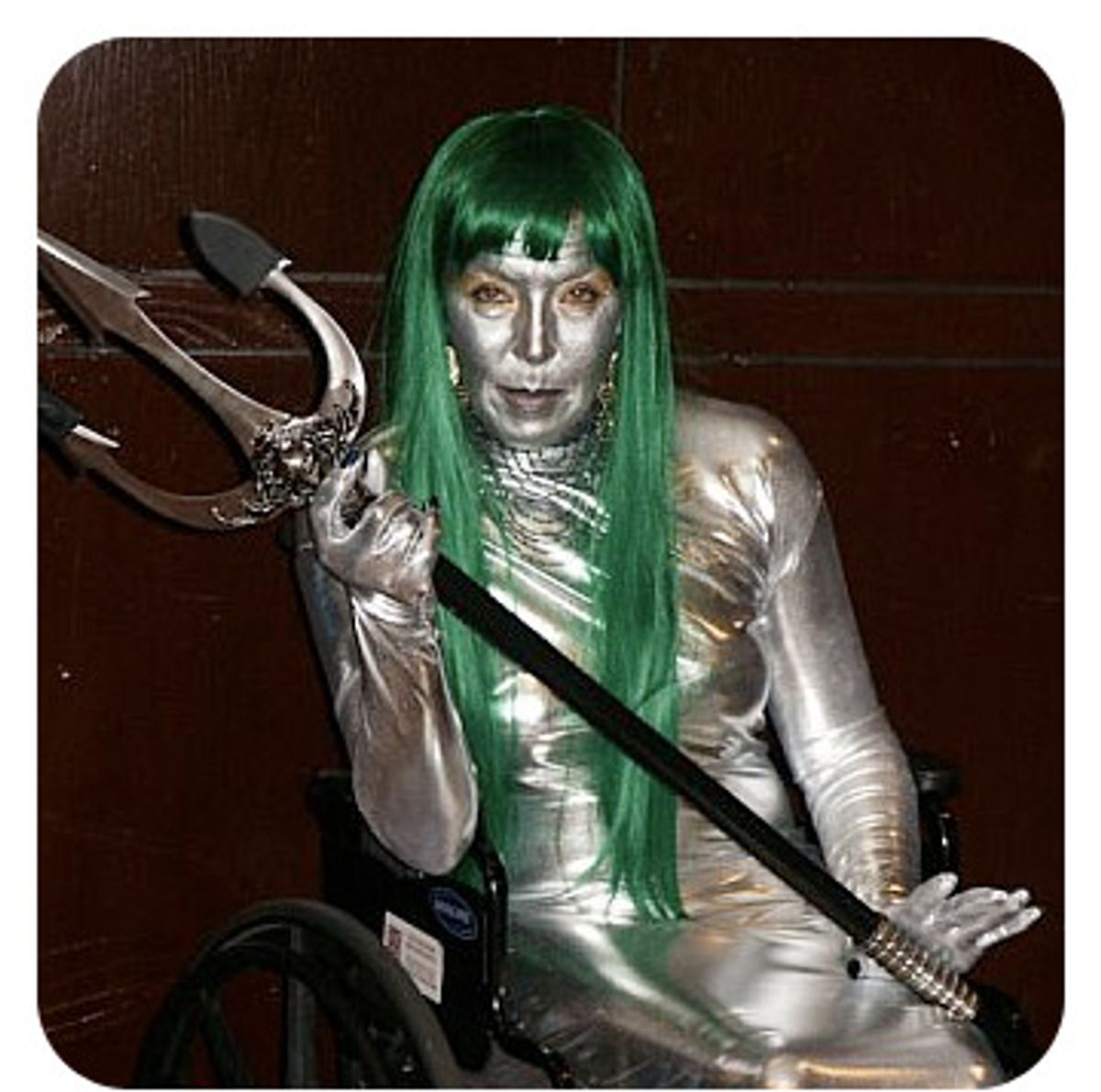
The conference's big Sunday-night finish was a Masquerade Ball in the enormous Sheraton ballroom. The place was a madhouse. There was someone carrying an inflatable goat, dressed as Hog's Head barman Aberforth Dumbledore; a silvery mermaid was in a wheelchair; a woman who looked like Mr. Tumnus scampered around with hairy haunches and an overexposed upper body.
Alex Carpenter of the the Remus Lupins and Parselmouths duo Brittany Vahlberg and Kristina Horner were roughhousing just in front of the entrance to the ball.
Carpenter, 23, who graduated last year from UCLA with a degree in English, has 55 concert dates scheduled this summer. He describes wizard rock as "probably the coolest summer job you'll ever have."
I asked the puppyish Carpenter if the hordes of boys and girls hanging on him throughout the conference meant that wizard rock has helped him score some horntail. He grinned and said, "There is a very strong distinction between opportunity and what you do about it. Wizard rockers are known for being pretty good guys, and behaving well. Because we're dorks."
I had just turned to the Parselmouths, who were bouncing off the walls with adrenaline and being 19, when there was sudden, tremendous squealing. The lobby emptied as house elves and unicorns charged the dance floor.
"Draco and the Malfoys sing a version of this song," Vahlberg explained breathlessly. "We want to go in and sing their version over it." And that's how hundreds of people, many of them born in the late 1980s, began yelling over Nena's early MTV classic "99 Luftballons": "The ministry's on red alert/ The aurors all spring to fight/ Moody opens up his eye/ Focuses it on the sky/ As 99 Death Eaters go by."
"Oh my god, this is better than prom," gushed Vahlberg when she and Horner returned, giddy and sweating. She was dressed in a venomous green dress, Horner in floaty blue. They both had the look of recently sprouted teens, unaware of their own coltish beauty.
The women met in high school in Seattle and are now freshmen at Bellevue Community College there. They first started writing wizard rock songs as a goof in 2004. Since then, they've produced a CD and traveled east to play with other wizard bands. This summer, they'll tour the Northwest.
Though they've taken on the personae of Slytherin brats, the women said their favorite Potter characters are the outcasts -- Neville, Draco, Snape and Luna Lovegood. "We are complete dorks," said Horner, entering some bizarro universe in which she was trying to convince me of how uncool she is. In high school, they explained, they enrolled in an advanced computer class. "The boys in it looked at us and decided to treat us like we didn't know anything," said Horner. "But it turned out we knew a lot," said Vahlberg. "Yeah, we recorded and produced our own CD, so clearly we know a little bit about computers?" added Horner in pitch-perfect upspeak.
In an adjacent room, a quiet girl I'd noticed throughout the weekend was standing to the side. Shoshana Rudski, a 14-year-old from Allentown, Pa., had traveled here with her grandmother. Potter books, said Rudski, "are an escape. I just read a chapter and I feel better."
I asked whether she was sad about the impending conclusion. She smiled wryly. "Let's just say that when I found out that there was a release date for Book 7, I ran to the library and gathered all the books around me, and sort of held them, and cried. A friend came and joined me. And then my teacher found me. It's so sad. But I've decided that I might as well be happy about it now, because there will be so much time to be sad."
Someone asked Rudski for the time. "It's 3:42 in the U.K.," she said. I asked if she set her watch on U.K. time because of the books. She nodded ruefully. "It's been set that way for years."
Rudski then pulled a piece of paper from her Harry Potter messenger bag. It was of her friend Alina Marhefka, who had desperately wanted to come to Phoenix Rising but couldn't. Rudski was having her picture taken with the drawing, so that her friend could say she had been there.
I was getting slightly fahrklempt, so I went to grab a drink. On my way, I bumped into Harper Robertson, the junior architect. She was in a red cape, her mother done up like a cat. "In the true spirit of the conference, we look ridiculous," said Harper. They didn't. They looked great.
I reminded her that we'd met yesterday, and a gigantic smile spread across her face. "Oh, yesterday. Yesterday was the happiest day of my life." Robertson's presentation had gone well, the proprietors of several of her favorite Web sites had asked her if they could link to her page, and she'd met some of her fandom heroes. "I giggled myself to sleep," she said dreamily.
Back in the ballroom, I was beginning to agree with Brittany Vahlberg that this was way better than prom. In fact, people anxious to host lively wedding receptions might want to consider asking their guests to dress in wizard garb. Boys danced with girls, girls danced with girls, boys danced with boys, and doxies danced with dementors. Everyone looked pretty, and if not pretty, then pretty weird. Guys lost their shirts. People were grinding, making out, hugging. They line-danced. They drank. They did the time warp. (Oh, did they do the time warp...) A couple got engaged. I was pretty sure that the Potter fans did everything that was legal (and some things that weren't) on that dance floor. My only surprise was that Bianca Jagger did not enter on a horse. In fact, I had the Rolling Stones in my head. "The music's screaming, my feet are flying, everybody's laughing, and nobody's crying."
Well, for now, anyway. Give it two months.
Shares