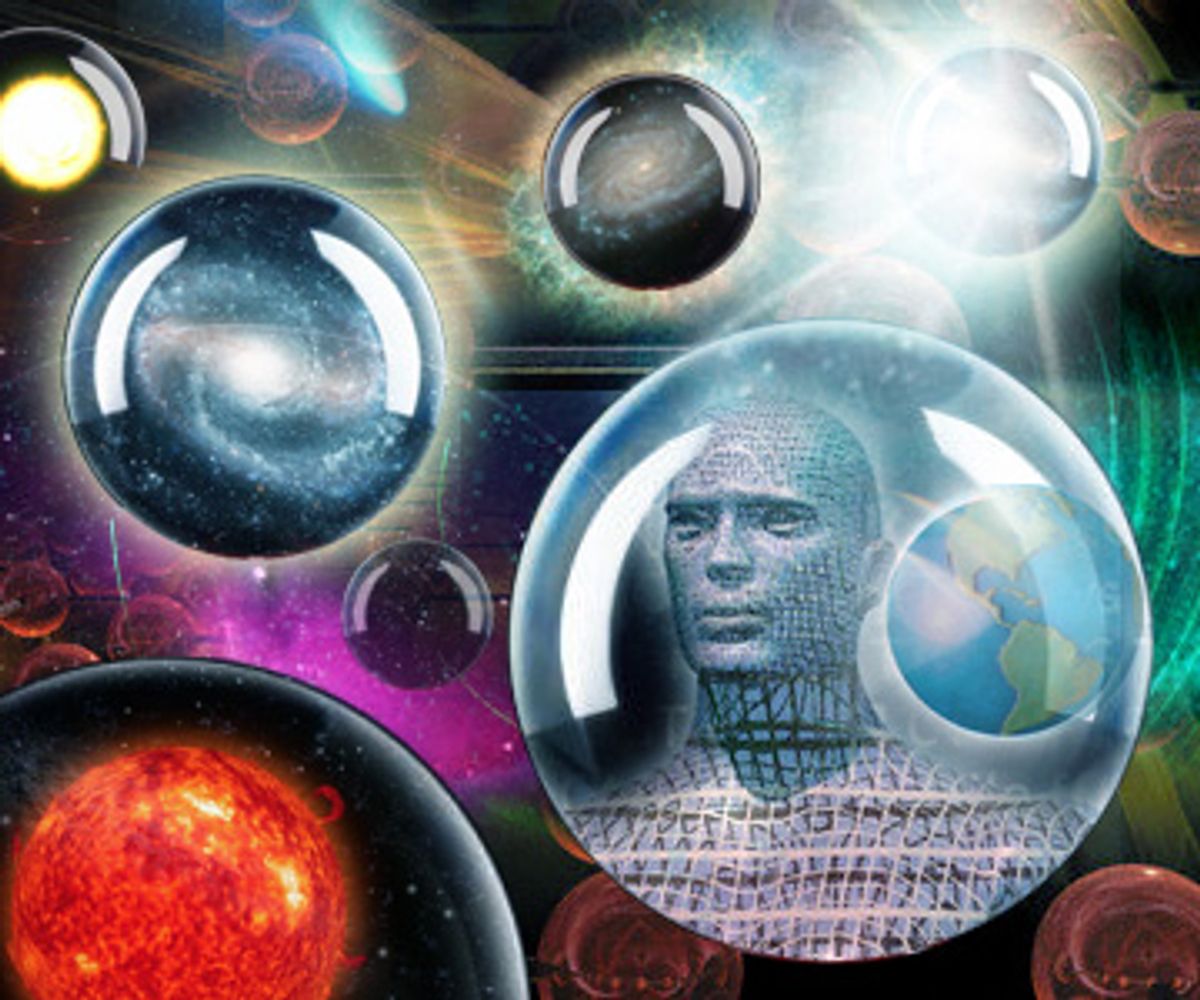
Forget science fiction. If you want to hear some really crazy ideas about the universe, just listen to our leading theoretical physicists. Wish you could travel back in time? You can, according to some interpretations of quantum mechanics. Could there be an infinite number of parallel worlds? Nobel Prize-winning physicist Steven Weinberg considers this a real possibility. Even the big bang, which for decades has been the standard explanation for how the universe started, is getting a second look. Now, many cosmologists speculate that we live in a "multiverse," with big bangs exploding all over the cosmos, each creating its own bubble universe with its own laws of physics. And lucky for us, our bubble turned out to be life-friendly.
But if you really want to start an argument, ask a room full of physicists this question: Are the laws of physics fine-tuned to support life? Many scientists hate this idea -- what's often called "the anthropic principle." They suspect it's a trick to argue for a designer God. But more and more physicists point to various laws of nature that have to be calibrated just right for stars and planets to form and for life to appear. For instance, if gravity were just slightly stronger, the universe would have collapsed long before life evolved. But if gravity were a tiny bit weaker, no galaxies or stars could have formed. If the strong nuclear force had been slightly different, red giant stars would never produce the fusion needed to form heavier atoms like carbon, and the universe would be a vast, lifeless desert. Are these just happy coincidences? The late cosmologist Fred Hoyle called the universe "a put-up job." Princeton physicist Freeman Dyson has suggested that the universe, in some sense, "knew we were coming."
British-born cosmologist Paul Davies calls this cosmic fine-tuning the "Goldilocks Enigma." Like the porridge for the three bears, he says the universe is "just right" for life. Davies is an eminent physicist who's received numerous awards, including the Templeton Prize and the Faraday Prize from the Royal Society in London. His 1992 book "The Mind of God" has become a classic of popular science writing. But his new book, "The Cosmic Jackpot," will challenge even the most open-minded readers. Without ever invoking God, Davies argues for a grand cosmic plan. The universe, he believes, is filled with meaning and purpose.
What Davies proposes is truly mind-bending. Drawing on the bizarre principles of quantum mechanics, he suggests that human beings -- through the sheer act of observation -- may have helped shape the laws of physics billions of years ago. What's more, he says the universe seems to work like a giant computer. Indeed, it's possible that's exactly what it is, and we -- like Neo in "The Matrix" -- might just be living in a simulated virtual world.
Davies recently moved from Australia to set up a research institute at Arizona State University. I spoke with him about some of the controversies now raging in physics, and why he's so determined to find meaning in the cosmos.
A lot of scientists get annoyed by talk about the universe being strangely fine-tuned for life. They see this as a sneaky way to bring religion into scientific explanations for how the universe began. Clearly, you have a different perspective. Why are you so interested in the idea that the universe is just right for life?
All my career, I've been fascinated by the fact that the universe looks not just beautiful but in some sense deeply ingenious. It looks like it's been put together in a way that makes it work exceptionally well. I suppose the most striking example is that the laws of physics and the various parameters that go into those laws seem to be just right for life. If they were even slightly different, it's quite likely there would be no life, no observers, and no people like you and me having this conversation.
How many laws of physics have to be just right for life to be possible?
It's a little hard to write down the definitive list, and part of the reason is that we don't yet know what are the truly fundamental set of physical laws. Changing some of those laws by even a tiny amount would wreck the chances for life. Others seem to have a bit more flexibility. Overall, the total number of these coincidences, or special factors, is probably somewhere between a half a dozen and a dozen. I think most scientists would now agree that you couldn't change things very much and still have life.
So for all of these to happen -- for instance, for carbon to be formed, for gravity to have the precise strength that it does -- you're suggesting that it's more than coincidence that they are just right.
That's right. To just shrug this aside and say, well, if it wasn't that way, we wouldn't be here, would we? -- that's no answer to the question. It's just choosing to sweep it under the carpet. And in the case of the carbon resonance, if the strong force that binds the particles together in the nucleus were a little bit stronger or a little bit weaker, that resonance would be at the wrong energy and there would hardly be any carbon in the universe. So the fact that the underlying laws of physics seem to be just right to make abundant carbon, the essential life-giving element, cries out for an explanation.
But most scientists seem to believe it's just a lucky fluke that we're here. They say there's no inherent reason that all of these physical laws happen to have just the right properties so that carbon could form, the Earth could develop, and human beings could evolve.
You're absolutely right. Most scientists would say it's a lucky fluke. And if it hadn't happened, we wouldn't be here, so we won't bother to ask what's going on. Now, that point of view might have been tenable 20 years ago when the laws of physics were simply regarded as just there -- as God-given or existing for no reason -- and the form they had just happens to be the form they had. But with the search for the final unification of physics, there's been more of a thrust towards saying, we won't just accept the laws of physics as given. We'll ask, how did those laws come to be? Are they the ultimate set of laws? Or are they just effective at low energies or in our region of the universe?
In the past, these "why" questions -- why the laws of physics are the way they are, why the universe began, why we are here -- were questions that theologians and philosophers asked. They seemed to be beyond science. But you're saying this is an arena where science can now operate.
Yes, there was a separation of powers -- "non-overlapping magisteria," to use Stephen Jay Gould's expression. In the past, the underlying laws of the universe were regarded as simply off-limits as far as scientists were concerned. The job of the scientist was to discover what the laws were and work out their consequences, but not to ask questions like, why those laws rather than some others? But I think we've moved on since then. Are we to suppose that these laws were magically imprinted on the universe at the moment of the big bang for no particular reason and that the form they have has no explanation?
There are different versions of the anthropic principle. Can you briefly lay those out for us?
Nobody can really object to the "weak anthropic principle." It just says that the laws and conditions of the universe must be consistent with life; otherwise, we wouldn't be here. But if we combine it with the multiverse hypothesis, then we're in business. The multiverse hypothesis says that what we've been calling the universe is nothing of the kind. It's just a bubble, a little local region in a much vaster and more elaborate system called the multiverse. And the multiverse consists of lots of universes. There are different ways you can arrange this. One way is to have them scattered throughout space, and each universe would be a gigantic bubble, much bigger than the size of what we can see at the moment, but there would be many, many bubbles. And each of these bubbles would come with its own set of laws.
So the billions of galaxies in our universe still make up just one universe. But in this theory, there would be many such universes.
That's right. Everything as far as our most powerful instruments can penetrate would belong to just one universe -- this universe. I call this a "Hubble bubble." So we're talking about a distance out to nearly 14 billion light years. Everything we see within that one region of space seems to have a common set of physical laws. According to one version of the multiverse hypothesis, if you traveled enough in any direction, you'd reach the edge of that bubble, and there would be a chasm of exceedingly rapidly expanding space, and then you'd come to another bubble. And in that other bubble, maybe all electrons would be a little bit heavier or gravity would be a little bit stronger. There would be some variation. And you would find that in only a tiny, tiny fraction of those bubbles, all the conditions would be right so there can be life. And of course it's no surprise that we find ourselves living in such a life-encouraging bubble because we couldn't live in any of the others.
The "strong anthropic principle" is far more controversial. What is this theory?
The strong anthropic principle says that the universe must bring forth life and observers at some stage. So even if there's only one universe, it must be the case that this universe will end up being observed by beings such as ourselves. Now, that's much harder for scientists to swallow because it seems to turn everything upside down. Most scientists think that the universe came into existence by some happy coincidence, or maybe from this multiverse selection there were beings who emerged. But these beings don't play a central role even in the multiverse theory. They don't play a creative role, whereas in the strong anthropic principle, the observers are in the central position. They are the ones dictating how the universe is put together. And that seems too much for people to swallow. It gives mind and consciousness a central place in the great scheme of things.
Well, it sounds fairly religious. Let's face it, the most common explanation for how all of this happened is that God set the process in motion so that human beings could eventually evolve.
You could give this either a religious or an anti-religious interpretation. The religious interpretation is that God made the universe just as it is in order that life and conscious beings could emerge. The other way, which I suppose would be anti-religious, is to say that the emergence of life and observers causes the universe to have the laws that it does. In the causal sense, it puts the cart before the horse. It makes the emergence of life and observers later on in the universe have some responsibility for the way the laws come into being at the beginning.
Is this what John Wheeler, the famous theoretical physicist, talked about when he made the case for a "participatory universe"?
Yes. Now we're into another variant of the anthropic principle -- which is sometimes called the "final anthropic principle" -- where, somehow, the emergence of life and observers link back to the early universe. Now, Wheeler didn't flesh out this idea terribly well, but I've had a go at trying to extend it. This has some appeal because the conventional theistic explanation and the conventional scientific explanation both suffer from the same shortcoming. They attempt to explain the universe by appealing to something outside it. In the religious explanation, appeal is made to an unexplained God who simply has to be there in order for the universe to be created in the form that it has. In the scientific explanation, the laws of physics just happily exist for no particular reason, and they just happen to have exactly the right properties, but it's all unexplained and it's all pushed off to outside of the universe. What appeals to me about John Wheeler's idea is that it attempts to provide an explanation for the bio-friendliness of the universe from entirely within it. Now, the difficult point is that we have to explain why life today can have any effect on the laws that the universe emerged with at the time of the big bang.
This sounds like it's coming right out of science fiction. Somehow, future people can go back in time and have some role in creating the universe. It's pretty far-fetched.
It is pretty far-fetched until you stop to think that there is nothing in the laws of physics that singles out one direction of time over another. The laws of physics work forward in time and backward in time equally well. Wheeler was one of the pioneers of this underlying time symmetry in the laws of physics. So he was steeped in the fact that we shouldn't be prejudiced between past and future when it comes to causation. The particular mechanism that Wheeler had in mind has to do with quantum physics. Now, quantum physics is based on Heisenberg's uncertainty principle. In its usual formulation, it means that there's some uncertainty at a later time how an atom is going to behave. You might be able to predict the betting odds that the atom will do this or that, but you can't know for certain in advance what's going to happen. Now, this uncertainty principle works both ways in time. There's no doubt about this. If we make an observation of an atom in a certain state now, then its past is uncertain just as its future is uncertain.
So one way to think about this is that there will be many past histories that will lead up to the present state of the universe. In the remote past, its state was fuzzy. Now in the lab, it's all very well to put an atom in a certain state and experiment on it at a later time. But when we're applying quantum physics to the whole universe, we simply can't establish the universe in a well-defined quantum state at the beginning and make observations later. We're here and now. So we can only infer backward in time. It's part of conventional quantum mechanics that you can make observations now that will affect the nature of reality as it was in the past. You can't use it to send signals back into the past. You can't send information back into the past. But the nature of the quantum state in the past can't be separated from the nature of the quantum state in the present.
So you're not talking about super-smart beings in the far future who go back in time and somehow fiddle with the laws of physics to create the big bang. You're saying this happens just through the act of observation itself, through the fact that human beings or other intelligent beings are aware of the universe.
Right. I'm not talking about time travel. This is just standard quantum physics. Standard quantum physics says that if you make an observation of something today -- it might just be the position of an atom -- then there's an uncertainty about what that atom is going to do in the future. And there's an uncertainty about what it's going to do in the past. That uncertainty means there's a type of linkage. Einstein called this "spooky action at a distance."
But what's so hard to fathom is that this act of observation, which has been observed at the subatomic level, would affect the way matter spread right after the big bang. That sounds awfully far-fetched.
Well, it's only far-fetched if you want to think that every little observation that we perform today is somehow micromanaging the universe in the far past. What we're saying is that as we go back into the past, there are many, many quantum histories that could have led up to this point. And the existence of observers today will select a subset of those histories which will inevitably, by definition, lead to the existence of life. Now, I don't think anybody would really dispute that fact.
What I'm suggesting -- this is where things depart from the conventional view -- is that the laws of physics themselves are subject to the same quantum uncertainty. So that an observation performed today will select not only a number of histories from an infinite number of possible past histories, but will also select a subset of the laws of physics which are consistent with the emergence of life. That's the radical departure. It's not the backward-in-time aspect, which has been established by experiment. There's really no doubt that quantum mechanics opens the way to linking future with past. I'm suggesting that we extend those notions from the state of the universe to the underlying laws of physics themselves. That's the radical step, because most physicists regard the laws as God-given, imprinted on the universe, fixed and immutable. But Wheeler -- and I follow him on this -- suggested that the laws of physics are not immutable.
I'm trying to understand how the laws of physics could change. You're suggesting that they were different 10 billion years ago. How could they change through the act of observation?
I have to explain my point of view in relation to the laws of physics. In the orthodox view, the laws are regarded as just unexplained, fixed, idealized mathematical relationships. It's an idea that goes right back to Newton-- that the universe is governed by these infinitely precise mathematical laws.
This is basically the Platonic view of the universe.
Plato had the view that mathematics lies outside of the physical universe, in a realm that's not part of space and time. It's often called the "Platonic heaven." But there's another view of the laws of physics, which is gaining increasing currency, that has really come about because of the information revolution. So a lot of physicists think that we should regard the laws of physics not as perfect, immutable mathematical forms that just happen to exist for no reason in this Platonic realm, but rather that they're more like computer software.
Let me explain that. When the Earth goes around the sun, we can imagine applying Newton's laws to predicting how it's going to move. That's just like a computer algorithm. If we know the position and motion of the Earth today, we can compute its position and motion this time next year. So the laws of physics could be thought of like a computer algorithm, taking input data, processing it and delivering output data. That inevitably leads to the analogy that the universe is really a gigantic computer. And many people are enamored of that idea.
So basically, information is all there is in the universe.
That's right. The universe is just a big information processor. Wheeler calls this "it from bit." Now if you take that view -- that the universe is a gigantic computer -- then it leads immediately to the conclusion that the resources of that computer are limited. The universe is finite. It's finite because the speed of light is finite. There's been a finite time since the big bang. So if we have a finite universe, we have a computer with finite resources, and hence, finite accuracy. So once you recognize that the universe is a gigantic computer, then you see that the laws of physics can't be infinitely precise and perfect. There must be a certain amount of wiggle room or sloppiness or ambiguity in those laws.
And the key point here is that the degree of error, which is inherent in the laws, depends on time. As the universe gets older, there are fewer errors because it's had longer to compute. If you go back to the first split second after the big bang, then the underlying errors in the laws of physics really would have been very large. So instead of thinking of the universe as beginning magically with a bang, and the laws of physics being imprinted magically on the universe with infinite precision right from the word go, we must instead think of the laws as being emergent with and inherent in the universe, starting out a little bit vague and fuzzy, and focusing down over time to the form that we see today.
There are some obvious questions about the big bang. Can we really talk about it coming out of nothing? Don't we have to ask, wasn't there something that caused the big bang?
Many people fall into that trap. But Augustine, in the fifth century, pointed out that the world was made with time, not in time. I think he got this exactly right. Of course, most people think that there must have been a previous event that caused whatever event we're talking about. But this is simply not the case. We now know that time itself is part of the physical universe. And when we talk about the big bang in a simplified model, then we're talking about not only matter and energy coming into being, but space and time as well. So there was no time before the big bang. The big bang was the origin of time.
People want to ask, what happened before the big bang, or what caused the big bang? But in a simple picture where there's just one universe, the big bang can be the ultimate origin of space and time as well as matter and energy. So unless the universe has always existed, you're faced with the problem that time itself comes into existence. And any attempt to talk about causation has to be couched in terms of something that comes after the beginning and not before the beginning ... because there was no before.
There are some obvious religious implications to all of this. My sense is that a lot of Jews and Christians are actually quite delighted with the big bang -- the idea that the universe was created out of nothing. It seems to correspond to the story of creation in Genesis.
I think there's a misunderstanding by religious people if they think that creation ex nihilo is anything like the big bang. People misunderstand what creation ex nihilo is about. It's not that there existed a God within time who was there for all eternity and then at some particular moment, on a whim, decided, "I'm going to make a universe" and then pressed a button that made the big bang. That raises exactly the objection that Augustine was addressing: What was God doing before making the universe? If the universe was a good idea, why wasn't it made an infinite time ago?
I might also say that it's always a bad idea for people to decide what to believe on religious grounds and then to cherry-pick the scientific facts to fit, because these facts are likely to change. And we may find that the big-bang theory goes out of favor at some point in the future. And then what? Religious people will have backed the wrong horse. So it's fraught with danger to seize on these cosmological ideas. But I personally think we can draw the conclusion that we live in a universe that's deeply imbued with meaning and purpose.
But most scientists would probably say there's no inherent meaning or purpose to the universe. It's an absurd universe. There's a famous quote from the Nobel Prize-winning physicist Steven Weinberg, "The more the universe seems comprehensible, the more it also seems pointless." Weinberg is an atheist who believes there's no ultimate point to human existence. Is he just wrong?
He and I would agree entirely on the scientific facts and would simply draw opposite conclusions from them. It's really an argument about whether the bottle is half full or half empty. Words like "meaning" and "purpose" are human categories, derived from human experience, and so we're projecting them onto nature and saying, well, the best way of understanding the universe is to say it behaves in a purpose-like manner.
In your book, you say it looks as though the universe's evolution is following a script. This raises the specter of teleology, which is a dreaded word among scientists.
I don't think anyone, including Weinberg, would deny that it looks like the universe is following a script. We call that script the laws of physics. There is no doubt that the universe seems to be following a pattern; we might even use the word "plan." The reason that I feel comfortable using words like "meaning" and "purpose" in connection with the universe is because I don't see them as being very different from words like "mechanism" or "information processing." I've said that the universe is like a computer. So the politically correct idea is to say the universe is a mechanism, a machine. That's OK. But to say it's like a living organism with a purpose is not. I just think that's inconsistent.
Are you saying that if you go back to the first few seconds of the universe, somehow the laws of nature were put in place so that intelligent life would arise billions of years later?
I'm not saying that an intelligent designer figured it all out and created the universe with a set of laws that would bring intelligent beings into existence.
You want to stay away from God.
I want to stay away from a pre-existing cosmic magician who is there within time, for all eternity, and then brings the universe into being as part of a preconceived plan. I think that's just a naive, silly idea that doesn't fit the leanings of most theologians these days and doesn't fit the scientific facts. I don't want that. That's a horrible idea. But I see no reason why there can't be a teleological component in the evolution of the universe, which includes things like meaning and purpose. So instead of appealing to something outside the universe -- a completely unexplained being -- I'm talking about something that emerges within the universe. It's a more natural view. We're trying to construct a picture of the universe which is based thoroughly on science but where there is still room for something like meaning and purpose. So people can see their own individual lives as part of a grand cosmic scheme that has some meaning to it. We're not just, as Steven Weinberg would say, pointless accidents in a universe that has no meaning or purpose. I think we can do better than that.
Do you think one reason the multiverse theory has become so popular in recent years is to keep the whole idea of God at bay?
Yes.
Because a lot of physicists seem to be at a loss for how to explain this cosmic fine-tuning. But with the multiverse, you can say there are an infinite number of universes and we just happen to be lucky to live in one that supports life.
There's no doubt that the popularity of the multiverse is due to the fact that it superficially gives a ready explanation for why the universe is bio-friendly. Twenty years ago, people didn't want to talk about this fine-tuning because they were embarrassed. It looked like the hand of a creator. Then along came the possibility of a multiverse, and suddenly they're happy to talk about it because it looks like there's a ready explanation. Only those universes in which there can be life get observed, and all the rest go unobserved. Notice, however, that it's far from a complete explanation of existence. You still have to make a huge number of assumptions. You need a universe-generating mechanism to give you all these universes. You need a set of laws that can be scattered across these universes, distributed in some way, according to some algorithm. You're no better off than saying there is an unexplained God.
Even the scientific explanations for the universe are rooted in a particular type of theological thinking. They're trying to explain the world by appealing to something outside of it. And I think the time has come to move beyond that. We can -- if we try hard enough -- come up with a complete explanation of existence from within the universe, without appealing to something mystical or magical lying beyond it. I think the scientists who are anti-God but appeal to unexplained sets of laws or an unexplained multiverse are just as much at fault as a naive theist who says there's a mysterious, unexplained God.
You say in your book that there's another explanation for how the universe is structured. You suggest we may actually live in a fake universe. We could be part of an "ingeniously contrived virtual reality show," as in the "Matrix" movies. Do you really think that's a possibility?
Clearly, it's a logical possibility that this entire universe could be a simulation, if we imagine that in a hundred or a thousand years we'd be able to make computers that are sufficiently powerful to simulate consciousness. You need only to believe that consciousness is ultimately a physical process, which in principle we can mimic. Then we clearly have the possibility of building a machine and feeding in electrical impulses to produce this or that sensation. So this raises the obvious question, is there a real world out there? And how do I know that it's not all a gigantic virtual reality show, with my own mental experiences being created by some super-duper computer, so that I'm just living inside this machine? Now, there are a number of philosophers who are enamored of this idea. How would we know from within the simulation that it is a simulation and not the reality? If it's a good simulation, we couldn't know. So we must be open to the possibility that this whole world is in fact a gigantic simulation.
Near the end of "The Cosmic Jackpot," you say that all these explanations about the universe are probably wrong, and "Perhaps we have reached a fundamental impasse dictated by the limits of the human intellect." Do you think future scientists will ever resolve these questions?
If future scientists are human beings, they may be stuck with the same problems that we have. The way we think, the way we like to analyze problems, the categories that we define -- like cause and effect, space-time and matter, meaning and purpose -- are really human categories that cannot be separated from our evolutionary heritage. We have to face up to the fact that there may be fundamental limitations just from the way our brains have been put together. So we could have reached our own human limits. But that doesn't mean there aren't intelligent systems somewhere in the universe, maybe some time in the future, that could ultimately come to understand. Ultimately, it may not be living intelligence or embodied intelligence but some sort of intelligent information-processing system that could become omniscient and fill the entire universe. That's a grand vision that I rather like. Whether it's true or not is another matter entirely.
Shares