

The year: 2002.
The setting: a closed-door strategy session in the Senate's LBJ Room.
The antagonists: Sens. Hillary Clinton and Russell Feingold.
The issue: Feingold's recently signed campaign finance reform bill. Clinton, whose husband's leasing of the Lincoln Bedroom had helped inspire the new law, was accompanied by an attorney. The attorney's job: Look for loopholes, loopholes that would allow the Democrats to keep raking in soft money -- unregulated, unlimited contributions to the party coffers. When Feingold objected, Clinton scolded him like Empress Livia dressing down a courtier.
"You're not living in the real world," she shouted.
"Senator," Feingold responded coolly, "I do live in the real world, and I'm doing just fine in it."
As a matter of fact, Clinton was right. Feingold does not live in the real world. He lives in Middleton, Wis., the Madison suburb that was just named the best place to live in America by Money magazine. And he represents a state whose residents seem to appreciate it when their senators don't spend gross sums of money to win their votes. William Proxmire, who was famous for exposing foolish government spending with his "Golden Fleece Awards," ran his last two campaigns for less than $200 apiece -- much of it spent on postage for returning unwanted contributions. Feingold won his first Senate primary after his wealthy opponents eviscerated each other with negative ads.
The upper Midwest -- specifically Wisconsin and its sister state, Minnesota -- has long seen itself as the conscience of America. Both states have a tradition of clean government and social reform, imported by German and Scandinavian immigrants. And both elect senators who, depending on your point of view, are either champions of progress or annoying liberal pains in the ass. Minnesota gave us Hubert Humphrey, Eugene McCarthy and Paul Wellstone. Wisconsin produced Gaylord Nelson, the founder of Earth Day, and Robert M. La Follette, one of the leading figures of the early 20th century progressive movement. La Follette steamed into Washington with a platform he called the Wisconsin Idea. Its planks included direct election of senators, state control of railroads, workmen's compensation, primary elections and a graduated income tax. Those were long-haired ideas in 1906, but thanks to Wisconsin, we now take them for granted.
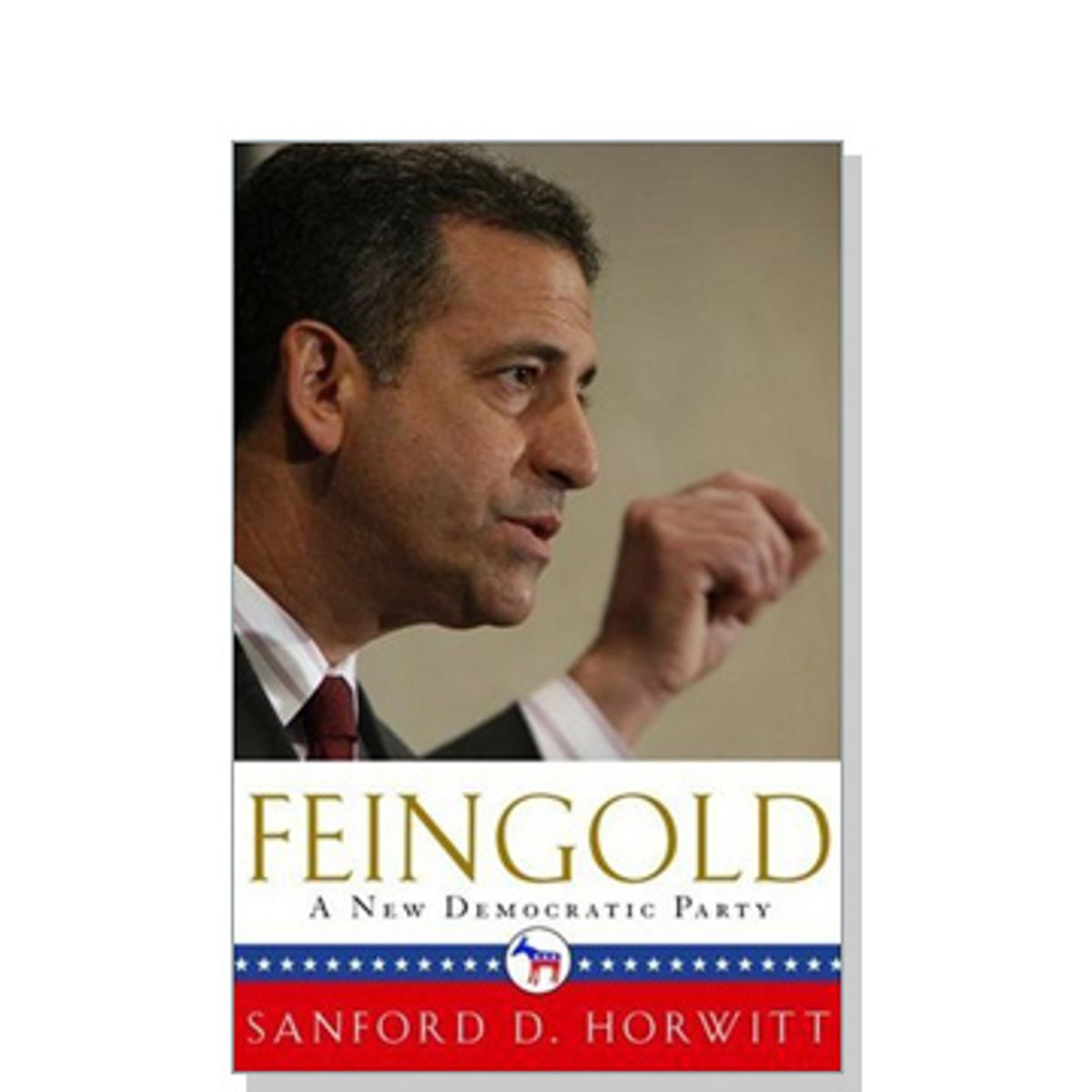
La Follette was resented by his colleagues for "calling the roll" -- reading embarrassing votes to a senator's constituents -- and for casting one of six votes against World War I. Yet in 1957, the Senate named this virtuous crusader one of the five greatest solons in its history. La Follette is also Feingold's idol, we learn in "Feingold: A New Democratic Party," a scrupulously admiring but shallow biography. Author Sanford D. Horwitt spent five years following Feingold to North Woods town meetings and interviewing family members, teachers, debate coaches and political allies. Horwitt, who grew up in Milwaukee, began this project as a Feingold booster, and can't seem to comprehend why anyone would dislike or disagree with the senator. Feingold's controversial style must have made him some enemies, but you won't find them interviewed here. Particularly in the chapters on Feingold's boyhood in Janesville, Horwitt makes young Rusty sound like another Wisconsin character from the 1950s -- Richie Cunningham of "Happy Days." Rusty loved his mother's lemon meringue pie, and H-O-R-S-E in the driveway with his brother. In high school, where he was this "skinny dude everybody liked," he cruised the strip in Camaros and Chevelles, stopping for late-night burgers at the Oasis.
As a young man, Feingold accumulated a clean-cut résumé -- state championship debater, straight-A student at the University of Wisconsin, Rhodes scholar, Harvard Law, elected to the state Senate at 29 -- but nonetheless, he likes to claim, "I'm a renegade by nature." Growing up, Feingold was schooled in the La Follette legacy by his father, a small-town lawyer who once ran for district attorney on the Wisconsin Progressive Party ticket. "Fighting Bob" had been a Republican, but the Feingolds migrated to the Democratic Party after Wisconsin elected Joseph McCarthy to the Senate.
In Feingold's first Senate campaign in 1992, he was a renegade. Outspent by his primary opponents, he ran ads comparing his ranch house with his rivals' mansions and vacation homes. Against incumbent Republican Sen. Robert Kasten in the general election, he cheekily claimed he'd been endorsed by Elvis. The Almanac of American Politics called the ads "cutie-pie liberalism," comparing them to Paul Wellstone's stunt of driving a green bus across Minnesota two years earlier. Feingold won easily. As Horwitt puts it, Feingold's campaign was in the tradition of La Follette's "progressives, who "mostly thought of themselves as perpetual underdogs against the big-money interests."
Once Feingold got to the U.S. Senate, he prohibited his staff from allowing lobbyists to pay for lunch, or even from taking refreshments at Capitol Hill receptions. For that, he was treated like Frank Serpico on the NYPD. Sen. John Breaux of Louisiana wondered if Wisconsinites ever had "a little fun."
"Oh, we do," Feingold assured him. "But we pay for it."
Milwaukee will never be as much of a party town as New Orleans, even if bowling is your favorite sport. Feingold's first stab at reform was a gift ban, aimed at stopping senators from accepting free junkets and tickets to black-tie balls. These were cherished perks, so it took Feingold two years to push a bill through Congress that capped gifts at $50.
Feingold's party could tolerate his financial temperance as long as it was a personal habit. But in 1998, it almost cost him reelection. That year, Feingold made a pledge to spend no more than $1 per voter, a total of $3.8 million. He also refused to raise soft money and asked the national Democratic Party not to run ads on his behalf. Feingold's opponent made no such promises. The National Republican Senatorial Committee ran an ad calling Feingold "slippery" for supporting "wasteful government programs" while presenting himself as a budget hawk. The senator's 19-point lead shriveled to a two-point deficit. Panicked Washington Democrats produced attack ads. Feingold denounced them -- "I called [Senate Minority Leader Tom] Daschle and I called up [Democratic Senatorial Campaign Committee chairman Bob] Kerrey and I said, 'Get those things off!'" -- but they ran for five days. Feingold won, by 35,000 votes. Did the negative ads make the difference? Feingold was too pure to walk the low road, but his seat may have been saved because someone else got down in the mud for him. The author doesn't ask that question. Instead, he writes, "On election night ... Feingold's big gamble was vindicated." Once again, Horwitt's reverence robs his subject of depth.
Feingold can get away with such goody-goody politics because his base expects no less. If liberals everywhere were as wholesome as their upper Midwestern kin, Republicans couldn't scare anyone with the "L-word." In Madison, which has sent a lesbian to Congress, and in Milwaukee, which has had three socialist mayors, liberals aren't angry, or decadent, or elitist. They form peace groups at the Lutheran church and volunteer at the nature center. Their cars are rusty, and they need new Rockport walking shoes. They donate to public radio. (The upper Midwest is the heartland of public radio, producing two of its most popular programs, "A Prairie Home Companion" and "Whad'Ya Know?") They are, yes, a little hurt that the United States is solving its problems with violence. Wisconsin, after all, abolished the death penalty in 1853. Up north, the rural contingent cherishes its hunting rifles (as does Feingold, a gun-rights supporter), but it also struggles through the winter on unemployment, and carries ancestral memories of labor struggles in logging camps and mines. On a county-by-county map of the 2004 election, the western shores of Lake Superior are one of the broadest patches of blue in the nation.
Wisconsinites are an independent lot. They're notorious ticket splitters. Although Wisconsin hasn't voted Republican for president since Ronald Reagan, the Democrat never wins in a walk. Wisconsin loves a maverick, too. That helps explain why it sent La Follette and McCarthy to the Senate. (The other reason: Germans. They're fans of clean government, but they also fear Russians.)
Immediately after Feingold's reelection, President Clinton was impeached. Once the case reached the Senate, Democrats moved to dismiss it. Feingold was the only member of his party to vote no. Back home, Democratic regulars were livid. But the Madison Capital Times, whose editorial page makes alternative weeklies sound moderate, praised its state's latest party-bucking senator. "Is it reasonable to despise this partisan impeachment process and yet to admire Feingold?" the paper asked. "We think so."
Later, Feingold was just as tough on George W. Bush. And just as lonely. While his Democratic colleagues worried about looking soft on terrorism, he was the only senator to vote against the Patriot Act. When the president was caught wiretapping American citizens without court approval, Feingold proposed a censure motion. No one would cosponsor it. (On Sunday, Feingold went on "Meet the Press" and again asked Congress to censure the president, this time for his conduct of the Iraq war.)
When Feingold went looking for allies in his campaign against soft money, however, he found the perfect partner in Sen. John McCain. McCain also models himself after a Progressive-era hero, Theodore Roosevelt. On fiscal issues, they have more in common with each other than with members of their own parties. A hundred years ago, both would have been Bull Moose Republicans.
"McCain's and Feingold's independence distinguished them in the Senate," Horwitt writes. "Neither played the earmark game and the inevitable vote-trading that it required -- and, therefore, they were free from much of the pressure to conform to party leadership."
The pair first introduced their campaign finance reform bill in 1996. The bill finally passed in 2002, after McCain made it a centerpiece of his presidential campaign and Democrats took over the Senate. President Bush signed it, but perhaps he knew, even then, that there was another way to veto McCain-Feingold. "This is the highlight of my professional life," Feingold exulted. "It won't completely end the primacy of money, but it's a big step in the right direction."
McCain-Feingold didn't end the primacy of money at all. The 2004 presidential campaign was the most expensive ever. Over $600 million was spent on advertising, more than three times as much as in 2000. The candidates hit up individual donors harder than ever, while "section 527" groups, such as Moveon.org and Swift Boat Veterans for Truth, appeared to collect cash that once would have flowed into party treasuries.
That same year, Feingold was elected to a third term, racking up the most votes in Wisconsin history. Like La Follette, he'd become a Cheesehead idol. Unlike La Follette, he's finding it tougher to spread Wisconsin values to the rest of the nation -- Hillary Clinton's "real world." Just this year, Bush achieved a belated line-item veto when his two Supreme Court appointees helped strike down a McCain-Feingold provision that banned attack ads in the months before an election.
It's likely that Horwitt set out on this project -- and timed its release -- with the expectation that Feingold would now be a declared candidate for president. Feingold did visit New Hampshire and Iowa, where Democrats treated him as "a heroic figure" for opposing the Patriot Act. He was also "a favorite candidate of liberal, antiwar bloggers." But just after the 2006 midterm elections, Feingold declared himself a noncandidate. He had just split up with his second wife, and advisors warned him that the Democratic establishment, fearful of an independent progressive, would use all its weight to squash his campaign.
"He had discovered that he didn't have the burning desire to run this time," Horwitt writes. "And he had no interest in merely using a presidential campaign as a platform for his ideas, or to increase his stature. He could use the Senate for that, especially now that his party was in the majority."
Maybe Feingold realized that his "last honest man" role is better suited for a senator. La Follette ran for president. He won 17 percent of the popular vote but carried only Wisconsin. The real world will never be like Wisconsin. But let's hope Wisconsin never joins the real world, either. It's nice to know there's a state where the greediest candidate doesn't win every election. What's more, the Senate can always use a pain in the ass. Thanks to Wisconsin, it usually gets one.
Shares