

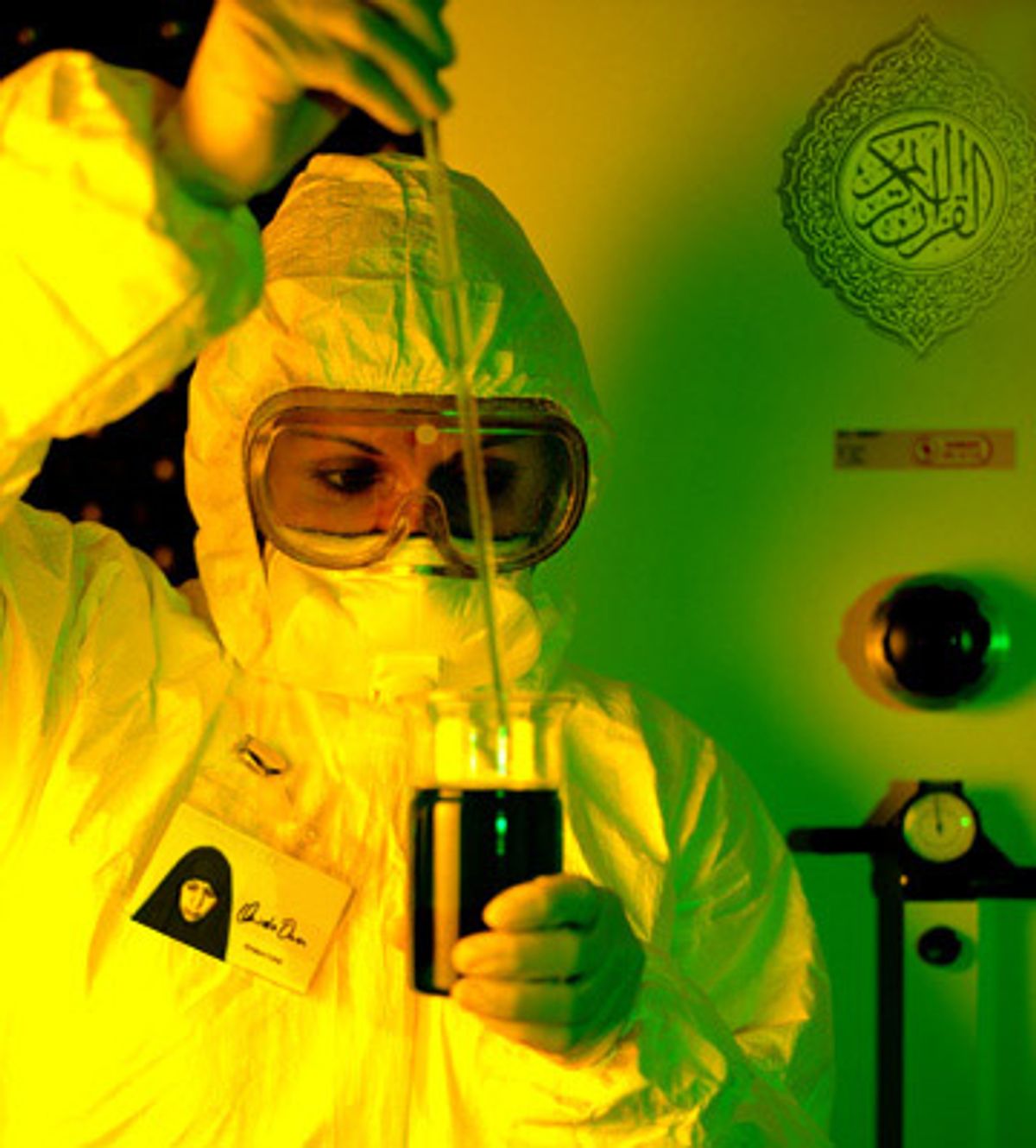
In October, Malaysia's first astronaut will join a Russian crew and blast off into space. The news of a Muslim astronaut was cause for celebration in the Islamic world, but then certain questions started popping up. How will he face Mecca during his five daily prayers while his space ship is whizzing around the Earth? How can he hold the prayer position in zero gravity? Such concerns may sound absurd to us, but the Malaysian space chief is taking them quite seriously. A team of Muslim scholars and scientists has spent more than a year drawing up an Islamic code of conduct for space travel.
This story illustrates the obstacles that face scientists in Muslim countries. While it's always risky to draw generalizations about Islam, even conservative Muslims admit that the Islamic world lags far behind the West in science and technology. This is a big problem for Muslims who envy the economic and military power of the United States.
What's so striking about the Muslim predicament is that the Islamic world was once the unrivaled center of science and philosophy. During Europe's Dark Ages, Baghdad, Cairo and other Middle Eastern cities were the key repositories of ancient Greek and Roman science. Muslim scholars themselves made breakthroughs in medicine, optics and mathematics. So what happened? Did strict Islamic orthodoxy crush the spirit of scientific inquiry? Why did Christian Europe, for so long a backwater of science, later launch the scientific revolution?
Taner Edis, the author of "An Illusion of Harmony: Science and Religion in Islam," is in a unique position to examine these questions. He grew up in Turkey, the son of a Turkish father and an American mother, and now teaches physics at Truman State University in Missouri. Though he comes from a Muslim country, his family wasn't religious. Today, Edis calls himself an "Enlightenment rationalist." "I am a bit of a physics chauvinist," he writes in his book. "I think that according to the best of our current knowledge, our world is an entirely natural, physical place that does not depend on any supernatural powers."
Edis didn't move to the United States until he was 20, so I was surprised to discover that he has no trace of a foreign accent. It turns out English was his first language; only later did he pick up Turkish on the streets. Edis often travels back to Turkey, where he's been watching, with a mixture of fascination and alarm, the sophisticated creationist movement that sprang up in Turkey and is now spreading throughout the Muslim world. I talked with Edis about the difficulties of reconciling science with Islam and the quest for an "Islamic science."
How would you assess the state of scientific knowledge in the Islamic world?
Dismal. Right now, if all Muslim scientists working in basic science vanished from the face of the earth, the rest of the scientific community would barely notice. There's very little contribution coming from Muslim lands.
But Islamic countries seem to be very open to using modern technology. Are you saying that's different from doing original scientific research?
Yes, it's important to distinguish between basic science in, say, physics or biology, and more technology-oriented work. Muslims have been trying to catch up to Western countries for the past couple of centuries. Especially in military and commercial areas, they have put their emphasis on applied science rather than basic science. So there are lots of medical doctors and engineers in the Muslim world. But the contribution to scientific research is much lower.
I suppose they could just import the science that's developed in the West. Is this really a big problem?
Falling further behind in something like condensed matter physics means that you'll have a harder time adapting technologies that are going to be based on this new knowledge of physics. And you're excluding Muslims from the creation of new technologies. It permanently locks the Muslim world into a subordinate position in those aspects of modern life that depend on creativity in technology and science. And this is a huge swath of modern life.
If you're a Muslim and you're worried about the military weakness of Muslim countries compared to Western imperialist powers, you're going to see that today's warfare depends a lot on high-tech developments. If you're worried about the Muslim world falling under the thumb of economically advanced Western powers, well, the modern economy depends on technology and science. This is not a controversial statement in the Muslim world. Even the most conservative Muslim realizes that the Islamic world is at a severe disadvantage right now in science and technology. The West has done a much better job. And somehow, Muslims are going to have to do better.
Is there outright hostility to science in Muslim countries?
Not at all. In fact, you'll typically find that, at least superficially, they are very positive about science. Even many devout Muslim apologists say Islam is supposed to be a scientific religion -- a religion that supports science down to the last detail. But this notion of a science-positive Islam is often combined with ignorance about the details of science and an openness to some deeply pseudoscientific ideas.
Yet there was a time, from the 9th through the 12th centuries, when Islam was arguably the center of the scientific world.
Very much so. If you're talking about the proto-scientific thought that was inherited from the Greeks and Romans, all of the action was taking place in the Islamic world. Western Europe at the time was a land of barbarians -- intellectually, totally negligible. In fact, Muslim thinkers developed Greek science; they didn't just preserve it. But it is a mistake to think of this as analogous to modern science. What Muslims were doing back then was still a medieval, pre-scientific intellectual enterprise. They never quite made the breakthrough, the scientific revolution, that took place in Europe.
Today, it's something of an impediment for the Muslim world to continually look back to the glories of the past and keep saying that the Islamic world used to be a world leader in science. This tends to obscure some very important differences between modern science and medieval thinking. They did some very interesting things in medicine and optics. But all of this was mixed in with astrology and alchemy and what today we would consider dead ends. This was not thinking of nature mechanistically, as happened in the scientific revolution in Europe, but in almost an occult sense.
But those things were also mixed together in Europe's scientific revolution several centuries later. Isaac Newton was fascinated by alchemy and astrology.
Indeed. I often say that all I learned about alchemy I learned from reading Isaac Newton. But in Europe, you had a three-way interplay between science, orthodox religion and more occult religious alternatives. You could have interesting alliances. These end up being separated through historical accident -- I don't see anything special about Western Christianity that sets it apart from Islam -- and they go their separate ways. This type of separation never really happened in the Muslim Middle East.
Many historians would disagree with your assessment that what Muslim scholars did during the Golden Age wasn't real science. They point to major discoveries in mathematics, physics and chemistry. And they say later European discoveries owe a direct debt to Muslim scientists. For instance, didn't Copernicus use the mathematical work of Iranian astronomers to construct his theory of the solar system?
I don't disagree with any of this. Muslims inherited the precursors of science developed in antiquity and developed this much further. Still, I have to emphasize how such ancient and medieval ways of thinking about nature are different than what we understand as modern science. Much of the praise heaped on medieval Muslim science is due to a very selective reading of history. We tend to pick out ideas that are similar to what eventually became successful and downplay ideas that seem occult and outright crazy today. But medieval Muslim thinkers took the weird stuff as seriously as anything that fed into modern science.
It's hard to avoid comparisons between Islam and Christianity. For centuries, the Christian church had as much control over European culture as Islamic thinkers did over Muslim cultures. And yet science flourished in Europe, starting especially in the 1600s. Why did the scientific revolution happen in Christian Europe and not in the Islamic world?
That's a very big question. There is no answer that I can give you that would command a consensus of historians of science. My perception is that a number of factors came together so that scientific institutions in Europe got lucky. They were able to break free of church constraints and unleash a powerful technology that plugged into emerging capitalism at that moment in history. After that, it was too late to go back and strangle science even if somebody wanted to.
At a certain point, the Vatican no longer objected to scientists who examined the physical world. They distinguished between the study of the natural world and the spiritual world. As far as I can tell, this split never happened in the Islamic world.
Sure, but that concession by the conservative Catholic hierarchy was done at a point when nobody in science really cared what they thought anyway. It was not as if the Catholics could censor or stop science in the late 19th century.
But that happened much earlier. If you go back to the 17th and 18th centuries, the cat was really out of the bag, wasn't it?
Yeah, but if you want to talk about the Catholic Church seeking an accommodation with modernism and science, you really have to come into the 19th and 20th centuries. If you're looking at the Islamic context, the story is different because Islam doesn't have any central church authority. The influence of Islam on scientific institutions comes through the general culture and the authority of religious scholars.
Why was it so much harder for science to take root in the Muslim world?
It was harder for science to achieve intellectual and institutional independence. This was not restricted just to science. In the Western world, the institution of law achieved a kind of autonomy from religion early on. Some historians argue that this was really a precursor to science achieving autonomy as well. In the Muslim world, law was never entirely disentangled from religion. Islamic culture has not been as supportive of intellectual independence for different areas of life.
Did science actually decline in the Islamic world in the 14th or 15th centuries? Or is it just that science in Europe exploded a little later, leaving science in the Islamic world far behind?
It depends on which historian you consult. The older point of view has been that Islamic intellectual life and science went into a period of decline after the Golden Age. But nowadays, many historians argue that science in the Islamic world continued to develop at its own pace. I don't know if I would entirely agree. But it's definitely true that much more emphasis has to be put on Europe taking off and therefore a relative gap opening. It's not so much a story of Islamic decline as Europe inventing an entirely new way of thinking about the natural world and really making a break with medieval ways of thinking. That didn't happen in the Islamic world.
Didn't Western colonialism also contribute to the decline of science in the Islamic world? Colonial rule often marginalized Muslims and dismissed the value of Islamic culture. In Indonesia, the Dutch even closed Islamic institutions and banned Muslims from universities until 1952.
All of this is correct. There is no overarching cause that single-handedly accounts for Muslim backwardness in science. Western colonialism has much to answer for. But then, I did not set myself the impossible task of disentangling all the reasons behind Muslim difficulties in science. What I can do, I hope, is to say something useful about the present, particularly how conservative Muslim thought continues to struggle with science.
Many Muslim thinkers talk about trying to resurrect and tap into the past glory of Islamic science. Are you saying this is a mistake?
Yes and no. If you go back to the 9th through the 12th centuries, some practices were useful, such as being more open to intellectual currents from many directions. But other things are not going to be helpful. If you look into the literature on Islam and science, one of the names you will very soon encounter is Seyyed Hossein Nasr, who is a Muslim philosopher of science. He works in the United States but has origins in Iran.
He teaches at George Washington University. Clearly, he has a distinguished academic position.
That's right. Seyyed Hossein Nasr says he's trying to revive certain distinctly Muslim ways of thinking about the universe. But it's a revival of all the strands of classical Islamic thought, including those strands which are very antithetical to science as we understand it today.
Where does this actually create problems?
One of the features of medieval Islamic science that some modern Muslim thinkers want to revive is the way of perceiving the universe as a spiritual, God-centered place. This tends to work against the independence of science from religious institutions. It's precisely this autonomy that helped science make the breakthrough in the Western world. In the Muslim world, this is still a relatively controversial concept. There is a tendency to say that science should operate under the guidance of religious concerns. I think this is one of the obstacles facing science in the Islamic world.
But this is complicated. Everyone agrees that Western science has been successful at what it does. And yet I'm willing to bet that many Islamic thinkers would say the price of scientific success in the West has been too high. Once science was divorced from religion, you could argue that it was only a matter of time before secular values would triumph, atheism would become a viable option, and the modern world would end up with the rampant materialism and consumerism that we have today. A lot of Islamic thinkers don't want that version of Western science.
This is a dilemma for many people in the Muslim world who are thinking about science and religion. On the one hand, there is a desire to catch up, especially in the technological realm which underpins the military and commercial superiority of the Western world. On the other hand, there is a desire to adopt modern science in such a way that local religious culture is not corrupted. So yes, they are very concerned not to go down the Western path. You can find many Muslim thinkers who say that Western Christians made a mistake by allowing science to operate independently of religious constraints. However, that is the way modern science has achieved the success it has. So it's hard to negotiate between these options.
I don't want to sound like I'm describing the Muslim world as a monolithic entity with no differences between Muslims. There is a very heated internal debate in Muslim countries about how to respond to the modern West, and science is only one concern. Some say the Islamic world has to secularize. Turkey has for many decades been an example of taking a more secular path and adopting westernization full scale. It has had some successes, though it hasn't fully taken root. But a lot of people think if you try and westernize totally -- if you separate science from religion and you separate politics from religion -- then you end up with the more compartmentalized modern society that we're familiar with in the West. And they're reacting against it. The intellectual options in the debate over science and religion are very similar to what we have in the West. What's different is the historical background and the institutional landscape. In the Islamic world, the liberal option is much weaker compared to what we have in the Western world.
By "the liberal option," do you mean reading sacred texts as metaphor rather than literal truth? For instance, liberal Christians don't take the creation stories in Genesis as scientific fact. They read these stories more as poetry. Are you saying that option, for the most part, doesn't exist for Muslims because the Quran is seen as a text that's been handed down from God?
It would be an overstatement to say that option does not exist, but it has a much weaker social position. Let me give an example. Here in the United States, the mainstream scientific community has a big problem with creationist movements and intelligent design. As scientists, one of our closest allies in trying to combat creationism is the liberal religious community. It's much more effective to send somebody to a school board meeting who's not a scientist but actually a priest or rabbi or minister in a more liberal denomination and to explain that they don't see a conflict between teaching evolution and religion. But in the Muslim world, this is much more difficult because the public affinity toward creationism is much stronger. Darwinian thinking really hasn't penetrated the popular discourse. Plus, it's very hard for scientists who work in Muslim countries to find liberal religious figures who would go out there and publicly say Darwinian evolution is not a problem for Islam.
How does this play out in schools? Ultimately, doesn't this come down to what is mandated by governments, either at the national level or the local level?
What happens depends very much on which Muslim country we're talking about. In many Muslim countries, you don't have much creationism, but only because evolution does not appear in their textbooks in the first place. In countries that have had some exposure to conventional science education, such as Turkey, then you also have more of a public creationist reaction. In the last 20 years, we've seen creationism appearing in Turkey's official science textbooks that are taught in high schools. Turkey has also witnessed a very strong popular movement for creationism that has spread to the whole Islamic world.
Can you tell me about the leader of this big creationist movement in Turkey, the man who goes by the name Harun Yahya?
Harun Yahya is a pseudonym. It's supposed to be a pseudonym for a Turkish religious leader whose name is Adnan Oktar. However, the amount of material that's put out under the name of Harun Yahya is absolutely immense. There are hundreds of books, articles, DVDs, tapes, magazines, all under the name Harun Yahya. So this is clearly not the production of one single person. Indeed, Adnan Oktar doesn't have the kind of educational background even to successfully fake a pseudoscience. The operation is distributing material in Europe and the United States. They mainly target a Muslim audience, but it's a modern Muslim audience. So they tend to target countries such as Turkey.
Did this movement come over from America? Was Harun Yahya inspired by American creationists who proselytized in Turkey?
No. There is some American influence, but it's fairly minimal. The Turkish creationists have taken the initiative and gotten in touch with organizations like the Institute for Creation Research in California. And what they've taken from American creationists are basically ideas and strategies for how to get creationism into textbooks. So Islamic creationism is an indigenous movement which is inspired by some aspects of Western creationism.
Is the critique of Darwinism basically the same as what you'd find from American creationists?
Much of the rhetoric is similar. There are only so many ways you can argue against evolution, only so many ways you can say the fossil record doesn't tell you what the biologists say. But there are also differences. For example, in American creationist circles, one of the stronger options is "Young Earth creationism." People who read the Book of Genesis literally believe in a creation that happened 10,000 years ago, literally done in six days. But the Quran is much vaguer about the time frame of divine action. Therefore, they are not as committed to fitting earth history into thousands of years. So Muslim creationists are almost invariably "Old Earth creationists." They tend to think of Noah's flood as a local event -- not such a big thing -- unlike the American creationists who think of the flood as the major geological event in earth history. So there are lots of differences that adapt creationism to the Islamic context.
What about the idea that human beings have a common ancestor with chimpanzees?
That's definitely a no-no. And this goes beyond creationism. It goes beyond Harun Yahya. By and large, because the Quran is fairly explicit about the special creation of humans -- Adam and Eve and so forth -- you will find that Muslims will typically be very reluctant to allow for human evolution.
I'm curious about your own background. Was Islam ever an important part of your life?
No. The Turkish side of my family is very secular. Some of my Turkish relatives are somewhat observant, but even they are very liberal-minded about their Islam. So I grew up in a very nonreligious household.
Do you consider yourself a Muslim?
No, I'm not. I'm not a religious person.
Why have you chosen to live in the United States rather than in Turkey?
Being part American and part Turkish, I have to choose one. I'm equally at home in both countries. But if you're going to have a career teaching physics, and an intellectual life in general, the United States is an easier place to do this. It has more resources, and it's just more comfortable to do science in the United States.
What makes it hard to be a physicist in Turkey?
First of all, factors that have nothing to do with religion. Turkey is a poor country. The amount of resources that they can devote to basic scientific investigations is very low. The physics department in Turkey where I got my undergraduate degree had some very good teachers, but the resources we had were fairly poor compared to any American university. I got my Ph.D. in the United States, and I've been here ever since. It really is much easier to stay in the United States.
There are some Muslims who talk about the need for an "Islamic science" that's quite distinct from Western science. They say we shouldn't separate knowledge of the physical world from knowledge of the spiritual world because they are interconnected. And they often argue that science should have an ethical dimension. We shouldn't just do science for the sake of knowledge. We should always be concerned about the moral outcomes. Does it make sense to talk about an Islamic science?
There are efforts to formulate a more Islamic science. The people who have this ethical context in mind are thinking not so much about physics or biology, but social science and applied science. Why are we doing this? And how can we include ethical and social concerns in our studies of the world? Debates about this take place among Western scientists as well. It's perfectly legitimate. What gets more interesting -- and from a mainstream scientific view, more dubious -- is the notion that you can take an Islamic point of view and allow these faith-based, revealed ideas to constrain how you investigate the world.
I'm assuming most scientists would say science is science. If it's done well, it doesn't matter who does it.
And many devout Muslim thinkers would agree with that.
The London-based writer and critic Ziauddin Sardar has argued that "Western science is inherently destructive and does not, cannot, fulfill the needs of Muslim societies." He says Western science has become an ideology that's highly efficient but is also dehumanizing.
Such sentiments are not difficult to come by in the Islamic world. A lot of these issues are matters of debate among Muslim intellectuals and people who are devout. There's no single point of view. I can also quote conservative Muslim intellectuals who say, "No, science is science except for a few exceptions here and there." But this idea of Islamizing science -- to give a specifically Islamic flavor to science -- has been very attractive to a good number of intellectuals in the Islamic world. I have a hard time seeing that as a positive development.
What would it mean to Islamize science?
The hope for Islamizing science is to defuse the threat that modern science poses toward more overtly religious ways of perceiving the world. In all areas of natural science, we seem to be converging on a purely naturalistic description of how the world works. And so concepts like supernatural agents or revelations start looking out of place to the way modern science has come to describe the world. And that's an issue for devout Muslims. So they would imagine, perhaps, a Muslim biology that includes concepts of divine design in the very notion of how you do biology in the first place.
There are a lot of people in the United States -- liberal Christians, Jews and Buddhists - who also complain about what they call "scientism" -- the idea that science explains all there is in the world. It obliterates the spiritual life. These people also tend to be fully supportive of evolution, but they say science can only explain so much.
You can find Muslim thinkers making similar pronouncements. "Scientism" and "reductionism" have become stock accusations in religious circles. I don't know if there's much more content here than saying, "I don't like naturalistic ideas."
You have been outspoken in your criticisms of science in the Islamic world and, by implication, the stranglehold that certain ways of Islamic thinking have had on science. Do you get flak for that?
Not really. First of all, these are points of view that many liberal-minded Muslims would agree with. My criticism of the state of science in Islamic lands is not dependent on my judgment about the existence of the supernatural. And Muslims themselves, even very conservative Muslims, are very aware that the Islamic world has a problem in science. As long as a secular person like myself is not doing some sort of Islam-bashing but has something genuine to contribute, even conservative Muslims can be very positive about engaging in this debate. Generally, my relations with Muslim creationists have been very cordial. I think the science they're putting out is complete nonsense. But that doesn't mean we have to be personally hostile.
So is there a way for Muslims to create a scientific culture that would really take root and flourish?
I don't know. My preference would be that the more liberal strains of Islam would gain more power, so that science and technology can be more autonomous from religious and moral concerns. Without this, I don't see the Islamic world taking a trajectory in science that's going to be similar to the Western world's. However, in the end, this is not something for me to decide. I'm an outside critic, being over here.
Shares