

The Republican Party is the least respected institution in the U.S today, George W. Bush's poll numbers are nearing Nixonian lows, and GOP Congress members and Bush administration officials are rushing for the exits. In the last week Karl Rove and Tony Snow, plus House leaders Denny Hastert, Deb Pryce and Charles Pickering, were all suddenly possessed by a desire to spend more time with their families, or their lawyers. Meanwhile, Washington is already bickering over the administration's September progress report on the Iraq quagmire, which will almost certainly be bad news for Bush and the GOP politicians whose fortunes are sinking with his.
Of course, you know what that means: It's time for another book about those crazy, doomed, dysfunctional Democrats!
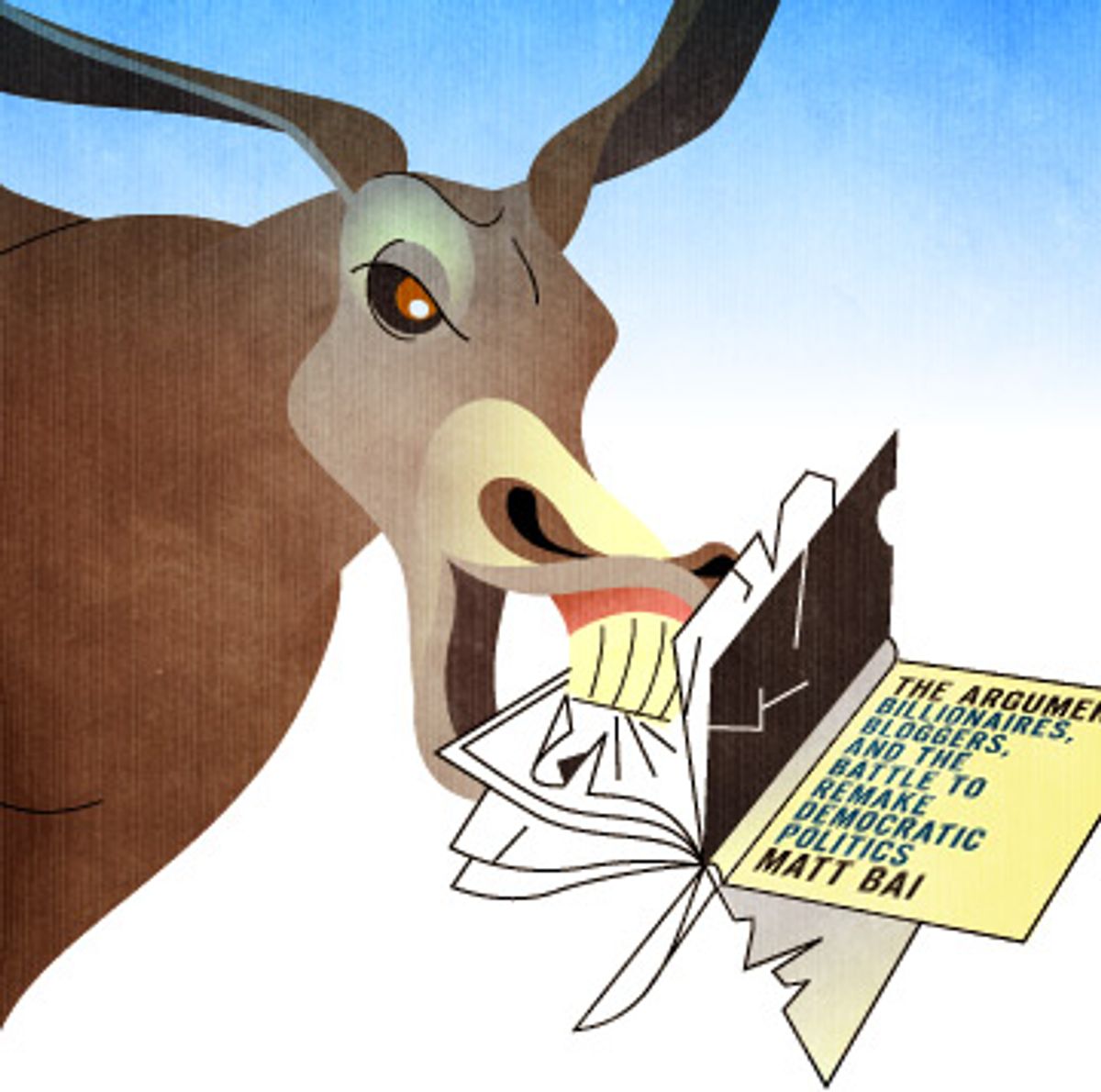
That's not an entirely fair way to set up Matt Bai's heralded anatomy of Democratic disarray in the Bush years: "The Argument: Billionaires, Bloggers and the Battle to Remake Democratic Politics." A book can have bad timing and still be right. John Judis and Ruy Teixeira published "The Emerging Democratic Majority" just before Republicans cruised to a 2002 midterm victory, and it probably didn't help sales. But they were right about the big picture: Women, minorities, urbanites, professionals and new-economy workers were moving toward the Democrats, helping the party take back Congress in 2006. Maybe Bai's right, too, and the Democrats will ultimately be undone by two flaws he thinks are crippling: their failure to put together a big, bold social policy for the 21st century, and their "disabling hatred" of George W. Bush.
Maybe he's right, but "The Argument" didn't convince me. Bai's written a fascinating but ultimately bewildering book that offers occasional insight, since he was smart enough to pay attention to Howard Dean before he was "Howard Dean," and then to follow the netroots story Dean introduced, in frequent pieces for the New York Times Magazine since 2003. So we get firsthand reporting, exclusive access to early meetings (not all of which, sadly, are that interesting), and some compelling small portraiture -- the Democracy Alliance's Rob Stein, Yearly Kos organizer Gina Cooper, blogfather Jerome Armstrong, plus a damning look at the abortive presidential campaign of former Virginia Gov. Mark Warner, who in Bai's telling decided to cut and run rather than fight the lefty blogosphere "mob."
But for all its love of big bold ideas, "The Argument" is premised on a big, bold idea that's simply wrong: that Republicans seized and held power in the Nixon-Reagan-Bush I generation by selling Americans on a positive platform of new programs for national renewal, while Democrats, by contrast, are now winning merely by not losing, bashing Bush for wrecking the country while never explaining to voters what they'd do instead.
I wanted to agree with Bai, at times -- I love big, bold ideas, really I do. But I think the role of big, new ideas in political realignments is overrated. Bai's book is flawed by his failure to grapple with the negativity, lo, the hatred behind the Republican revolution of the '70s and '80s, some of which is still politically operative today. Does he really think Reagan rode to power on the Laffer curve, not by bashing Cadillac-driving welfare queens, scruffy war protesters and big bad government? Both Nixon and Reagan (George Bush I was merely Reagan's long tail) were the political beneficiaries of a resentful, sometimes racist reaction to the perceived excesses of the 1960s and '70s, associated with the Democrats, far more than they were the avatars of a wildly popular new way of running the country. Nixon borrowed more from George Wallace than he did William F. Buckley.
Forty years later, as Democrats gain power -- and they are likely to win the White House and strengthen their control of Congress next year despite the flaws Bai depicts -- it will be largely because voters think Republicans have gone too far in every imaginable way: starting a bloody, unnecessary war that puts the world at risk; corruption, incompetence and cronyism at home and abroad; a dramatic erosion of civil liberties that is literally changing what it means to be an American. For many voters, the Democrats' commitment to fight Republican overreaching isn't merely "negative" or anti-Bush, as Bai argues, it's an ambitious, positive program to restore the country's social, political, global, military and economic vitality. It's complex, and its ultimate success is far from certain. But to many voters it's as welcome as those helicopters flying in to rescue people stranded on their roofs during Hurricane Katrina two summers ago.
How did Bai, with an eye for a good story, go wrong? It's important to remember he got started after the dismal 2002 midterms and did a chunk of his work after the Dean boom went bust and Sen. John Kerry lost to Bush in 2004; he barely had time to assimilate the startling results of the 2006 election, and it shows. Clearly Bai was ground down by interminable meetings where Democrats flagellated themselves for their failures in 2002 and 2004, and searched for gurus to get them out of the wilderness. Time spent that way will cost anybody some IQ points. Chunks of the book are painful to relive: the party's obsession with framing expert George Lakoff, religious lefty Jim Wallis, "What's the Matter With Kansas?" author Thomas Frank, each man embraced by this or that leading Democrat as though he's Moses leading them to the promised land. We witness the sordid spectacle of wealthy Democrats whining about their impotence. "We are so tired of being disenfranchised!" billionaire Lynda Resnick wails at a lavish 2004 book party for Arianna Huffington. For some of the people Bai interviewed, the solution that emerges from all this wailing and rending of expensive garments seems to be that rich Democrats and smart people must unite and give the party what it needs: the benefit of their big brains and bigger bank accounts, but only on terms dictated by the rich folks, preferably in meetings held at fancy resorts.
Bai hooks up with former Clinton administration staffer Rob Stein, an apparently endearing idea guy who was peddling a PowerPoint argument showing how Republicans consolidated power because they invested in an intellectual infrastructure that hatched and then marketed new policies. They launched the Heritage Foundation and the American Enterprise Institute, whose ideas were popularized by media outlets like Fox News and the Weekly Standard. This GOP brain trust -- some might call it the vast right-wing conspiracy -- developed and promoted Republican programs while also (and this is underplayed by Bai) demonizing Democrats and their programs. Stein sold wealthy liberals on the need to do the same. He quickly signed up big Democratic donors George Soros and Peter Lewis for something that started as the Phoenix Group (right, out of the ashes) and morphed into the Democracy Alliance. Bai tracks the Alliance's brief rise and quick fall into petty power plays, and its sort-of rise again after the 2006 election, but he's not convinced the group is doing any more than tinkering at the margins of political thinking. "Even in victory, some of the partners remained vexed by their inability to articulate what progressives actually stood for," he writes about a fancy Alliance meeting after Democrats took back Congress last year.
That "inability to articulate what progressives actually stood for" vexes Bai throughout "The Argument." Of all the liberal insurgent groups and individuals in the book, MoveOn comes off best, perhaps deservedly so. (DNC chair Howard Dean remains a cipher.) Bai seems to like the understated servant-leadership of people like Eli Pariser, Wes Boyd, Tom Matzzie and Ben Brandzel. He's torn between satirizing and lionizing the direct democracy of their famous house parties; he goes to one where Chris Rock's mother-in-law (really) hosts a small group in Arlington, Va., and watches as they and about 100,000 members at other parties throughout the nation struggle to come up with three policy prescriptions, each in five words or less, that are positive, not merely negative or anti-Bush. The process actually works. "Health care for all," "Energy independence through clean, renewable sources" and "Democracy restored" emerge as the consensus choices. But how this admirable if wan troika of policy prescriptions translates into a political program is never made clear, either by Bai or MoveOn, so the accomplishment feels underwhelming in the end, despite Bai's obvious respect for the Berkeley, Calif., activist group. At least they aren't just bashing Bush!
Bai is more negative about the liberal blogosphere, and its role in the Democrats' current supposed quandary. He purports to admire the blogosphere. He seems to genuinely like Jerome Armstrong and Markos Moulitsas Zuniga of Daily Kos, who get a lot of ink in "The Argument." He charts the first YearlyKos convention, and maybe most important, the meeting's role in former Gov. Mark Warner's short and not so sweet flirtation with the idea of a presidential run. Warner, recall, was the Democratic Leadership Council guy paradoxically endorsed by Armstrong, to the consternation of some lefty bloggers. Armstrong's pal Kos didn't endorse Warner, though he did famously embrace him at Warner's lavish YearlyKos party in Las Vegas in 2006, proclaiming, perhaps regrettably, "As a first date, this is pretty damn cool!" (It's worth noting that Bai seemed to heart Warner as well. He wrote a flattering profile of Warner in the New York Times Magazine earlier that year anointing him as the man who could beat Hillary Clinton.)
Bai's problems with the blogosphere start to show more clearly as he writes about YearlyKos, though we are supposed to be seeing the trouble through Warner's eyes. At his Vegas party, Warner is jazzed. "This is the new public square! This is the new face of the Democratic Party!" he tells the bloggers. But he begins to sour on his new friends as they pepper him with tough questions about how he'll undo the damage of the Bush years. He -- or is it Bai? Or both? -- starts to view the lefty blogosphere as Bush-hating, Hugo Chavez-loving naifs, comparable to Jane Fonda in the 1960s, all hopped up about American wrongdoing in the world while oblivious to the al-Qaida threat. In a small session with about 20 elite bloggers, Warner is clearly flustered by their belligerence toward the administration's foreign policy, their worries about Bush's intentions toward Iran and their concern for rolling back domestic spy programs. "I fundamentally believe the terrorist threat is real," an exasperated Warner tells them, and Bai leaves the impression that most YearlyKos bloggers, by contrast, don't.
Just two months later, in October, the bold candidacy of Mark Warner, "the freshest, most electable alternative to Hillary Clinton," in Bai's words, evaporates. The former governor told the world he wanted to spend more time with his family, but Bai wasn't convinced. "I suspected that his various run-ins with the donors and bloggers of the new progressive movement had also convinced Warner that, in order to succeed, he was going to have to be more angry and divisive than the governor who had won over so many Republicans -- and more partisan than the president he hoped to become," Bai tells us. And the bloggers Warner had initially lionized as "the new face of the Democratic Party" turned out to be something more disturbing.
"They were, in fact, the voices of the new public square, but it was more like the Parisian public square in the days of the Bastille -- not a place where townspeople came to carefully consider what their leaders had to say, but where the mob gathered to make demands and mete out its own kind of justice." Yikes. If Warner really was scared away from running for president by the YearlyKos "mob," then the mob did the country a big favor, because Warner needs to grow a pair before he runs for church choir director, let alone president. (It seems equally plausible Warner didn't have the proverbial fire in the belly, for a host of reasons, including the fact that GOP Sen. John Warner is widely expected to retire rather than bid for a sixth term next year. That race is easier for the Democratic Warner to win than the 2008 presidential nomination; he is also rumored to be mulling another run for governor.)
Things only get worse the more time Bai spends at the other bloggerpalooza event of summer '06 (which, given Bai's angst about the blogosphere, might best be called the Summer of Hate) -- the insurgent campaign of preppie cable exec Ned Lamont against Iraq war cheerleader Joe Lieberman. Bai clearly thinks Lieberman got a raw deal. His overall Senate voting record, Bai points out, is comparable to Hillary Clinton's. His sin was supporting the Iraq war and being kissed (but Lieberman tells Bai there was "no actual lip contact") by President Bush. The lefty blogosphere's effort to defeat Lieberman, according to Bai, was marked by two features the writer can't abide: the bloggers' desire to exert power for its own sake, and even worse, a desire to exert power motivated mainly by hatred. He quotes his friend Markos as saying if the bloggers could take down Lieberman "then no one will want to be the Joe Lieberman of 2008." "The real goal here for the netroots," Bai concludes, "wasn't so much about change as it was about power."
This is the crux of what's wrong with "The Argument." Bai depicts the revolt against Lieberman as though it's the cool kids turning on a nerdy old friend they don't like anymore. Throughout the book, he minimizes what the Iraq war means to bloggers, to Democrats, to the vast majority of American voters, to the world, in order to depict Democratic insurgents as power-mad kingmakers or simply haters. But this wasn't some wonky clash over, say, the dimensions of welfare reform or the estate tax; or some venal battle to protect the power of teachers unions or the tax advantages of hedge fund executives. It wasn't Egomaniac Asshole Pol No. I vs. Egomaniac Asshole Pol No. 2. The dishonest marketing of the Iraq war and the treacherous lies behind it, the cavalier way it was executed, the disastrous way it unfolded, along with some Democrats' collusion in all or part of the debacle, have shaped and will shape American political culture for years to come. And it happened because the so-called vast right-wing conspiracy, the intellectual and media infrastructure Rob Stein charted, had succeeded in a decades-long campaign to smear Democrats as un-American in every imaginable way -- and very specifically, after 9/11, as terrorist sympathizers and appeasers. Most disturbing to angry party insurgents, Democrats like Joe Lieberman helped them along, not only by supporting the Iraq war through today, but by going on right-wing Fox News and the Wall Street Journal wingnut editorial page attacking Democrats in exactly the same terms Republicans used.
Making sure that "no one will want to be the Joe Lieberman of 2008" wasn't, then, about naked power. It was about undoing the awful Republican war and disastrous foreign policy with which Joe Lieberman colluded -- and ensuring that Democrats, in the future, would stand for something different, or not stand as Democrats. Bai misses all of that. He revisits the low point of the blogosphere's campaign for Lamont, when Firedoglake's Jane Hamsher ran an ill-advised, kind of inexplicable photo of Lieberman in blackface. If you didn't already know Hamsher was Big Trouble, Bai telegraphs it this way: She was "a onetime Hollywood producer whose seminal work was 'Natural Born Killers,' the movie that set a new standard for senseless violence onscreen." Ah, there you have it, the marriage between amoral Hollywood and the lefty blogosphere, targeting poor Joe Lieberman.

Still, Lamont won the primary. But Lieberman won reelection running as an independent, and the lesson for Bai is clear: The bloggers behind the Lamont campaign lost interest and moved on, and other Democrats never fully warmed to Lamont, once it was clear that he "lacked a discernible agenda" beyond being not-Lieberman. (Perhaps more relevant, the neophyte candidate also took an ill-advised post-primary vacation and never got his campaign back into gear.) Connecticut voters, according to Bai, preferred the platform of their incumbent senator (who in fact lied about wanting to bring the troops home soon and his alliance with the Bush administration, all while relying on the votes of Republicans to win reelection.) That Bai draws so many wrong conclusions about the Lieberman race ruins the book.
Let me be clear: Like Bai, I would like to see more political will (the ideas are there; it's a mobilized constituency behind a few key ideas that's missing) to do something about the healthcare nightmare, the public education crisis, persistent inner-city poverty, the shock waves of globalization ... I could go on and on. I think the 2008 Democratic nominee will need to articulate and build a constituency behind a compelling vision of post-Bush America that reckons with terrorism, security and a new U.S. role in the volatile global economy. He or she may not need it to get elected, the way the Republicans are going, but they'll need it to govern and to solve the problems voters elect them to address -- as well as to get reelected.
I should also acknowledge that I've had my own issues, occasionally, with parts of the liberal blogosphere. I've asked whether they want to be new media pioneers or Democratic kingmakers; I've worried some are more interested in becoming the new gatekeepers than crashing the gate. But I've come to be happy they're around -- and that's because I remember how it was before.
It's clear to me that at least some of the billionaires and bloggers Bai depicts as obstacles to the development of a new Democratic message have been crucial in winning Democrats the luxury of having such a problem -- thinking about what to do with power -- after years of being caricatured and humiliated and bullied and Swift-boated into political irrelevance. Bai undervalues the role of two Democracy Alliance-related projects, the Center for American Progress and Media Matters, in combination with the liberal blogosphere, in combating the right-wing noise machine. During the impeachment of President Clinton, Salon was virtually alone -- remember that 54 news organizations passed on the story of impeachment macher Henry Hyde's adulterous affair before we published it -- in challenging the partisan jihad against the president. During the Florida recount in 2000, when we exposed the many ways Republicans had excluded Democratic voters, and exhorted party leaders to keep fighting to count every ballot, despite Paul Gigot's "bourgeois riot" boys and others who'd labeled Al Gore and his running mate (that's right, Fightin' Joe Lieberman) "Sore-Loserman," Gore campaign manager Donna Brazile took the time to e-mail us to thank us for our relatively rare show of public support for Democrats who actually fought back. When victorious Bush supporters took one last parting shot at the Clintons in the media -- remember how they allegedly vandalized the White House and Air Force One? Oh, except they didn't, despite Tony Snow's best efforts to peddle the story; we had the debunking story virtually to ourselves. These days I wake up on California time, marvel at the latest White House lie, GOP spin or Iraq war propaganda, and think about how to report out the truth, knowing it's possible one or two bloggers have already beaten us to it (luckily one of the best, Glenn Greenwald, works for Salon now).
Finally, it's crucial to remember that the Democratic Party had some big, bold ideas in the 1960s, but they didn't turn out quite the way Bai hopes big, bold ideas will. Pushed by the civil rights, antiwar and women's movement, the Democrats became the party of inclusion, of racial equality. The Democrats became the party that questioned unchecked U.S. military adventurism and untrammeled corporate power. In my opinion these were all good ideas, but the anxiety they engendered helped lead to 20 years of Republicans in the White House, interrupted briefly by Jimmy Carter after Nixon went too far. Reagan ousted Carter by continuing to hammer away at Democrats as the party of minorities and the poor. Sure, he talked about "Morning in America" and that "shining city on a hill," but he mostly played on fears that liberalism had run amok. The divorced, Hollywood-friendly Reagan also unleashed the hounds of the Christian right and ignited the culture war that rages to this day. The first President Bush paid them insufficient homage and lost the presidency; his son wouldn't repeat the mistake.
Clearly Democrats are still fighting the backlash against that last set of big ideas, and it's a fight worth continuing. The only party leader who, like it or not, had a strategy to defuse the backlash and move the country forward was Bill Clinton, and Bai doesn't know what to make of him, which is another major flaw in "The Argument." At spots in the book Clinton seems the epitome of what Bai thinks is wrong with the party: the street fighter who'd sell his soul for power, the triangulator who stood for nothing, who'd do anything to win an election. At other times, he looks like exactly the figure Bai says Democrats have needed: the guy who's willing to challenge New Deal and Great Society orthodoxies, to back work over welfare and a balanced budget over new social programs, to devote hard thinking to the realities of globalization and U.S. security. And in fact, Clinton was both things, which is what made him so formidable, and his success so confusing. Was his presidency a victory for liberalism, anti-liberalism or content-free hardball politics? Bai never makes up his mind, and the book suffers.
What's clear to me, if not to Bai, is that the right-wing noise machine overreached on Clinton's impeachment, a scarring event in American history, and it spawned a needed corrective in a left-wing noise machine. Meanwhile, the Bush administration overreached in every way -- Iraq, cronyism, corruption, civil liberties and privacy. Out of all the scandals of the last six years, I think one is routinely overlooked: the Terri Schiavo case, when the Republican Party outdid itself kowtowing to the Christian right. It wanted to prove it was the "party of life," but instead proved it was the party of outrageous privacy violations, and scared the hell out of most Americans. (Holy Joe Lieberman, by the way, was one of the few Democrats to support the GOP's despicable opportunism in the Schiavo case.) All across America people belatedly began to realize Republicans had become the bedroom police, that the party had appointed itself the decider in intimate family matters as basic as life and death. Post-Bush America came to life in March 2005, and things have been easier for Democrats ever since.
That doesn't mean Democrats can sit back and wait for Election Night 2008, and simply count the votes. But unlike Matt Bai, I think undoing the disasters of the Bush administration makes for good policy as well as good politics, and I think most Americans agree. One of my favorite stories in "The Argument" features Democratic Congressional Campaign chairman Rahm Emanuel, another ambiguous figure -- Bai seems to like him, even though he's a message-agnostic, win-at-any-cost pol from Chicago -- blowing up after having to sit through a work session on crafting a coherent Democratic appeal. Told that it's not enough to simply attack the Republican Congress (which is the whole point of Bai's book), Emanuel snarls: "I have my knee on their vertebrae, and I'm not going to let up on the pressure until I hear the vertebrae snap."
Maybe we're supposed to be horrified by Emanuel's bloody pragmatism, but I enjoyed it. There are enough stories like that for me to say that Democrats and other Bush opponents should read "The Argument" to see what Bai sees. Then they should draw completely different conclusions, and get back to work saving the country.
Shares