

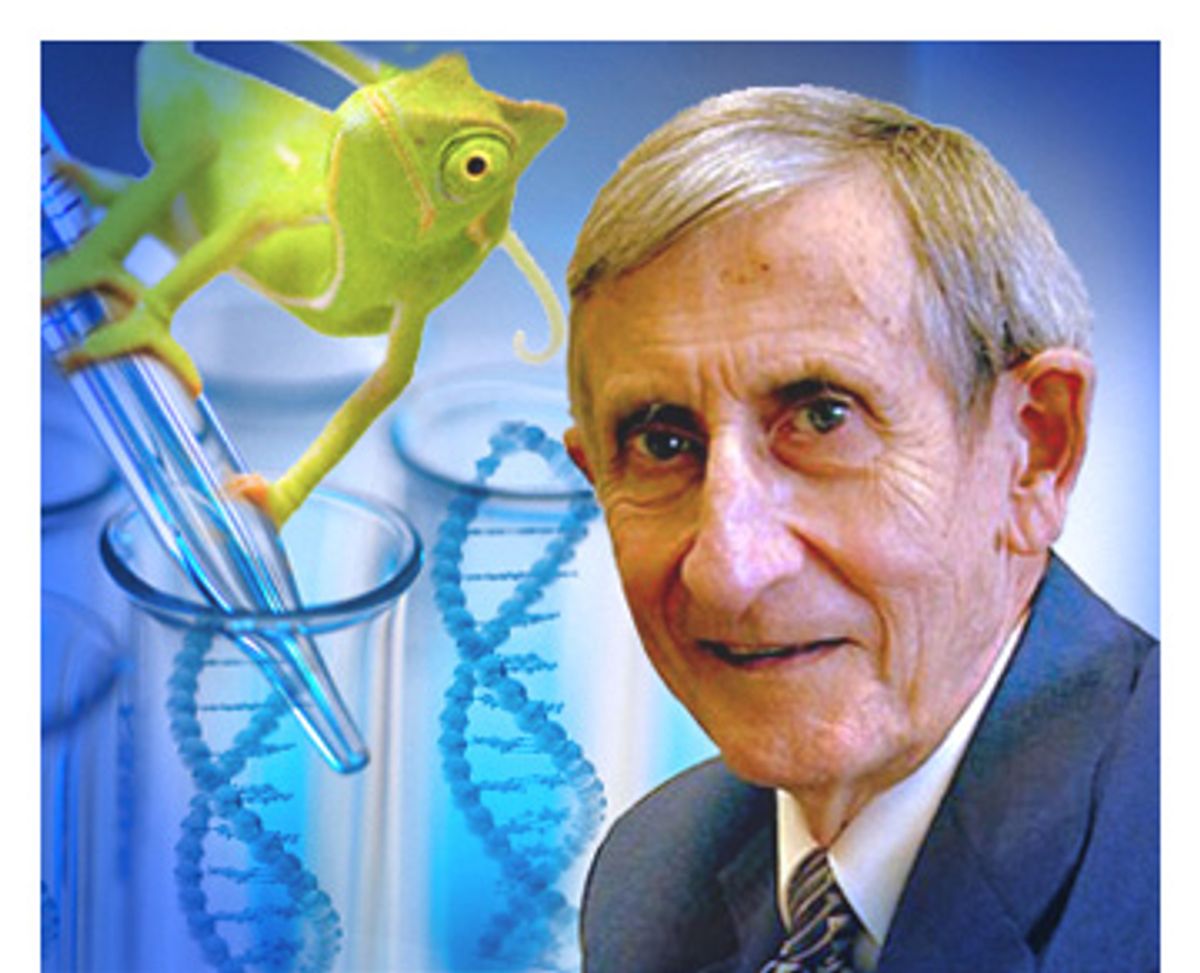
In his new collection of essays, "A Many-Colored Glass," renowned physicist Freeman Dyson turns his thoughts to do-it-yourself biotech and breeding one's own pet lizard, the fallacies of global warming science, science fiction (with a tip of the hat to recently departed Madeleine L'Engle) and the importance of biology to the future of religion. To Dyson, a deeper understanding of the human brain means a better understanding of theology and perhaps more tolerance for those with different beliefs.
Such broad-spectrum thinking, particularly for a scientist, usually puts you in one of two camps: quack or genius. Dyson has been called both. Yet his penchant for challenging conventional wisdom is matched by a sense of humor, a necessary attribute for any scientist who has seen seven decades' worth of scientific hits and flops -- some of them his own.
In the science world, Dyson is best known for unifying the three versions of quantum electrodynamics invented by Julian Schwinger, Shinichiro Tomonaga and his friend and colleague Richard Feynman. But it's his broader writings on nuclear weapons, the science of immortality and the expectation of extraterrestrial intelligence that have captured the public.
Dyson is quick to remind readers that he's a scientist, not a soothsayer. He has said that "it is better to be wrong than to be vague" and has certainly suffered the former rather than the latter. Recalling his advice to a young Francis Crick to stick with physics rather than waste his time in biology, Dyson quips, "When I was a young and arrogant physicist, I tried to predict the future of physics and biology. Even a smart 22-year-old is not a reliable guide to the future of science. And the 22-year-old has become even less reliable now that he's 82."
Dyson never earned a Ph.D., but in addition to his 18 honorary degrees he has received numerous awards, ranging from the National Book Critics Circle Award for his 1984 book, "Weapons and Hope," about the nuclear threat, to the 2000 Templeton Prize for Progress in Religion. Among his six children are digital age guru Esther Dyson and science historian George Dyson.
To read "A Many-Colored Glass" is to get a sense of the wonder and awe that continue to drive our successes and failures at understanding the world around us. While Dyson continues to write prolifically, if you ask him what he's up to, he's apt to refer to his work as "scribbling equations on paper." In conversation, Dyson is studied and frank, unafraid of one-word responses -- all the better, it seems, to spirit him along to a question he might like better.
You write that it's impossible to observe both the scientific and the religious aspects of human nature at the same time. What do you mean?
For me, science is just a box of tricks, and I enjoy playing with them. It's a form of exercise. It has nothing to do with philosophy, certainly even less to do with religion. It's essentially just a skill that I happen to have learned. Some people think about science much more solemnly. For me, science has nothing much to do with deep thoughts.
Do you think science and religion are at odds?
No. I think it's only a small fraction of people who think that. Perhaps they have louder voices than the others.
What do you think of what Richard Dawkins is doing.
I think Richard Dawkins is doing a lot of damage. I disagree very strongly with the way he's going about it. I don't deny his right to be an atheist, but I think he does a great deal of harm when he publicly says that in order to be a scientist, you have to be an atheist. That simply turns young people away from science. He's convinced a lot of young people not to be scientists because they don't want to be atheists. I'm strongly against him on that question. It's simply not true what he's saying, and it's not only not true but also harmful. The fact is that many of my friends are much more religious than I am and are first-rate scientists. There's absolutely nothing that stops you from being both.
Dawkins calls religion as a virus.
I disagree totally. He has the arrogance to say that anyone who does not share his views is infected with a virus. No wonder he cannot coexist peacefully with them.
You've mentioned that you believe in God. How would you characterize your religion?
For me, religion is much more about a community of people than about belief. It's fine literature and music. As far as I can tell, people who belong to my church don't necessarily believe anything. Certainly we don't talk about that much. I suppose I'm a better Jew than I am a Christian. Jewish religion is much more a matter of community than it is of belief, and I think that's true of us Christians to a great extent, too.
Were your parents Christians?
Yes. Nominally. I would say they're practicing Christians, but not believing Christians.
What's the difference?
Oh, it's totally different. A practicing Christian is somebody who lives a Christian life and likes to worship in common with a lot of other people and considers the church as a community to which to belong, but you don't inquire closely as to what the others believe. Of course, some people take belief very seriously, and others don't.
You've said, "My conception of God is not weakened by my not knowing whether the physical universe is open or closed, finite or infinite, simple or multiple. God for me is a mystery, and will remain a mystery after we know the answers to these questions ... I cannot imagine that he is greatly impressed by our juvenile efforts to read his mind."
I don't remember the context out of which this remark arose. Maybe I was thinking of the fight between Galileo and the Aristotelian philosophers of his day. The Aristotelians wanted to keep the heavens separate from the earth so there would be room for God in the sky. Galileo said the moon was a world like the earth with mountains and seas. Translated into modern language, Galileo was saying that the size and shape of the universe are not telling us anything about God.
Physicist Richard Feynman has said that nobody understands quantum mechanics. Has the interpretation of quantum mechanics become a religion among scientists?
I wouldn't say that. For me, the important thing about quantum mechanics is the equations, the mathematics. If you want to understand quantum mechanics, just do the math. All the words that are spun around it don't mean very much. It's like playing the violin. If violinists were judged on how they spoke, it wouldn't make much sense.
You write that as our understanding of biology advances, so too will our understanding of religion.
It impacts upon our understanding of theology. What I was pointing out is that human theology is based on our own value system -- above all our knowledge of good and evil as we experience it. Take an autistic child. I took the case of Jessica Park, who is a friend of mine who happens to be autistic. If she had a theology, it would be quite different because she cannot understand other people suffering. She has no conception of other people's existence in the way we have. It's a radically different world that she lives in. You can tell by the fact that she can't understand the difference between "I" and "you." She uses the words indiscriminately.
So the idea of a suffering savior would have no meaning for her at all. If she had a theology, it wouldn't involve sin. One thing that is characteristic of autistic people is that they cannot tell a lie. Jessica never tells a lie because to tell a deliberate lie, you have to have the idea of deceiving somebody. That's something she couldn't imagine. Since there is no sin, there can be no fall from grace and no redemption.
The example of Jessica shows us how our own view of the world might be equally skewed. There may be many essential features of the world to which we are blind, just as she is blind to other people's thoughts and feelings. So our theology also reflects our possibly skewed view of the world.
You write about the importance of "heretical thoughts" in the scientific community. What do you mean?
This is mostly about politics. In "A Many-Colored Glass" I came out of the closet as far as global warming is concerned. I believe global warming is grossly exaggerated as a problem. It's a real problem, but it's nothing like as serious as people are led to believe. The idea that global warming is the most important problem facing the world is total nonsense and is doing a lot of harm. It distracts people's attention from much more serious problems. That's an example. It's not so much to do about science. It's really a political question.
Why did you choose to be heretical about climate change?
I'm heretical because I was in the business of studying climate change at least 30 years ago before it became fashionable. I used to go to Oak Ridge National Laboratory [in Tennessee], which was then the leading place for studying it, and they had a very good group of people there. I went there regularly and wrote a paper, which was published, essentially about the connection between climate and vegetation. It was amazing how little we knew, and that's still true. It's just very interesting that, scientifically, almost all the statements that are made publicly are wrong.
We have no reason to think that climate change is harmful if you look at the world as a whole. Most places, in fact, are better off being warmer than being colder. And historically, the really bad times for the environment and for people have been the cold periods rather than the warm periods. The fact that the climate is getting warmer doesn't scare me at all. There's no reason why one should be scared. The economic conditions in the world and the technology change much more rapidly than the climate, so I don't see any reason for being in a hurry.
There's a huge movement among scientists and policymakers making the case that global warming is urgent. Have you publicly debated any of them?
It's not very helpful. True believers are not going to change their minds just because of me.
Why do you believe they feel so strong about the issue? Do you think they misconstrue the science?
I think it's a combination of things. Take Al Gore, who is sort of the chief propagandist. I think for him it really is a religion. He has this unshakable belief that it's his mission to spread the gospel of global warming according to Al. So there's nothing I can do about that. His film is a brilliant piece of work. It looks wonderful when you see it. The fact is of course that the pictures don't actually prove what he's saying is true.
Can you give an example?
A polar bear sitting on a melting piece of ice. The poor bear is going to drown, and it's a tear-jerker. But in fact, the bears are doing very well. The numbers of bears in the Arctic are increasing rather than decreasing. On the whole, they like it to be warm.
Just because you see pictures of glaciers falling into the ocean doesn't mean anything bad is happening. This is something that happens all the time. It's part of the natural cycle of things. We know from measurements that glaciers have been melting for 200 years at least. So it's certainly long before human activities could have caused it.
What we also know, going back 4,000 years, is that the glaciers were actually a lot smaller. They actually grew in the meantime. So it seems to be some sort of cyclical process. They grow and shrink and there's no particular reason for being worried just because they're shrinking at the moment. I'm not saying there's no climate change. Of course there's climate change. Climate change is part of the normal order of things, and we know it was happening before humans came. There is also human-induced climate change. That's certainly happening too. But I don't think there's reason for worrying about it.
So climate change has been politicized?
There is this very strong organization, the IPCC, the Intergovernmental Panel on Climate Change. It's a group of officially anointed experts who produce statements every five years. This community of people is regarded as sacrosanct. And they're very intolerant. They always regard any criticism as a hostile act that has to be fought. I think they have behaved pretty badly. But that's rather an unusual case in the world of science -- that's where the politics has corrupted the science. But in general, scientists are not largely against heretics. This is something rather peculiar to climate studies. It also has to do with the way [the studies are] funded. The whole community of climate experts is funded on the basis that it's an urgent problem. So [they] can't possibly say it's not urgent or else they'll lose their thumbs.
Let's talk about your largely positive perspective on biotechnology. Bill McKibben, Bill Joy and other scientists have argued that our ethical maturity is lagging behind our technological capabilities.
That's completely obvious, but that doesn't mean that we couldn't do well with the technology. Technology gives you power that you can use both for evil and good. I'm looking forward to the good uses of biotech. You can't get rid of the dark side, but one shouldn't overestimate the dark side. It's a question of balance. People have been talking so much about the dark side, so I talk about bright side just for a change.
Do we have historical evidence that scientists can handle the dark side -- apart from the simple fact that we're still here?
Take the case of recombinant DNA. It was 30 years ago when they discovered recombinant DNA, which is a gene splicing. Biologists then drew up a set of guidelines to avoid dangerous experiments. These guidelines have actually worked for about 30 years, and we have had no bad accidents in consequence. The problem, of course, is you may have deliberate evildoing. It remains to be seen whether we can handle that. But the guidelines certainly have been helpful.
How do you see the domestication of biotechnology in the near future?
I saw it happen in the case of computers 50 years ago. Here in Princeton we were building the first programmable computer. John von Neumann, the boss in charge of the project, never imagined that computers could become small and cheap and user-friendly. He thought of computers as big, expensive things that would always need experts to handle them. He thought they would belong to big organizations and that they would get bigger and more expensive as time went on. And of course, he just failed entirely to see what really would happen. They got smaller and cheaper and more powerful and ended up in the hands of schoolchildren and even preschool children.
The biggest part of the computer industry is computer games. I see the same thing happening with biotech. It's now regarded with great suspicion because it's in the hands of big corporations and they do things that people disapprove of, like putting poisonous genes into crop plants. It's become politically unpopular. But I think that it's going to become domesticated so that do-it-yourself kits will become more available to everyone. You will be able to read and write your own genomes and produce roses and orchids and lizards and snakes or any kinds of creatures, according to your own design.
You view this as a creative enterprise?
Yes. Film technology became one of the major art forms of the 20th century. I would say that writing genomes will probably be an art form for the 21st century in the same kind of way. We will have all these creative people designing creatures and trying out beautiful arrangements. It's a new form of landscape design where you can design the plants as well as the landscape. With that will probably go biotech games for children, where you give the child some eggs and seeds and a kit for writing the genomes and seeing what comes out. That will certainly be a very messy and sometimes dangerous business, but I think it's on the whole likely to be very good for education. People get a better understanding of the natural world when they can manipulate it themselves. For them it will seem natural, which of course is the way it is with computers. My grandchildren are much more at home with computers than I am. So I think it'll be the same with biotech.
What about the notion of genetically engineering ourselves or designing people? Does that concern you?
The genetic engineering of humans concerns me greatly. I did not talk about it in my latest book because I have talked about it before. It raises many fundamental problems of ethics and equity that do not arise when you are engineering wheat and soybeans. I am not advocating a take-home, do-it-yourself tool kit for designing human babies.
You write that cultural evolution has replaced biological evolution as the main driving force of change. What do you mean?
This is an idea that I borrowed from Carl Woese, who is a very famous biologist. The idea is that you can divide the history of life into three periods. First, the early period where all genes were freely exchanged between different cells, so that the living world consisted of primitive cells and genes, which are really the same thing as viruses, traveling around exchanged from cell to cell. That's what we call horizontal gene transfer. Evolution was then collective. Anything useful that was invented by one cell could be shared with all the others, so evolution went very fast.
Sometime about half a billion years later, things changed because the creatures started to become selfish and refused to share their genes with their neighbors. They kept the genes for themselves, and that's what we call the invention of species. A species is a collection of creatures that does not breed outside the species. As soon as life became divided up into species, evolution became Darwinian. It was then competition between species. Each invention only benefited the species that invented it. Everybody else had to compete separately. Evolution then went much slower for a couple of billion years. That's what I call the Darwinian interlude.
Now, since humans came along, that has changed again. Now we're back in an epoch when genes can be horizontally transferred. We learned how to move genes around from one creature to another. That's what we call gene splicing. So humans can easily take genes from one animal, put them into a virus or a bacterium and multiply them into a large population, and then put them back into another creature. You can very easily spread desirable qualities from one species to another. That's now the new era of what I call open-source genetics, an analogy to open-source software in the computer business. It means that genes are shared between species. Species in the end will fade out. They will become merged. I think that's a hopeful future, but it's also going to be dangerous, of course. And all sorts of unintended consequences will no doubt come to plague us. But it seems to be happening anyway.
Do scientists have a sense of what caused the initial shift from the more open-source evolution to Darwinian evolution?
No. That's something that we don't know about at all in detail. But I like to use the analogy of Bill Gates. Some bacterium got slightly ahead of the others and decided to establish a monopoly. They were just anticipating Bill Gates by a couple of billion years.
Part of your vision of biotech for the future is what you call "green technology." And your green technology is quite different from the conventional sense of "green." Can you explain?
I simply mean technology based on biology rather than on physics. So green technology is milking cows, or growing grapes and making wine. It also means moving genes around from one plant to another. Green technology, among other things, is growing soybeans that are pesticide resistant and then using pesticides to kill the weeds. That is something that is now taken for granted. It works quite effectively. I'm just extending that to using that kind of technology to produce new chemicals -- in particular, to produce liquid fuels.
My idea is that in 50 years, this whole problem of fossil fuels will evaporate because we'll learn how to grow trees that produce liquid fuels much more efficiently than existing trees. So we'll have an ample supply of fuel without having to dig it out of the ground. I think that's very likely to happen. Fifty years is long enough for that kind of technology to take over the world, and 50 years is short enough so that the climate won't have changed very much in the meantime.
Explain how you envision this happening through trees.
At the moment, trees are less than 1 percent efficient in turning carbon dioxide and sunlight into wood. And wood is also not a convenient fuel. It has to be harvested. You have to chop down the tree to get the wood. That's destructive and ugly. So, first, you could program a tree to be 10 times as efficient, and so you'd need 10 times less land to produce the fuel. Secondly, you could produce the fuel in the form of a liquid that would go into an underground pipeline, so that you wouldn't need to chop down the trees to get the fuel. It seems to me a very practical solution. It's just a question of learning how to do it.
What about genetically modified foods? Are you concerned with the potentially destructive ecological effects of gene splicing?
The ecological effects of G.M. food crops may be bad, just as the ecological effects of old-fashioned farming may be bad. But the opponents of G.M. food crops have grossly exaggerated the harm that they could do. In most situations, the advantages of G.M. food crops greatly outweigh the disadvantages.
Why do you believe green technology can empower those in poor, rural areas?
It has the great advantage that it uses sunlight as the source of energy, and sunlight is distributed very evenly over the globe. It's especially abundant in the tropics, where most people live. The fuel will be produced much more evenly over the globe than fossil fuels.
There are plenty of resource-rich areas that are poor. Historically, richer countries control the resources. So how could this empower rural communities more than in the past?
Well, it's up to them. You've got to educate your population to handle the technology. Some countries have done it very well. Asian countries have been remarkably good at it. Countries like Japan, Taiwan and Korea are the examples everybody looks at. In one generation, they changed from being poor to being rich, essentially by spending lots of money educating people. One thing the Japanese did that was very wise was to translate all the scientific books of the world into Japanese, so that children learned science in their own language from the beginning. That's the main reason why Japan jumped ahead compared with other Asian countries.
So the corollary to the advance of green technology will be education, likely through the Internet?
Oh yes. The Internet is a wonderful development. It means that people all over the world can learn quickly, and it's been enormously helpful. It will be even more so in the future. We want to see everybody in Africa hooked up to the Internet. It's not so far away. I think it's getting cheaper all the time. Now they talk about $100 personal computers, not to mention cellphones. These are spreading very fast in places like Africa. Chances are that a lot of these countries will manage quite well.
Shares