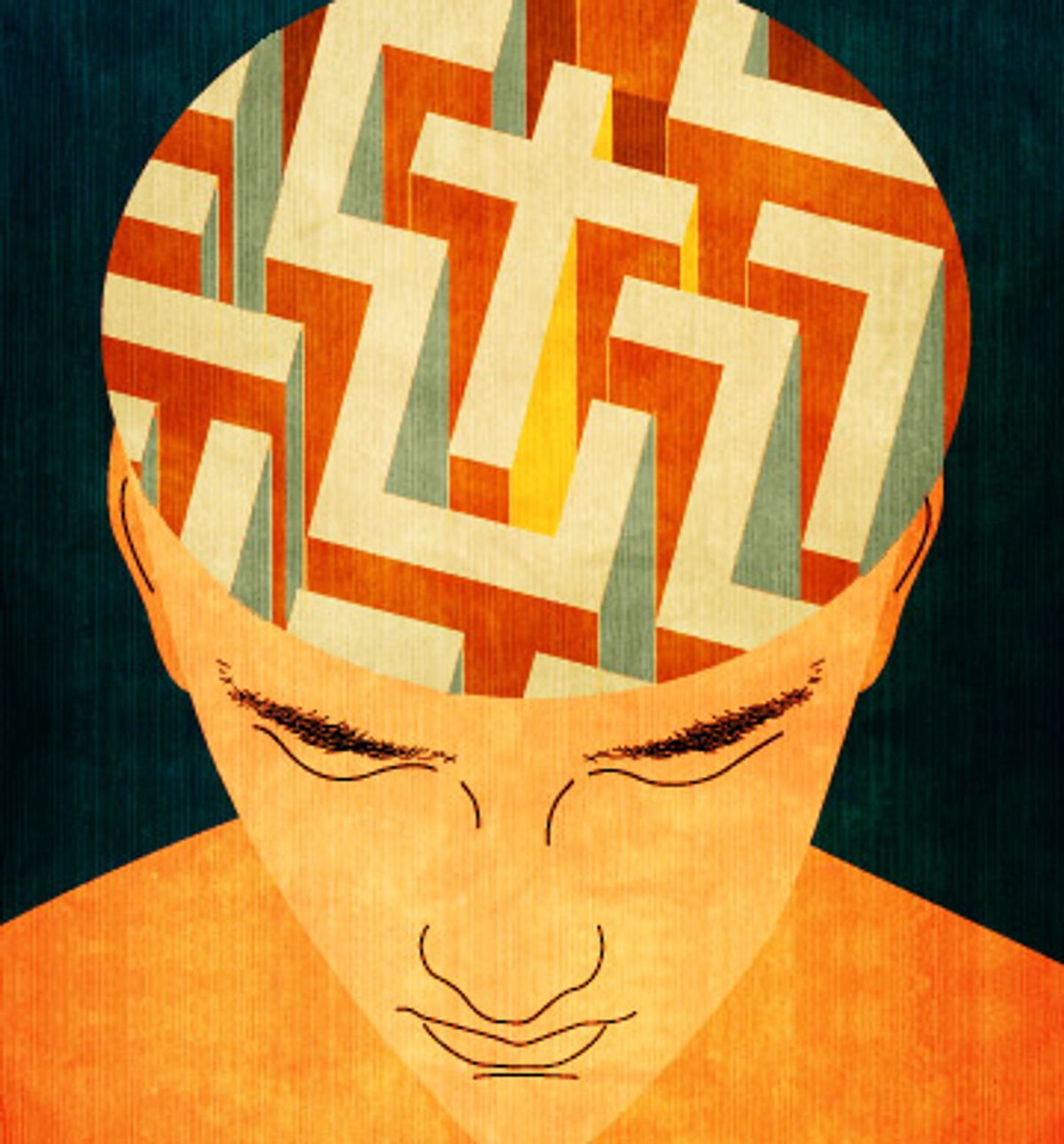
"I've always been obsessed with the mind-body problem," says philosopher Renee Feuer Himmel. "It's the essential problem of metaphysics, about both the world out there and the world in here."
Renee is the fictional alter ego of novelist and philosopher Rebecca Goldstein. In her 1983 novel, "The Mind-Body Problem," Goldstein laid out her own metaphysical concerns, which include the mystery of consciousness and the struggle between reason and emotion. As a novelist, she's drawn to the quirky lives of scientists and philosophers. She's also fascinated by history's great rationalist thinkers. She's written nonfiction accounts of the 17th-century Jewish philosopher Baruch Spinoza and the 20th-century mathematician-philosopher Kurt Gödel.
Perhaps it's not surprising that Goldstein would end up living with Steven Pinker, a leading theorist of the mind. He's a cognitive psychologist at Harvard; she's a philosopher who's taught at several colleges. Although they come out of different disciplines, they mine much of the same territory: language, consciousness, and the tension between science and religion. If Boston is ground zero for intellectuals, then Pinker and Goldstein must rank as one of America's brainiest power couples.
With a series of bestselling books on language and human nature, including "How the Mind Works," Pinker has emerged as his generation's most influential cognitive theorist. His work on the evolution of language, and how humans possess an innate capacity for language, revolutionized linguistics. His writing about the nature/nurture debate helped shift prevailing thinking away from seeing human nature as a blank slate.
Pinker and Goldstein share a basic philosophical outlook, but I discovered that their views diverge somewhat when it comes to the "science and religion" debate. In a wide-ranging joint interview, we talked about animals and language, atheism and astrology, Iraq and faith, and their most recent books, Goldstein's "Betraying Spinoza" and Pinker's "The Stuff of Thought: Language as a Window Into Human Nature."
Steve, do you think language is what makes our species unique? Is this the defining trait of human beings?
PINKER: It's certainly one of the distinctive traits of Homo sapiens. But I don't think language could have evolved if it was the only distinctive trait. It goes hand in hand with our ability to develop tools and technologies, and also with the fact that we cooperate with nonrelatives. I think this triad -- language, social cooperation and technological know-how -- is what makes humans unusual. And they probably evolved in tandem, each of them multiplying the value of the other two.
You have a fascinating observation in your new book about causation. You say the way we construct sentences, particularly verbs, has a lot to do with how we understand cause and effect.
PINKER: That's right. For example, if John grabs the doorknob and pulls the door open, we say, "John opened the door." If John opens the window and a breeze pushes the door open, we don't say, "John opened the door." We say something like, "What John did caused the door to open." We use that notion of causation in assigning responsibility. So all of those crazy court cases that happen in real life and are depicted on "Law and Order," where you have to figure out if the person who pulled the trigger was really responsible for the death of the victim, tap into the same model of causation.
I talk about the case of James Garfield, who was felled by an assassin's bullet, but lingered on his deathbed for three months and eventually succumbed to an infection because of the hare-brained practices of his inept doctors. At the trial of the murderer, the accused assassin said, "I just shot him. The doctors killed him." The jury disagreed and he went to the gallows. It's an excellent case of how the notion of direct causation is very much on our minds as we assign moral and legal responsibility.
Rebecca, you've written a great deal about competing philosophical theories of language. Do you think our mind can function apart from language? Or does language define our reality?
GOLDSTEIN: Obviously, much of our thinking is being filtered through language. But it's always seemed to me that there has to be an awful lot of thinking that's done prior to the acquisition of language. And I often have trouble translating my thoughts into language. I think about that a lot. It often seems to me that the thoughts are there and some words are flitting through my mind when I'm thinking. So there's something very separate between thinking and language. But that might vary from mind to mind.
As a novelist, this must be something you think about.
GOLDSTEIN: Very much so. My novels begin with a sense of the book, a sense of the place, and then I have to find the language that does justice to it. Strangely, I find that in my philosophical work as well. And in math; I've done a lot of math. I have the intuition, I'll see it, and then I have to translate it into language. So I've always had a keen sense that thought does not require language.
What do you make of the language studies of various animals -- for instance, the bonobo Kanzi, who's learned to piece together simple sentences by pressing lexigrams. Is that real language?
PINKER: It isn't a scientific question whether something is real language. That's really a question of how far you want to extend the word "language." I think the scientific question is: Are the chimpanzees, bonobos and gorillas who are trained by humans doing something that's fundamentally the same as what children are doing when they first acquire language? I suspect they are quite different. You need experimenters hell-bent on training chimpanzees, whereas with children, you can't help but acquire a language if you're a child in a human community. Indeed, children thrown together in a community that doesn't have a language of its own will invent one in order to communicate with each other. And while it's impressive that chimps have been trained to learn a few dozen or even a couple hundred symbols or signs, the ability to combine them is quite rudimentary and forced.
You each dedicated your most recent books to each other, and I'm curious about how your relationship has influenced your work. You've both written about language and human nature, about religion and the power of reason. Do you talk about these things around the dinner table?
GOLDSTEIN: [Laughs.] Yes, there's no way around it. Our work spills over into our lives, and our lives spill over into our work.
PINKER: But that's not the only thing we talk about.
Would you say your common interests are partly what brought you together?
GOLDSTEIN: Oh yes, completely. Actually, we met through each other's work. I was a great fan of Steve's work. And then I discovered that he had cited me in one of his books. It was my unusual use of an irregular verb. So it was completely through our work and my tremendous interest in Steve's work that we first came to know each other. I don't know if I should say this, but when I first met Steve in the flesh, I said that the way he thinks had so completely changed the way I think -- particularly what I had learned from him about cognitive psychology and evolutionary psychology -- that I said, "I don't think I've had my mind so shaken up by any thinker since [18th-century philosopher] David Hume." And he very modestly said, "That can't be the case." But it was the case. So I can certainly say that Steve has profoundly influenced the way I think.
PINKER: I've certainly been influenced by Rebecca as well. Our connection isn't just that we met through an irregular verb, which sounds like the ultimate literary romance of two nerds finding each other. [Goldstein laughs.] Rebecca as a philosopher is a strong defender of realism -- the idea that there is a real world that we can come to know --which emboldened me to press that theme in my own writings, even though people often say that we just construct reality through language. And the topic of consciousness -- how the mind emerges from the body, and what makes the three-pound organ that we call the brain actually experience things subjectively -- is a theme that runs through both my nonfiction and Rebecca's fiction and her philosophical writings.
Do you show each other your articles and books as you're writing them?
GOLDSTEIN: Yes, we've each seen each other's work in early drafts and in the final work. But this is the first time I've ever shared my work with anybody while it's happening. I'm very private about my work. So this has been a very new experience for me. Now I'm wondering how I ever wrote any books without having Steve read them.
Are you very open in your criticisms and suggestions about each other's work?
PINKER: Very much. But we're not brutal.
GOLDSTEIN: We can be brutal. [Laughs.] Sweetly brutal.
PINKER: But yes, we each say, "This isn't working. This joke isn't funny. I don't think your readers are going to understand what you're trying to get at here."
Rebecca, the dedication in your Spinoza book reads, "For Steve, despite Spinoza." Can you explain that?
GOLDSTEIN: Spinoza wasn't a great fan of romantic love. He didn't think that the life of reason had any place for romantic love. And Spinoza's methodology is strictly reductive. He tries to prove everything, starting with definitions and axioms. And he has this rigorous proof that romantic love will always end badly.
Does that mean he did not experience romantic love himself?
GOLDSTEIN: He didn't, as far as we know. There are some rumors about his landlady's daughter, who went to another young man when he gave her a pearl necklace. But no, Spinoza's view about love is all directed toward love of truth and God and nature. It's not directed toward another person. To love another person is to want desperately for them to reciprocate. And that's not something we have complete control over. Therefore, it's irrational. He argues that romantic love just increases your fragility and vulnerability and therefore you ought not to do it.
In your book on Spinoza, you talk about your own religious education in an orthodox Jewish school, and how Spinoza was trotted out by one of your teachers as precisely the kind of heretical thinker that good Jewish girls should avoid. But this seemed to make you especially interested in him. Why do you still like Spinoza so much?
GOLDSTEIN: It's interesting. It's almost like there are two different Spinozas. And I really didn't bring them together until I wrote the book. At my very orthodox all-girls high school, Spinoza was presented to us as a kind of cautionary tale: This is what can go wrong if you ask the wrong questions. I was in a school that discouraged one from even going on to college. And philosophy was absolutely the worst thing you could study because it does ask you to question everything. Then there was the Spinoza I came in contact with when I was a professional philosopher. Spinoza is a metaphysician of a very extravagant sort. He wants to deduce everything through pure reason. And that was a kind of philosopher that I was also taught to dismiss and disdain. So both sides of my training -- the orthodox Jewish training, the analytic philosophy training -- pushed me to dismiss Spinoza.
I also like the grandeur of his ambition. He really does believe that we can save ourselves through being rational. And I believe in that. I believe that if we have any hope at all, it's through trying to be rigorously objective about ourselves and our place in the world. We have to do that. We have to submit ourselves to objectivity, to rationality. I think that's what it is about Spinoza. He's just such a rationalist.
Spinoza certainly dismissed the religion he'd been exposed to. Do both of you consider yourselves atheists?
[pause] GOLDSTEIN: Yes.
PINKER: Yes.
GOLDSTEIN: Proud atheists.
PINKER: There, we said it. [Laughs.]
So you have to hesitate for a moment before you use that dirty word?
PINKER: Atheists are the most reviled minority in the United States, so it's no small matter to come out and say it.
I find it puzzling how the recent atheist manifestos by Richard Dawkins, Sam Harris and Christopher Hitchens have all turned into bestsellers in a country that's overwhelmingly religious. According to various polls, half of all Americans believe the Bible is the literal truth. A recent Newsweek poll found that 91 percent believe in God. How do you explain the enormous popularity of these books?
PINKER: Part of it is that the people who buy books -- at least that kind of highbrow trade book -- are not a random sample of the population. The opinions sampled by these polls are probably soft. When people are asked a question, they don't just turn a flashlight into their data bank of beliefs and read out what they see. When people say, "Yes, I believe in God and the Bible," they're kind of saying, "I'm a moral person. I have solidarity with the community of churchgoers that I was brought up in and that I currently belong to." I think that if you were to probe a lot of people's religious opinions, they would not be as religious as the numbers would suggest.
GOLDSTEIN: It would be fascinating, though, to see a poll of the people who are buying the new atheist books and see how they are answering these questions.
PINKER: Well, the question often arises whether these authors are preaching to the choir. Especially since these books make no concessions toward religious sensibilities. It's a full-throated intellectual assault on the concept of God. My sense is that the books are really not aimed at the 91 percent of the people you cited who believe in God, but rather at some minority of people who are wavering, who've been brought up in a religious way but now have some private doubts. They perhaps think that confessing to being an atheist is like confessing to being a child molester. So they're not willing to even think those thoughts. Then they come across a book that seems to vindicate all of their doubts. And that tortured minority of reflective, analytic people from a religious background -- perhaps like Rebecca from her religious background -- are who the books are aimed at. Julia Sweeney's one-woman show, "Letting Go of God," would be representative of the kind of person whose mind could be changed by a book like that.
Steve, you recently waded into the controversy over Harvard's proposal to require all undergraduates to take a course called "Reason and Faith." The plan was dropped after you and other critics strongly opposed it. But the people who supported it say that every college graduate should have a basic understanding of religion because it's such a powerful cultural and political force around the world. Don't they have a point?
PINKER: I think students should know something about religion as a historical phenomenon, in the same way that they should know something about socialism and humanism and the other great ideas that have shaped political philosophies and therefore the course of human events. I didn't like the idea of privileging religion above other ideologies that were also historically influential, like socialism and capitalism. I also didn't like the euphemism "faith." Nor did I like the juxtaposition of "faith" and "reason," as if they were just two alternative ways of knowing.
One of your critics in this controversy is Stephen Prothero, a religious studies professor at Boston University, who wrote the book "Religious Literacy." He said, "You can be a very smart person and be very dumb when it comes to religion. Professor Pinker just doesn't get it." Prothero says we have to understand religion to come to grips with hot-button issues like abortion, stem cell research and gay rights. And he says Iraq is such a mess right now because our leaders in Washington just didn't understand a basic fact about Islam before they launched the war -- that Sunnis and Shiites hate each other.
PINKER: I think religion is one of the things you have to understand. But the situation in Iraq is not primarily a theological one. There are just as fierce battles among the various tribes and militias, clans and nationalities. So it's not just a Shiite-Sunni dispute. The mistake was not being ignorant of religion. The mistake was being ignorant of all aspects of Iraqi society, including family structure, local history, the evolutionary psychology of kinship and how it reinforces ties of family and clan and kin in Iraq in a way that differs from countries that we're more familiar with. So religion should be part of it. But I don't see why, of all of the forces that go into history -- military, economic, sociological, evolutionary, psychological -- religion itself should be privileged.
GOLDSTEIN: It depends on what you mean by understanding religion. Obviously, religion is a tremendously powerful influence in history. But I have to say -- and I think this is something that Steve and I disagree on -- I do worry whether some of the people who are writing the new atheist books understand what it feels like to be a religious person. Do they get what that feels like? I don't want to say that there's only one kind of religious impulse. There are so many different ways of responding to the world that could be called religious -- some of them very expansive and life-embracing, and some of them not. But I think one of the things that made Steve nervous was to pose these two things -- faith and reason, religion and science -- as alternative ways of pursuing truth. In terms of the pursuit of knowledge, faith is not an alternative mode to science and to reason.
PINKER: Exactly. I would be opposed to a requirement on astrology and astronomy, or alchemy and chemistry. Not because I don't think people should know about astrology. Astrology had an important role in the ancient world. You can't understand many things unless you know something about astrology -- the plays of Shakespeare and so on. What I'm opposed to is equating it with reason or science.
But can you really equate religion with astrology, or religion with alchemy? No serious scholar still takes astrology or alchemy seriously. But there's a lot of serious thinking about religion.
PINKER: I would put faith in that same category because faith is believing something without a good reason to believe it. I would put it in the same category as astrology and alchemy.
Those are fighting words!
GOLDSTEIN: [Laughs.] He said it, not me.
Rebecca, where do you come down on this? Obviously, you've moved away from the religious milieu you grew up in. But do you reject it out of hand, as Steve does?
GOLDSTEIN: I do, intellectually. We get into terrible trouble if we believe sloppily, if we let emotions -- and our own view of the way we want the world to be -- shape the way we think the world is. This accounts for a great deal of the madness in the world. So I am completely committed to trying to justify everything, and in that regard, I have very little use for faith. However, I know what it feels like to believe without justification. And we all do it. I mean, I believe my children are the most wonderful children ever born. Of course, most parents feel that way. It's a useful thing, perhaps. Could I justify it? Should I even go about justifying my love for them? There would be something wrong with that. So I have more sympathy toward an emotional reaction to the world and some of the more religious reactions.
Steve, you've written about the need for scholars to investigate what you call "dangerous ideas." For instance, do women have different abilities and emotions than men? Would society be better off if heroin and cocaine were legalized? Let me suggest a dangerous idea not on your list -- the idea that the mind is more than the physical mechanics of the brain, that there might be some aspect of consciousness that goes beyond an individual's brain. Is this a dangerous idea?
PINKER: No. It's an idea that probably the majority of the population believes. The more dangerous idea is what most biologists believe, which is that the mind is the information-processing ability of the brain. In the 19th century, the idea that there's something to consciousness beyond the functioning of the brain was a serious scientific hypothesis. Scientists as distinguished as Alfred Russel Wallace, the co-discoverer of evolution, and William James, a hero of both Rebecca's and mine, were involved in kitschy, seance-like demonstrations trying to contact the souls of the dead. Those experiments failed. We don't seem to be able to communicate with the great beyond.
But there's some dispute on this history. Deborah Blum just wrote about this in her book "Ghost Hunters." James and other scientists searched for proof of the supernatural, and he discounted the vast majority of these psychics. He dismissed virtually all of them as frauds. But there were a few he couldn't explain away.
GOLDSTEIN: Yeah, his Mrs. Piper. He was very convinced by her. He did want desperately to believe in the afterlife. He had lost a young son, Herman. There's often that tremendous desire. I've lost a sister. I'd love to believe she still exists in the world. I know how powerful that desire is. But that's different from any kind of proof or evidence.
Virtually all religious believers think the mind cannot be reduced to the physical mechanics of the brain. Of course, many believe the mind is what communicates with God. Would you agree that the mind-brain question is one of the key issues in the "science and religion" debate?
PINKER: I think so. It's a very deep intuition that people are more than their bodies and their brains, that when someone dies, their consciousness doesn't go out of existence, that some part of us can be up and about in the world while our body stays in one place, that we can't just be a bunch of molecules in motion. It's one that naturally taps into religious beliefs. And the challenge to that deep-seated belief from neuroscience, evolutionary biology and cognitive science has put religion and science on the public stage. I think it's one of the reasons you have a renewed assault on religious beliefs from people like Dawkins and Daniel Dennett.
The neuroscientific worldview -- the idea that the mind is what the brain does -- has kicked away one of the intuitive supports of religion. So even if you accepted all of the previous scientific challenges to religion -- the earth revolving around the sun, animals evolving and so on -- the immaterial soul was always one last thing that you could keep as being in the province of religion. With the advance of neuroscience, that idea has been challenged.
Some prominent scholars of the mind have not adopted the strict materialist position. The atheist Sam Harris, who's a neuroscientist by training, says he's not at all sure that consciousness can be reduced to brain function. He told me he's had various uncanny -- what some would call telepathic -- experiences. And there's David Chalmers, the philosopher, who's also critical of the materialist view of the mind. He has argued that the physical laws of science will never explain consciousness.
GOLDSTEIN: It's interesting. Actually, my doctoral dissertation was on the irreducibility of the mind to the physical. We have not been able to derive what it's like to be a mind from the physical description of the brain. So if you were to look at my brain right now, I would have to tell you what it is that I'm experiencing. You can't simply get it out of the physical description. So where does that leave us? It might mean that we're not our brain. It might mean that we have an incomplete description of the brain. Our science is not sufficient to explain how this extraordinary thing happens -- that a lump of matter becomes an entire world. But the irreducibility doesn't in itself show immaterialism. And you can turn it around and say, look, all the neurophysiology that we have so far shows there is a correlation between certain physical states and mental states. And even a dualist like Descartes said there's a one-to-one correlation between the physical and the mental. So I'm not sure that we've settled this question once and for all.
PINKER: I'm also sympathetic to Chalmers' view. It might not be the actual stuff of the brain that makes us conscious so much as it is the information processing. I don't think Chalmers' view would give much support to a traditional religious view about the existence of a soul. He says that consciousness resides in information. So a computer could be conscious and a thermostat could have a teensy bit of consciousness as well. Still, the information content requires some kind of physical medium to support the distinctions that make up the information. And the Cartesian idea that there are two kinds of stuff in the universe -- mind and matter -- doesn't find a comfortable home in current views of consciousness, even those of Chalmers.
I know neither of you believes in paranormal experiences like telepathy or clairvoyant dreams or contact with the dead. But hypothetically, suppose even one of these experiences were proven beyond a doubt to be real. Would the materialist position on the mind-brain question collapse in a single stroke?
PINKER: Yeah.
GOLDSTEIN: Yeah, if there was no other explanation. We'd need to have such clear evidence. I have to tell you, I've had some uncanny experiences. Once, in fact, I had a very strange experience where I seemed to be getting information from a dead person. I racked my brain trying to figure out how this could be happening. I did come up with an explanation for how I could reason this away. But it was a very powerful experience. If it could truly be demonstrated that there was more to a human being than the physical body, this would have tremendous implications.
Many stories of the paranormal turn on anecdotal, once-in-a-lifetime experiences. They fall outside the realm of what scientists can study because they are not repeatable. That raises the question, does science have certain limits to its explanatory power? Might there be other parts of reality that are beyond what science can tell us?
PINKER: It's theoretically possible. But if these are once-in-a-lifetime events, one has the simpler explanation that they're coincidences. Or fraud.
GOLDSTEIN: Or wishful thinking.
PINKER: Statisticians tell us that people underestimate the sheer number of coincidences that are bound to happen in a world governed by chance. That's why it would be essential to do the statistician-proof experiment or the Amazing Randi-proof experiment, showing that it isn't just stage magic. If that could be done, if you could show that someone could know something without it having to go through their sense organs -- that you could cut the optic nerve connecting the eyes to the brain and the person could still see. Then, yeah, everything that I've been saying would be refuted. The fact that we don't have reliable paranormal phenomena, the fact that all aspects of our experience do depend on details of the physiology of the brain, make it a persuasive case that our consciousness depends on the brain.
GOLDSTEIN: Yeah, but what you're saying could be very true. It could be in the nature of the phenomena that it's extremely difficult to reproduce it in controlled experiments. In which case, we'll never know. I think it's a kind of arrogance to say that our science is complete. It's an amazing thing that we can know as much about the physical world as we do know. Why assume that we know everything about the world that there is to know? We've developed through all sorts of happenstance a kind of methodology that allows us to know a tremendous amount. It's an extraordinary thing that we can test and probe nature. And it's yielded amazing secrets. But why assume that this methodology that we're just damn lucky to have been able to stumble upon is going to yield all secrets? Of course, there could be things beyond the reach of science. But could we have any good evidence for accepting it? As soon as you have good evidence, it becomes science. So can there be good evidence for non-scientific propositions? No. Because the minute there is good evidence, it becomes science.
I still have to wonder if the study of neurons, synapses and brain chemistry will ever be able to explain things like dreams or the creative process.
PINKER: That's a good example of something that's very difficult to study scientifically because it's rare and unpredictable. But it doesn't involve any kind of magic. When you throw together 100 billion neurons with 100 trillion connections, a lot of things are going to happen that are very hard to track down. And I suspect that creativity -- we don't call it creative unless it's rare -- means that it's going to be hard to study but not impossible. Historians who study creative individuals have uncovered a lot about the preconditions for creativity -- for instance, what goes into a Mozart or an Einstein.
They can understand that. But just by looking at the brain itself, will you ever be able to understand the creative mind?
PINKER: I suspect not. In fact, the reason I'm not a neurobiologist but a cognitive psychologist is that I think looking at brain tissue is often the wrong level of analysis. You have to look at a higher level of organization. For the same reason that a movie critic doesn't focus a magnifying glass on the little microscopic pits in a DVD, even though a movie is nothing but a pattern of pits in a DVD. I think there's a lot of insight that you'll gain about the human mind by looking at the whole human behaving, thinking and reporting on his own consciousness. And that might be true of creativity as well. It may be that the historian, the cognitive psychologist and the biographer working together will give us more insight than someone looking at neurons and brain chemistry.
Shares