

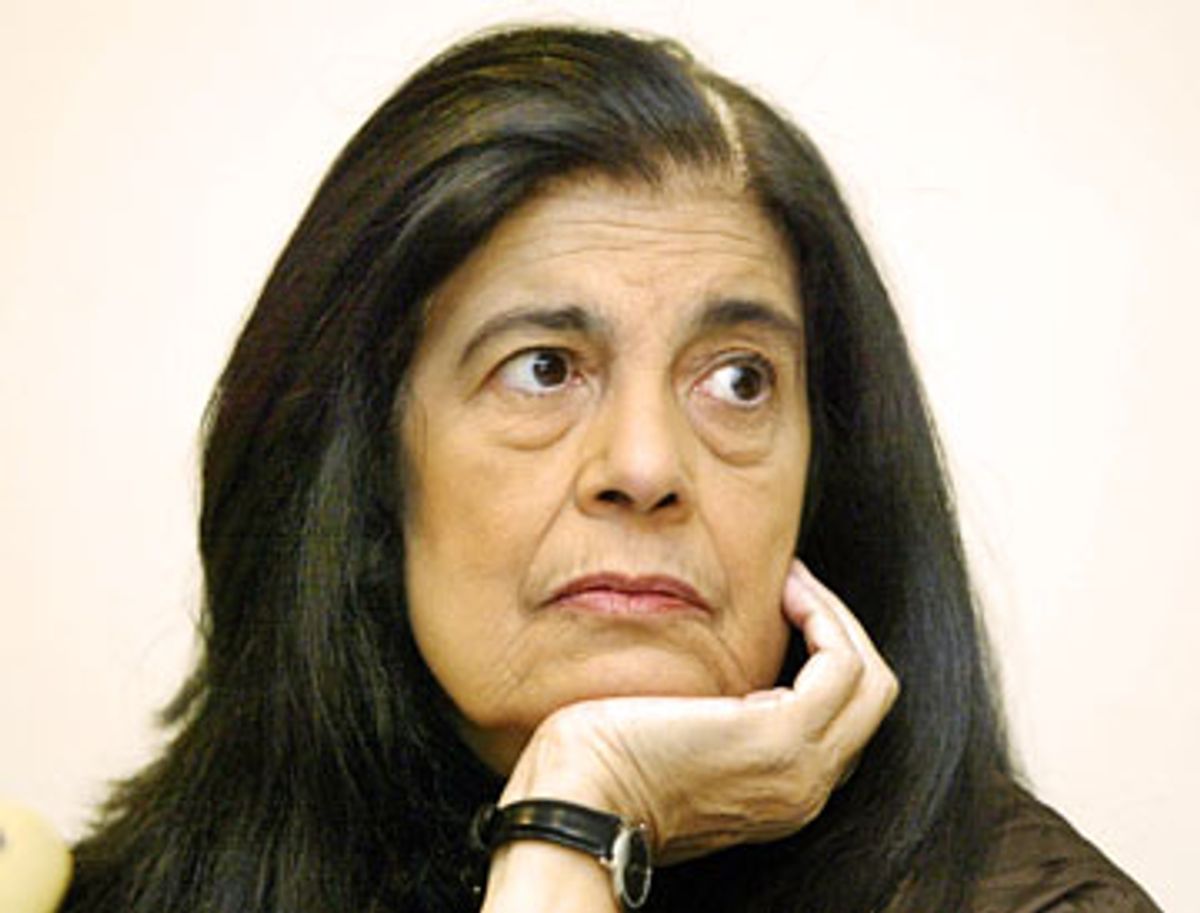
David Rieff has written a sobering and often horrifying account of his mother's final days. In 2004, his mother, Susan Sontag, died from a brutal form of blood cancer, myelodysplastic syndrome. She fought her illness to the end, implicitly asking those closest to her, including her son, to lie: She didn't want anyone to tell her she was dying. It's a striking contrast. The celebrated writer demanded honesty of intellectuals -- Rieff says she loved reason and science "with a fierce, unwavering tenacity bordering on religiosity" -- yet maintained a willful delusion about her death.
In "Swimming in a Sea of Death," Rieff wrestles with how to be a dutiful son to his dying mother while being true to himself. It's a remarkably unsentimental account. There's no gushing between mother and son or deathbed reconciliations. This is not a portrait of Rieff's relationship with Sontag, though at one point he refers to their "strained and at times very difficult" relations. It is a book about dying, grieving and what it means to survive the death of a loved one.
Beginning in the 1960s, Sontag became a cultural critic with enormous range, dissecting everything from camp to Marxist critic Walter Benjamin, from photography to how illness is misread as a metaphor for patients' psychology. She was a best-selling novelist and a singular presence -- the brainy, glamorous woman who held her own among the testosterone-filled intellectuals of the period.
Rieff is a distinguished author in his own right. A contributing writer to the New York Times Magazine, and a past contributor to Salon, he's reported on war-ravaged countries and carved out his own reputation as an acute analyst of foreign policy. Rieff refers to writing as "the family olive oil business." His father, the sociologist Philip Rieff, wrote his own masterpiece, "The Triumph of the Therapeutic: Uses of Faith After Freud." Sontag married Rieff when she was 17 and left him seven years later. In her later years, she had a relationship with Annie Leibovitz, whom Rieff avoids discussing in his memoir, except for one loaded comment about the photographer's "carnival images of celebrity death."
"I am not a confessional person," Rieff insisted. He could be terse when fielding questions about his relationship with his mother, and he became angry at the notion she suffered a "bad death." Still, throughout our interview, he displayed his own brand of remarkable candor.
When did you first hear your mother had this form of blood cancer?
It was in the spring of 2004. I was coming back from about a month in Israel/Palestine, where I was trying to do a story on Yasser Arafat. I have a habit -- a superstition, really -- of not calling people I'm close to while I'm on an assignment that could be dangerous. But I usually check in once I get out. I had to change planes at Heathrow Airport in London, so I called my mother. She said she might be ill again, might have some kind of blood cancer. She was trying to be cheerful. I was trying to be cheerful. Then I flew back. The next morning, I picked her up and accompanied her to the doctor who gave her the test results. The physician was not a very empathetic guy. I'm sure he's a good doctor, but his human skills were not exactly brilliant. And he told her the bad news. She had this lethal blood cancer and, basically, there was no treatment.
It was a death sentence.
It was. The standard time between diagnosis and death is nine months, and there are no drugs that work more than a few months to keep your blood counts where they're supposed to be. It turned out that if she wanted to try something rather than palliative care during the last months of her life, there was one possibility. It's a long shot: an adult stem-cell transplant, a bone-marrow transplant. She found a physician at the great cancer center in New York, Memorial Sloan-Kettering, a brilliant man who had all the human skills the first doctor did not. He said, "If you want to fight, if what matters to you is not quality of life…" And my mother said, "I'm not interested in quality of life." He said, "Well, the best place to have this transplant would be at the Fred Hutchinson Center at the University of Washington Hospital in Seattle."
So she was going to do everything she could to survive.
She wanted to live at any price. When she said, "I'm not interested in quality of life," she meant it. She was somebody for whom extinction -- death -- was unbearable. So she was going to fight for every breath, no matter how much suffering that entailed.
Twice before, your mother had cancer and survived. One time, weren't the odds incredibly stacked against her?
They were. This was in the mid-'70s, a time when American physicians tended to lie to their patients and tell family members something closer to the truth. I was told by her doctors that she would die quite soon. She had Stage 4 breast cancer that had spread into her lymph system. She had a basis for thinking it wasn't hopeless when a doctor said it was.
Yet this time it did seem hopeless.
The chances were indeed stacked against her. But she didn't want to hear it. So what do you do, as the person who's close to someone who wants to live at any price, when you think this fight isn't worth it? Do you lie? Do you insist on telling the truth when it's perfectly clear the person doesn't want to know the truth? Which was certainly true of my mother.
Even though she did say, "Don't lie to me."
She wanted to be lied to. I mean, she didn't want to be lied to, but she wanted to live. She hoped that I and other people in her life would give her reason to hope. I felt that I had to do that, whatever my own opinion was. Before the transplant, I thought the odds were bad. Coming back to my mother's previous experience with breast cancer, I thought, "Well, don't leap to conclusions here. They wrote her off in the '70s. Yeah, it's an even more lethal cancer, and yeah, she's even 30 years older, but maybe she'll beat the odds." But when the bone marrow transplant started to go wrong soon after it took place, I didn't think she would make it. Yet every signal she was giving me was, "Give me hope. Help me believe I might make it." In the end, I chose to do that. The most important thing I thought was: It's her death, not mine.
Can you tell me about your mother's last days?
Everything that could go wrong did go wrong after the transplant. She suffered like someone being tortured. I found a way to be present but not look at the way she had become physically. She flew back to New York when it was clear the leukemia had become full-blown and the transplant had failed, and spent the last six or seven weeks of her life in Memorial Sloan-Kettering. In the end she couldn't even roll over unassisted.
Once she died, I asked the other people in the room to leave. And I really looked. To be blunt, I took off her shirt. And she was just a sore. Her body was just a sore from the inside of her mouth to her toes. So the suffering was extraordinary. But the actual death was comparatively easy in the sense that she didn't seem to be in pain. In the last days, she kind of withdrew. And when she spoke, she spoke about the distant past -- about her parents, about people she was involved with 30 years before. She wasn't focused on the present or any of us. Then she lapsed into a kind of somnolence. And then she died. It wasn't terrible.
Did not telling her the truth about her condition take a toll on you?
It exacted a tremendous price. I never got to say goodbye. I don't want to romanticize the end of life, but we never had the kinds of conversations I would've liked to have had with her. Conversations about the past. I would've liked to have said certain things to her. We had a complicated relationship. There were very good times and very bad times between us. I would have liked to have gone beyond those before she left us. But that's impossible if you decide not to acknowledge the fact of dying. So that's the price I paid. But she made it very clear what she wanted. I didn't feel that my interests could be put ahead of that.
You write that it wasn't just that she desperately wanted to live, she was also terrified of dying. Wasn't there a kind of existential dread?
There was. In my experience, lots of people are terrified of dying. I've also met lots of people who aren't. But she was one to whom it was just terrible news. So I don't think she was at all unique. Of course, some people of faith find it easier. But my mother wasn't a person of faith.
Your mother was an atheist. She refused to accept any consolation from the hope of an afterlife. How much did that contribute to her dread?
Well, I'm an atheist too; if anything, more militant than my mother. I think it would have been grotesque of my mother to have become a person of faith purely in the interest of consoling herself. Surely, that would have been the most terrible therapeutic use of faith, and a disgrace in terms of faith. You shouldn't start to believe because it suits you.
But it does raise the question: Without the consolation of religion, does the prospect of dying lead to dread?
Well, it sure doesn't help. I don't know. There are certainly religious traditions that don't believe in an afterlife. So I don't think we can just take the Christian or the Islamic model and say those visions of a personal afterlife are what religious faith is. If you look at Buddhism, if you look at Judaism, neither has an afterlife in that sense. So I'm not sure it's faith vs. atheism.
These days, there's a lot of talk about what's called "a good death." Usually this means someone who accepts dying and stops fighting it. There's a certain grace that can follow. Not only is there a sense of inner peace, but the dying person often has meaningful and profound conversations with friends and family. To use a word you scorn in your book, there is some "closure." By contrast, it would seem that your mother had anything but a good death. Do you see it that way?
No, I think that's something people say to console themselves. I don't believe a word of what you just said. I don't know whether you believe it or not. But I know this argument very well. First of all, I think that argument does a real disservice to human variety. People are very different in their lives and very different in their deaths. The idea that one good death fits all seems incredibly reductive to what human beings are all about. It's like saying all human beings should be cheerful. I don't know that being cheerful is better than being a melancholy person. People have different temperaments. When you say "grace," it lets family members off the hook. They don't have to feel so bad that the person is going. So I don't buy it.
I have the impression that this is the way your mother had to die. Given who she was, there was no other way.
What I'm saying is that the right way for one person to die may not be the right way for another person to die. And she was somebody who desperately didn't want to die. So why should she have made our lives easier by going gracefully? That doesn't seem right to me.
She was buried in Montparnasse Cemetery in Paris, where many famous writers are buried. You say your mother had a horror of cremation. Do you know why that was?
Sure. Cremation seemed to confirm extinction. If you have a grave and your bones are there, it's somehow less confirming of extinction. I understand that viscerally. She spoke a lot during her life about how horrified of cremation she was. But all the decisions about her burial are decisions that I made, trying to think through what I thought she wanted. She gave me no instructions of any kind.
You have just a brief reference to Annie Leibovitz, your mother's off-and-on companion for 20 years. You call her book of photos -- which included pictures of your mother as she was dying and after her death -- "carnival images of celebrity death." There seems to be a good deal of bitterness packed into that short sentence.
There is, but it's contained in that sentence. And that's all I propose to say about Annie Leibovitz.
You have been a writer for many years, but to my knowledge, it's only been quite recently that you've written this directly about your mother. Not only did you write this memoir, you're also editing her diaries and helping put out some of her unpublished essays. Why have you taken this active role in your mother's work?
That's a good question. One answer is because I'll probably do a better and more responsible job than someone who didn't know her. If I'm going to edit stuff about her life in the '50s, I'm the only one alive who would know about it directly. Another answer is that if I had her journals in my possession after she died, and they were simply mine to dispose of as I wished, I don't think I would have published them. I don't know if I would have destroyed them or simply left them for other people to deal with after I'm dead. But I'm fairly certain I would not have published them.
But in her lifetime, long before she was diagnosed with MDS, my mother decided they were going to be public. She sold her papers, including her diaries, to UCLA. So they were going to appear at some point anyway. And she didn't embargo them. So I felt either they would leak out in one way or another or I could try to edit them to make them coherent. What I've left out, people will be able to go to UCLA and read. It's not as if I burned anything.
Near the end of the book, you say, "I have preferred to write as little as possible of my relations with my mother in the last decade of her life, but suffice it so say that they were often strained and at times very difficult." Can you explain why they were difficult?
No, I think that explains it. What I will say, though, is that when I wrote this book, I thought a lot about what I'd say and what I wouldn't say. And I decided, finally, that I would tell the truth about anything that I could tell the complete truth about. That doesn't mean someone else who was there would agree with my account.
But I also decided that I was going to leave out certain things. And that may be because I didn't want to have a fight with somebody, because I didn't want to offend somebody, because I thought I'd hurt somebody's feelings, or because I just preferred that something not be known. I'm just not prepared to talk in any seriously honest and self-revealing way about my relationship with my mother.
So I felt what I needed to do was not give the false impression that somehow our relations had been very good, but instead to say they were very complicated. And over that decade, they had very high highs and very low lows. It was important to have that on the record. But I wasn't going to say anything more. I'm not a confessional writer. I'm not a confessional person. This is all very new territory to me.
It seems that something has changed for you, and you wanted to engage with your mother more directly in print.
I wanted to engage with her death in print. But I shall not write a biography. I will write prefaces to these journals, which will contain biographical material, and a future biographer may find them somewhat useful. But I didn't want to write a book about my relationship with my mother, about her relations with other people, or a literary account of her work.
Do you think you will ever write about your relationship with your her?
God, I hope not.
Why not?
Because I don't think it's anybody's business. It's just prurient as far as I'm concerned.
But you know there will be future biographies of Susan Sontag. You could set the record straight.
Oh, you never set the record straight. People write what they want to write. When Max Brod wrote the famous first biography of Kafka, every future biographer has tried to point out what Max Brod left out. Anyway, I don't want to write a biography of my mother. I don't want to write a memoir of our relationship. But on the other hand, I'm a realist. I can't stop people from writing biographies after her death, any more than she could stop any number of biographies, one of them extremely disobliging, from appearing during her lifetime. It's just the way of the world.
Your book is remarkably self-effacing. At one point you say, "That my mother both enjoyed and made better use of the world than I have done or will do is simply a statement of fact." You also write that you wish you'd complied more with her wishes during her life and suppressed more of your own. Aren't you being awfully hard on yourself?
No, I don't think so. I think the latter comment is in the context of talking about guilt that I think all survivors feel. A lot of what I describe in this book has nothing to do with the particular personality of David Rieff, or the particular personality, let alone celebrity, of Susan Sontag. From my experience in hospital wards, talking to family members of dying people, I think that a lot of what I describe is the common experience of people. I hope the book is helpful in that way.
So it's wrong for me to read into this that you wish you had put some of your own needs aside and accommodated your mother more?
I do wish that. But I know it's preposterous. I think it's the commonplace guilt of survivors. The wonderful doctor and writer Jerome Groopman likes to quotes Kierkegaard that life can only be understood retrospectively but has to be lived prospectively. That seems just right. The other part -- that she made better use of the world -- I don't think that's self-effacing. That's a fact. If there's one thing I'm vain about, it's that I'm willing to stare facts in the face. And my mother enjoyed the world more than I do. She did more things in the world than I do. She took more pleasure in the world than I do. Those are all facts. I don't think that's a particularly strange or masochistic thing to say.
As you look back over your mother's career, how do you think she'll be remembered? How should she be remembered?
I hope she'll be remembered as a person who did good work, was serious, and didn't give in to the kind of cheap easy way outs that intellectuals in our culture so often give in to. As far as the relevance or importance of her work in the context of the long history of literature and criticism, I think history will sort that out. That's above my pay grade to say.
I interviewed your mother a couple of times late in her life. I was stunned by how dismissive she was of those dazzling essays that she wrote in the '60s and that made her famous. When I asked her about one of her early critiques of the novel, in which she wrote, "I could not stand the omnipotent author showing me that's how life is, making me compassionate and tearful," she called that comment "juvenilia," and said, "It's really hard to be nailed to what one wrote 35 or 40 years ago." And she went on to say that she no longer liked to write essays, saying, "I can do so much more as a novelist." Why do you think she was so dismissive of her essays?
It's funny. I think she's right. And the idea that one is going to think the same thing at 68, or whenever you did the interview, as one did at 31 would suggest lack of growth.
Do you think her great achievement was the fiction she wrote in her last years?
I think [her 1992 novel] "The Volcano Lover" is the best thing she ever did.
But she is most famous for those essays she wrote in the '60s and '70s. She was a cultural critic of renown who had fascinating things to say about art and the avant-garde, not to mention various writers. You're saying that's not how she should be remembered in the future?
It's not for me to say how she should be remembered. I'm not Solon the law giver. I don't think, however, that the fact that she became famous has very much to do with the quality of her work. It's indisputable, as you say, that that's what brought her to national and then international attention. But that doesn't mean that was what was most valuable about her work. But I don't think she would have repudiated a lot of the essays she wrote. It's just that she changed her mind about the novel. She was much more interested in experimental art when she was young than she became later in life. She didn't want to be an essay writer, but she continued to write essays, although they came harder and harder throughout her career.
Your mother was an iconic figure in intellectual circles, not just because of what she wrote but how she looked and acted. Women in particular talked about her enormous cultural significance. She became the model of an intellectual woman who had both great flair and moral profundity. Why do you think she gained that stature?
Why people capture imaginations is a mysterious process. I agree with you entirely that she captured the imagination of a certain time and became famous, and then I think did really good work and backed it up. But why she became so celebrated, what the combination of elements were -- her public role in the anti-Vietnam movement and other political events; her looks -- I'm sure it was a complicated combination.
I'm sure you were aware of that mystique as you were growing up, the fact that your mother cut such a distinctive figure. Did you feel privileged? Intimidated?
No, not intimidated. It was a complicated experience. I felt lots of things, not all of them resting easily together. I had very complicated feelings, as one does about one's parents. I mean, this book may be of interest because people have heard of my mother. If that's what it is, there's nothing I can do about it. I hope it has some relevance to people who've never heard of Susan Sontag, let alone of me. But I can't control how people read a book. In fact, I think once you write a book, it doesn't belong to you anymore.
I came across a photo of you and your mother that ran many years ago in Vogue magazine. You were probably 12 or 13 at the time. Her arm is draped over your shoulder. You're wearing a John Lennon cap.
Yeah, it's an Irving Penn picture.
Was it a heady experience to get that kind of attention for a boy at your age?
You mean the Macaulay Culkin syndrome? [Pause] I took it for granted in the world that I grew up in. I didn't think it was particularly odd. I knew children of well-known people in my school and other places. "Heady?" I wouldn't have said.
Do you think you became a writer because of your mother's example?
No, I think I became a writer in spite of her. I don't mean in the sense that she opposed it. On the contrary, she was very pleased that I was a writer and encouraged me in every way. I was one of those kids who was always writing stories and thoughts and all that. Fortunately, I don't keep my journals. So after I'm gone, nobody is going to be able to publish them. Also, I wasn't a prodigy. My mother was a prodigy as a child.
When I say "in spite of," what I mean is that when I saw that I still wanted to write in my early 20s, I thought very consciously, "Oh, if I become a writer, I will spend the first 10 years of my career having anyone who reviews a book of mine say, 'David Rieff, Susan Sontag's son.'" And I didn't want to go through that. And I was too unwilling to pay that price, so it took me a long time to become a writer and pay that price, which I did. For the first 10 years of my career, that's indeed what happened. Eventually, I did enough work so people got bored connecting me to my mother.
Do you think it's not an accident that the area you carved out for yourself as a writer -- going to war-torn countries and covering foreign affairs -- was very different from what your mother wrote about?
It wasn't conscious but it certainly makes sense. I never thought about it. But I'm sure it's true. It's too obvious not to be true.
I've heard that your mother had a wonderful and vast collection of books in her apartment. What happened to those books?
They were sold to UCLA.
So not just her papers, but the books, too?
Yes, the library as well. It's all at UCLA.
You didn't want the books yourself?
They weren't mine to keep. She'd sold them. I have a library anyway. I come from a line of people who have private libraries. It's a weird thing in this age of the Internet. My mother had a big library. My father had a big library. I have a big library. They're stand-alone projects.
Shares