

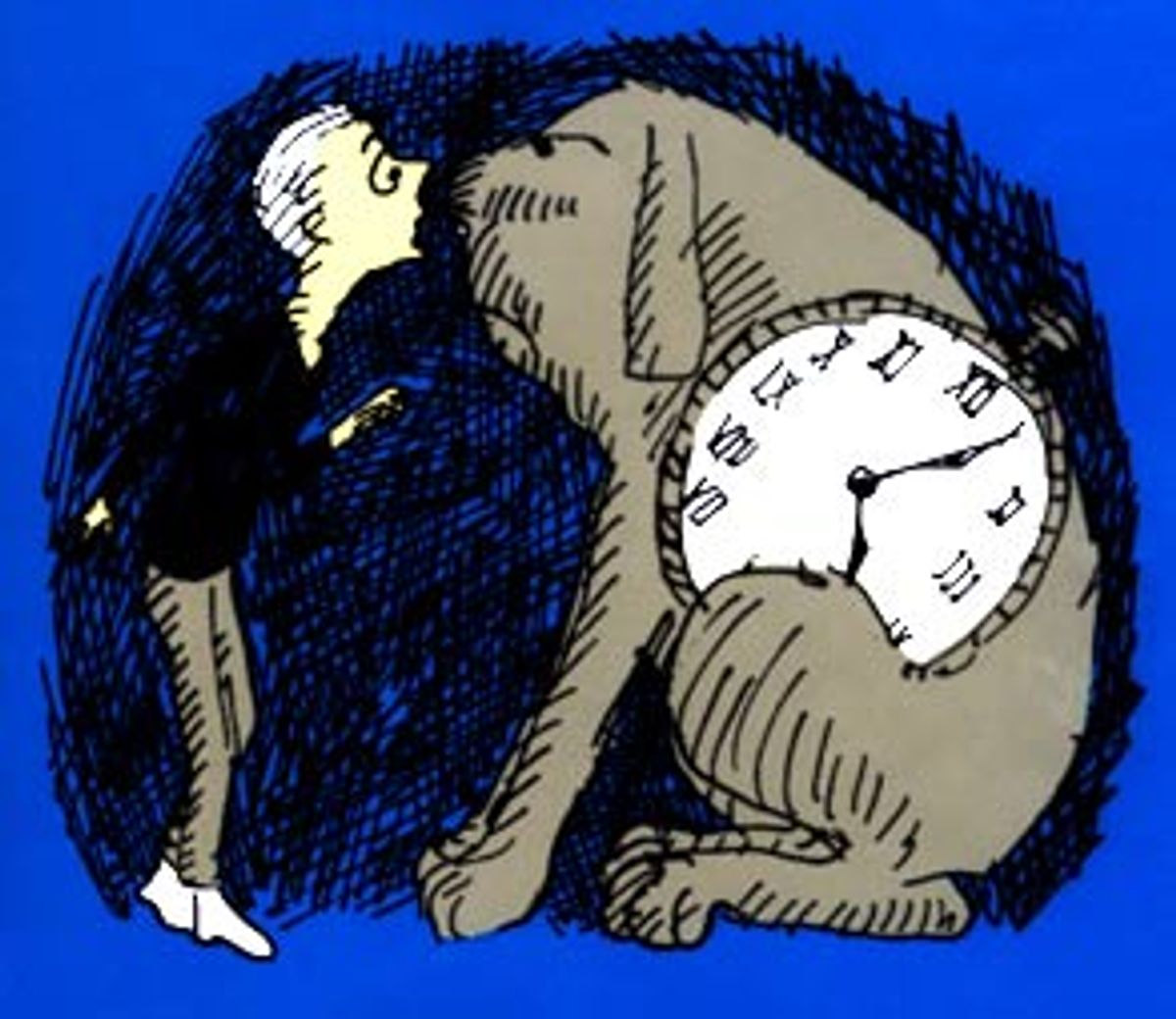
When you're a kid, the authors of your favorite books seem superhuman and remote. They lived long ago, like Louisa May Alcott, or far away, like A.A. Milne. Either way, it was hard to believe that these Olympian beings, capable of inventing worlds and characters so immediately, so powerfully real, could possibly be regular people, just like your parents and teachers. Then one day, you find yourself walking past the Books of Wonder children's bookstore in Manhattan (worth a visit when you're in town) and you spot a sign in the window. Norton Juster and Jules Feiffer will be autographing copies of their books, including the immortal 1961 classic, "The Phantom Tollbooth."
Whoa. You mean Norton Juster -- creator of Milo, the boy who one day receives the mysterious gift of an assembly-required toy turnpike tollbooth and magically enters the Lands Beyond, where he embarks on a quest to rescue the maidens Rhyme and Reason from exile and thereby reconcile the estranged kingdoms of Dictionopolis and Digitopolis -- that Norton Juster, walks among us mortals? If you're lucky, you've become a literary journalist, and you can invite Juster, an architect and retired teacher who lives in Massachusetts, to come by your office for an interview. And if you are indeed that lucky, you'll find him to be a robust 72, definitely a regular guy, but nevertheless as warm and witty as you could ever hope.
How did you wind up writing "The Phantom Tollbooth"?
I submitted a grant to do a children's book about urban aesthetics, how you experience and use cities. In six months I was up to my neck in 3-by-5 cards and I realized I was not really enjoying myself. I took a break to visit some friends at the beach and to take my mind off of it, and I began doing what I thought was a little story, going nowhere, just to clear my head. It just kept going.
When I had about 50 pages a friend took it to Random House, and they liked it and offered me a contract to finish the book, which really depressed me because it was no longer a game.
That's funny because one of the scariest characters in "The Phantom Tollbooth" is the Terrible Trivium, a very elegant gentleman with no face at all. His motto is that "there's always something to do to keep you from what you really should be doing."
Exactly. Someone I've known from childhood says that I can sit at my desk with something real to do and realize that I have to straighten out the paper clips, or there's something happening out the window, or a shopping list that has to be compiled. There's always something. Everyone has that kind of demon in their life; though, like all of the demons in "The Phantom Tollbooth," it's also very particular to me.
Yet it's ironic that something you started in order to avoid doing something else turned out to be such a remarkable achievement.
The secret, at least in my life, is that if you want to do something you have to do something else to get away from that and that's the thing that turns out to be worthwhile -- whatever you're doing to escape from doing what you're supposed to be doing.
One of the things that seems to really strike a chord with people in "The Phantom Tollbooth" is Milo's state of mind at the book's beginning: "When he was in school he longed to be out, and when he was out he longed to be in. On the way he thought about coming home, and coming home he thought about going. Wherever he was he wished he were somewhere else, and when he got there he wondered why he'd bothered. Nothing really interested him -- least of all the things that should have." I suspect that the first thing people today would say about Milo is that he's depressed.
That was a problem I had back then, too. Milo's not a dysfunctional kid. He's very typical. I kept having to rewrite those sections because I didn't want him to come across as someone who had these deep psychological problems. He just couldn't figure out why he was being oppressed by all these things. When you think about it, kids get an extraordinary number of facts thrown at them, and nothing connects with anything else. As you get older, all these threads begin to appear, and you realize that almost everything you come across connects to six other things that you know about.
Kids don't know this. You give them a date, or a historical figure, or some fact in math or science and that's it. They're just disembodied things that don't mean anything. Milo doesn't know where he fits in any of this and why he has to learn all of it.
When the book first came out in the early '60s, the revealed wisdom was that you could not give kids anything to read beyond what they knew already. There were vocabulary lists. Lord help you if you put words in a book for ages 6 to 8, or 8 to 10 that they felt a child of that age couldn't understand. They also thought that fantasy was very bad for children because it disoriented them. It's changed somewhat for the better. The publishers told me that they had great misgivings because they thought that the book was too far beyond children.
But I've found in my travels, talking with kids, that they like the story and if a story is compelling for them, they'll get by any difficulty. They'll get involved with something that interests them. I think that's the great secret; it's being interesting rather than sticking to those artificial standards that they set up.
Some critics have said that kids won't be able understand this book.
And kids don't understand a lot of it. I get letters from kids of about 8, asking about the story and indicating that there's stuff they don't understand. But quite often I'll get a letter from a kid who's 13, 14 or 15 years old, saying "I wrote you when I was 8, I reread it," and they'll talk completely differently about the book. That's wonderful. It means they're understanding it on a different level.
And you can reread the book as an adult because there are still new levels of understanding -- for example, the Terrible Trivium, who I think can only be apprehended in his full menace by an adult.
There were themes in there that I threw in because they amused me at the time. The whole conflict between words and numbers, that old thing that C.P. Snow wrote about many years ago. I didn't lay it out as a thesis or anything, but it was fun having it in there. And it doesn't get in the way of the story.
Do you think children's books are overly concerned with messages?
Almost any time you start with a message and write your book from that you're in big trouble. We convey many messages in the things that we write, but in many cases, especially with children, you don't want to end with "This is what you should think." You want to end with something that says, "Now, you think about it." To a child, and to an adult, too, what you discover by yourself, or what you think you discover by yourself, is what stays. Especially with children -- they're immediately suspicious of anything that they're told.
You had no idea when you started this book how it would turn out?
I had no idea. One of the first things I wrote was that scene where the Mathemagician, the ruler of Digitopolis, explains infinity to Milo. I'd had a conversation with a child who said to me, "What's the biggest number there is?" One of those wonderful children's questions you never know how to answer. I asked him a question: What do you think the biggest number is? He gave me one of these 80 skillion, 159 trillion numbers that went on and on, and so I said, "OK, add one to it." He thought that was enormously funny. I realized that we were talking about infinity as only two total mathematical illiterates could and having an absolutely wonderful time.
I started with that scene, because I loved it. I wrote the book from all different angles. It wasn't completely sequential, but just little bits and pieces. One thing that was extraordinarily useful to me was when I had a character or an idea for a scene, I'd write a lot of conversations between the characters, which was my way of getting to know how they sounded and what they might say. After you do this, and you're writing the scene, you sometimes get the feeling that you're sitting back and simply recording or eavesdropping on what the characters are saying. They're making the conversation and you're just there as a scribe. That's a wonderful feeling.
Were there particular scenes in "The Phantom Tollbooth" where that happened for you?
There's the scene at the royal banquet in Dictionopolis. I loved the whole idea of that; it was a constant game for me, when they all have to say what they want to eat [and the meal they name magically appears]. My favorite meal as a child -- the three things I loved most were hot dogs, corn on the cob and chocolate pudding, so of course I had to get that in there.
I confess that as a general rule I don't like puns, so I consider it a huge accomplishment of this book that I love the puns in it. My favorite pun is the cart without an engine or anything to pull it. To get somewhere in it you have to be very quiet because it goes without saying.
That's my favorite also! My father was a punster. I had the same reaction that you do; he'd say something and I'd groan. There's no way you can deal with that as a child. You're not that facile or quick. Years later I got to appreciate it. He'd sometimes walk in a room and say, "Ah ha! I see you're coming early since lately. You used to be behind before but now you're first at last ... "
I'm starting to see where this book came from.
It was interesting because my father dislikes fantasy, but he enjoyed this book. Ninety percent of that is because I, his son, wrote it, but I think he genuinely understood that a lot of the wordplay in there was inspired by him.
Speaking of children's fantasy, it seems that the question of how to get the characters from normal life into a fantastic environment is a particular challenge. Writers have had their characters fall down rabbit holes, walk through wardrobes and be carried off in tornadoes. Where did the tollbooth come from? It's such a lovely blend of the magical and the mundane.
It was exactly what you say: I was looking for a rabbit hole sort of thing, but I wanted it to be in contemporary terms. I was thinking about what was a common experience for children that was a transition point where something changes. It seemed to me that almost every kid has been in a car going through a tollbooth.
Not in California. That baffled me as a child.
You didn't have tollbooths?
No, it was all freeways. Although that wasn't any more baffling than the treacle well in "Alice in Wonderland." I spent a lot of time wondering what treacle was.
Now that they're starting to get rid of tollbooths, a lot of kids may be in your position with my book. But having been brought up in the East, it was something I was very familiar with and it seemed like a perfect, contemporary way for a kid to go from one world to another one.
An example of the deft writing in the book is how the magical things aren't overly described or explained. There's a scene in the Fortress of the Soundkeeper in which the Soundkeeper pulls out an envelope and tells Milo that the exact tune George Washington whistled as he crossed the Delaware is inside it. Then you write, very simply, "Milo peered into the envelope and, sure enough, that's exactly what was in it." And perhaps first among the many other things that are left unexplained in the book is exactly who sent Milo the tollbooth. Do you have an idea of who it was?
That question gets asked more frequently in the mail I get than almost any other question. I had a phone call from someone recently who wouldn't let me off unless I told him where the tollbooth came from. And frankly, I don't know where the tollbooth came from. It was just there. We conjure things in our own minds to fulfill the requirements we have. Obviously there was something inside Milo that was trying to get him out of that ennui so that he could understand the real joys of life, which are learning and being involved in things. So even if I did know, I wouldn't tell anybody where that tollbooth came from.
While you were writing "The Phantom Tollbooth," were there any scenes that surprised you as you wrote them, or made you wonder, "Where did that come from?"
What jumps to my mind is the scene of Milo conducting the dawn. And that's interesting because when the manuscript was turned in, the editor didn't like that and wanted to cut it. He was a wonderful editor, really terrific, and we argued about it. A lot of what he'd said I acted on, but finally with this one, he said, "Well, it's your book." So we kept it in.
I don't know why it happened, but it was as you described it. As I was writing that scene, a couple of times I had to catch my breath because I didn't know where I was going with it. It just began to happen.
It's one of my favorite scenes in the book. The conductor who conducts all the colors in the world, the Great Chromo, asks Milo to watch his orchestra during the night while he gets some rest. Milo decides to try his hand at conducting the sunrise, and the result is pretty disastrous, with colors going all wrong and the sun rising and setting seven times, very quickly. But Chromo sleeps through this and you write, "To this day no one knows of the lost week but the few people who happened to be awake at 5:23 on that very strange morning."
One of the ways I thought about ending that scene was with Chromo getting up and saying, "Oh, I had such a wonderful night's sleep. I feel like I slept for a week!"
Let's talk about some of your other books, which some fans of "The Phantom Tollbooth" may not know about, even though they've been quite successful. "The Dot and the Line," which has just been republished, is "a romance in lower mathematics" as you call it, in which a straight line is in love with a dot who has inexplicably attached herself to a good-for-nothing squiggle.
The story came very quickly. It struck me as funny, this whole triangle. The squiggle is an absolutely disreputable character who treats women badly, yet they flock to him. I knew several people who were that way. I was more like the line. I was never the romantic lead in any of these things.
I had a terrible time thinking of how to illustrate it. One illustrator, an old friend, said, "You have to do it. It's your book." Once I realized that, I had a lot of fun doing it. When I finally handed it in, I had a moment when I thought, "Nobody's going to think this is funny at all. It's my own little thing," but it's been in print for about 38 years, and now it's come out again with a lot of interest. It amazes me.
It's very droll. The poor straight line is pining with unrequited love for this dot. He's so upset that at one point you say he was "completely on edge," and the line is printed right on the edge of the page. The line also observes that no matter how he looks at the dot, she's perfect because she looks exactly the same from every angle. The dedication reads, "For Euclid, no matter what they say." So there are quite a few mathematical jokes in it.
There are. I'm not a great mathematician, even though I'm an architect. It took me a long time to realize that mathematics is one of those fields of endeavor where you have to have a sense of humor. When you think about a concept like negative numbers -- you can't really take that seriously. Probably most of the math I know is in that tiny book, though, so don't push me on it.
With "The Dot and the Line" you did the art yourself, but with "The Phantom Tollbooth" you had someone else do the illustrations, Jules Feiffer.
That happened completely naturally. At that time Jules Feiffer and I were sharing a duplex in Brooklyn Heights. He was on the floor below me and just getting started in his career, which of course has blossomed enormously. He'd hear me pacing back and forth, because I pace while I'm writing. He got interested and I gave him a few sections. He started doing illustrations and they were wonderful. I never thought of the book in any other way. I brought the book to the publisher with the illustrations. I since learned that you just don't do that.
People always ask me if I'm going to do a sequel, and probably I won't. The sequel most people want is another trip with Milo and basically the same characters.
They'd want you to bring back Tock, the watchdog, and the Humbug. You can't blame them, they're such appealing characters.
Tock was inspired by the old radio program "Jack Armstrong." I was looking for companions for Milo to travel with and the first one needed to be stalwart and dependable and truthful and you could bet your life on him and he'd always be there in an emergency. Jack had an uncle named Uncle Jim who was all those things. He was the model for Tock. At the same time, I suddenly realized that I needed two companions. Tock is just one side of the equation. Tock was the kind of person who was the friend your mother wanted you to play with. But of course you were always attracted to the kind of kid your folks didn't want you to play with, who was not terribly truthful, always got into trouble, was not completely dependable, erratic, a fraud, a bluffer, you never knew what he was going to do. And of course, that was the Humbug.
Yet you're not up for a sequel that continues with those characters, like the Oz books.
I don't think I can do that. It's a fine thing to do. It's what J.K. Rowling is doing with Harry Potter, and those books are quite wonderful. Her books are just a shade off of reality. There aren't spectacular, intergalactic things happening, it's just a shade of what you'd expect to happen.
You keep up with children's literature?
I can't say I'm a great scholar of it, but I try to keep up with things that are interesting.
Do you want to plug anyone else?
There was a terrific book called "The Mouse and His Child" by Russell Hoban.
Did you have any inkling when you were writing "The Phantom Tollbooth" that you would have such a big influence on so many people's imaginations?
You never know that. I had the usual first book paranoia. I was convinced that the book was distributed in the dead of night, in unmarked trucks, in unidentified boxes that were immediately put in the basements of bookstores where they would never been seen again. And I don't know why this happened, but then we got the lead review in the New Yorker, in their special children's books section. Emily Maxwell, Bill Maxwell's wife, did the review, and it took off from there.
I think it surprised everyone because they said, "This book will never go. It's too difficult. The ideas are too complex and too abstract. The vocabulary is beyond children." I was perfectly content to have done a book and to have it published. But it's interesting. It's become an extraordinary part of my life. I get mail constantly and try to answer them all because I know how much it means to a kid to write and to get a reply. I don't think a day or a week goes by that something doesn't happen in relation to that book. It's been a wonderful thing.
Shares