
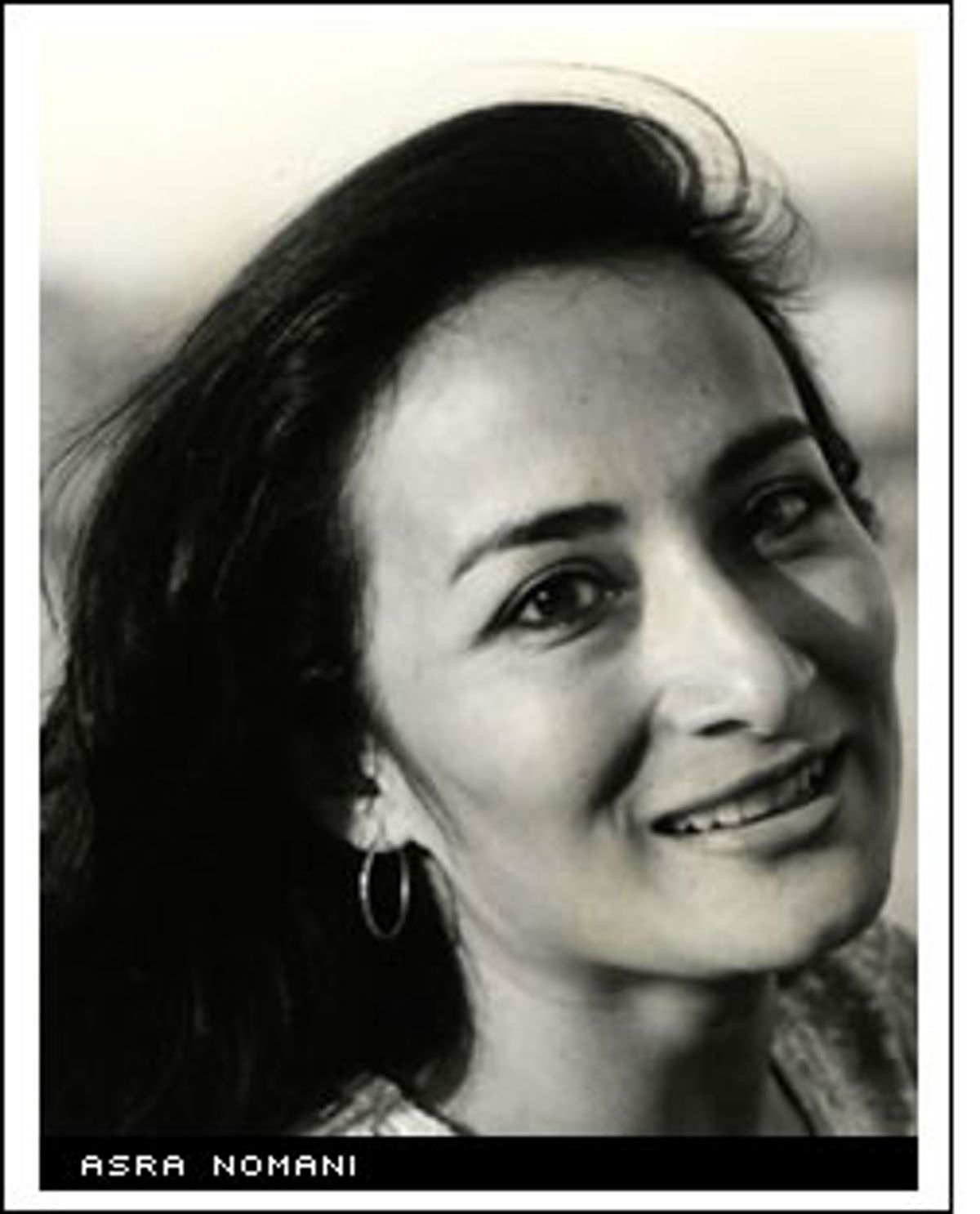
Horrified by the murder of her friend Daniel Pearl, journalist Asra Nomani made the hajj to Mecca. Now she's fighting to reclaim her faith from the men of darkness.
Mar 16, 2005 | In her new book "Standing Alone in Mecca: An American Woman's Struggle for the Soul of Islam," Asra Nomani, formerly a reporter for the Wall Street Journal and an international correspondent for Salon, embarks on a demanding spiritual and physical quest to make peace with her Islamic identity and her place as a woman within the faith. Joined by three generations of her family -- including her newborn son, Shibli -- she journeys to Mecca to complete the hajj, the great pilgrimage required of all Muslims once in their lives.
Though Saudi Arabia is controlled by strict, Wahhabist clerics, Nomani encounters unexpected liberties in Mecca. The sheer number of people who attempt the hajj -- more than 2.5 million each year -- makes it difficult to enforce many of the restrictions that normally impinge on Muslim women's freedom. At the Masjid al Haram, the most sacred mosque in Islam, Nomani walks proudly through the main doors beside her father -- an act she realizes would be forbidden in her hometown mosque, where segregation between men and women is strictly enforced. And though she fears for her safety as an unwed mother in a country where zina, or illegal sex, is punishable by death, she's surprised to encounter a supportive and complex spiritual community of pilgrims.
Buoyed by the kindness of her companions and inspired by examples of strong and daring Muslim women from the history of Islam, Nomani returns to America determined to address the inequities and abuse many women suffer at the hands of repressive fundamentalist theologians. She even takes the battle to her own backyard, challenging the leaders of her local mosque by refusing to submit to segregated prayer services and bigoted sermons. What begins as a simple act of personal protest ignites firestorm of dissent and controversy, and earns her both ire and admiration from the global Muslim community.
This month, Nomani launches the Muslim Women's Freedom Tour, which will take her across the country in a campaign for religious equity and personal justice for women in Muslim communities around the nation and the world. She spoke with Salon by phone from her West Virginia home about her hopes for the future of Islam, her anger over the murder of her friend and colleague, journalist Daniel Pearl, and how it feels to be put on trial by her own mosque.
"Standing Alone in Mecca: An American Woman's Struggle for the Soul of Islam"
By Asra Nomani
HarperSanFrancisco
320 pages
Nonfiction
Your life has been full of dualities: You grew up a practicing Muslim in a largely white middle-class West Virginia town, and while you profess devotion to family and the traditions of Islam, you chose a very independent and unconventional life as journalist and a single mother. How do you think those dualities have shaped your identity?
I think that I had to cross boundaries -- even physical boundaries -- from the earliest age, and I ultimately had to cross a lot of the psychological boundaries that usually serve as a box around our identities. I was always feeling out of sorts when I was a kid. I never felt like I had found a real home in the place I was living. When I first moved to New Jersey [from India] when I was 4, I didn't even speak English. So I think I was always an observer of reality, and ultimately I became an observer of my own reality, which eventually led me to journalism and writing. Writing helped me reconcile a lot of the contradictions in my life, because it meant I would actually take note of them. And traversing that world made me recognize that you can really be anything you want to be.
Before you decided to go on the hajj, you traveled through Asia as a journalist reporting on Buddhist pilgrimages, and you even wrote a book on the Hindu erotic philosophy, tantra. Have you always found yourself drawn to stories about faith?
I think from my earliest days I've wondered about spirituality and all of the questions that plague mankind and humanity about God and truth and goodness. I see it in my journals from when I was young, where I wondered about the conflicts in culture that I was seeing between Islam and the West. I was always trying to make sense of the world, and I think that was why as an adult when I finally got a paycheck and could travel freely, that's what I chose to do -- to physically travel where my mind had been taking me.
While covering the war in Afghanistan for Salon, you fell in love with a Pakistani man and became pregnant with his child while still unmarried -- an act that branded you a criminal in the opinion of many Muslims. How did you reconcile your decision to keep your child with your religious upbringing?
My parents loved me so fully when I couldn't even love myself. I spent my pregnancy curled up in despair, and I lived with the shame of it like a noose around my neck. I felt so lonely; I had been fighting for my relationship so I could be the nuclear family I thought I was supposed to be. But my parents never gave me a hard time. They were the ones who let it go -- they didn't want to see me destroyed. It was through the compassion and the love that they showed me that I was actually able to be kind to myself.
Get Salon in your mailbox!