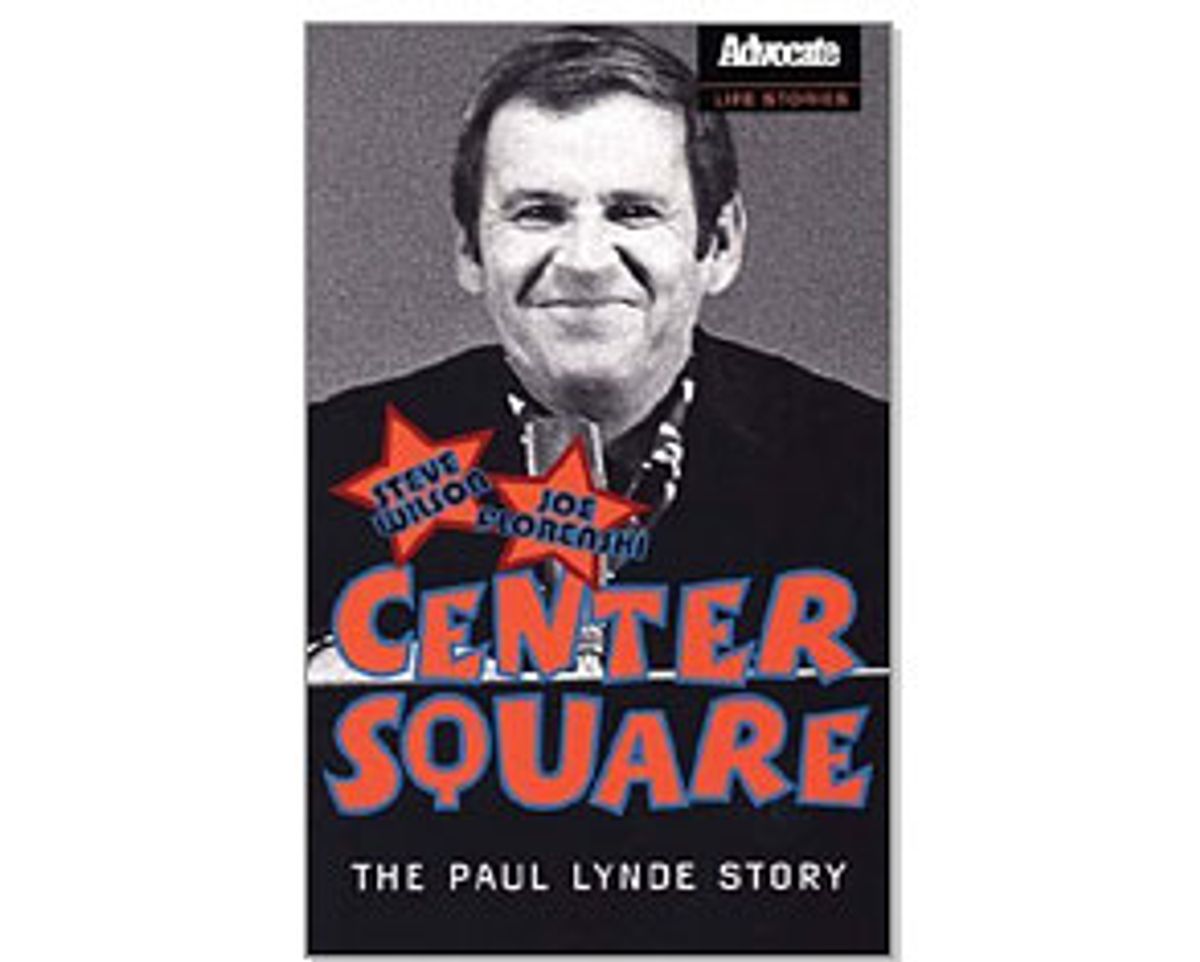
What took so long? In an age where celebrity biographies and memoirs outnumber actual celebrities, when even the life and career of Erik Estrada are deemed worthy of a 208-page meditation (opening line: "Any man's beginning reaches back past his point of origin ... to the deepest roots of his heritage"), how is it possible that the strange, sad life of legendary gay comic actor Paul Lynde ("Hollywood Squares," "Bewitched," "The Munsters," and an untold number of variety shows) has not already been observed, analyzed and dissected through a rainbow-tinted lens?
Indeed, over the course of a 27-year career that was filled with many more downs than ups, Lynde did perhaps more than any other single celebrity to open America's minds and hearts to the notion of a gay man cracking wise on a daily televised basis. Although he never officially came out, this Trojan horse in a silk shirt was a presence invited into millions of homes at a time when most weren't exactly hoisting triangle flags for all their neighbors to see. Never merely a limp wrist for hire, somewhat arch and more than a little bitchy, and yet strangely likable, he was deemed "safe" for the whole family's consumption, which only made his spicy dollops of gay wit dropped into the tasteless gruel that was 1970s TV that much more palatable for middle-American consumption. Exhibits A, B and C, from "Hollywood Squares," circa 1974:
Peter Marshall (host): Is the electricity in your house A.C. or D.C.?
Lynde: In my house it's both.
Marshall: True or false: Bob Hope and Jackie Gleason were recently seen in Central Park dressed as women.
Lynde (frightened): Was anyone else identified?
Marshall: In a recent column, Billy Graham said he would like to urge young people to reserve sex for the only place it belongs. Where is that?
Lynde (frightened): A state prison.
Now, nearly 24 years after his death at the age of 55, the man Mel Brooks once described as being capable of getting laughs by reading "a phone book, tornado alert, or seed catalogue" is at long last receiving the kind of serious attention that he always craved and felt he always deserved. "Center Square: The Paul Lynde Story," by Steve Wilson and Joe Florenski, would surely have made the scion of Mount Vernon, Ohio proud -- although, it's safe to say, he would have been none too pleased with the photo of his obese younger self decked out in a snug Boy Scout uniform. Regardless, this frustrated character actor and bit player, this "Liberace without a piano," has finally landed right where he always dreamed he would one day be: in the center of the stage, with the spotlight all to himself.
I spoke with Wilson and Florenski on the eve of their cross-country book tour. In appropriate fashion, a "Paul Lynde impersonator" was invited to join the biographers on their odyssey, but he was deemed too "difficult" and subsequently dropped from the bill.
What happened with the impersonator?
Steve Wilson: Joe and I contacted him to do a little routine with us for the tour, but he had all sorts of demands, like airfare for his makeup person. Would the real Paul have been so difficult to work with? Most likely. So it was kind of fitting.
What made you want to research Paul Lynde in the first place? You're both in your mid-30s and were quite young when Paul was in his prime.
S.W.: I only vaguely remember seeing him on "Hollywood Squares," but I watched a lot of "Bewitched" and caught [the 1973 animated feature based on E.B. White's book] "Charlotte's Web" more than once, too. I never knew that the character of Uncle Arthur and the voice of Templeton the rat were the same man until a roommate gave me the Paul Lynde lowdown. I realized what a lingering impression Paul left on me over the years, and I became even more fascinated when I started looking into his life.
Joe Florenski: That's more or less the same for me. I started researching him out of boredom and couldn't believe so little had been written about him.
Why do you think this is the case? The biographical terrain is pretty well trampled on when it comes to celebrities, well-known or otherwise. While there have been a few articles on Paul Lynde over the years, there's been nothing at all in-depth.
J.F.: I dug up a lot of minor profiles in publications like Weight Watchers magazine, but that was about it. Though Paul was huge on "Hollywood Squares," to most people he was just a character actor on a daytime game show, not worthy of the same kind of ink reserved for movie stars. To many gay people, his reputation fared even worse. In some ways, he came to symbolize what's perceived to be a self-loathing era for gay culture.
S.W.: That was one of the reasons we wanted to write the book, to help restore his standing, at least a little bit. Paul not only made a great and singular contribution to pop culture, but his going out there every day on "Squares" and bringing gay humor to the masses was heroic, even if it was largely unintentional.
What do you mean by unintentional? Was he not aware of his role as a gay icon?
S.W.: If anything, he felt like a gay whipping boy. Bad choice of words there. The friends we interviewed said Paul felt stigmatized by the industry about being gay. And by "unintentional" I mean that he got very fed up with "Squares" and after a while, through a combination of the writers getting more risqué as the '70s wore on and Paul not caring one way or the other, he gradually let his guard down. Eventually, his gayness became incredibly obvious. His jokes came straight from gay culture, but mainstream America back then had practically nil exposure to that world.
It's been said that Paul blamed his gayness for his lack of career advancement, but isn't this the sole reason we know him today? The material that he was saddled with was lousy, by and large. And yet his "gay oriented" jokes on "Squares" were really quite edgy for the time.
J.F.: Well, he also blamed network stupidity, bad scripts, his drinking problem and, most embarrassingly, Jews for his career never taking off. But yeah, it's interesting that his queerness gave him a certain edge and fueled his comedy even as it held him back.
Going back to "Hollywood Squares" -- much as Paul hated being on that game show, it seems that this really was the best outlet for him.
J.F.: The host of the show, Peter Marshall, makes a good point in our book about a little bit of Lynde going a long way; too much of him was overkill. That helps explain why Paul's sitcoms never went anywhere, but why his zingers on "Squares" got him so much notice -- pretty much solid raves from the get-go, from both the audience and the producers. He was an immediate smash. He was 40, by the way, and the veteran of many failures, when he first appeared on "Hollywood Squares."
It might surprise a lot of people to know that most, if not all, of Paul's zingers were scripted by writers. You make it clear in the book that Paul wasn't very adept at improvising.
S.W.: The writers on "Squares" took great pains to pen jokes in Paul's voice. But there's a lot to be said for what Paul's great delivery did for those lines. They would have sounded mighty lame coming from anyone else. And he did have his moments of ad lib brilliance too, like the time he was presenting with a female chimp in a skirt at the 1972 Emmys and he chastised her with, "You forgot to use your Feminique [douche]."
Also, keep in mind that he might have been a better improviser if the standards of the day had allowed him to joke around as he did so effortlessly in real life. I think living in the closet for so long may have clamped him up. There was one time when he showed up to dedicate a new high school in his hometown of Mount Vernon, Ohio, and panicked when the organizers expected him to speak for 30 minutes without any prepared material. He was probably more afraid of what offensiveness might have come out of his mouth than anything else.
I've seen a few bootlegs of the failed sitcoms in which Paul starred as the leading man. Peter Marshall was right about a little going a long way. Watching the shows was like staring directly at the sun or eating a large bag of candy. It was all too much. I felt a bit dizzy and nauseated.
J.F.: We have a higher Paul tolerance than most, but it's true, his manic approach really did only work in small doses. In the [short-lived 1972 sitcom] "The Paul Lynde Show," for instance, who's going to believe him as a family man for a whole half-hour every week? (Though he did get off some funny lines on that show, and many of them he wrote himself, or so he claimed.) That's why he was great as Uncle Arthur on "Bewitched" and the father in "Bye Bye Birdie" and Templeton the rat in "Charlotte's Web." He was just in and out at the right moments.
Here's something shocking: Paul was on "Bewitched" only a total of 11 times. I thought he appeared much more frequently. Again, a small dose of Lynde went a very long way.
J.F.: Right, it is surprising that he was only on the show 11 times. His presence was very strong. He guest-starred on one "Bewitched" as Sam's driving instructor and hit it off so well with Elizabeth Montgomery that her producer husband, William Asher, created the Arthur role for him. The three of them hung out together and became friends off the set. Asher, by the way, told us he bailed Paul out of jail on the night of one of his most notorious episodes.
What happened?
J.F.: Paul got pulled over for a DUI and told the cop who came up to his car window: "I'll have a cheeseburger and fries!"
Is that story true? Paul's misdeeds have become legendary, and many are still recounted in Hollywood. I wonder how many of them are tethered in any way to reality.
S.W.: We had lots of sources for that story. Paul even used to brag about it. Police records backed up other stories, like the Jim Davidson episode. He and the young actor went to San Francisco to party for the weekend and Jim got drunk and fell out their hotel window. It never became a big scandal, but it probably ruined Paul's chances of getting a few projects off the ground.
J.F.: Another notorious Paul story that turned out to be true was the time he was on an airplane and a little girl was running up and down the aisle, making a lot of noise. He grabbed her and then shouted at her mother: "You keep this little girl quiet or I'm gonna fuck her!"
Not exactly the stuff comedy legends are made of.
S.W.: It worked for Paul. As we dug around for the truth behind other stories, we came to realize that Paul really lends himself well to tall tales. He's sort of a gay folk hero that way. As an example, we talked to a writer who wrote a short story in which Paul slaps a character while they're making love and says: "When you get fucked by Lynde, baby, you keep your eyes open!" It was pure fiction, but it just sounds so much like Paul that other people we talked to thought it was real.
Is there a comic actor who's famous for doing less? In a sense, Paul always played himself. Whether he was a warlock or an animated rat he was always the same character: "Paul Lynde." He didn't exactly stretch his acting chops.
J.F.: But isn't that the case with most movie and TV actors, no matter how famous they are? Also, Paul's persona had much more dimension to it, not just the tight grin and the weird asthmatic laugh and the nasally voice, but also a poignant vulnerability underneath all the anger. You always felt sympathy for this raging ineffectual. He based it on people he grew up with in Ohio, and he spent so many years perfecting it that you can't blame him for clinging to it. Plus, it worked for him. It really hit a chord with audiences, and other entertainers ripped off different elements of it -- Charles Nelson Reilly is a big one; he took the laugh.
Most comedians and comic actors are angry, and if they're not, they're usually Paul Reiser. But Paul Lynde seemed to be a special case. Where do you think this rage came from and how did it fuel his comedy?
S.W.: He had a lot stacked against him, especially growing up. He was a fat kid. Classmates, as well as his brothers, picked on him. His mother was loving, but his father not so much. Meanwhile, everybody in town thought he was a freak for putting on backyard shows and marching around in the dresses he found in the attics of friends' houses. He made the best of it by becoming a class clown, but when comedy is a defense mechanism like that, it's bound to be mean. After college, he didn't get any decent parts for years, and the stress and frustration of that just made matters worse.
You interviewed a lot of his friends for the book, but not too many family members. Were they uncooperative?
J.F.: In a sense. His direct relatives died by the time we started the book, and they likely wouldn't have been too helpful anyway. An "A&E Biography" special that we helped out with apparently miffed Paul's sister just before she died. She wrote a letter taking the producers to task for purporting -- gasp! -- that Paul was gay. The extended family seemed to have the same qualms when we tried to talk to them, so it didn't work out.
At the end of his life, Paul seemed to be getting his act together. And yet he became something of a loner. He kicked booze and drugs, but would spend his days filling out crossword puzzles, and most of his social interaction was hosting dinner parties for his close friends during which he would apologize for his past offenses.
S.W.: He hinted to a few friends about some event that finally pushed him over the edge and made him realize he had to kick his habits, but he wouldn't say specifically what it was. It could have been the time he got banned from Northwestern, his alma mater, for spouting incredibly racist comments at a black man standing behind him at a local Burger King. The man turned out to be a Northwestern professor. Or it could have been maybe something much quieter. Whatever the case, he gave up booze, but going cold turkey may have been too much of a shock to the system, because he died about a year later.
Did he ever officially come out, even to friends near the end?
J.F.: To his friends, sure he did. But he kept a fairly rigid line between his gay friends and his celebrity friends, rarely mixing the two except when he might bring a fling along on a "Squares" junket or the like. Publicly, he still kept himself in the closet, but just barely by the end. A 1976 article in People came the closest of any mainstream media in outing him. It featured pics of him with Stan Finesmith, his "chauffeur-bodyguard," who, according to the article's photo caption, also doubled as his "hair stylist and suite mate."
I suppose it's only fair to ask if he could ever really be considered a gay hero if he never officially came out.
J.F.: I've personally never considered Paul a gay hero. True, in his own way, he played a part in gay liberation, but it's not like he led the Stonewall Riots. Had he lived longer, maybe he'd have outed himself on the cover of a magazine. But if he had come out, it would probably have meant the further end of his career, as in putting the nail in its coffin. That would have been that.
Rumors have circulated about Paul's death for years. Your book puts an end to them.
J.F.: People have said things like a hustler left the vicinity the night of Paul's death with a big stash of loot, leaving Paul dead and naked. But the more we looked into it, the more it all adds up to a heart attack, just like the coroner's report says. He died at almost the same age as his father and for the same reason. With the way he lived, it's kind of surprising he didn't have a heart attack sooner.
How do you think Paul would have fared today? Although he complained about not achieving more fame through movies and leading roles, he was lucky to be around during the zenith of game shows and variety shows, the last vestiges of vaudeville. He was able to shine in both settings.
J.F.: If he'd survived the '80s, he could have easily cashed in on the celebrity cookbook craze or become a game show host. I could see him with his own daytime talk show in the '90s, when that was big.
S.W.: Yes, and these days he'd be great in a reality show. He could host a dinner party each week and tell everybody off. And, of course, as an elder statesman of gay TV, he could easily get a supporting or recurring role on any one of the many gay-themed shows out there today. Maybe as the DJ on "The Ellen DeGeneres Show."
And his legacy?
J.F.: For most people Paul is just a funny footnote of TV history. Like a character in the new "Bewitched" movie or as the butt of jokes on cartoons like "The Simpsons," "SpongeBob SquarePants," and "American Dad." But it's not a stretch to say "Will & Grace," "Queer Eye for the Straight Guy" and other gay television shows are Paul's legacy. Way before any of them, Paul was getting away with being gay on a daily basis on TV -- an unheard of feat back then.
S.W.: But here's something sad: The sign proclaiming Mount Vernon, Ohio, as the birthplace of Paul Lynde was recently changed to read: "Home of Daniel Decatur Emmett, Author of [the song] 'Dixie.'" Maybe we can start a petition to get the old sign back. Or, at the very least, to hold a Paul Lynde day.
With the Paul Lynde impersonator as honorary mayor?
S.W.: The town would never be the same!
Shares