


Universal Pictures
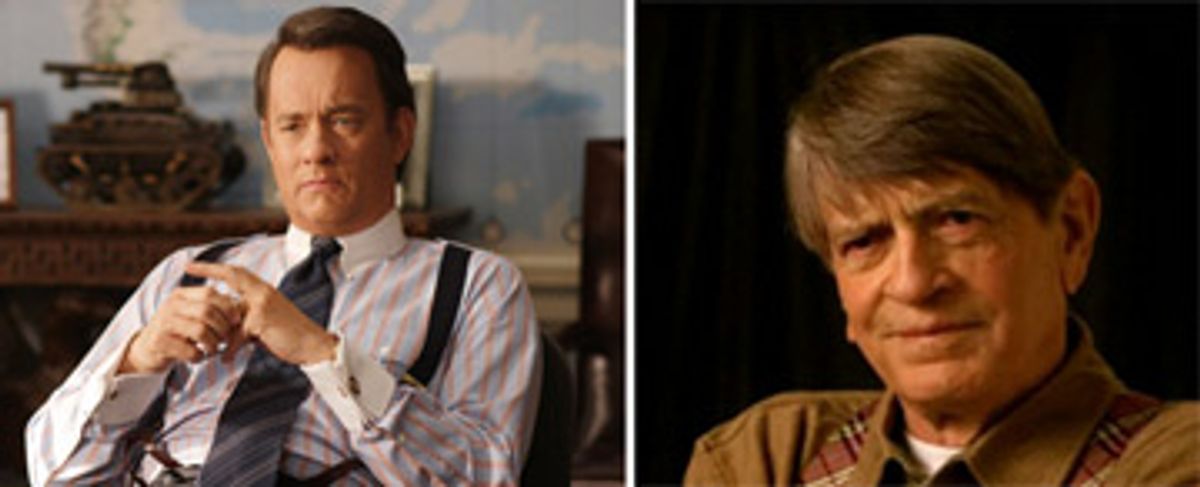
Left, Tom Hanks as Charlie Wilson, right, the real Charlie Wilson.
If "Charlie Wilson's War" (brand-new on DVD) is an entertaining mishmash, oddly less than the sum of its remarkable parts, the story it has to tell is one of the most fascinating, improbable and haunting yarns in recent world history. It sounded like a perfect combo: "West Wing" creator Aaron Sorkin and director Mike Nichols team up to tell the story of former Texas congressman Wilson, a legendary boozer and womanizer who secretly directed billions of taxpayer dollars to the 1980s Afghan mujahedin insurgency against the Soviet Union -- a war that shaped the world we live in, for good and for ill.
But the relative failure of "Charlie Wilson's War" at the box office wasn't just a matter of the public's lack of interest in topical or political material (although that probably played a role). Sorkin's script has to pack an immense amount of historical background into less than 100 minutes; it leaves out much of the complexity and internal paradox of the Afghan war, and often feels clunky and expository. Tom Hanks and Julia Roberts are awkwardly cast as Wilson and Joanne Herring, the evangelical Christian Texas socialite (and Wilson's occasional paramour) who first got the randy congressman interested in the Afghans' David-vs.-Goliath struggle against Soviet invaders.
Philip Seymour Hoffman is predictably great as renegade CIA agent Gust Avrakotos, who arranged the secret arms deals (an unholy partnership between Israel, Egypt, Saudi Arabia and Pakistan) that preserved American deniability by putting Soviet weapons in the Afghan rebels' hands. Once the Afghans had arms and training that enabled them to shoot down Soviet helicopter gunships by the dozens, the tide of the war -- and the tide of 20th century history -- shifted radically. In 1989 the Red Army left Afghanistan, and two years later the Soviet Union itself had ceased to exist, the Berlin Wall had been pulled down and the Cold War was over.
Both Avrakotos and Wilson grasped that driving the Russians out of Afghanistan, while a monumental achievement, was not sufficient; without help in building a civil society, that nation would once again fall into chaos, with unpredictable consequences. But they weren't able to do much, and nobody else paid attention. Much of the money and power generated during the Afghan war flowed to Islamic extremists who were just as much anti-American as anti-Soviet. Caught up in Cold War triumphalism, the United States moved on, and at least to some degree the rise of the Taliban, the arrival of al-Qaida and everything that followed were the "blowback" from that failure.
With Nichols' uneven but entertaining film just out on DVD from Universal Home Video, the real Charlie Wilson got on the horn with me from his home in Lufkin, Texas, to talk about it. A Democrat from a conservative east Texas district, Wilson was known in Congress as a social liberal, a Cold War hawk, a tremendously skilled backroom dealmaker -- and a hardcore partyer who never said no to women, whiskey or, you know, other things like that. His wild living and strange foreign-policy partnerships -- he was friendly with former Nicaraguan dictator Anastasio Somoza, and lobbied for the Pakistani government after leaving the House in 1996 -- have made him, to say the least, a controversial figure within his own party. But he still describes himself as a liberal Democrat, and at 74 with a new heart (after a transplant last fall), he sounds almost as feisty as ever. Modesty, however, is not his strong suit.
You know, ordinarily I'd ask someone in your position how it felt to see yourself on the big screen, played by a movie star. But I've seen pictures of you as a younger man, and I think you were a better-looking guy than Tom Hanks.
Well, I think that's the case, yeah. My wife certainly agrees with that. We've mentioned that to Tom, and he's sort of ambiguous about it. He won't commit himself either way.
It's pretty tough to boil all this amazing history down to a film that runs not much over an hour and a half. What should people know about this story that didn't make it into the movie?
Well, please understand that I'm not critical of the priorities of the movie. But I would love to have seen more of the inside wrestling-around in Congress, the things we had to do and the degrees we had to go to, to get around the rules. I'd like to see the public more educated about that.
Right. The movie focuses a lot on your personal excesses, which are certainly entertaining. But you were also known as one of the most skilled operators in the corridors of Capitol Hill.
That's right, and I'd like to have seen more of that. But I understand why they couldn't do that. The key ingredients are all there. The initial outrage at the lack of interest at the CIA [in the plight of the Afghans], the beginning of the weaponization of the mujahedin, and then the way it snowballed and became a major thing. The shooting down of all those Soviet helicopters, and then the Soviets pulling out. It was major stuff.
It's probably hard to look at that history from a detached perspective because you were so intimately involved with it. But if you hadn't been there, would somebody else have done something similar? Or to ask the question another way, would some other factor have brought the Soviet Union to its Waterloo moment?
That's a good question, and I think the answer's no. I think this deal was the sun and the moon and the stars lined up just right. It was a once-in-a-lifetime, a once-in-a-million-lifetimes thing. The Congress was in a mood to go after the Soviets, and it just happened. It would be very hard to happen again. You don't have many wars where you have a clear right and wrong, and nobody can argue the other side. In the wars in Central America, the contra wars, the arguments were endless as to where the real merits were. But in this one there was no argument. It was the good guys against the bad guys, period.
And that sense transcended the usual Democrat-Republican partisan divisions of Washington.
Absolutely. Without that it could never have happened. If you'd had somebody out leaking to the press, somebody trying to gain partisan advantage, it would have all fallen apart.
Looking back on this, do you still feel it's appropriate for such a major foreign-policy decision to be made in secret, without the public even knowing about it?
Well, some foreign policy things are best done in private. It would have been very hard to explain to a reporter why he wasn't getting this over the AP wires.
So what's the public role? Is it our job just to elect the people with the right principles, and then trust them to do these jobs properly?
I think it is, in a case like this. I don't think the public really has a possible role in intricate foreign-policy decisions and executions like this one.
To look at more recent history, we were led into war in Iraq by the administration and the foreign policy establishment ...
It wasn't the foreign policy establishment. It was the president and the National Security Council and, mostly, the vice president. It wasn't the State Department.
If you had been in Congress in 2002 and 2003, how would you have voted on the Iraq war?
I would have voted against it. I wouldn't have been convinced.
Even based on what you knew at that point? You thought the WMD argument was pretty thin?
Very thin, and totally unproven. Somebody would have had to show me some evidence, and there was no evidence on the weapons of mass destruction, other than Saddam Hussein's defiance. And you don't invade other countries because they're defiant. Otherwise we'd have troops on the way to Zimbabwe right now. [Laughter.]
Given the amazing success of this covert operation in Afghanistan, why doesn't it happen more often? Why didn't Congress do something quietly about Rwanda or Darfur?
You've got to have somebody that's passionate and reckless, who really pushes it and is willing to take chances. We had that in Afghanistan and we haven't had it since. In Afghanistan, there was a lot of luck involved, a lot of things fell into place. It would have been hard to do if it had been a civil war. But with a Soviet invasion, that straightened out all the moral arguments.
We were able to do all these things because for the first three years of this, the press was overwhelmed by the excitement of Central America. We were moving millions and millions of dollars through Afghanistan, while the president and Congress were fighting over $5 million in Central America, and the press was riveted by that. I never understood that.
You've probably been asked this question hundreds of times since 2001, but I'll ask it again. To what extent were later events in Afghanistan -- the rise of the Taliban, the arrival of Osama bin Laden and al-Qaida, and everything that followed that -- the unintended consequences of your secret war in the '80s?
People will always argue about that, and there's no empirical answer. I think the telling thing was that Muslims looked back at this and saw that they had taken down one superpower, in the Soviet Union. It made them think that maybe they could take down another one. That was the contribution of the Afghan war to 9/11.
In the film we see you arguing that the United States had a moral responsibility to rebuild Afghanistan after the Soviets left. Do we still have that unfulfilled responsibility?
Absolutely. We still owe it and we have to fulfill it. I think we probably will, but we'll mess around with it, not do it as directly as we should and not do it in as timely a way as we should. I think we should be in there right now. We were trying before the Iraq war started, but then Iraq pulled away both military resources and civilian reconstruction resources.
Lastly, our readers need to know who you're supporting in the Democratic campaign for president.
I voted for Obama in the Texas primary.
Really? Could he win in your old district?
Well, if the campaign's right, and if John McCain -- who is a friend of mine -- just marches in lockstep with the Bush policies, then I think he might. But we can't depend on Texas to deliver this election for the Democrats. [Laughter.]
Shares