Leave the tap running while brushing your teeth, and you're dumping four and a half gallons of water down the drain, according to the U.S. Environmental Protection Agency.
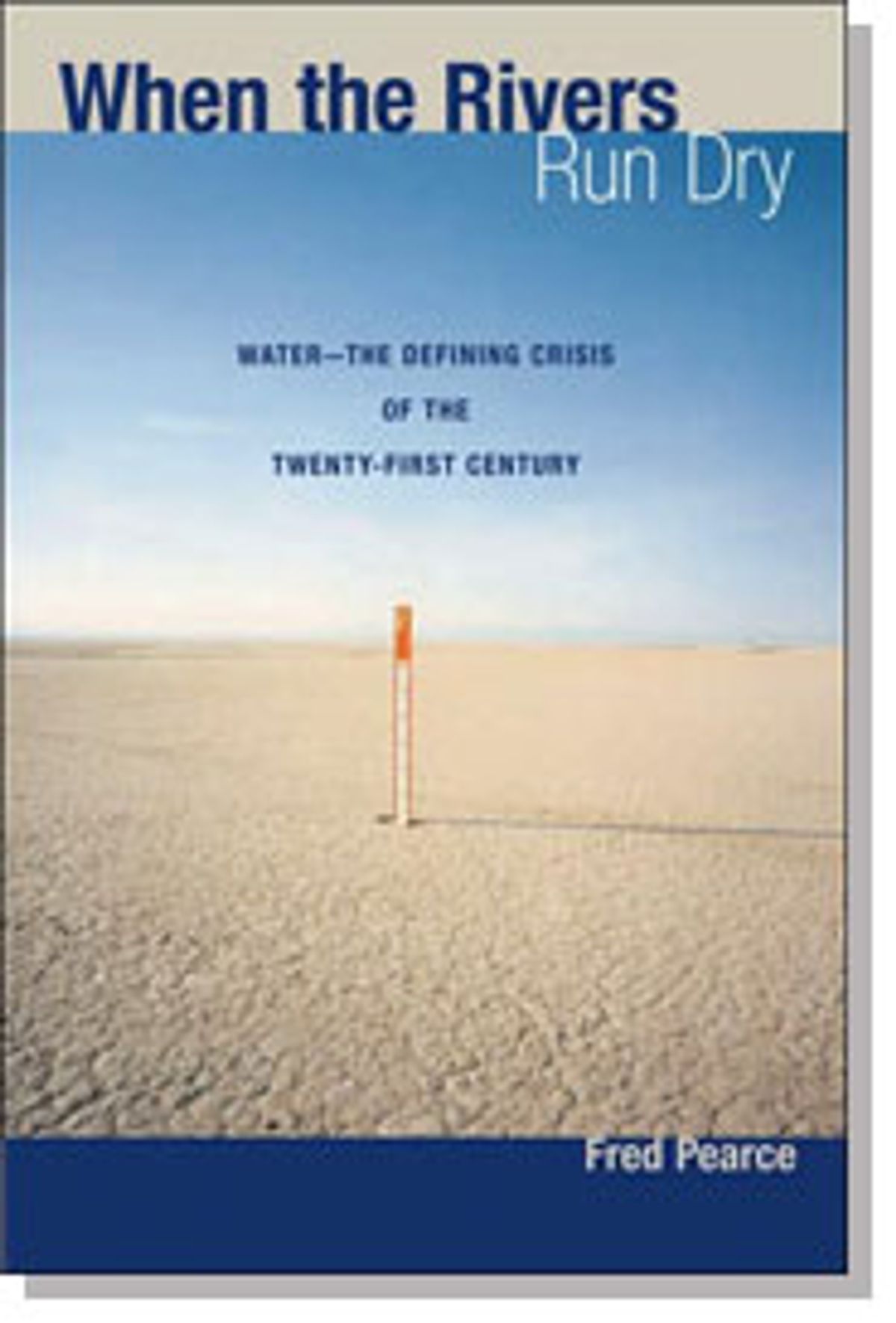
That's the kind of shiny stat trotted out to inspire profligate water-wasters to conserve. Just shut off the tap, save water. It's easy! Huzzah! Yet, as British science journalist Fred Pearce makes crystal clear in "When the Rivers Run Dry," the water we consume -- and waste -- in everyday life is hardly limited to what comes out of our own faucets.
Pearce, a longtime editor for New Scientist, who is now an environmental consultant for the magazine, calculates that it takes 40 gallons of water to grow the ingredients for the bread in a single sandwich, not to mention 265 gallons to produce a glass of milk and 800 gallons for a hamburger. And that's just what's for lunch. Don't get him started on what you wear to this water-rich feast. Even a simple cotton T-shirt bearing some hopeful green slogan like "Save the Bay" is a huge water user. Pearce figures it takes 25 bathtubs-full of water to grow the scant 9 ounces of cotton for such a shirt.
Water is the ultimate renewable resource, literally falling from the sky back to earth after it evaporates. And since it's so heavy and cumbersome to move great distances, it's also a local resource. Yet, start quantifying the water embedded in foods and goods, the "virtual water" as economists call it, and water is fast becoming a global commodity like oil. There's Brazilian water in the coffee beans grown for an American latte; there's Pakistani water in the cotton in that T-shirt.
In "When the Rivers Run Dry," Pearce finds a growing strain on many local water resources around the globe, as the world's population grows. As he visits dozens of countries, he sees rivers that have been so diverted, depleted and dried out, such as the Rio Grande, that they no longer conform to their original map locations. Pearce reports that the fallout from the competition for water resources is enormous, exacerbating tensions between Palestinians and Israelis in the West Bank and even accidentally poisoning villagers by the millions in India and Bangladesh.
Yet, Pearce also finds hope in the way some communities around the world are harvesting and using water. Salon spoke with the writer by phone from England about why he thinks we need a "blue revolution."
If there are 650 gallons of water in a pound of cheddar cheese, is it futile to make small gestures like turning off the water when you brush your teeth in the name of saving it?
It helps with water bills, so it makes sense in that way. And it may make sense with local water resources, which may be constrained, just within a small town, or even a community.
At the global scale, no, it doesn't make much difference. Most of the water that each one of us uses comes from the water used to irrigate the crops that we consume. That's principally food, but not only. Cotton for our clothing is a major user of water around the world.
We don't really know as we pick up the food from the store whether our purchases are responsible for making some local crisis elsewhere worse, but it is often the case. Many countries are facing serious water shortages; often their rivers are running dry, or their water tables falling very fast, and in many cases much of that water is being exported by those countries in the form of goods. Yet, when we pay market price for those goods, that price doesn't usually include any estimate of the cost to the water resources. We still think of water as an unlimited resource rather like the air we breathe.
Now some countries are entirely dependent on water from elsewhere to feed their people, on this "virtual water."
Many countries have run out of water for growing their own crops and are now importing water in the form of food. Egypt really, for instance, lost the ability to feed itself perhaps 30 years ago. It now imports a large amount of water in the form of food. That is the only way it can do it. Water is pretty heavy stuff to move, but the trade in products produced with water is huge, and in many ways can be seen as a trade in water.
What are some of the rivers around the world that have run dry, or are most in danger of it?
There are two rivers in a bad way in the U.S., one of which is the Colorado. There's a U.S. treaty with Mexico to deliver water over the border, and the U.S. has considerable difficulty in providing any water over the border to meet its minimum treaty requirement, because all the water is used up essentially by farmers and increasingly by cities along the Colorado.
The water goes off to Southern California, Phoenix, Tucson [Ariz.]. By the time the river crosses the border into Mexico, which is close to its delta, it is really very dry. There's not a lot of water left.
The Rio Grande is another interesting example. It essentially dries up about a thousand kilometers from the sea near El Paso [Texas]. The riverbed is virtually dry for 300 kilometers before some more water comes back in from tributaries coming in from Mexico.
So, whatever it looks like on the map, really the Rio Grande is two rivers. There's a river that gives out at El Paso, and there's the tributary that comes in and replenishes the last run to the Gulf of Mexico. There are very serious economic repercussions from the drying up of the Rio Grande. I met farmers who simply no longer have water to irrigate their crops, and that's on both sides of the border, on the Mexican side and on the Texas side.
If you look around the world, virtually no water flows from the Nile into the Mediterranean; very little water flows from the Indus through Pakistan into the Arabian Sea; the Yellow River in Northern China, one of the world's longest rivers, is essentially dry for much of the year. A little flow goes down to the sea, but very little. So, this is close to becoming a global phenomenon, some of the world's largest rivers, and longest rivers, simply not reaching the sea.
One response to rivers running dry is to move water enormous distances, at the cost of hundreds of billions of dollars. What do you make of such grand projects?
There are plans now for huge transfers of water across some of the world's biggest, most densely populated countries in order to provide water for the new mega-cities, and for farming. China's got one of the largest, and that's going to take a large amount of water out of the River Yangtze, which runs through the south of the country, and deliver it into the northern plains, to the Yellow River, which has essentially run dry for much of its course.
Essentially, the Yangtze is going to replenish the waters of the north of China. This project is already underway. Two of the three branches that are planned are already under construction. China hopes to be delivering water from the Yangtze to Beijing in time for the Olympics in 2008. This project will probably cost something like $60 billion. It's a major enterprise in order to keep northern China from running dry. India has talked about something even larger.
Yet, in these vast projects to move water around, aren't incredible amounts of the water lost through evaporation or seepage from canals?
Many large engineering projects suffer from a huge range of inefficiencies, which is why -- in general -- I'm not in favor of them. It's much better to do things locally, because you can control the water more. One thing that surprised me greatly was discovering that with Lake Nasser behind the Aswan High Dam in Egypt -- one of the world's kind of totemic dams -- that the evaporation from the reservoir behind that dam annually amounts to, in metric, 15 cubic kilometers of water [3.6 cubic miles], if you can imagine a vast amount like that.
That is roughly the amount of water that is used by the whole of the United Kingdom in a year. In other words, you could fill every tap, meet every water demand in the U.K., a country of more than 50 million people, simply by the water that evaporates from the surface behind the Aswan Dam.
Now, that's an amazing statistic, but there are other reservoirs that lose similar amounts of water, especially in the hot tropical regions. That can't make much sense, if you have a country which is desperately short of water, and desperately trying to collect it up to deliver it to farmers. There are also huge evaporation rates from some of the distribution canals. Also, seepage from beneath distribution canals can be a major loss of water.
What's the solution?
With seepage, often, farmers, being rather practical people, simply sink some drilling rigs into the ground, and stick a pump in and pump that water up again. So, they tend to recycle it. But evaporation is a real loss. I'm not quite sure what you do about it other than manage water more locally. One of the most heartening trends I've seen traveling around the world -- and I've seen it in China and India and in other places -- is the effort by farmers and villagers to harvest the rain as it falls. They don't let the water go into the rivers and run away to perhaps a large dam, or run away to the sea. They simply capture it locally, and even pour it back down their wells, creating a storage system so that they can pump it up later in the year. So, particularly in India where most of the rain falls in 100 hours over 100 days, you simply have to capture that and store it locally in ponds, or even underground in wells. That's a rather efficient way for a local community to manage its water supply. It's being very effectively applied in thousands of villages across India.
Are you optimistic that there will be a kind of "blue revolution" of innovative ways to conserve and capture water?
I'm an optimist, not a pessimist. I'm a pessimist in the sense that we use water so inefficiently and so carelessly now that it makes you despair, but I'm an optimist also because there is so much potential for doing things better. When you find that irrigation systems waste 60 or 70 percent of their water it does make you despair, but you realize that there is a huge potential to do things better. I find that given the chance farmers and local communities, and even towns and countries, will and can do a lot of things better.
Still, conserving water in one location can mean just donating it to someone else to squander.
Unlike many of the resources that we rely on, water does move -- down rivers and between countries -- in ways that we can't do much about. When water gets short, the conflicts that arise over water do get very complicated.
On the West Bank, for instance, the Israelis and the Palestinians are almost as much in conflict over water as they are over land. The Palestinians are very angry that they are not allowed to sink more wells and drill more boreholes on the West Bank region, because the Israelis say that the water is already fully used, when most of that water is in fact used by Israelis not only in their settlements, but also in Israel proper.
While we often see water as a kind of free resource, provided by nature, once it gets in short supply the powerful do have an ability to grab hold and keep water -- whether behind dams, or by sticking pumps into the ground. We haven't quite reached the situation where water wars are breaking out, but we're getting quite close in some parts of the world.
Where do you see potential for future water wars?
The River Nile is one, which is often talked about. The Egyptian government has said in the past that if a war is likely to be fought in their region, in North East Africa, it is almost certainly going to be about the River Nile. Egypt is absolutely and totally dependent on the Nile water to survive. The Nile flows through 10 countries before it reaches Egypt, which is very concerned that a country upstream, like Ethiopia, might start to build large dams, which would interrupt the flow of water down the Nile to Egypt.
People have also rattled their sabers over the Tigris and the Euphrates, both of which flow out of Turkey through Iraq on their way to the sea. In fact, during the first Gulf War, Turkey threatened to stop the flow of water down into Iraq as an act of war, using the dams it was building. It never did it, but it threatened to, and that caused a great deal of unease in that region.
India and Pakistan have a treaty over the River Indus, which flows through India. In fact, it collects most of its water in India, and then flows on into Pakistan, which is heavily dependent on that river for its survival. There is an agreement about who can have what water from that river, but if that treaty would break down then that again could be the basis for a very nasty water war. Of course, now you're talking about two countries that are both nuclear powers.
Is the American lifestyle more consumptive of water than other counties, as it is of energy resources, like oil and natural gas? And do you think the U.S. might end up importing water from Canada in the future?
It's an issue that keeps coming up. Canada has a great deal of water, particularly in the West, and America has quite a lot of demand for water, particularly in the West. So, you can imagine circumstances under which the U.S. would like to get its hands on Canadian water. Canadians are adamantly opposed to this, and I think that you'd have a great deal of difficulty getting any water out of them. They are prepared to use their rivers to generate hydroelectricity to sell electricity to the U.S., but they're not prepared to sell their water.
Domestically, American users are among the highest water users in the world, but you [Americans] stabilized your water consumption in recent years, principally by having more efficient toilets that use much less water in the flush. Canadians have not changed their toilets in the same way. They are probably now the No. 1 domestic users of water in individual homes. But neither the U.S. nor Canada reaches anything like the per capita water consumption of Uzbekistan and Turkmenistan.
Both of those use absolutely vast amounts of water to irrigate their cotton crops. It's a system set up by the Soviet Union, which has been carried on through today. They produce huge amounts of cotton grown using water taken out of the rivers in what is in many ways an arid region. The main consequence of that huge use of water is that they've dried up the Aral Sea, which was once the fourth biggest inland sea. It's sitting in Central Asia not far from the Caspian Sea, which is even bigger. They dried up the rivers that fed that sea, virtually no water reaches the sea anymore, and the sea has retreated fantastically.
I have been to see it, and you stand on the shoreline or what was the shoreline of the Aral Sea, and look out towards what once were waters where fishing boats got good catches, and all there is is desert. The water is over the horizon 60 miles away. It's one of the most extraordinary sights you'll see in the world -- how the Aral Sea has disappeared. People call it one of the great ecological catastrophes in the world, and I really think that's true. It has happened entirely as a result of misuse of water to pour the contents of what were large rivers onto fields to grow cotton, and it destroyed a sea in the process.
[Editor's note: A recent report in the New York Times found that the Aral Sea is being brought back in some places.]
Aside from rivers and seas, how is water disappearing that we can't so readily see, underground water?
As rivers are running dry, in many countries of the world, and I've seen this especially in India, farmers are beginning to rely more and more on pumping out underground water reserves. There is usually a lot of water underground one way or another, some of it recent from rainfall, some of it essentially fossil water that's been there for thousands of years. Farmers are pumping this water out, which is lowering the water table.
That is causing an emerging water crisis in a number of Asian countries, but India is probably the worst example. They call it a creeping anarchy because nobody has any control over what the farmers do. They simply get a private drilling rig. They drill down, and they stick a pump into the ground, and start pumping the water up.
In some parts of India where they're relying more and more on underground water, they're bringing up unexpected poisons, perfectly natural poisons, but ones which have lain in the rock beneath them undisturbed for hundreds of thousands of years. The two big examples are fluoride and arsenic. Both of these turn out to be absorbed by underground water. Because there is no great tradition of using underground water, until recent years, nobody really knew. But as farmers and people start pumping this water up, they're finding that there are huge rates of poisoning -- especially in Bangladesh and in West Bengal in India.
What are some of the effects of those poisons?
Well, they kill ultimately. They're slow-acting poisons, so you can drink the water for a number of years and then you slowly start having effects. Scientists from the World Health Organization have said that they believe this is one of the world's worst poisoning epidemics ever seen, because it involves tens of millions of people in both Bangladesh and parts of eastern India.
What impact will climate change likely have on water supplies around the world?
Nobody knows exactly what is going to happen to rainfall under global warming. We're fairly certain that climate change will make most of the world warmer. There are uncertainties about how weather systems are going to change, but the bottom line probably is that the wet places will get wetter, and the places that are dry will get still drier.
Shares