


Bob Richman
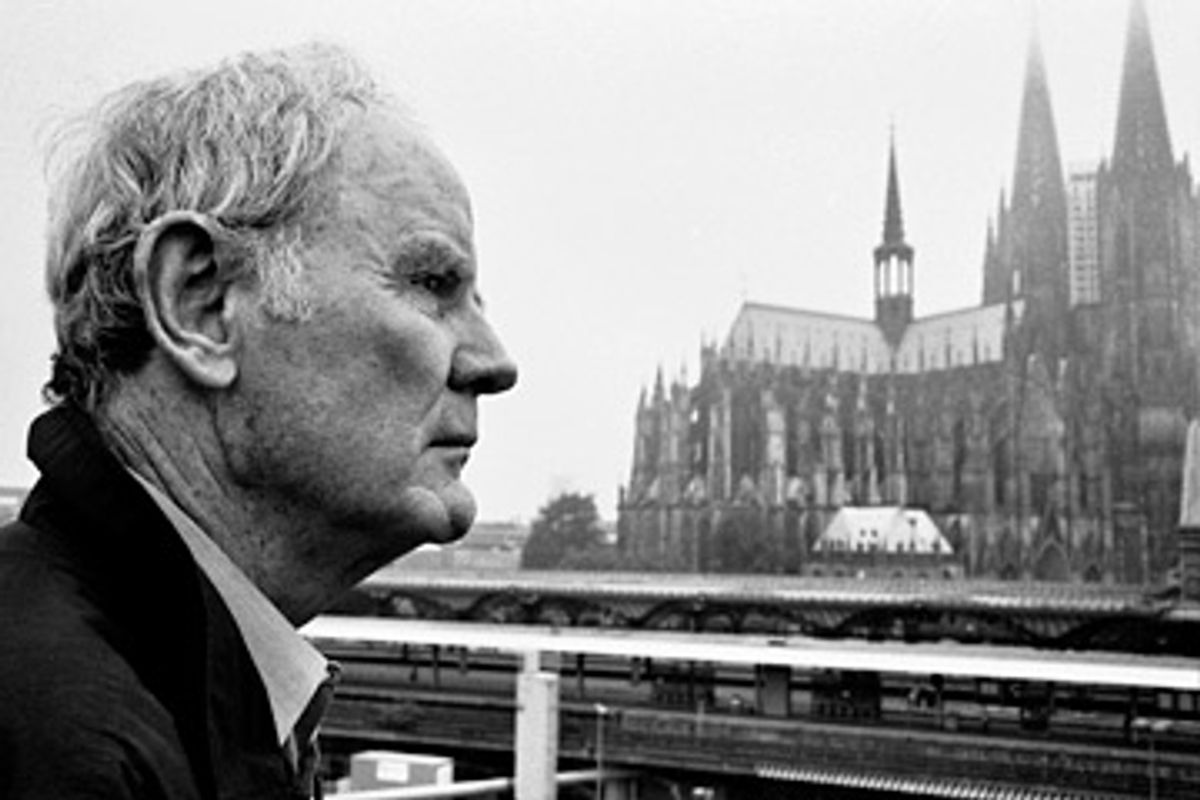
Author James Carroll in "Constantine's Sword," the documentary based on his book.
Partway through my conversation with James Carroll about the Roman Catholic Church and its long history of religious intolerance and anti-Semitism, the former priest turned bestselling author and journalist actually pauses to give Mother Church a break. "You know, you have to be as old as I am to appreciate how much the church has changed," he says. (Carroll is 65.)
"The church I was born into, the church of Pope Pius XII, was totally on the side of war," Carroll says. "In the Cold War, the Vatican was a staunch ally of the better-red-than-dead impulse, and for the first half of the 20th century the church was consistently on the wrong side of history." (As I told Carroll, my own father, who was raised in Ireland in the 1930s, remembered the church collecting pennies for Francisco Franco, so he could carry on the fight against godless communism.)
But in the early 1960s, Pope John XXIII issued an encyclical challenging the idea that there could ever be a just or righteous nuclear war, and for the last 40 years the Vatican has been a vocal critic of all the overseas military adventures launched by the United States. That draws Carroll's attention back to the day's news, and to his mounting sense of irritation -- and something deeper than that -- with the current pope. "I don't know why Pope Benedict doesn't make that an issue on this visit," he says, his ire audibly rising. "I don't know why he insists on celebrating George W. Bush, a man who is presiding over an outrageous, unjust war. That strikes me as totally inconsistent with the positions the Vatican takes."
Carroll is forever appointing himself the task of demanding that the church live up to its own ethical and rational standards, and forever finding it impossible. As with all true Christian martyrs, his passion is born of love. He is frequently attacked by the Catholic League and other defenders of the faith, but Carroll is no outsider. Although he left the priesthood in 1974 (he is married to novelist Alexandra Marshall and has two grown children), he is still a Catholic, still a communicant and still a weekly Mass attendee.
In his role as the peripatetic narrator of director Oren Jacoby's new documentary "Constantine's Sword," a travelogue-style film adaptation of Carroll's magisterial book of the same name, Carroll cuts a deceptively mild and scholarly figure. But the word he keeps using, in his prose, in the movie and in conversation, is a weighty one: "reckoning." Carroll believes that Christians, and especially his fellow Catholics, must come to grips with the past. They can't claim to be a force of morality and integrity until they face the church's painful history of anti-Jewish libel and persecution -- and face it in what he terms a spirit of "repentant change."
The culmination of Christian anti-Semitism, of course, arrived under the Nazis, but "Constantine's Sword," as its title may suggest, is at least as much about the Roman and medieval eras as about the Holocaust. At 96 minutes, Jacoby's film cannot accommodate all the extended digressions into history, mythology, geographical rumination and personal reminiscence that make Carroll's book (at 700-odd pages) such a rich and absorbing experience; it's more like a highlights tour of his worldview. He travels from Rome to the Rhineland, from Auschwitz to Colorado, interviewing biblical scholar Elaine Pagels, former U.S. Sen. Gary Hart and megachurch pastor Ted Haggard (just before his male escort-related fall from grace), among many others.
Carroll's objects of contemplation are various and his approach is always sober and reflective. He finds the roots of anti-Semitic violence in the Emperor Constantine's sudden conversion to Christianity, which came in a vision as he was crossing a bridge over the Tiber. He visits the tomb of St. Helena, Constantine's mother, who purportedly went to the Holy Land and brought back the True Cross. He visits the medieval German towns that Crusaders purged of Jews on their way to kill Muslims in Palestine, finds a letter of warning that Jewish philosopher-turned-Catholic saint Edith Stein wrote to Pope Pius XII in the 1930s, and considers his own trajectory. The son of a leading conservative Cold Warrior, Carroll became an antiwar activist as a Boston University chaplain in the early 1970s. (As readers of Carroll's memoir "An American Requiem" already know, his father was an important Air Force general and head of the Defense Intelligence Agency.)
Along with the 2000 bestseller "Constantine's Sword" and the National Book Award-winning "An American Requiem," Carroll is the author of many other books, including "House of War," his 2006 "biography" of the Pentagon (the building where he spent much of his childhood), the 2004 "Crusade: Chronicles of an Unjust War" and several novels. He is also a columnist for the Boston Globe, and spoke to me from his home in that city.
Is it just fortuitous circumstance that your film is coming out now, while Pope Benedict is making his first visit to America?
It's a total coincidence that the film is being released on the day the pope is visiting New York -- in fact, on the day he visits a synagogue [on Manhattan's Upper East Side]. It's certainly an evocative moment.
That's a powerful symbol, and of course John Paul II made similar gestures. In your judgment, how far has the church hierarchy come in confronting anti-Semitism within the church?
As I think the film makes clear, I think it's come a considerable way. I regard Nostra Aetate, a declaration of the Second Vatican Council [on the church's relationship with non-Christian religions], as a huge, unexpected transformation of Christian and Catholic theology. The question that remains is to what extent the hierarchy of the church will fulfill the promise of Nostra Aetate, or whether it's even going to roll it back. A couple of signals from Benedict are cause for questions, if not more than that. I'm thinking of his reauthorization of the prayer for the conversion of the Jews.
As part of bringing back the Latin Mass, you mean.
That's right. That may seem like an issue of good manners, but it goes much deeper than that. Nostra Aetate did two things: It renounced the Christ-killer charge against the Jews, but it also affirmed the permanent validity of God's covenant with Israel. Judaism is not an obsolete religion. That's an absolute repeal of a basic Christian principle, and it's hugely important, the affirmation that Jews have this covenantal relationship with God. And the corollary is that it's no longer necessary or proper for Christians to proselytize with Jews, trying to get them to be baptized. That's a huge change, and an extremely important one.
People who only watch my film with one eye think it's tracing a dark history. But with the other eye, it really puts on the record this tremendous act of repentant change that the Catholic Church accomplished at the Second Vatican Council. It's hugely important that it be carried through, and not be rolled back. That involves two things: The church's willingness to reckon with the history of Christian anti-Semitism, and to fulfill the theological change of Nostra Aetate.
In the film, I raise the question of whether Pope Benedict is stepping back from a full reckoning with the full history of Christian anti-Semitism. I was bothered when he spoke at a synagogue in Cologne and laid the responsibility for Nazi anti-Semitism on what he called neo-paganism [the official Nazi religion]. That's just gravely inadequate. For a German pope to do that -- I just felt obliged to lift it up. The news media didn't pay attention to that. But Catholics and Jews who've been part of the Jewish-Christian dialogue recognized that as a troubling signal.
It'll be interesting to see what the pope says at the synagogue in New York. He'll have to address the history of Christian anti-Semitism in some way, and he'll probably have to address the Holocaust. When he went to Auschwitz, a few months after speaking in Cologne, he also manifested a very incomplete notion of Christian history in relationship to Auschwitz. Both in what he said and in the incredibly troubling symbolism of the people he greeted there.
There were 30 Auschwitz death-camp survivors present when the pope went there, and he greeted them. It was very moving; it was beautiful. But, astoundingly, 29 of the 30 were Polish Catholics. One of them was a Jew. Actually, a couple of hundred thousand Polish Catholics died at Auschwitz, and they should be remembered, absolutely. But a million Jews died there, and to treat Auschwitz as if it's some kind of ecumenical grave site and not the center of the anti-Jewish genocide is a big problem. A big problem.
You know, when Catholics and non-Catholics look at the personal histories of the last two popes, it's difficult to avoid seeing major differences. John Paul II suffered under the Nazi occupation of Poland and was known to have helped Jews seeking refuge. His record in that context was impeccable. Benedict was a member of the Hitler Youth and then a German soldier. Is it totally unfair to draw conclusions from that?
I wouldn't hold Benedict responsible for the situation he found himself in as a teenage boy. There wasn't a lot of freedom of choice in Nazi Germany. My questions have to do with the ways that youthful experience does not seem to have left him prepared, compared to John Paul II, to accomplish the kind of reckoning that he needs to accomplish.
Abstracting from Benedict, I would say that it seems bizarre to me that at the beginning of the 21st century the cardinals of the Roman Catholic Church elected a German man with a personal connection to the Third Reich. That's separate from a personal criticism of Benedict, but the symbolic significance of that election is astounding, I would say. Then to have that German pope showing signals of stepping back from that history is bothersome.
When I checked out "Constantine's Sword" from the Brooklyn Public Library, it was sitting on the shelf right next to the book about religious tolerance ["Truth and Tolerance: Christian Belief and World Religions"] that Benedict wrote when he was Cardinal Ratzinger.
That is interesting, especially because his approach to tolerance is limited. He really is reasserting what I regard as outmoded claims to the triumphal superiority of pope-centered Roman Catholicism. All other Christian denominations, not to mention other religions, are inadequate and inauthentic ways to God. That's also an astounding signal, coming from a pope after the Second Vatican Council. He was much more forthright about taking those positions as Cardinal Ratzinger than he has been as Pope Benedict, at least so far.
Along with meeting Jewish leaders and visiting a synagogue, Benedict is also supposed to meet with various American Muslim, Buddhist and Hindu leaders. What is he likely to say to them?
I don't know. His record with Islam also raises major questions. Not just the Regensburg speech a couple of years ago [in which Benedict invoked a 14th century characterization of Islam as "evil and inhuman"], but also the tone-deafness and insensitivity of his baptizing Italy's leading Muslim.
Wow! I don't know about that.
This was at the midnight Mass during the Easter Vigil at the Vatican -- perhaps the most visible Mass of the year -- where it's the tradition that converts are baptized. One of those singled out for the privilege of being personally baptized by the pope was a man who's famous in Italy, a significant newspaper columnist who was a Muslim and a critic of radical Islam. His own spiritual journey has brought him into the Catholic Church, and I don't second-guess that. But why was he chosen to be given this high-profile baptism at the Easter vigil? Muslims have to take that as a triumphal signal: Look who we got!
You know, many of our readers are going to be wondering, at this point, why you have stayed in the church, given all this history. I'd like to hear you state your affirmative reasons for remaining a Catholic, both personally and in broader terms.
Well, it's both personal to me and something broader. Let me first say that I stay in the Catholic Church in exactly the same way and in the same mood that I stay an American. I have no more complaints against the church than I have against the United States of America. I am American, and I am Catholic. I am Catholic for two reasons, one deeply personal: I'm at home in this community. Even as fully aware as I am of its flaws, it just makes me feel more at home, because I'm aware of my own flaws. I got over, a long time ago, the idea that the church was above the human condition. I'm religious, and I especially value celebrating the mass with my fellow Catholics, wherever I happen to be on a Sunday. It can be full of very conservative people, and I feel completely at home and completely connected with them. I will hear, and mostly I do hear, sermons that are insulting to the intelligence, but the nurturing goes on far below that.
The second reason is that the church is worth fighting for. It's the largest NGO in the world. Its reach is unlike any other organization. It goes across the boundaries of north and south, rich and poor, illiterate and high-tech, ancient, modern, fundamentalist and postmodern. It's an extremely consequential institution. And whether or not it goes fundamentalist in the 21st century is a matter of war or peace.
Fundamentalist religion is a threat to world peace, and the Catholic Church, which is not traditionally fundamentalist, could become one of those fundamentalist Christian responses to the postmodern world. If it does, it's a catastrophe. There's not going to be any peace in this century if there isn't piece among religions, and the Roman Catholic Church has a huge role to play in that. I find it an extremely compelling thing to do with the rest of my life, to represent the reformed, enlightened, rational tradition of the Roman Catholic Church and argue for it.
"Constantine's Sword" opens April 18 at the Lincoln Plaza Cinemas and Quad Cinema in New York, with national release to follow.
Shares