

Clotaire Rapaille is a controversial, often outrageous figure, an anthropologist turned marketing guru and Frenchman turned American. From his flamboyant appearance (he swans around in a cravat and black velvet frock coat, drives a Rolls-Royce, plays polo and lives in a restored industrialist's mansion in Tuxedo Park, N.Y.) to his sweeping pronouncements on the "archetypes" underlying various national cultures, he tends to elicit either rapt attention or dismissive scorn. Academics write him off as both irrational and behind the times, rival market researchers accuse him of being simplistic and a shameless self-promoter -- but an impressive roster of Fortune 100 companies have engaged his services and come back for more again and again.
Rapaille's method involves a three-stage focus group process, one that starts with the rational aspect of the participant's experience -- the "cortex" as Rapaille calls it -- then moves on to a more creative, storytelling portion targeted at the "limbic brain." The final stage, during which the participants are encouraged to lie on comfy cushions and dig down to their earliest memories of "cars" or "coffee" or even "seduction," is the only one that really counts for Rapaille. These sessions allow him to tap into what he calls the "lizard brain," a center of primal impulses, needs and memories that he calls "imprints." When it comes to decision-making, we may offer excuses from the cortex ("I want a car with great safety features"), but what really motivates us are the primitive emotions of the lizard brain ("I want a car that makes me feel free and strong").
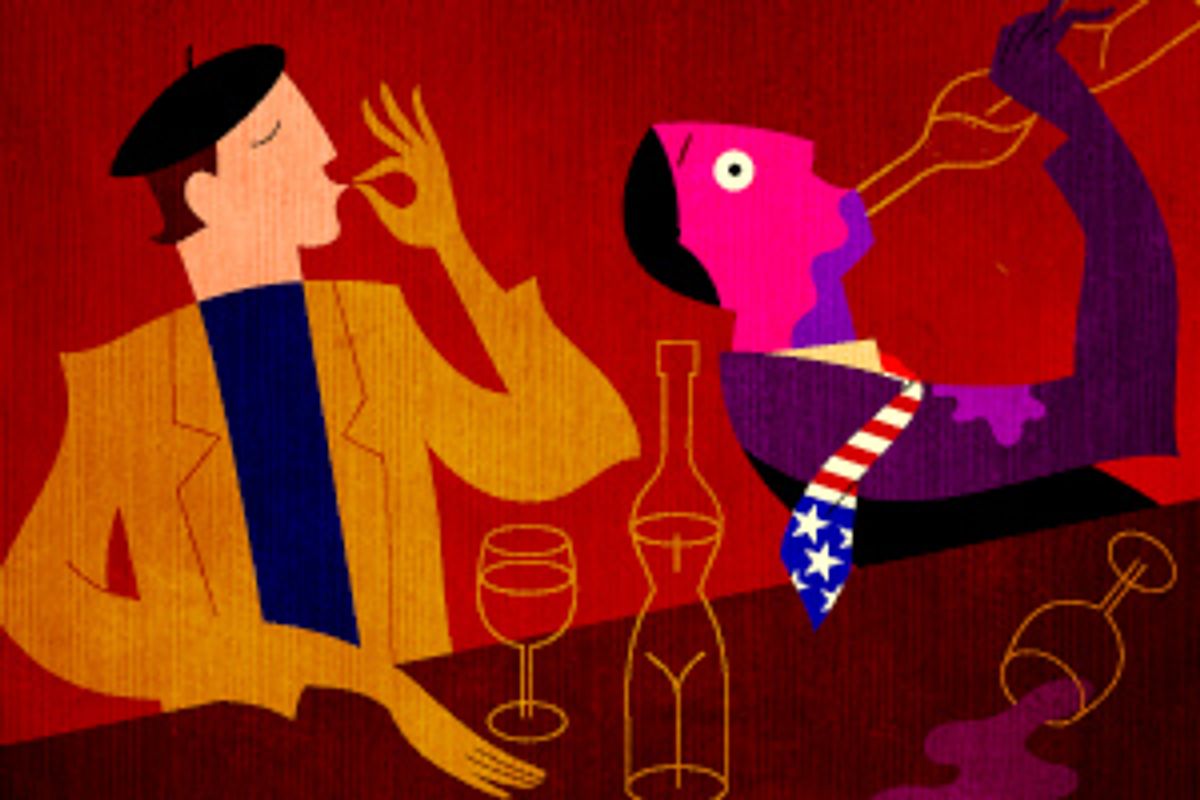
Rapaille's latest book, "The Culture Code," offers a few fairly predictable (if not necessarily inaccurate) conclusions, such as the fact that Americans view money as a badge of personal worth and one's work as "who you are." But some of the code pairings have a startling, metaphorical potency that feels genuinely insightful. "The American Cultural Code for alcohol is GUN," he writes, explaining that the American association of alcohol with danger and transgression, and of alcoholic drinks as primarily a path to intoxication, baffles the people of his native France, who see wine as an art form to be savored. Rapaille grew up in France during World War II, and moved to America as an adult, but he considers himself to be American at heart and his upbringing has given him a valuable perspective on his new home. "You can't really understand one culture unless you understand other cultures and compare," he states. Salon called up the richly accented Rapaille at home, and then later on his BlackBerry as he sped down Route 4, to hear his thoughts on love American-style, what a politician needs to do to win the White House and why religion in the U.S. is just like Disney World.
One of your theories is that the most powerful emotional "imprints" people received occur in their childhood. You spent your childhood in France, presumably receiving a lot of French cultural imprints, yet you consider yourself an American.
If I go back to my first experience during the war in France, the Germans were running the show and the French were trying to escape or survive. Then one day, I saw the Germans throwing off their helmets and running away. An American tank came out of the forest, with a white star. I remember the colors, the smells, everything. Then a big guy came out of the turret, and gave me chocolate and chewing gum and took me for a ride! How can you beat that? My imprint was that I wanted to be in that tank, to be those guys. I didn't want to be with the French, these losers. At school they tried to imprint me the French way, saying General de Gaulle liberated France. I said: I'm sorry, he wasn't on the tank.
These imprints are so strong that they dominate the others. Now I still have some French imprints. My relationship with cheese, food, love and women is very French. But there are some elements of me that make me more American than many Americans. An issue that is very unique to America is that you can choose to be American, but you cannot choose to be German or French, which is why they have so much trouble with immigrants over there.
So you believe that through an affinity with a culture, and an early positive imprint of it, and then immersing yourself in it as an adult, you can absorb some of those imprints even though you're not a child?
Exactly.
I went back and forth reading this book between scoffing at some of your statements as simply cultural stereotypes and finding them illuminating. A lot of your critics have accused you of trafficking in stereotypes. Do you make a distinction? How do you answer those criticisms?
This is a usual criticism I have. People say it's simplistic, cliché and stereotype. I make it clear in the book that I'm not telling you everybody is like that. There are people in France who are not arrogant. Not many, but some. You can find Americans who are not interested in money. I'm not telling you everybody is the same. We have what I call a reference system that's available to everybody in a given culture. So when we speak about killing yourself, for example, you never find an American man going to the kitchen, taking a kitchen knife and intentionally opening his stomach. That reference system is not available in American culture. In Japan a few months ago, three bankers who were bankrupt went to a hotel and opened their stomachs with swords. I'm not telling you that every Japanese is going to kill himself this way, but this is available.
Stereotypes never exist randomly or by accident. There's a reason why they are there. The first reaction is to say that the Italian is a good lover, the French is an arrogant guy, the American is materialistic. These are the clichés. The reality is that behind that you have some tensions. The American might be very materialistic, but the other side is that we are very idealistic. We give so much to charity and are so concerned with religion. We are concerned about the spiritual dimension all the time.
You say that these things change very slowly.
Yes, very slowly.
What about fashions? You've advised the manufacturers of SUVs and other big vehicles, but more energy-efficient cars do seem to be coming back into vogue. Do you think that's a significant change?
In America, we want big, powerful cars. That is the reptilian brain of America. Then the cortex says, "That's not intelligent. We're using too much gas." And at certain times of crisis, people will go to smaller cars or hybrids. As soon as we have the power, we will go back to big ones. This is the American frame of mind. When is your house big enough? Never. When do you have enough money? Never. When is your car big enough and powerful enough? Never. There's a market for big cars in the future.
Now we can still be clever and have big cars that are efficient, of course. The small, hybrid car is for when we are poor. If we have the money, we go to the big car.
You describe America as an adolescent culture, and that idea is not unfamiliar to many of us. What does it mean to you?
You have a series of elements and when you look at them all together, they tell you the same thing. For example, we never look at instructions. We never plan. The Iraq war is an example of that. We always want the short-term, quick fix. This is a stereotype, of course, but it's really true in the sense that we have the repetition of this pattern again and again. We are very uncomfortable with sex and have no sex education with our children, just some anatomical education. We have a hard time with our children because how can adolescents raise adolescents? I don't want to know what I'm going to do when I grow up even if I'm 75 because I don't want to grow up. I want to have fun, to be rich and famous now, to play. Now, I choose to be American because I'd rather be part of an adolescent culture than a senile culture.
You feel that France is a senile culture?
Oh yes, they're almost committing suicide right now. They're destroying themselves.
To be an American you have to have a big dream, for you, for your family, for the world. In some other cultures, this is just ridiculous: Save the world? I just don't want rain tomorrow. On the other hand, because we don't know it's impossible, sometimes we do it.
You say that a Frenchman says, "I think," while an American says, "I do." How do you reconcile this immediate gratification impulsiveness with the famous American industriousness?
For an American, if you think too much something is wrong with you. Yet there is this ability to do things, and that's because we learn by making mistakes. I did a lot of research about quality, comparing Americans with the Japanese. Americans don't want to do it right the first time the way the Japanese do. I don't mean consciously, but if I do it right the first time, then what do I do next? What do I learn? In this attitude, there is a lot of wisdom.
When it comes to hard work, in America there is an element that's like obsession. We are obsessed with proving ourselves. We work so hard because you have to make it, to prove who you are. We are in permanent search of identity. That's very American. It's why you have all these self-help books and all the people helping you to discover who you are. You can only discover who you are if you try. And you have to try and try and try and never give up. Always more.
So the energy and desire to prove oneself is behind the work ethic, rather than some mature notion of responsibility?
Absolutely. This is why people reinvent themselves so often in America, which I love. You can't do that in many other cultures.
Right now, most Americans are convinced that the nation is profoundly divided by this gulf between red and blue states. But you don't think it's that significant.
Well, there is a culture war, the nation is divided in many ways and so on. But the reality is that the differences are nothing compared to what we have in common. Especially compared to other cultures. There are more differences between Canadians than between blue and red state Americans. Americans may be in permanent search of personal identity, but the Canadians are in permanent search of a collective identity. As Canada, they don't know who they are. The French Canadians are not part of Canada and there are so many differences between Toronto and Vancouver that the people in Toronto say the people in Vancouver are part of California. The Canadians' anxiety is about how to survive as a country. A Canadian magazine had a headline that read, "If Canada Disappears Tomorrow, Would Anybody Notice?"
What about partisan politics in America? It seems particularly bitter at the moment.
Politics in America has a different code than in Germany, England or France. The Democrats and the Republicans say the same thing. After a while, they just say, for example, "We have to protect the border or deal with immigration and we just have different ideas about how to do that." The main goal is the same. In other parts of the world, you have different parties with completely different goals.
So what do you think the divide in America is about? Because people feel it very strongly.
I think we have two parts of the brain fighting it out. The blue people are supposed to be thinkers. But the majority of America, the people who drive a pickup truck with a six-pack in the back and a gun, they see themselves as the ones who are doing and making this country, not just sitting there thinking. They shoot first and ask questions later. The key notion for me is that the blue people think too much, and because they think too much they can't agree on anything.
President Bush seems to be working that kind of shoot-first, no-nonsense code, but the failure of his policies has made him very unpopular all the same. It seems like the ideal opportunity for the Democrats to step in and regain some ground, but hardly anyone seems to have much faith that they can pull it off. What do you think of their chances?
Here's one issue: Don't tell people, "Drive a smaller car." That goes against American culture. Say, "I'm going to do everything to make us energy independent." Independence is so American. We don't want to be dependent on all these crazy guys in the outside world. We want to be independent. And then we have to do whatever we have to do to become independent. A theme like that is very powerful, and Thomas Friedman wrote several articles about it but nobody is really listening to him.
We need a cultural leader, not just someone who says I can push a button and send atomic bombs to you. Someone who is proud to be an American and can present an image of America to the world. Not to impose our culture to the world, but we want you to understand it and we want to understand yours and respect each other. George W. Bush has not done that.
But doesn't he embody a lot of codes of American culture?
In some ways, yes, he is the cowboy and so on. But my position is that Bush never won an election. I'm not going into the controversy -- it's that the other guys lost. Kerry lost, Bush didn't win. Kerry should have won, that was so clear to me, but he did everything wrong. He didn't represent all the American culture and so we are left with President Bush.
Here's a suggestion: The whole idea of a can-do spirit is part of the American code, but it's more than just a confident attitude. You have to go on and actually get things done.
Exactly. Where are the results? When are the kids coming back home? Maybe you have the wrong plan over there in Iraq.
Of course you say that we don't like to plan, but that attitude seems a lot less bold when the result is failure.
Right, because John Wayne always does kill the bad guy. And then it's over, he won. When did Bush win?
You say the American code for the president is "Moses." What do you mean by that?
He is a leader in the most basic sense. He gets up and tells us he's seen a vision of the promised land and he's going to lead us there. You need a vision that people can identify with. That is very, very strong in most of the world, but in America it's stronger than anywhere else.
What do you think about the rise of Christian fundamentalism?
Religion in America is Disney World. We're not really serious about it the way the Muslims are. We just want some rituals, we have so many different brands of religion. We like the stories about it and talking about what they say and don't say. It's little stories for children. When in Kansas they try to stop the teaching of evolution, it's like at Disney World. If you are in the Mickey Mouse costume, the rule is that you never take off your mask. You're not supposed to show in public that there is a real guy under the mask. That's religion in America; let the people keep their illusions. Don't show the reality.
Now, because we are adolescent, we like to take things to extremes: extreme sports, extreme everything. Moderation is boring -- eating in moderation? No way. So we apply that to religion, too, religious extremism.
Some of the most startling codes you describe have to do with intimate life in America, subjects like love and sex. Once you got people to talk about some of their earliest memories and emotions about romantic love, you discovered that the American code for that was "false expectation." That's sad, but when I think about how people talk about their love lives in America, it's true that disappointment and disillusionment are very common themes.
The expectation in America is an adolescent expectation. There is a Mr. or a Miss Perfect out there somewhere, and I am going to meet this person and everything in my life is going to be changed and be good. We put so much expectation on the other person. There's infatuation when we discover them and think, "This is it!" It's perfect, fantastic. Then after a few months the love hormone leaves the brain and the reality starts showing up. So we say, "OK, I made a mistake, I chose the wrong person. I better find another one."
In other cultures, expectations are very different. For many centuries, love wasn't even part of the picture. Children would be married off by their parents at a very early age and it was families making close relationships with other families. This notion that everything should be coming from this one person is a very American, impossible dream.
I always say if you want to understand a culture, look at what the people do at 5 o'clock. In England, they drink some kind of hot water with an herb in it: tea time. In Spain, they kill a bull. The Americans have the happy hour, they get drunk. The French have cinq a sept, a very special thing, it's sexual. Men and women, who are married but not to each other, after work they go to a hotel and have sex. It's seen as experiencing pleasure with somebody else. For the French, life is about the refinement of pleasure. I'm not saying it's right or wrong, but the cultures do provide very different reference systems.
The American disillusionment with love, by the way, explains a little bit why we work so hard.
Because at least you get something out of working hard when maybe you feel like you've gotten nothing but heartache from love?
And because if you are desperately in love with three men and make love 10 times a day -- I'm exaggerating, of course -- you don't have much time to work.
That in itself could start to seem like work after a while! You also say the code for sex in America is "violence," which seemed facile to me at first because we tend to pair sex and violence as dangerous things. But really what you're saying is that people talk about their formative sexual experiences as emotionally wounding and battering, or as contests with winners and losers in which someone takes something from someone else, or as something they have to survive.
There is definitely something that is sad in this picture. This is, again, because there is no refinement, no culture, no teaching and no rituals in the American culture. Other cultures, like the Italian -- Italian men have a strong feminine dimension, which they are comfortable with. When we sell cosmetics in Italy we sell almost more to men than to women. They take care of their skin, their hair, they dress very carefully. They can relate better to women because of this feminine dimension. American men are not supposed to have this feminine dimension because that means they are homosexuals. The guy is supposed to score, to invade, to win, to possess. Italian men don't care so much about that. They want to enjoy the other person and the reciprocity. He is not so much concerned about winning. The game itself is a pleasure. That is why we have the cliché of the Italian lover.
You see something like this with the U.S. border. There is this fear of invasion, which if it happens means that the other one doesn't control his territory anymore and he loses. I found a book written 50 years ago by an American anthropologist who speaks about the battle of the sexes in America. Nothing has changed.
And the French?
The French have a different attitude. It goes back to the 18th century. It's refinement. You're supposed to be in search of the higher level of pleasure, whatever it is. In food, you always want to combine this with a particular wine because the purpose is not to fill up the tank, the way it is in America. In America, we say "Thank you, I'm full." There's no translation in France. It doesn't mean anything. You say it was delicious, talk about how exquisite it was.
In French dinner conversation, you never talk about money. If someone said, "I made a million dollars today," it's pornography. We always speak about sex, what do you do and how do you do that and how interesting. I know this club where they do this, and so on. It's amazing. It's normal conversation. Of course not everybody does it, but what is clear is that no one wants to talk about money. Lingerie is so French because women dress up for dinner and for sex. You turn down the lights, you put music on, have flowers. You have to take your time. Slow food was invented by the French, while Americans invented fast food. And fast sex.
You also say that the American code for overweight is "checking out."
The purpose to be thin is to attract a man to get pregnant. Then you have the baby and want to get skinny again, why? To get pregnant again. So finally you say, "Enough is enough, I am fat and I am going to stay that way. I don't want to get pregnant again." Add to this in America you have a tension between food and sex, which we know has the code of "violence." Women check out, they say they're not available anymore, they don't want to play this game. And if you push into being very obese, then people have to take care of you and you become a baby again.
And you also write that being obese can be a way of checking out of things like an active social life, family life and the intense American competition for success.
Yes, exactly.
Some other codes you describe include the code for female beauty, which you say is "man's salvation."
Men are supposed to transcend who they are when they fall in love. The woman's beauty, which causes this, is supposed to be inside and outside. It's almost like a divine mission, a doorway to the divine, and so there is supposed to be a purity to this beauty. It transforms the man.
It helps them transcend the combative nature of sexuality?
Right, the man surrenders. He gives up and stops trying to score. He leaves the fight. That's the salvation.
So it's not necessarily a sexy kind of beauty?
No, and this is very important, because then you would be manipulating the guy. And if you're manipulating the guy, he's not saved. It has to come from himself. American women are uncomfortable with being too sexy. You have to be sexy, but not too sexy. It is very, very difficult. I joke that if I come back one day as a woman, I don't want to be an American woman. It's too difficult.
In America, seduction is dishonest. In America, we say, "What you see is what you get," whereas in French culture it doesn't matter what you have, it's what you do with it.
It's an art and they're comfortable with that, while American women feel they should be natural.
Absolutely. Beauty is an art. Red is red and blue is blue. It is not the color of the paint that makes the painting. Americans think a woman should be what she is and not have any intentions behind that. In French culture, the only thing that is sexy is the intentions.
Shares