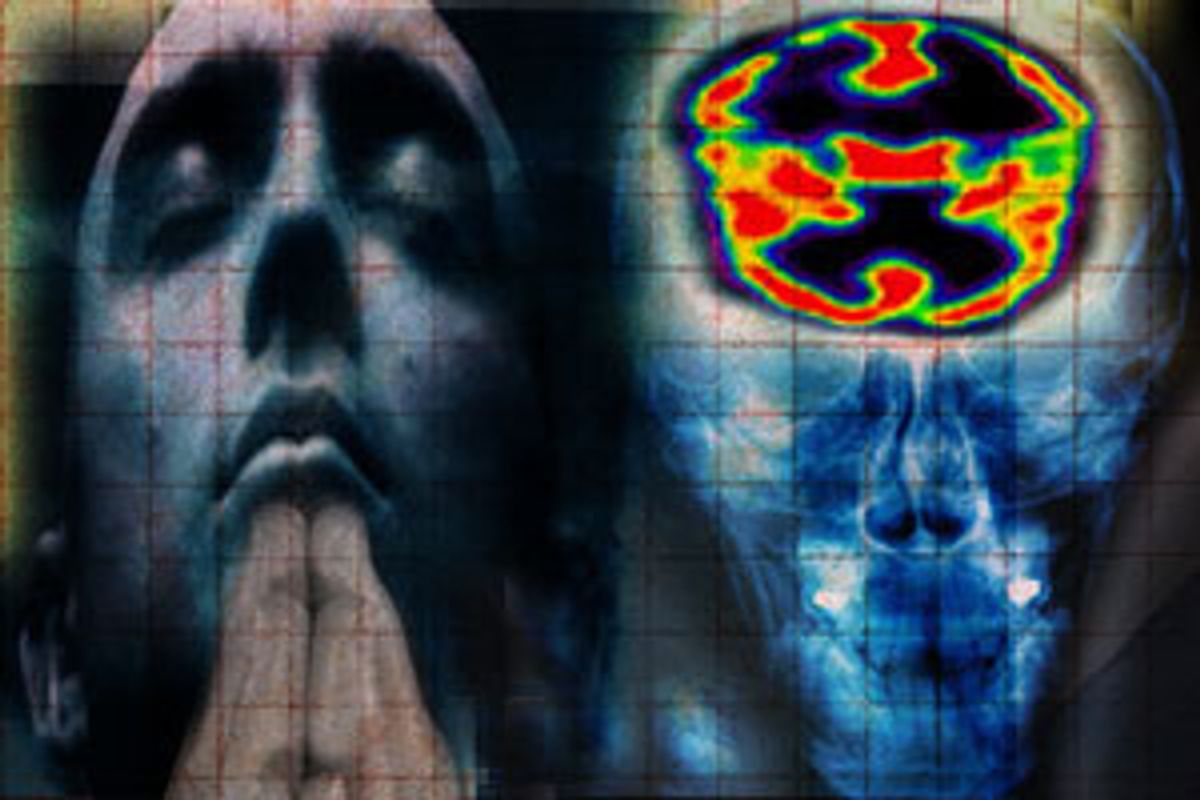
Can we actually see God in the brain? Well, not exactly. But a few enterprising neuroscientists have found ways to detect and measure the varieties of our religious experience. Using brain scanning technology, researchers have been able to pinpoint which parts of the brain are activated during prayer and meditation. While they can't answer the biggest question of all -- does God exist? -- they are probing one of the deepest mysteries in science: the nature of consciousness.
They're also wading into a thorny issue in the science and religion debate: the connection between brain and mind. Most neuroscientists assume the mind is nothing more than electrochemical surges among nerve cells in the brain. But neuroscientists who study spirituality tend to be open to the possibility that the mind could exist independently of the brain. Some even question the materialist paradigm of science -- the idea that the only reality worth studying is what can be tested, quantified and reproduced. They wonder whether current scientific methods will ever be able to explain consciousness. But others are skeptical. Stephen Heinemann, president of the Society for Neuroscience, recently told the Chronicle of Higher Education, "I think the concept of the mind outside the brain is absurd."
One of the pioneers in the new field of neurotheology is Andrew Newberg, a 40-year-old physician at the University of Pennsylvania and director of the Center for Spirituality and the Mind, who has just published a book, "Why We Believe What We Believe: Uncovering Our Biological Need for Meaning, Spirituality, and Truth," written with his colleague Mark Robert Waldman. Over the last decade, Newberg has conducted a series of brain-imaging studies of various spiritual practitioners, including Franciscan nuns, Buddhists and Pentecostal Christians who speak in tongues. His lab research has brought some surprising -- and curious -- results. For instance, during his study of Pentecostals, Newberg was amazed to see one of his own lab assistants start to sing and speak in tongues. It turned out that she had been doing it as part of her own religious practice for almost 10 years. Newberg himself hasn't joined any organized religion, but he's clearly been influenced by various contemplative traditions.
Newberg uses an imaging technique called single photon emission computed tomography, which measures blood flow in various parts of the brain. More blood flow, of course, means more brain activity. In his studies, Newberg has found that there's no single part of the brain that controls all religious experience. In fact, a specific religious belief will shape a person's spiritual experience -- and what happens in his or her brain. And while his research falls short of proving the presence of God, it does show that engaging our spiritual selves can have profound effects on our biological selves, too.
I spoke with Newberg by phone about his brain-imaging studies, the nature of mystical experiences, and whether scientists will ever crack the mystery of consciousness.
Do you think the human brain is hard-wired for religious belief?
Well, I think the brain is structured in such a way that we can very easily have religious beliefs and spiritual experiences. But the problem with the term "hard-wired" is that it implies that someone or something did the hard-wiring. And I'm not sure that I can say that. When we look at how the brain is set up to help us understand our reality, it's very easy to see how we have different types of spiritual experiences and feelings of transcendence. And ultimately, this spills over into our ability to form religious concepts. So our brain is always asking those questions, which often wind up resulting in a spiritual or religious quest.
In your book, you say God may exist but we can only experience God through our brain. Can brain-imaging technology actually tell us much about the experience of the divine?
It certainly can tell us what happens in our brain when we have a religious or spiritual experience. For example, in our study of Franciscan nuns during prayer, our brain scans show what happens in the brain if they experience being in God's presence. What those scans don't prove is whether or not that experience was real in some sort of objective sense -- that God really was in the room, communicating with them. At this point in our technology, that is something we can't answer. Whether we will ever be able to answer it, I don't know.
You studied Franciscan nuns who had prayed for decades, and you also studied Tibetan Buddhists who'd meditated for many years. What happened when they came into your lab?
We found that the Franciscan nuns activated several important parts of the brain during prayer. One part was the frontal lobe. I've been particularly interested in the frontal lobe because it tends to be activated whenever we focus our mind on something. This can be very mundane, like focusing on a problem we're trying to solve at work. Or it can be focusing on a phrase from the Bible, which was happening with the Franciscan nuns. They would focus their attention on a particular prayer of great meaning, and they'd begin to feel a lot of unusual experiences. They would lose their sense of self. They would feel absorbed into the prayer itself. They'd no longer see a distinction between who they are and the actual prayer process itself. Some people call it a feeling of connectedness or oneness.
Another part of the brain that changes in the prayer state is the parietal lobe. This is located toward the back top part of the head. The parietal lobe normally uses our sensory information to create a sense of our self and relates that self spatially to the rest of the world. So it's that part of our brain that enables us to get up out of our chair and walk out the door. We've hypothesized that when people meditate or pray -- if they block the sensory information that gets into that area -- they no longer get a sense of who they are in relation to the world. They may lose their sense of self, and they feel they become one with something greater -- ultimate reality or God.
Do the Buddhists have that same sense of oneness when they meditate? Was the same thing happening in the brain, even though Buddhists don't believe in God?
We did see similar changes. In both prayer and meditation, we see a decrease of activity in this orientation part of the brain. So when the Buddhist meditators feel a blending in or absorption with the visual object -- in this case, they're doing a visualization technique -- we see a similar change. And it raises some very intriguing issues. How similar are these different practices? Are they associated with similar or different changes in the brain? When these practitioners had the same kind of experience -- a feeling of oneness or an experience of focusing the mind -- we saw very similar changes in the Buddhist meditators and the nuns. But one difference was the nuns actually activated the language areas of the brain. Of course, that made sense because it was a verbal practice. They were focusing on a prayer, whereas the Buddhist meditators activated the visual areas of the brain because they were focusing on a visual image -- a sacred object they would hold in their minds.
This is fascinating. You're saying once you get past a few specific differences, the same kind of thing seems to be going on in the brains of the Buddhists and the nuns. Both have a sense of oneness and that oceanic feeling that the mystics have talked about for centuries, even though their metaphysical systems are quite different.
Exactly. And part of why I've been doing this research for the last 10 years is to see where the similarities are. I think one of the great equalizers, in many respects, is the human brain. If you go anywhere in the world and take a person's brain and slice it up and look at it -- as a lot of medical people do -- you will see a lot of the same basic structures and connections and functions.
Clearly one thing you've done is to show there's nothing delusional about spiritual or religious experience. This is a normal thing happening in the brain. But I'm wondering if there's anything especially spiritual about these experiences. Could an intensely pleasurable experience -- say, sex or great music -- produce similar brain activity?
To a certain extent, I think it can. When we look at how the brain works, it has a limited set of functions. So if one has a feeling of euphoria -- whether one gets that through sex or religion or watching your team win the championship -- it's probably going to activate similar areas of the brain. There's a continuum of these experiences. People can describe a religious experience as being anything from a mild sense of awe to a profound mystical experience, where the person changes fundamentally how they understand the whole world. Now, religious or spiritual experiences do seem to be among the more complex sets of experiences. When somebody meditates, it involves a lot of different parts of the brain. There's not just a religious part of the brain. And that makes sense when you look at the richness and diversity of these experiences.
But I think you're also asking one of the most important questions: Are we really capturing something that's inherently spiritual? This is a big philosophical question. If the soul or the spirit is really non-material, how does it interact with us? Of course, the human brain has to have some way of thinking about it. Perhaps the most interesting finding I could have would be to see nothing change on the brain scan when one of the nuns has an incredible experience of transcendence and connectedness with God. Maybe then we really would capture something that's spiritual rather than just cognitive and biological.
You also did a study of some Pentecostal Christians who speak in tongues. What happened when you hooked them up to your brain-imaging technology?
Well, this was a fascinating study for me personally. One of the problems I have with the meditation studies and the nun studies is that what they're doing is all internal. So you see them sitting in a room, but you're missing the big fireworks. It's a much more fascinating experience to watch people who speak in tongues. They're moving and dancing and making vocalizations that are incomprehensible to the rest of us. And we found some very unique differences from all the meditation states that we'd seen. We saw an actual decrease of activity in the frontal lobes. They are not really focusing their attention on the practice of speaking in tongues. They actually lose their attention. They feel they are no longer in control of what's happening to them. And we think that may be associated with this drop of activity in the frontal lobes.
When the Franciscan nuns prayed, they activated the language part of the brain. Was that true with the people who spoke in tongues?
We did not observe that. That also is intriguing. Speaking in tongues is a very unusual kind of vocalization. It sounds like the person is speaking a language, but it's not comprehensible. And when people have done linguistic analyses of speaking in tongues, it does not correspond to any clear linguistic structure. So it seems to be distinct from language itself. That's interesting because we did not see activity in the language areas of the brain. Of course, if somebody is a deep believer in speaking in tongues, the source of the vocalizations is very clear. It's coming from outside the person. It's coming through the spirit of God.
So what did you find most significant about that study?
The most fascinating result was that it represented a very different type of spiritual and religious state than what we saw during prayer or meditation. We saw very different changes in the brain. Different types of religious practices and beliefs seem to be associated with different changes in the brain.
I have to ask, do you meditate?
I don't do a formal type of meditation. A lot of why I got into this research area in the first place was because of my own exploration of how we understand reality. I was very intrigued by what our brain, what our mind could find out about our world. It started out as a very Western-based, scientific approach. But as I proceeded down this path, my own thinking became much more contemplative and, in many ways, became a meditation type of practice. So while I personally don't do a formal Tibetan Buddhist or Zen meditation, I do look at contemplative practices. And it's given me a better understanding of what people are actually doing when they engage in these practices.
We have to recognize the limitations of science. It's great for understanding that a certain medication is helpful for patients with a certain disease, but it may not be helpful for trying to crack the nut of human consciousness. And we may really need to develop a new kind of science -- or at least a new approach to science -- that would keep the strengths that science already has, but add a new layer to it that has to do with subjective experiences and contemplative approaches.
One thing that's difficult about this whole subject is the language we use. We've used words like "transcendent" and "mystical" and "spiritual." Do they all mean the same thing?
Well, throughout this discussion we've been talking about spiritual and religious experiences in the same way. And that may or may not be accurate. I've come to realize that everyone defines those experiences a little bit differently. So if I asked 15 people, what does spirituality or God mean to you, I would probably get a different answer from each person. But a lot of people will describe spirituality as having something to do with a sense of the self connected to some greater reality. Whether they ultimately call that a spiritual realm or some deeper interconnectedness of all things in the universe, there's that kind of similarity.
There is a history of defining some of these words in very specific ways. Didn't William James define "transcendence" as something quite rare -- experiences that are not reproducible?
That's true. People talk about transcendence as being indescribable or ineffable. And they've tried to use certain kinds of ideas or emotions to describe it. But that's part of the problem. A lot of these experiences are indescribable. It's like trying to explain what love is -- what it means to say you love your spouse or your child. How does one describe that? We can talk about words but it's harder to get at what exactly that experience is about.
Well, it raises interesting questions. In the William James definition, the Buddhist meditators and Franciscan nuns in your lab were not having a transcendent, once-in-a-lifetime experience. This must be a problem for you as a neuroscientist. I'm sure you'd love to see this kind of experience in your lab, but it's highly unlikely you'll ever get a brain scan with someone who has one of these truly profound experiences.
That's true. That is a great challenge for us to figure out how to capture this very rare, mystical experience. The way we've established our research is to look at a whole continuum. So even though the imaging studies we've done haven't specifically measured or captured a mystical experience, the changes that we see support an overall model that we've been developing over the years. Different parts of the brain may be involved when someone has one of those truly unique, life-altering kinds of experiences.
Would you be willing to speculate here? Suppose you could somehow record what the medieval mystics like Meister Eckhart or St. Francis talked about -- these truly big, profound experiences? What's your guess as to what happened in their brains when they had those experiences?
I think the orientation part of the brain would be profoundly affected. So while we're seeing decreased activity in this orientation part of the brain during prayer, for example, I think if somebody had a true mystical experience, we would see a vastly greater change -- to the point where there would be a complete loss of their sense of self in relation to the world. Now, one other aspect of the overall function of the brain that we haven't mentioned is the autonomic nervous system that regulates our arousal and our quiescent responses in the body. What we have hypothesized is that in these peak states, there is a simultaneous activation of both this very profound sense of arousal and alertness and also a deep sense of oceanic bliss and calmness. Maybe someday, if we're fortunate enough, that could actually be captured on a brain scan.
There's a fundamental mystery in all of this research you've been describing. A religious person might call a mystical vision a gift from heaven, while a neuroscientist would say it's just an electrochemical surge firing in the brain. Is there any way to resolve this question?
Well, I think there is. We really need to look not just at what science has to say, but what the subjective nature of these experiences are, what the spiritual side has to say. And it's been my goal to get people to look at both of these perspectives. What is the reality of those experiences -- that's really what the question is. Is it really a spiritual reality, or is it just a biological one?
This is essentially the question that divides atheists from religious believers.
Exactly. I think it's something that could be answered at some point. But it really requires a philosophical and consciousness perspective, as well as a biological perspective. What we have to be careful about is explaining away those experiences just because we capture something in the brain that's associated with these experiences. It's possible that we might be able to explain it away at some point, but at this time, I don't think we can.
I often get asked, could we just develop a drug that makes people spiritual? Well, that already exists. If you look at shamanic cultures throughout the world, many use different substances that don't diminish their experiences at all. It doesn't become just a drug-induced state that affects their physiology. It's their way of opening up their brain as a window into the spiritual realm. Again, I think it ultimately comes down to the belief systems that we hold.
Would it ever be possible to devise some kind of brain-imaging test to get at the question of whether there is some reality outside of us? That's really what we're talking about: some larger intelligence -- God or some divine presence. Could we determine whether there's something that's not just in our brains?
I think it would be very difficult. I never want to say never, but the problem is that all of science is something that we as a conscious observer look at and interpret. So we never really get outside of our own mind to look at what's out there in reality. On the other hand, let's say we get lucky enough to see an experience where someone does feel they get beyond the brain, where they feel intimately interconnected with the universe or with God. And we see whether or not that is always associated with something going on biologically or whether there's ultimately something that happens beyond simply the biological. That's why I think we always need to consider both the scientific perspective, but also, what consciousness is all about and how the conscious mind interprets the world. I think it's possible, but it's very complicated. Could we design an experiment to do that? I think it's very hard to do without making a lot of assumptions that ultimately will explode the research and foul us up in our science.
There's a basic metaphysical question here: Does consciousness exist outside the brain? Do you want to weigh in on this?
Well, at this point, there isn't an answer. I'm open to both possibilities. I don't think we have enough information to be able to say one way or the other.
Shares