

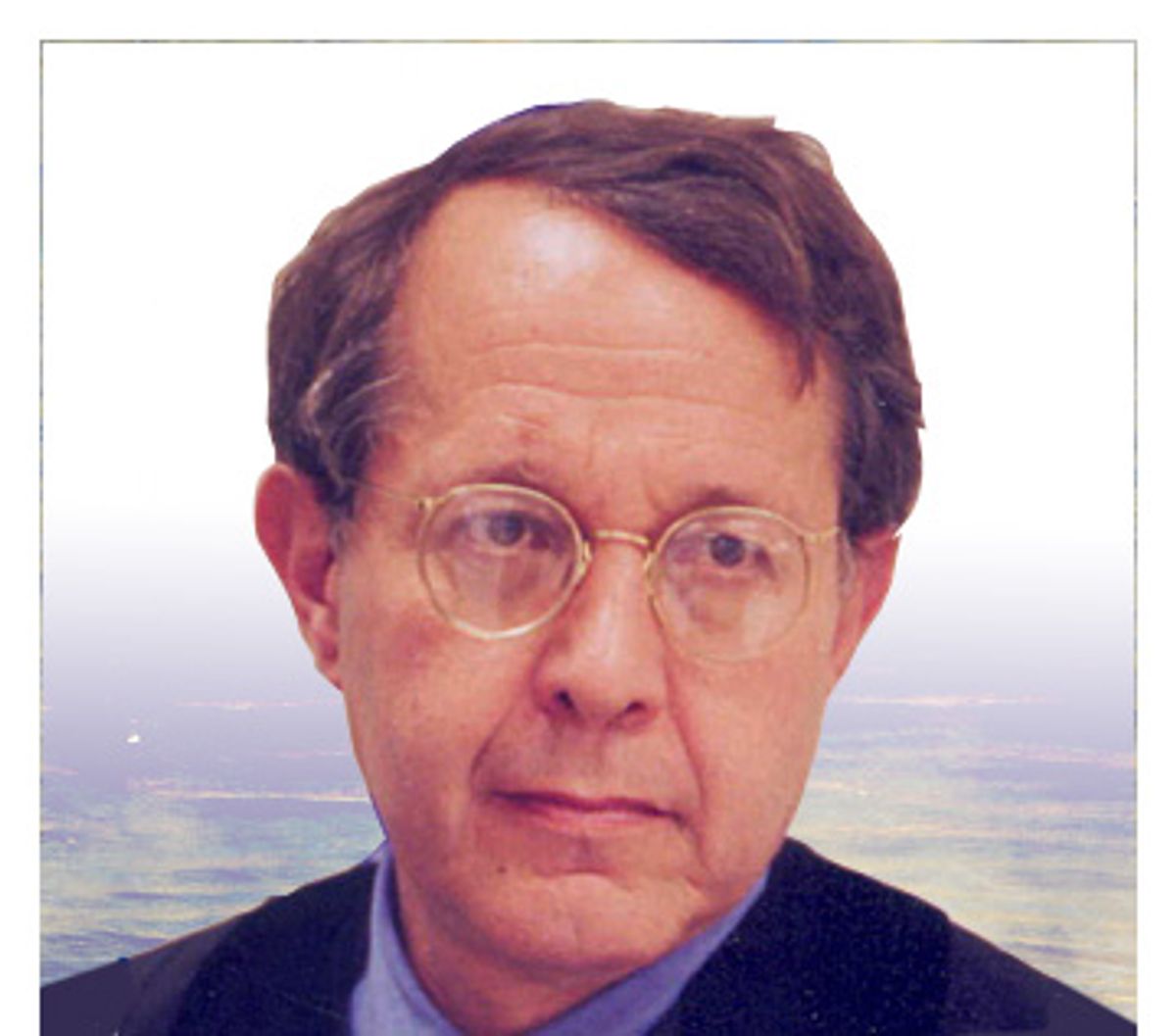
School days, writes Jonathan Kozol, should be full of "aesthetic merriment." But instead, too many of America's 93,000 public schools, particularly those in the inner cities, are what the poet Gwendolyn Brooks once called "uglifying," brimming with demoralizing indignities. Those indignities -- and also the acts of "stalwart celebration" that surface in classrooms across the country -- are the topic of Kozol's latest book, "Letters to a Young Teacher."
Kozol, who will turn 71 this year, has written about race and class in the classroom before, most recently in 2005's "The Shame of the Nation" -- and in his latest work, an undercurrent of anger still simmers. But rather than descend into polemic, Kozol returns in "Letters" to his teaching roots, using a correspondence with a teacher he calls Francesca as a chance to pay tribute to the men and women who devote their lives to children every day.
Francesca herself is "semi-fictionalized," a stand-in for the young educators -- almost all women -- who have been writing in remarkable volume to Kozol over the years. Still, Kozol insists that Francesca "is a very real person," "marvelously well-educated" and certified as a teacher. Written for an audience that is just becoming politically engaged, their exchange gives Kozol a forum in which to address No Child Left Behind, high-stakes testing, vouchers and other privatizing forces in public schools -- while at the same time leaving ample room to praise and celebrate the inspiring, human qualities he encounters in teachers, "empathetic principals" and, of course, kids.
From page to page, the focus of Kozol's "Letters" shuttles from the mundane to the profound -- from loose teeth to the democratic aims of education -- in a thoughtful first-person that echoes another "buoyant spirit" of New England: Henry David Thoreau, who wrote in "Civil Disobedience," "as for supporting schools, I am doing my part to educate my fellow countrymen now." And in fact, Kozol's goals -- in calling for "a sweeping, intellectually sophisticated political upheaval" -- are no less lofty.
Salon spoke to Kozol from his home in Byfield, Mass., about the fun of first graders, the trouble with "utilitarian" teaching, and why No Child Left Behind is "the worst education legislation" in 40 years.
Unlike some of your previous books, "Letters" strikes me as being more about teachers than students.
Yes, that's true, although the students -- especially because they're young and so delightfully impertinent -- force their way into the story repeatedly. Like most teachers, Francesca talks about the children all the time.
But it's true, the main purpose of the book is to describe what it's like to be a young teacher just beginning in an inner-city school at a time when there are unprecedented pressures, in part because of No Child Left Behind. It records a year of correspondence and visits with an irreverent young woman who also happens to be an excellent teacher. I think of the book as an invitation to a beautiful profession.
Can you really call it an "invitation" when a huge part of your work is describing the many challenges teachers face in urban schools?
Well, teachers have been profoundly demoralized in recent years and are often treated with contempt by politicians. There's a great deal of reckless rhetoric in Washington about the mediocrity of the teaching profession -- and I don't find that to be true at all. We are attracting better teachers and better-educated teachers today than at any time since I started out in 1964.
I emphasize teachers because they are largely left out of the debate. None of the bombastic reports that come from Washington and think tanks telling us what needs to be "fixed" -- I hate such a mechanistic word, as if our schools were automobile engines -- ever asks the opinions of teachers. By far the most important factor in the success or failure of any school, far more important than tests or standards or business-model methods of accountability, is simply attracting the best-educated, most exciting young people into urban schools and keeping them there.
In your letters, you spend a lot of time reassuring Francesca that it's OK to follow her instincts, or even encouraging her to be subversive, to disregard school policies if they don't make sense to her.
I would say pleasantly subversive. In part that is Francesca's character anyway -- but I do recommend an attitude of irreverence on the part of teachers who are having tests and standards shoved down their throats from Washington. We try so hard to recruit exciting teachers into these schools, but nearly 50 percent of them quit within three years. In order to survive, they need to keep their individuality, their personalities, intact, and they need to fight to defend a sense of joyfulness that brought them to this profession in the first place.
In most suburban schools, teachers know their kids are going to pass the required tests anyway -- so No Child Left Behind is an irritant in a good school system, but it doesn't distort the curriculum. It doesn't transform the nature of the school day. But in inner-city schools, testing anxiety not only consumes about a third of the year, but it also requires every minute of the school day in many of these inner-city schools to be directed to a specifically stated test-related skill. Very little art is allowed into these classrooms. Little social studies, really none of the humanities.
In some embattled school systems these high-stakes tests start in first grade, or even kindergarten, in order to get the kids used to the protocol of test taking -- yet a vast majority of low-income kids have no preschool before they enter kindergarten. According to Marian Wright Edelman of the Children's Defense Fund, less than 50 percent of eligible children are provided with Head Start nowadays, and it's even worse in the poorest inner-city districts. Meanwhile, the children of my affluent Harvard classmates, or their grandchildren, typically have three years of developmental pre-K education. Then a few years later, they all have to take the same exam -- presuming the affluent kids go to public schools -- and so some are being tested on three or four years of education and some on twice as many years.
Is that what you said recently when you went to speak to the Democrats on the Senate education committee?
Yes. I think the tests in their present form are useless, because although President Bush promoted them by saying, "All we want to do is help these teachers see where their students need more help," the results typically don't come back before the end of June. What is the teacher supposed to do when she finally sees the test scores in the middle of the summer, send a postcard to little Shaniqua, saying, you know, "If I knew last winter what I know now, I would have put more emphasis on the those skills"?
I recommended to the Democrats that they replace these tests with diagnostic tests, which are given individually by the teacher to her students. They are anxiety-free and you don't have to wait six months for McGraw-Hill or Harcourt to mis-score them, as they often do. The teacher gets results immediately. And it's not time stolen from education because she actually learns while she's giving this test.
After the Supreme Court decision last June on segregation in Seattle's school districts, you wrote a critical Op-Ed in the New York Times about a transfer provision in No Child Left Behind that says that if a student is in a perennially failing school, that child must be permitted to transfer to a high-performing school. Can you explain your argument?
The idea of the provision is that a child's parents should be able to transfer the child to a successful school in their district if the child's school has proven to be a hopeless failure. The trouble is, there aren't enough schools in overwhelmingly poor and minority inner-city districts to which a child can transfer. So less than 3 percent of eligible kids have transferred during the years since No Child Left Behind came into effect.
I proposed that the transfer provision be amended not only to permit but to require states to make cross-district transfers possible -- so that a student in the South Bronx could be transferred to Bronxville, which is, I have tested in my car, only about a 12-minute drive. It would be a very simple amendment to add and it would drive a mighty blow against the deepening re-segregation of our urban schools, without making any reference to race. Justice Kennedy, in his partial concurrence, pointed out that strategies like these, which are race-neutral, would certainly be constitutional.
How would those changes help to retain the wonderful young teachers you write about?
First of all, it would immediately relieve that sense that there's always a sword above their heads, and that sword is empirically measurable testing. It would relieve the sense that every minute of the day has to be allocated to a predesignated skill. It would free them from the absurdity of posting numbers and the language of standards on their blackboards, which are of absolutely no benefit to a child. As Francesca once pointed out to me, no child's going to come back 10 years later and say, "I'm so grateful to you for teaching me proficiency 56b."
It would free the teachers from all of that, and it would allow these young teachers, most of whom have majored in liberal arts, and who love literature and poetry, to flood the classroom with all those treasures that they themselves enjoyed when they were children, most of them in very good suburban school districts.
You use a lot of military language like "combat," "assaults" and "capitulation" and return again and again to the idea that the administrative brass doesn't know what the grunts are living through. Are our schools really war zones?
Yes, they are. You rightly called teachers "grunts," in that they are the ones who are doing the actual work. In the inner-city schools these classrooms are not simply the front lines of education: They're the front lines of democracy. No matter what happens in a child's home, no matter what other social and economic factors may impede a child, there's no question in my mind that a first-rate school can transform almost everything. So long as the teacher is energized and highly skilled and her personal sense of exhilaration in the company of children is not decapitated by a Dickensian agenda.
I've received at least 30,000 letters, calls and e-mails or written notes handed to me from young teachers in the past two years alone: These teachers by and large are very well-educated and they are highly idealistic. And they know something that the testing and standards experts don't seem to know: namely, that the main reason for learning to read is for the pleasure it brings us, not for the utilitarian payoff of being able to read your orders.
So you take issue with the argument that children need to be prepared for the realities of the marketplace. But isn't that what they will face?
Yes, children do have to be prepared for the economic world -- but the invasion of the public schools by mercantile values has deeply demoralized teachers. I've been in classrooms where the teacher has to write a so-called mission statement that says, "The mission of this school is to sharpen the competitive edge of America in the global marketplace."
Francesca once said to me, "I'm damned if I'm going to" -- I don't think she said "damned," because she's too polite; maybe "darned" -- "treat these little babies as commodities or products. Why should they care about global markets? They care about bellybuttons, and wobbly teeth, and beautiful books about caterpillars." I think we have to protect those qualities.
Most of the teachers we're trying so hard to recruit into these schools, then driving out, tend to be the children of the 1960s generation, and they are steeped in civil rights values, and those who have gone to good colleges and universities come into these schools with what I would call almost a preferential option for minority children of the poor. But no matter what they've read beforehand, they're generally stunned at the profound class and racial segregation they encounter. It's not as if they didn't know that this was the case, but when they're suddenly in a class, as Francesca was, with not a single white child and only three white kids in the entire building, it hits them hard.
Is that how Francesca experienced it?
Francesca and I once had a long talk. I tend to say that we've basically ripped apart the legacy of Brown v. Board of Education, but it was she who first pointed out to me that we haven't even lived up to the mandate of Plessy v. Ferguson, because our schools are obviously separate but they're certainly not equal.
Now, especially with the recent Supreme Court decision [on segregation], there's a sense of profound anger among these teachers. A sense that everything they grew up to believe is good and right is being discarded by our society. They also note that despite all the fatuous claims from the secretary of education, the achievement gap between the races has not closed. And even worse, the cultural gap has actually widened because of the narrowing of the curriculum in these schools.
Francesca, despite the fact that she refused to teach to the test, managed to be very effective in teaching skills, and her children did well. Apparently you don't need to hire Princeton Review to come into your school and use scarce education funds to pay them to create artificial test-score gains.
You're an advocate now. Have you ever considered going back to the classroom yourself?
All the time. When I was visiting Francesca's class, I was jealous of her. When I give lectures what usually happens is some teacher or principal in the audience will grab me at the end and say, "Do you have four hours tomorrow morning before you leave? Would you visit my school?" and I always try to do it. And then I don't want to leave because it really brings my spirits back. I love the unpredictable. I love the whimsical in children. I love it when a child asks me what you might think is a funny question, like, "Do you feel sad because you're old?" Or, "Is it lonesome to write?" It's a wonderful question, don't you think?
I'm still very healthy and I sometimes think I would love to go back and teach first grade or second grade. First grade, under the best conditions, is what I call the miracle year, because that's the year when -- if you're in a reasonably good situation, and if your children have a little pre-K, and if they've had a good kindergarten year -- it's in first grade that you see the children go from knowing letters only as images, the shapes of the letters, to suddenly writing and reading. Writing real sentences and reading real books. That's a miracle to me. To me that's more dramatic than anything that happened to me at my four years at Harvard.
This book revisits some of the topics -- like dealing with unsupportive administrators -- from your 1981 book, "On Being a Teacher." Why did you feel the need to return to those subjects?
Well, I've spent more time with other teachers since then and spent so much time in classrooms that -- I can't quite explain why. I know this book has a political cutting edge and it's going to make me a lot of enemies in Washington from the right-wing think-tank types. I'm sure they won't be sending me any bouquets from the Heritage Foundation, or the Manhattan Institute. But it's the first book I've ever written where I actually enjoyed it every day, and it's because there's enough in it, and because I think of it sort of as an invitation to the dance. I think the book, in a strange way, is kind of a cheerful book. Wouldn't you say so?
Somewhere between naive romance and sophisticated idealism.
I hope it's not naive. It's not a theoretical book, like, wouldn't this be wonderful? or something. It's based on being there. Francesca's kids did well. At the same time, she did not stick to the standards. I don't think there's anything in No Child Left Behind about reading the sonnets of Rilke to first graders.
Shares