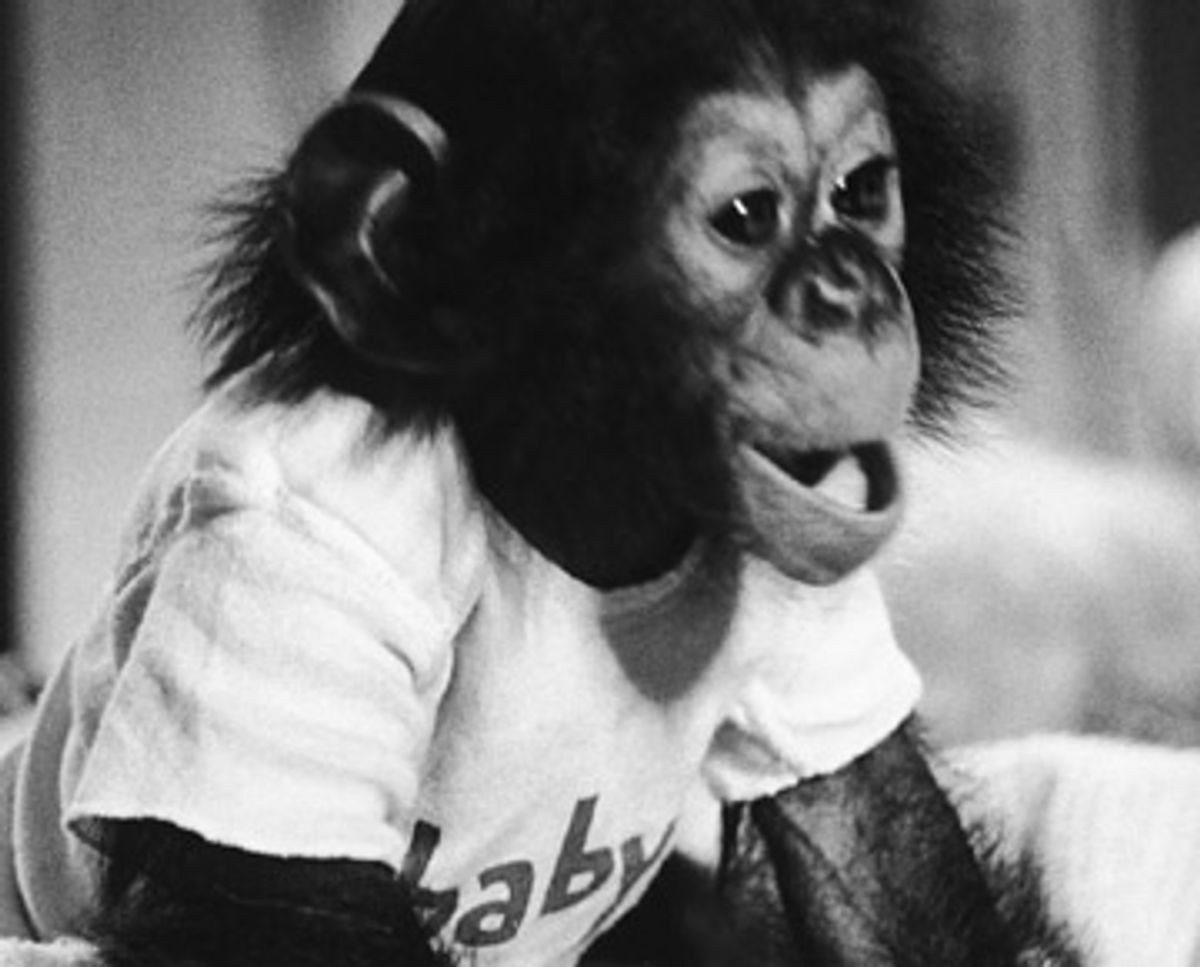
Sometimes we're animals.
How else to account for a man who approaches a female chimp nursing its wide-eyed newborn, takes aim amid howling protests from nearby apes and blasts the mother with a tranquilizer dart -- then snatches the sobbing infant and delivers it to an otherwise thoughtful, loving woman, who whisks the creature off to her New York brownstone?
It was science, this was the '70s, and the gauntlet had been thrown down by none other than Noam Chomsky. While nonhumans may communicate with one another, the MIT linguist said, they are fundamentally incapable of language. Columbia University professor Herbert Terrace set out to disprove the assertion with an ambitious and groundbreaking study. The experiment that followed involved a cleverly named chimpanzee and some less-than-clever human choices. The fascinating, ultimately heartbreaking account has finally been told in journalist Elizabeth Hess' primate biography, "Nim Chimpsky: The Chimp Who Would Be Human."
Fancy Upper West Side address, nice clothes, summer in the Hamptons, fawning media attention, parents mellow enough to pass him their joint now and then -- for a year and a half, Nim had a life many humans would envy. But that was the problem: He himself wasn't human, merely raised to think he was. He bonded intensely with his adoptive family, and indeed learned around 125 words in American Sign Language, but in the end his fate wasn't that of a true son. Funding for the project ran out, Nim proved more difficult to handle as he got older, and eventually he was unceremoniously sent away.
Terrace would make a dramatic concession to Chomsky on the language question, sending waves throughout the field. But the charismatic subject at the center of the study more or less vanished. Nim bounced through some of the assorted grim facilities that house chimps, all the while making it clear he longed for his human family. For a creature who would demand hugs after being disciplined, and bring tissues to his adoptive mother when she cried, relocating to a world of cages and strange, hairy beings was incomprehensible.
Ultimately Project Nim illuminated as much about humans as about chimps. There was never any exit strategy. The implications of humanizing a wild, and intelligent, creature seem to have eluded the people responsible. At the time New York magazine referred to the study as a "scientific revolution with religious consequences that occurs once every few hundred years." One hopes it's no more often than that.
Hess spoke to Salon from her home in upstate New York.
How did people respond when they'd find out you were writing a book about chimpanzees?
I got a lot of banana jokes. And people were surprised to see that these animals are so complicated, and so emotional, and that they form such deep and serious attachments to human beings. That's why I wanted to write this. It's a novel experience to read a biography of a wild animal.
I was surprised myself. When I discovered Nim's story, it was like I was struck by lightning. No one really knew that story. He'd had these moments of incredible celebrity that were well documented, but ultimately what happened to him was a bit of a mystery.
The fact that Nim had been raised in a human family [by Stephanie and W.E.R. LaFarge], and learned how to operate around people, made him a very interesting subject. His life also allowed me to write about a variety of landscapes where chimps end up. The book takes you behind the scenes of a major behavioral language science experiment, and inside a primate breeding colony, and briefly inside a biomedical research lab, and ultimately to a sanctuary. Which in the end is about as good as it gets for any captive-born animal.
Can you describe the happy period when Nim first got to the house in New York?
Nim was with the LaFarges for 18 months, and most of that was a pretty happy time. I think it was incredibly exciting to have this baby chimp around. He loved to be held, he drank from a bottle. By the time he was 2 months, he could cling to walls and get up and down the banister. There was a giant waterbed in the living room that Nim loved to bounce up and down upon.
He was very beguiling. They dressed him in OshKosh and little T-shirts, and taught him how to sit at the table and use utensils. I think he really enjoyed being part of the family.
After funding ran out and Terrace declared the project a failure, Nim was taken from his loving home in New York, and bounced around various grim research facilities before he wound up at Cleveland Amory's sanctuary, in Texas. Tell me about what it was like for Nim to be put back in a cage with other chimps after he'd only ever known humans.
It was terrifying. One graduate student described the response that all the [research] chimps had [upon being reintroduced to other chimps] as a nervous breakdown. Nim's brother [and the subject of another study] Ally was so terrified and upset that he suffered a kind of paralysis for a while. They often pull out all their hair; they refuse to eat; some get beaten up by other chimps because they don't know how to respond to them.
The former graduate students in New York believe that Nim had no idea he was a chimpanzee. One of them suggested to me that Nim might have thought he was going to grow up, lose all his facial and body hair and eventually look like the people who were around him. That would be a reasonable supposition. Throughout his life, Nim preferred to be with humans.
Toward the end of his life, he was paired with an ex-circus chimp named Sally Jones. That, I think, was the first deep relationship he had with his own species. They were inseparable. Sally was a lot older, a lot milder. Nim had a reputation for breaking out of his cage in Texas. When Sally came, he would break out of his cage, but then he'd remember her, and he'd go back and get her. He'd lead her out of the cage and they'd go on a little romp together. Cleveland Amory was always afraid that Nim was going to run off into the woods. But he had no desire to run away. Nim would go to the nearest house and bring Sally with him, and they would raid the refrigerator, go through the closets and try on any shoes that were lying around, and sometimes they'd get into bed and turn on the TV.
He was also dangerous. Chris Byrne, the manager at [Amory's] Black Beauty Ranch that Nim was closest to, learned that when Nim broke out, the best thing to do was to just be completely calm. He'd see Nim at the door and he'd say, "Nim, welcome," as if Nim had been invited over for cocktails. He'd let him sit down for a while. Then he'd slowly lead Sally back to the cage, and Nim would eventually follow.
Can you describe the first time you met a chimp?
Oh yes. I went out to the Black Beauty Ranch to see the three adult chimps who were Nim's companions when he died in 2000. I went out just to hang out with them, and learn what it's like to look in their eyes. I certainly remember the first time I held hands with one of them. It's quite a joyful-slash-terrifying experience.
Partly it's so profound because they're so humanlike. But another part is that they're in a cage and you're on the outside. There's a built-in injustice to the relationship -- there seems to be a clear consciousness about that in them. Nim used to sign "out" all the time. Anybody who passed by his cage in Texas, he'd start signing to them, to see if they knew any sign language. If they didn't, he'd get disappointed and go to the back of his cage. He enjoyed signing and taught the other chimps some signs.
When they like you, they're extremely gregarious. They want to show you things. They love books and magazines. There was a children's book all about Nim while he was in New York, basically a photo book, and Nim kept his one copy of this book safe, even though chimps tend to wreck everything. He would bring it down and show the other chimps, then bring it back to his bunk and keep it under his sleeping area so that no one could destroy it. He would just look at pictures of his New York City family, and himself, over and over again.
What kind of response have you gotten from people who'd been involved with Nim?
Everybody felt so bad that they'd worked so hard to convince him he was human, and then he was just shipped off at the end of the experiment. There was no exit plan. No one ever asked, "What's going to happen to the chimp?" In the '70s, this is the way research was done. At the end of the experiment, the animals were either euthanized or sent to the next experiment down the line. Nobody asked questions about it. There was a tremendous amount of sadness and guilt wrapped around the whole project.
When Project Nim ended and Terrace finally published the results, years later, in Science magazine, he not only argued that Nim did not learn American Sign Language -- that he was merely mimicking his teachers -- he argued that all apes [in language programs] were mimicking their teachers. He basically tried to put a knife into the heart of all language research with animals. He sided with Chomsky. There were a lot of [other] projects under way at that time, and he had a huge effect on funding. It was a small, fragile movement to begin with. It took about five years for the field to recover.
Why do the language capabilities of a chimp matter?
I think they matter to different people for different reasons. The value of Project Nim is still hotly debated. The fact that chimps are really good at a gestural-based language is not surprising. Whether or not their use of ASL has anything to do with the way humans use ASL is still debated. What I can say is that those people who were around Nim had no problem understanding him.
Yet in Project Nim they made many mistakes. They brought Nim into a classroom, they made him hang his coat up on a hook, they sat him down at a little desk, and they drilled him in sign language. This is not a great way to teach a little human person, and it's certainly not a great way to teach a chimp. Nevertheless they documented a vocabulary of more than 100 words and 20,000 different combinations. But the question of what Nim learned -- everyone has a different point of view about it.
Now, we're looking much more closely at the animal mind, not the way in which the animal might use a human language. And what we're discovering is how little we know about how the animals communicate, and how little we know about their intellectual potential. Most of these captive animals have been born in captivity and locked in small cages their entire lives. If you did that to a human, it certainly wouldn't stimulate their intellect. Now that we know these animals have consciousness and desires and emotions, we think of them as sentient beings. We wonder not only what they have to say but whether we're doing the right thing by them, or to them.
It sometimes seems there's a disconnect in our thinking about chimps. On the one hand, we know very well that they're capable of seeming human -- in movies and commercials they look and act very much like us. But on the other hand, people sometimes seem shocked when they find out how complex or intelligent they actually are.
I think that's the lesson learned at Project Nim. This very adorable, humanlike baby turned into a wilder and wilder creature. People don't realize that chimps aren't forever these little people that are cute and funny. And they don't realize that they're actually an endangered species. They're kind of an invisible species here, too -- there are very few in zoos. Most are in research, and we don't get to see those. The ones we see on TV and in ads are babies.
How many chimps are there in captivity in the U.S.?
I think around 2,000. Five hundred are owned by the government and are in research labs. Another 600 are in privately owned research labs. Then there's a number of them in the entertainment industry and a number that are privately owned in exotic collections.
And there's a huge, mostly hidden number in garages and attics, right? People take them in thinking they'll always be cute and little, but they get big and unwieldy, and go on to live a very long time.
Yes. In the '70s, the period I was writing about, it was a kind of fad to raise a chimp as a pet in your home, and treat it very much as a child. None of these did very well. They not only tear through the families, but they tear through the house. They eat everything and wreck everything in sight. They're not easy to control. Marriages broke up, children were badly bitten, and people realized that while it was a really fun idea, the reality was far more harrowing than they'd imagined.
How does a chimp break up a marriage?
Chimps bond very tightly to their mothers. The fathers have very little to do with raising the babies. A lot of these women who had been raising orphan chimps [in the '70s] were suddenly engaged to be married, and their chimp babies would not accept their husbands.
What needs to change to improve the lot of apes and monkeys in this country?
We need to get the chimps, which have been in these small cages their whole lives, into sanctuaries where they can step on grass for the first time, and think about whether they want to climb a tree. We need to ask what we owe them, especially because many of these animals have given their lives to research. And once we start asking these questions, I think the answers are going to be so obvious. In many countries it's illegal to use chimpanzees for any biomedical research, or any invasive research at all, and I think that really needs to happen here. I predict it will.
Just to anticipate some of the responses you'll get for that, I want to be clear that the chimps being studied are not all saving human lives.
Oh no, not at all. But I think the whole attitude toward chimpanzees is finally starting to change. We're going to be the last country to protect chimpanzees legally. It wasn't so long ago that we were using them in car crash studies. We've used them for all kinds of useless toxicity studies. The AIDS studies were a disaster.
There's a lot of research now that looks at how successful research on chimps has been -- [and it's] relatively unsuccessful. I think we're getting to a point where we have to ask, are they really necessary? Or are they being used because it's a good way of getting grant money, or because they're simply there?
Shares