

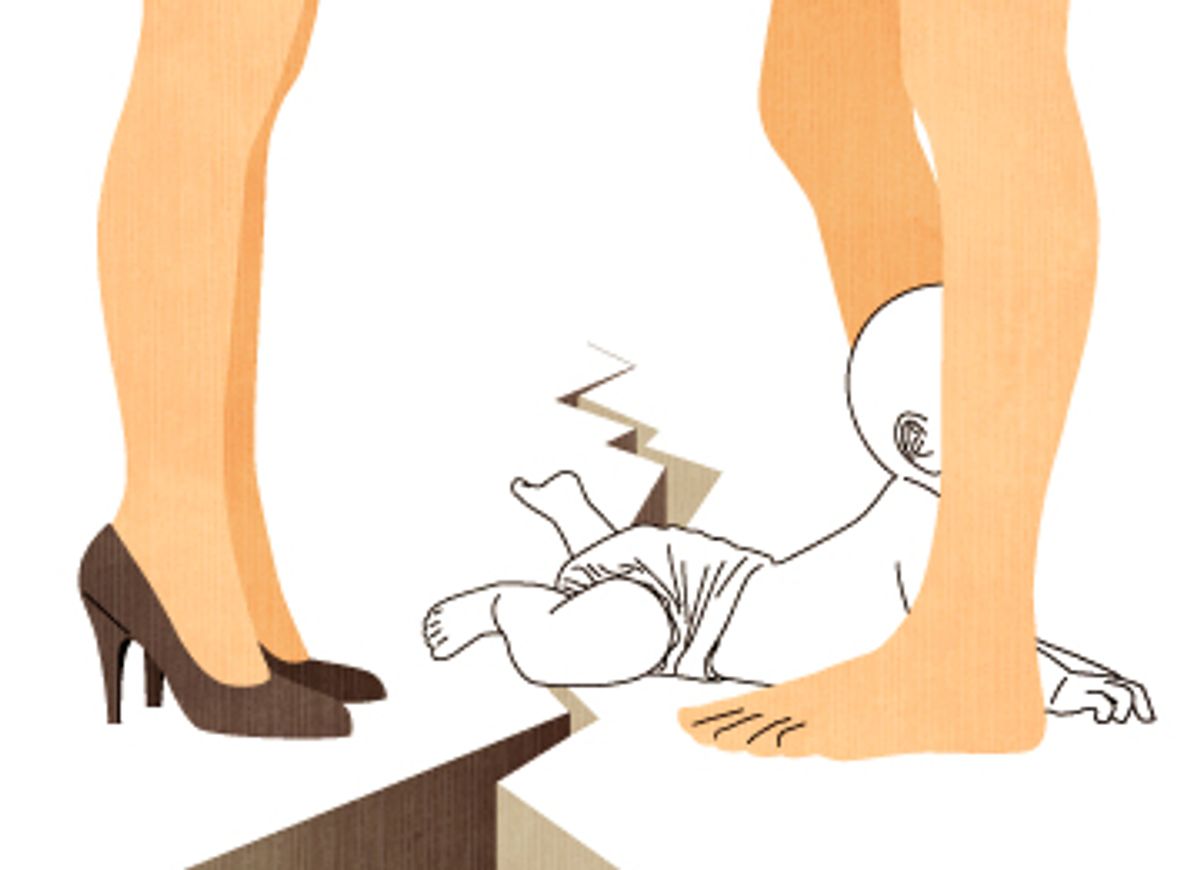
Signing up to be a combatant in the "mommy wars" is a ballsy move. For several years, journalists and cultural critics, including Lisa Belkin, Caitlin Flanagan, Linda Hirshman and Leslie Bennetts, have been locked in a snarling tussle over the political, personal and economic implications of professional women choosing to give up their jobs to parent full-time. The arguments are painful, rife with tension over class and gender inequity, and pinpoint tender issues of intellect, ambition, what it means to be a good parent, and what it means to be a good woman.
It may be something of a surprise that the newest foot soldier on the front lines is not a polemicist or an Op-Ed columnist. Meg Wolitzer is a novelist, author of previous critical successes such as "The Position" and "The Wife." Her new book, "The Ten-Year Nap," tells the story of a group of formerly high-achieving women who forsook their careers when they had children. Ten years later, as the book's title implies, these mothers are waking up, and realizing that they are bored, directionless, worried about money, and perhaps overinvested in the lives of their husbands, their children and their friends.
At their center is Amy Lamb, a former lawyer whose mother, a successful, and very happy, novelist, incessantly nudges her daughter about getting back to work. Amy considers returning to the law, but is crippled by the insecurity born of being out of the workforce, away from the technological innovations that have transformed her profession. Listless, with a 10-year-old who is no longer dependent on her, Amy becomes embroiled in the entanglements of another mother -- a working mother -- whom she meets at her son's prep school.
"The Ten-Year Nap" is an engrossing, juicy read about girlfriends, marriages, jealousies and money. But it's also an occasionally brutal dissection of the habits and hang-ups of a rarefied group of mega-mamas. Scenes in which someone breast-feeds another woman's child, or an anorexic stay-at-home mother devises a plan to launch a chain of SlimGyms for people with "eating differences," are hilarious but uncomfortable in their detailed apprehensions of what it means to find your artistic and professional ambitions rechanneled or derailed.
I recently sat down for an interview with Wolitzer, who insists that when it comes to the mommy wars, she's Switzerland.
You claim not to be taking sides in the mommy wars ...
Oh no, I would never.
But I can't help but feel that a book that begins with the sentence, "All around the country, women were waking up," is a pretty broad blow against those who have opted out.
Oh, you found me out! When I started writing "The Ten-Year Nap," I was judgmental of women I had known and liked, who had given up careers when their kids were born, and somehow 10 years had gone by and they weren't sure what they were doing. I thought to myself, "Why aren't they driven? Why aren't they guided by some singular purpose?"
But as I wrote and the characters became more complex, I thought, "Who am I to say?" I'm not writing a polemic. I really want to show what it's like for women who stop working. And that hasn't been done, as far as I could see, in fiction.
But there have been novels about working women, and about mothers.
Anytime you have intelligent women in a novel, they have jobs like "urban planner" or "architect." It's meant to show that they are smart. You never show them at that job, because that's too boring, but you have to give them a job to assure the reader that they're the kind of people the smart reader would like.
In fiction, stay-at-home moms have often been [subject to] mockery, and I think it's very sexist: the stay-at-home mother whose children are oversubscribed, who has reduced her entire brain to trivial things. I mention a character in the book whose husband is so bored when his wife talks about her day that he has to take Ritalin in order to listen. And look, I have a bit of playfulness in this book because I don't want it to be a somber meditation on motherhood versus work. I really want the novel to be about motherhood and work, and also about female ambition and what happens to it over time.
I don't read judgment in your treatment of the women, but I do feel sympathy from you for women who are bored, or worried about money, who feel bad about themselves for not having passions.
Certain kinds of '70s novels, in the first wave of feminist novels, were very earnest and ended with the woman getting into her hatchback Nova and taking off on the open road. The equivalent here would be that the women go back to work: Cue up the idea of them feeling purposeful. But as I say in the book, most jobs are not wonderful and most people don't necessarily have a passion, or even something they're so good at, that they can't wait to go back to.
It also doesn't go without saying that the kind of lives we're talking about here come from a narrow band of society, because most women don't have the luxury of saying, "Should I work?" or "Will I feel fulfilled?"
I set the novel in New York because I did want to have it in a milieu of affluence where at least you understood that the possibility of not working was very real. But elsewhere in the country, I meet readers who have left jobs when their kids were born and are now working in half-ways in which it's hard for them to keep up. If you're a corporate lawyer, they want you there all the time. A lot of women have left those jobs because the jobs don't love them or respect their lives.
The men of my generation and older don't have these choices. Ever. They're the schleppers, just sort of going along. That's another novel, I suspect.
The discussion of half-time work reminds me of one of the funniest details of the book, the suburban mothers who create Wuv Cards.
One of characters who is really brainy moves to the suburbs and meets a bunch of women who were formerly in business, but now out of the workforce, and are starting a business called Wuv Cards. These are greeting cards that children are meant to give their parents. And these earnest women, who were formerly in marketing or advertising, get together to put together this crackpot business. There I am really lampooning the idea of suburban boredom and finding something to do with yourself.
In that plotline, you speak to some points made by Linda Hirshman and Leslie Bennetts, not simply about what the costs of not working might be for women, but the costs to a workforce that loses their brilliant minds. Because instead of solving the national budget crisis, they make Wuv Cards a success! There's a loss if we take all these minds out of the workforce.
That's a great point. But as a novelist you can only hint and suggest at that. Otherwise you really ruin the novel. There is something inherently appalling about really intelligent people, in any context, not using their minds. People understand pulling back for motherhood in the early years. Some of the most powerful experiences I've ever had have been as a young mother when my children were very little. When you're nursing a baby, you don't have to use your brain, and it's a relief, frankly, because you're so tired. Yet you feel this great sense of confidence that what you're doing is really important, and there are very few experiences where that's so, especially when you come from a background that values education in a big way. But as your children get older, and you have done your job right so they are out in the world, the sense of need is less apparent.
Then the notion you suggest of the world missing what you could have given it is absolutely there. But for a lot of women, vulnerability sets in. I spoke to some women in a book group. When I told them what I was writing about, they all said, "You're writing about our lives. Do you want to know anything from us?" So I did talk to them, and it was much more complicated than you might think. They felt vulnerable when they tried to go back, and then they were ashamed of that feeling because they thought of themselves as achievers, very ambitious, very, very bright. There was a wound to pride that allows you to think only of yourself and not in the ways you're talking about, about the larger social fabric: What am I not giving to other people that I might have done?
I always thought that one of the side effects of feminism has been the professionalization of parenthood. Because once you had a generation of high-achieving women who were compelled to leave the workforce, they applied the same skills to parenting as they did to jobs, creating a situation in which in order to be a good mom you have to be a mom 24 hours a day.
Which then creates anxiety among other mothers. That's the heart of the mommy wars. The comparative notion really always creates havoc. Also, raised as I was by a feminist mother, on Ms. magazine, the sense that you can have it all was instilled in all of us -- and I'm really glad that it was. But when motherhood pulls you in one direction, and work pulls you in another, that sense becomes diluted. Somebody said to me long ago that it's not a question of having it all, but that you can have a lot of most things. That's a nice way to think about it. Think about if your life is going in the direction you want it to go, and try not to be riddled with self-doubt. I was riddled with self-doubt as a new mother. But I was fortunate in that I have always had a job in which I could work at home, so I had children at my feet.
And did your husband also work at home?
Yes, and it made all the difference. We were both home; we never left our crazy diaper-strewn apartment.
This is the ironic situation for many of the writers who are guiding this cultural conversation, including Caitlin Flanagan.
It's a rarefied situation. I feel very fortunate. Because resentment can really set in, if your husband is out in the world feeling the cool breeze upon him and he waltzes in at night and you've been with the baby, there is perhaps a chill going both ways, because your worlds have become so different. It is changing for younger couples. But I don't know many men in their mid-40s who are stay-at-home fathers. It's still fairly new, and infrequent to see. But it makes all the difference, that kind of parity.
Do you call this a feminist novel?
Oh yeah, of course. Because it's telling the truth about women's lives. That's my definition. It's not demeaning women's lives. It's not pitting women against one another. Even the working-mother character, Penny Ramsey, is not so much a fully realized character as she is a figure of transference that the other characters revolve around. She's the idea that makes them feel a little bad about themselves, the one who's really pretty, really intellectual, has a job that they consider really worthwhile -- running a small museum. Above and beyond all of this, she is having an affair, so she has an erotic component in her life that may have fallen away for some of the other mothers. I didn't give her as much of a full character as the others -- she doesn't get her own point of view -- because I set a challenge for myself that this would be a book in which the main characters don't work.
Penny Ramsey is also the only character whose husband is sort of a shit. Everyone else has a great husband. I was interested in how you wrote the men -- it must be easy to slip into stereotypes when writing about a man whose wife stays at home.
I once appeared in an academic book called "Women Without Men," and there was this long section that talked about how I had so few men in my books. It was kind of like that postcard, "Oh my God, I forgot to have children!" "Oh my God, I forgot to put men in my books!" Then I wrote "The Wife" and it was about the wife of a famous, semi-shit novelist. It was an exploration of male power and female complicity in that power. That book heralded a change in my writing; I wanted to look at male and female experiences.
But in "The Ten-Year Nap," what was important to me was that the characters were likable enough. And what that means is that the men in their midst are important choices that they have made. If a woman has a horrible man who works for Halliburton as a husband, that has to be part of the point about her character.
One of the most devastating plot points involves Roberta, a mom and former artist. She befriends Brandy, a young aspiring artist whom she ferries for an abortion in South Dakota. She begins to mentor Brandy, but eventually dumps her. In having that young woman who would give her eyeteeth for the chance at having the careers these women have opted out of -- along with the interstitial portraits of the women's mothers, who yearned to have the opportunities for work that their daughters have simply stopped doing -- I thought you were drawing particularly strong contrasts.
But the thing is, characters in a book, and people in life, don't live our lives in context; we live our lives. It's like that thing: I cried because I had no shoes. You're not thinking about the footless guy. You're not thinking about the young woman who can't have the things that you are so cavalierly tossing aside. This story isn't clean.
Shares