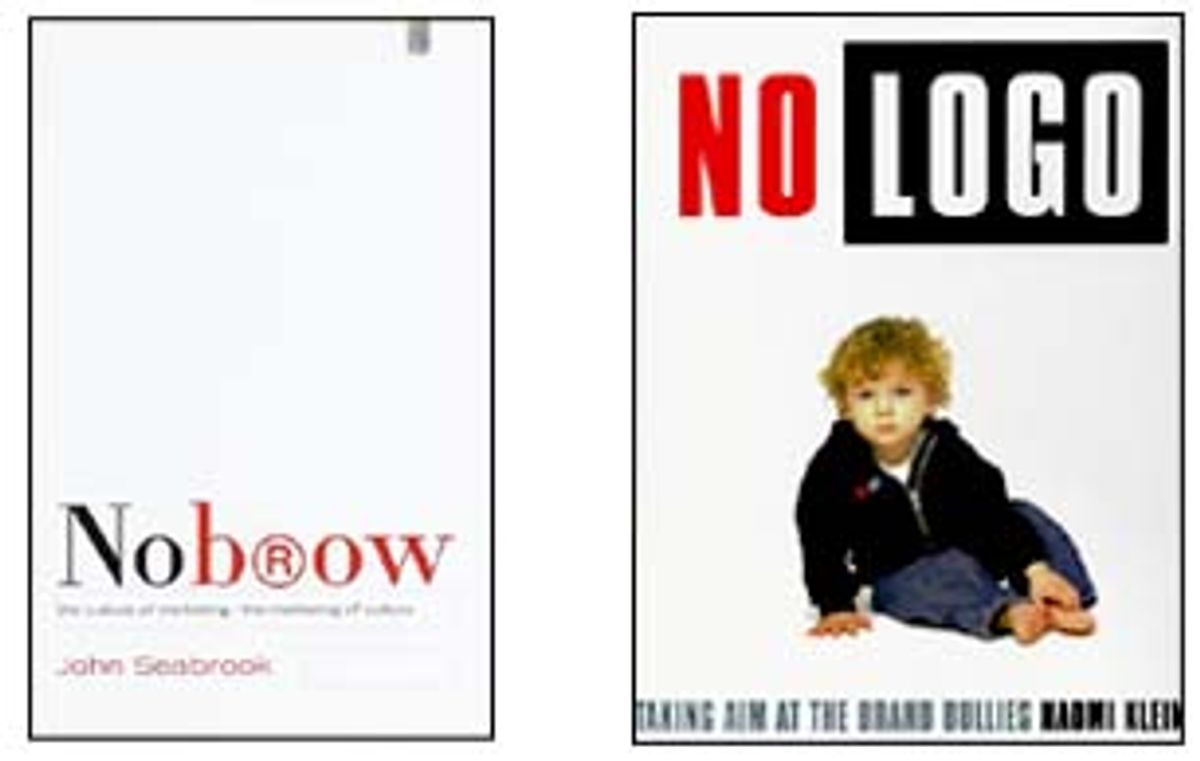
Consider this passage from John Seabrook's new book, "Nobrow":
By the 1990s, the end of the High-Low hierarchy of distinctions was at hand ... It could be felt in the change of manners: in the old days if you said to your dinner partner, "How are you?" he or she would say, "Fine thank you. How are you?" But in the present, when you said, "How are you?" you heard "Fabulous. I've just published my memoir about my incestuous affair with my alcoholic father, and the film rights have been optioned by Oliver Stone, and he's talking to Kate Winslet for the role of the heroine, and Entertainment Weekly has an item about me this week."
My response to this, and it was quite visceral, was to put the book down and promptly take a shower. I wanted these ideas off me. We're supposed to be laughing along with Seabrook here, shaking our heads at the rise of the ridiculously self-involved. But the delusion that sticks with me is Seabrook's: a smugness masquerading as thoughtful indignation, a lazy conviction that the study of a dinner greeting constitutes cultural analysis and that annoyingly inclusive "you" that assumes your friends sound like Seabrook's friends, which is to say, like press agents. Just who is John Seabrook speaking to? In the airless world of "Nobrow," he's talking to those both old enough to sincerely believe that Tina Brown ruined the New Yorker and young enough to think that the Chemical Brothers lost something when they landed on MTV. In other words, no one.
|
Nobrow No Logo |
"Nobrow" is billed as a meditation on an ascendant muddle in American culture: a creeping everglade of hype, populism and fame between "highbrow" (intellectual culture) and "lowbrow" (commercial culture). The terms "highbrow" and "lowbrow" originate with that ornery journalist H.L. Mencken, who fashioned them in 1915 to, as Seabrook says, "render culture into class" with a phrenological punch. In America, Seabrook argues, "people needed highbrow-lowbrow distinctions to do the work that social hierarchy did in other countries." But by the '90s, the cultural hierarchy that they defined (and preserved) had collapsed, leaving "Nobrow" -- "not culture without hierarchy, of course," but an area where "commercial culture is a source of status, rather than the thing the elite define themselves against."
Forget the fact that Seabrook's thesis isn't news -- postmodernism has been remarking on that hi/lo hybrid for some time now -- and isn't even particularly convincing. (Isn't he really just saying that lowbrow won?) His argument is merely a setup for a portrait of Tina Brown, the much-maligned hi/lo maven and erstwhile editor of the New Yorker. According to Seabrook, Brown's arrival marked the coming of nobrow to the bourgeois sanctum of classy Manhattan magazine culture, and the beginning of her tenure neatly coincided with Seabrook's own as a staff writer. And if you're the kind of person who cares about the tempests that have tossed that magazine -- if the names Renata Adler and Robert Gottlieb give you goose pimples -- then you're in for a dishy feast. Otherwise, prepare for some seriously overcooked meat.
What Seabrook has done in "Nobrow" is repurpose his New Yorker essays on MTV, George Lucas and David Geffen with the curtain drawn back on how the pieces were "relationship brokered" by Brown. For example, Brown was a friend of Judy McGrath's, the president of MTV, and called on Seabrook to spend June there doing a profile on the place. What one comes away with from "Nobrow" is the sense that a) Brown was almost entirely responsible for Seabrook's subject matter and b) when you leave Seabrook alone to come up with his own subject matter, he will talk about his father's suits, Dean & DeLuca tomatoes and the irresistible urge to buy $200 Helmut Lang T-shirts in SoHo.
While there are moments of interesting anthropology in "Nobrow," Seabrook doesn't seem to be able to locate his own story. "Big-Grid Ben," his profile of 15-year-old Kurt Cobain wannabe Ben Kweller and the vectors of the music industry that start to swirl around him, contains some nicely raw moments, like this one: "I was thirty-eight, and I was pretty depressed about it. Christ, thirty-eight years old, and here I was, with a couple of kids young enough to be my children, writing down their bons mots, which mostly consisted of different variations on the word 'dude.'" (We should also note that Brown sent Seabrook on this assignment after she was tipped off about Kweller by Danny Goldberg, the president of Mercury Records, who had signed him.) Strangely, after all this buildup, the chapter ends just as Kweller's first album gets released. Seabrook describes its failure in a paragraph. In a book about "the culture of marketing," doesn't the story of Kweller begin when the record hits the shelves?
You get the sense that Seabrook's intended audience is strictly magazine editors, the cultural commissars who feel most guiltily bound to respect highbrow culture even as they throw themselves at lowbrow. At heart, what haunts Seabrook is really a fear of being late culturally, which is strictly a pathology of the media elite, and weren't they always nobrow anyway?
Fortunately, we have Naomi Klein's athletic and expansive "No Logo: Taking Aim at the Brand Bullies" as an antidote to the soft writing and sloppy thinking in "Nobrow." Klein, who has written for the Village Voice (where I also write) and the Baffler, knows her enemies well: the "brand-bombing" Wal-Mart; Starbucks and the Gap, with their "clustering" tactics; the beer and cigarette companies that think the world is their billboard. She also knows her allies, like the culture jammers (Adbusters), the third world unionists and the new urban guerrillas (Reclaim the Streets) who are throwing wrenches into the machines. Here we get profiles of the hi/lo/nobrow mix, but this time with political teeth. Klein tracks radical chic ad agency Weiden and Kennedy trying to tap Ralph Nader to sell Nike shoes: "The idea was simple. Nader would get $25,000 for holding up an Air 120 sneaker and saying, 'Another shameless attempt by Nike to sell shoes.' Nader responded, 'Look at the gall of these guys.'"
"No Logo" seems to be pitched as a textbook (it's giant and heavy), but its best elements are personal and journalistic. Klein has an easy way with her own complicated brand memories: her pre-adolescent hunger for Happy Meals, her mall-rat humanism, her survival at the Esprit store as a high school student. The best sections travel to the Philippines, where Klein plants herself outside one of the 52 Export Processing Zones at which workers receive $6 a day to make Nike shoes, Gap pajamas, IBM monitor screens and Old Navy jeans. These free-trade zones, the dystopias of late capitalism, are squeezing the hope from the local communities as they sedate them with the best salaries around. The EPZs are the point of origin of Seabrook's $200 T-shirt, and they are terrifying.
Klein's book came out late last year, and the writing was obviously concluded long before then. But it's impossible not to notice the prescience of her argument that there is a rising opposition to the brand bullies, optimistic as it might seem at first blush. The rambunctious World Trade Organization protests in Seattle were in part organized (or hatched) by Reclaim the Streets. The success of Linux and open-source code like it is evidence of the rise of democratic, publicly owned brands. Klein may be traveling somewhat familiar terrain with "No Logo," but her aim is expert. And at least, unlike Seabrook, she's carrying a weapon and not just an ambivalent valentine.
Shares